

What Is CAST AS BOOL in SQL?
CAST AS BOOL means turning a value like a number, text flag, or nullable field into a true/false result so your SQL logic becomes cleaner, more consistent, and easier to use in analytics.
What does CAST AS BOOL mean in SQL?
In SQL, CAST AS BOOL is a type conversion expression. It tells the database to interpret an existing value as a boolean value, usually TRUE or FALSE. That sounds simple, but it becomes incredibly useful when raw data arrives in mixed formats like 1 and 0, yes and no, or text labels coming from apps, CRMs, and ad platforms.
Boolean data type in SQL, in plain language
A boolean is the simplest logic type in SQL. It answers one question: yes or no? true or false? In analytics, that often maps to fields like is_paid_user, has_converted, is_active, or email_opt_in.
Instead of repeatedly checking whether a column equals 1, equals 'Y', or matches 'true', a boolean field lets you express logic directly. That makes filters easier to read, calculated dimensions easier to reuse, and reports easier to trust.
How CAST AS BOOL fits into type conversion
CAST is part of SQL’s general type conversion toolkit. You use it when the stored format of a value is different from the format you want to work with in a query. CAST AS BOOL specifically converts a source value into a boolean target type.
This matters when source systems were not designed with analytics in mind. A marketing export may store subscription status as 'yes', while an event stream may store it as 1, and another table may use TRUE already. Casting helps normalize those differences at query time or while building cleaned models.
Basic syntax of CAST AS BOOL
The syntax is short, but behavior depends on your SQL dialect. That means the idea is universal, while the exact accepted values may vary from one database to another.
Generic syntax examples
The standard pattern looks like this:
- CAST(column_name AS BOOLEAN)
- CAST('true' AS BOOLEAN)
- CAST(flag_value AS BOOL)
Some systems use BOOLEAN, others accept BOOL as a shorthand. In practice, analysts often use this in SELECT lists, WHERE filters, CASE expressions, and intermediate models that clean source data before reporting.
If you are writing and optimizing SQL queries, explicit casting is a strong habit because it makes the intended logic visible instead of leaving the database to guess how values should be interpreted.
Differences between CAST, ::bool, and other notations
Many SQL engines support the standard CAST(expression AS type) syntax. Some also allow shorthand forms like expression::bool. The shorthand is compact and popular in certain systems, but it is less portable across dialects.
Other platforms may use conversion functions such as TO_BOOLEAN or rely on CASE expressions instead of direct casts. If your team works across multiple warehouses, the safe move is to check which syntax is supported before reusing query patterns.
For shared analytics code, standard CAST syntax is often easier for everyone to recognize. For quick exploration, shorthand notations can be convenient. The key is consistency inside your project.
How CAST AS BOOL behaves with common data types
This is where things get interesting. Converting values to boolean sounds straightforward, but different source types can produce different outcomes depending on the platform and the input value.
Casting numbers to BOOL (0/1 and other values)
The most common numeric pattern is 0 for FALSE and 1 for TRUE. Many analysts expect this, and many systems support it. But some databases may reject other numbers, while others may interpret any non-zero value as TRUE.
That difference matters. If a source system accidentally sends 2, -1, or 99, one database may cast it successfully and another may throw an error. When data quality is uneven, it is often safer to normalize the rule yourself with CASE instead of relying on automatic boolean conversion.
For example, CASE WHEN status_flag = 1 THEN TRUE WHEN status_flag = 0 THEN FALSE END is more explicit than hoping every numeric value casts the way you expect.
Casting strings to BOOL ("true", "false", etc.)
Text values are even trickier. Some SQL engines accept strings like 'true' and 'false', and some also accept variants like 't', 'f', 'yes', 'no', '1', or '0'. Others are much stricter.
Case sensitivity may also differ. A value like 'TRUE' might work in one system and fail in another. Leading or trailing spaces can cause surprises too. Raw marketing data is full of that mess: 'Yes', ' yes ', 'Y', 'N', 'FALSE', and blank strings all showing up in the same column.
Because of that, analysts often clean the string first using TRIM and case normalization, then map accepted values into a controlled boolean result.
NULL values and CAST AS BOOL
NULL usually stays NULL when cast to boolean. That is important because NULL is not the same as FALSE. It means the value is unknown or missing.
In reporting, mixing up NULL and FALSE can change results fast. A customer with no consent record is not necessarily the same as a customer who explicitly opted out. When you build boolean logic, decide whether missing values should remain unknown or should be converted into a default value with COALESCE or CASE.
Practical examples for analytics and reporting
CAST AS BOOL shines when messy operational data needs to become dependable reporting logic. This is where boolean fields stop being abstract and start saving time.
Converting flags and indicators into BOOL
Many source tables store indicators as integers or text. Turning them into booleans creates reusable fields for downstream analysis. Instead of filtering on campaign_clicked = 1 everywhere, you can define is_clicked once and reference it consistently.
That also makes dashboard logic easier to audit. A column named is_refunded is much clearer than a raw status code that needs to be decoded in every report.
Cleaning messy marketing data (yes/no, Y/N, 0/1)
Marketing data rarely arrives perfectly standardized. One table says yes/no, another says Y/N, another sends 1/0, and imported CSV files may contain blanks. A strong pattern is to map those variants into one boolean output in a cleaned model.
Example: imagine a lead table with an email consent field loaded from several forms. You want one reliable boolean field for reporting.
You could write:
- CASE
- WHEN LOWER(TRIM(email_consent)) IN ('yes', 'y', 'true', '1') THEN TRUE
- WHEN LOWER(TRIM(email_consent)) IN ('no', 'n', 'false', '0') THEN FALSE
- ELSE NULL
- END AS is_email_opted_in
This approach is often safer than directly casting raw text because it captures business rules explicitly. It is also useful when encapsulating logic in SQL stored procedures or reusable transformation layers.
Using CAST AS BOOL in WHERE, CASE, and JOIN conditions
Once values are normalized, boolean fields become powerful building blocks. In WHERE clauses, they simplify filtering. In CASE expressions, they make derived categories cleaner. In JOIN logic, they can help align tables with compatible flag definitions.
For example, a filter like WHERE CAST(is_test_user AS BOOLEAN) = FALSE is more readable than repeating a chain of text comparisons. Still, if the source field is messy, a pre-cleaned derived column is usually the better long-term move.
Common pitfalls and SQL dialect differences
This is the trap zone. CAST AS BOOL can look universal, but the accepted syntax and input values vary enough that assumptions can break queries or, worse, quietly change results.
Dialect support: when CAST AS BOOL doesn’t work
Not every SQL platform supports BOOL and BOOLEAN in the same way. Some accept CAST AS BOOLEAN, some prefer a different function, and some do not allow direct casting from certain source types at all.
If a cast fails, it may be because the target type name is unsupported, the source value is invalid, or the dialect expects a different conversion method. This is why schema design and type rules matter, especially when aligning with broader data integrity rules and key constraints in SQL.
Unexpected results when casting strings and numbers
The biggest risk is assuming all truthy-looking values behave the same. They do not. A blank string, a value like '2', or a mixed-case text flag may convert differently than expected or fail entirely.
This becomes even more important when fields influence access, consent, or visibility logic. If a boolean cast is part of protected reporting logic, validate the accepted inputs carefully and make sure transformations are documented alongside your rules for handling and masking sensitive data in SQL.
Performance and readability considerations
Repeated casting inside large queries can make logic harder to read and, depending on the database, may reduce optimization opportunities. If the same conversion appears again and again, it usually belongs in a staging model, view, or data mart table.
Readable SQL wins. A named boolean column like is_valid_lead is easier to understand than a dense expression buried in every dashboard query. Explicit cleanup early in the pipeline also reduces debugging later.
Where CAST AS BOOL fits in data mart workflows
In data mart work, booleans are not just convenience fields. They are structure. They turn messy source indicators into reliable analytical dimensions that teams can use across dashboards, models, and metrics.
Standardizing business logic in data marts
Data marts work best when common business definitions are standardized once and reused everywhere. Boolean fields are perfect for that. Instead of each analyst deciding what counts as active, subscribed, converted, or internal traffic, those rules can be defined centrally.
That standardization supports cleaner joins, simpler filters, and more maintainable warehouse models. It also fits naturally with designing relational schemas for analytics, where field consistency helps reports stay aligned across fact and dimension tables.
OWOX Data Marts context: why boolean fields matter
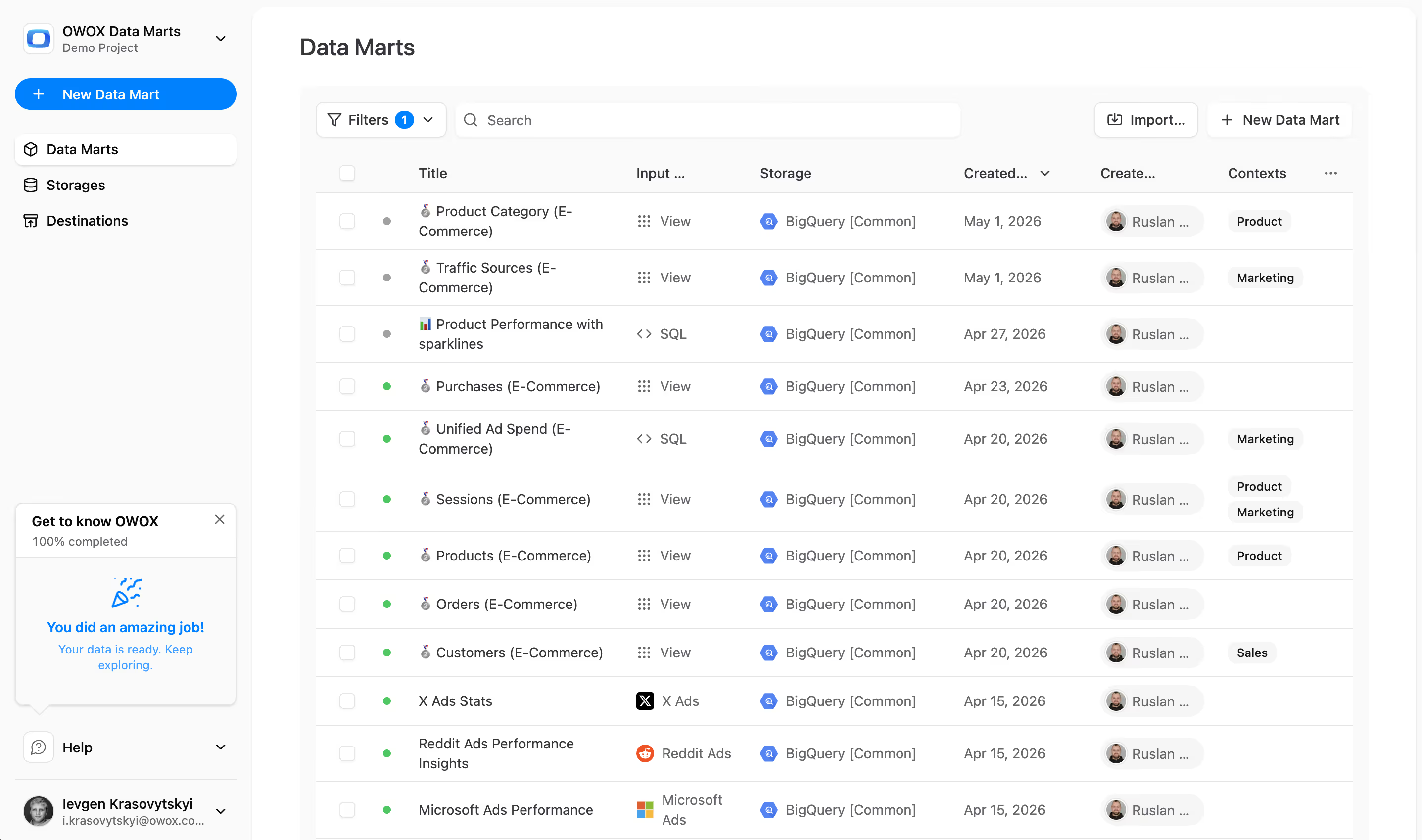
In an analytics-focused data mart, boolean fields help keep business logic tight and reusable. They are ideal for audience flags, attribution exclusions, consent indicators, test-data filters, and operational quality checks.
When these fields are standardized early, reporting becomes faster to build and easier to trust. That is the real power of CAST AS BOOL: not just converting a value, but shaping raw data into logic your whole team can actually use.
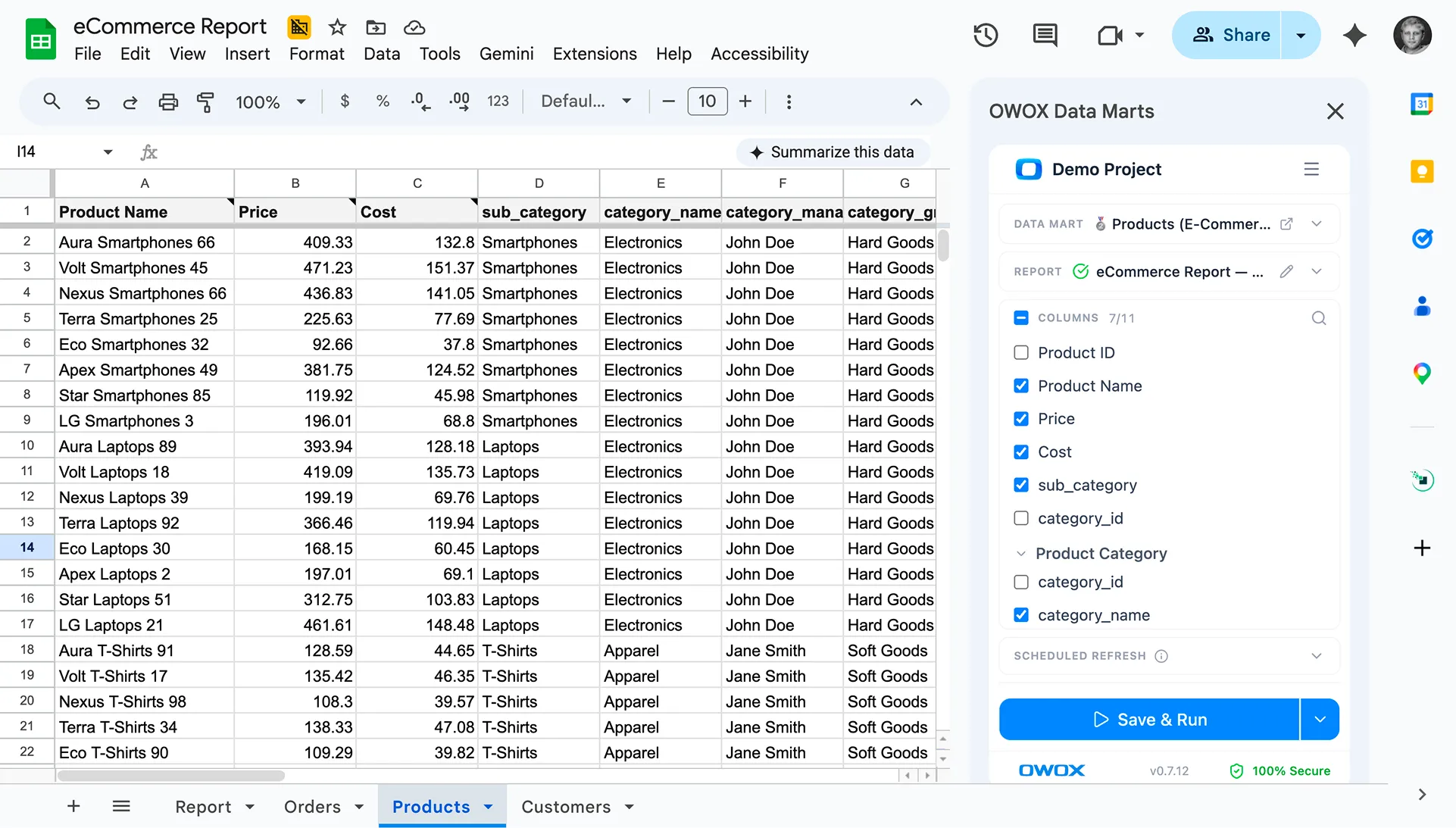
Want cleaner flags, reusable business logic, and analytics-ready boolean fields without chaos? Build smarter models with OWOX Data Marts and streamline your data mart workflows from the start.
%202.png)



"AI by its nature will hallucinate. You need guardrails so you can trust your data."
"We had six or seven different channels and no single source of truth. It was almost impossible"
"We regained time. And time is the one resource that never comes back."