

What Is Healthcare Analytics?
Healthcare analytics means using healthcare data, statistical methods, and BI tools to spot what is happening, why it is happening, and what to do next across patient care, operations, marketing, and finance.
What Is Healthcare Analytics?
Healthcare analytics turns messy, high-volume healthcare data into decisions teams can actually use. It pulls information from clinical systems, claims platforms, CRMs, scheduling tools, and finance workflows to measure performance and improve outcomes.
In practice, it is an industry-specific application of what data analytics is and how it works. The difference is the stakes: analysts are not just optimizing clicks or revenue, but also care quality, patient flow, reimbursement, and compliance. That makes healthcare analytics both exciting and demanding.
The goal is evidence-based action. Analysts use dashboards, models, and reports to help clinicians, administrators, and marketers answer questions like: Which patients are at risk? Where are operational bottlenecks? Which campaigns bring in qualified appointments? Are quality metrics improving?
Key Data Sources in Healthcare Analytics
Healthcare reporting gets powerful when multiple systems are connected instead of analyzed in isolation.
Clinical data (EHR, lab, imaging)
Clinical data is the core of many healthcare analyses. It includes diagnoses, medications, procedures, vitals, encounters, lab results, and imaging metadata from EHR and departmental systems.
This data supports outcome analysis, readmission tracking, risk scoring, and care pathway monitoring. It is also one of the hardest sources to standardize because coding practices, timestamps, and record structures vary across providers and systems.
Claims, billing, and financial data
Claims and billing data connect care delivery to reimbursement. These sources show payer mix, charges, denials, collections, costs, and revenue cycles.
Finance and BI teams use them to understand margin by service line, identify billing leakage, and compare expected versus actual reimbursement. When joined with clinical data, claims can reveal where utilization patterns drive both quality and cost.
Operational and staffing data
Operational systems track scheduling, bed occupancy, wait times, throughput, staffing coverage, and resource usage. This is where workflow bottlenecks become visible.
For example, analysts can compare appointment demand with provider availability, or connect ED arrival surges to staffing gaps. These datasets are key for capacity planning and service-level improvements.
Patient engagement and marketing data
Healthcare organizations also analyze website sessions, call center logs, lead forms, CRM activity, campaign touchpoints, and patient communications. These sources show how people discover services, book appointments, and stay engaged.
Bringing together data collection across multiple healthcare systems helps analysts measure the full journey, from acquisition to visit to downstream value. That is especially useful for service line marketing, retention analysis, and outreach optimization.
Types of Healthcare Analytics
Different analytics methods answer different levels of business and clinical questions.
Descriptive and diagnostic analytics
Descriptive analytics shows what happened. Think monthly admissions, average length of stay, claim denial rate, or campaign conversion rate.
Diagnostic analytics goes one step further and asks why. Analysts might segment readmissions by diagnosis group, compare no-show rates by clinic, or trace a drop in conversions to a broken intake form or delayed callback process.
Predictive analytics (risk and demand forecasting)
Predictive analytics uses historical patterns to estimate future outcomes. Common examples include readmission risk, patient churn, appointment demand, staffing needs, and expected claims denials.
These models help teams move from reactive reporting to earlier intervention. A hospital can flag high-risk patients before discharge, or forecast demand spikes before they disrupt operations.
Prescriptive analytics and optimization
Prescriptive analytics recommends what action to take. It is often used for scheduling optimization, care management prioritization, routing resources, or selecting the next best outreach step.
The output is not just a prediction but a decision framework. For example, if a patient has high readmission risk and low follow-up adherence, the system may recommend outreach within 24 hours and a priority care coordination slot.
Real-time and near–real-time monitoring
Some healthcare decisions cannot wait for a weekly report. Real-time and near–real-time monitoring supports operational awareness through frequently refreshed dashboards and alerts.
Teams may track bed availability, incoming patient volume, referral backlogs, campaign pacing, or delayed lab processing. Speed matters here, but so does signal quality. Fast dashboards are only useful if the underlying logic is trusted.
Common Use Cases for Analysts and BI Teams
Healthcare analytics spans patient care, operations, and growth all at once.
Patient outcomes and readmission analysis
Analysts study outcomes by diagnosis, procedure, provider group, or discharge plan to identify improvement opportunities. Readmission analysis is one of the most common use cases because it affects both patient care and cost.
Typical questions include which patient groups have the highest 30-day readmission rates, which discharge pathways reduce return visits, and whether follow-up timing changes outcomes.
Capacity, scheduling, and resource optimization
BI teams use operational data to improve throughput and reduce waste. They model appointment utilization, room turnover, provider schedules, and staffing coverage.
This helps answer tough questions fast: where to add slots, how to reduce no-shows, which clinics are overbooked, and when demand will exceed capacity.
Healthcare marketing and campaign performance
Marketing analysts in healthcare focus on more than clicks. They connect campaigns to inquiries, bookings, attended visits, and sometimes downstream revenue or service line growth.
The challenge is attribution across privacy-sensitive environments and long conversion paths. When done well, campaign analysis helps teams invest in channels and messages that drive real patient engagement.
Regulatory, compliance, and quality reporting
Healthcare organizations produce a huge amount of structured reporting for internal governance and external requirements. Analysts support quality scorecards, compliance tracking, audit-ready reporting, and standardized KPI definitions.
Consistency is everything here. If measure logic changes between teams, trust disappears fast.
Example: Building a Readmission Risk Dashboard
A readmission dashboard is a classic healthcare analytics project because it brings together clinical, operational, and BI thinking in one place.
Data model and feature inputs
A practical model starts with a patient encounter table and links it to diagnoses, procedures, discharge details, follow-up activity, prior admissions, payer information, and selected demographic fields. Analysts often create features such as number of admissions in the last 12 months, chronic condition count, discharge disposition, length of stay, and follow-up completed within seven days.
A simple warehouse workflow might aggregate one row per discharge event, then calculate whether a new inpatient encounter occurred within 30 days. That row becomes the basis for reporting and risk modeling.
Key metrics and thresholds
The dashboard usually includes:
- 30-day readmission rate
- High-risk discharges by unit or provider
- Follow-up completion rate
- Average length of stay for readmitted vs. non-readmitted patients
- Readmission rate by diagnosis category or payer
Teams may define thresholds such as high risk above a model score cutoff, or urgent outreach required when a patient has multiple chronic conditions plus no scheduled follow-up. The exact thresholds depend on organizational policy and model design.
How teams use the dashboard in daily decisions
Care coordinators use it to prioritize outreach. Unit managers use it to compare discharge quality across departments. Executives use it to track trend lines and intervention impact over time.
The real power is workflow integration. Instead of reviewing readmissions after the fact, teams can act on today’s discharge list, focus resources on the highest-risk patients, and monitor whether interventions are closing the gap.
Challenges in Healthcare Analytics and How to Handle Them
Healthcare analytics is powerful, but it gets complicated fast.
Data quality and fragmentation across systems
Healthcare data often lives in disconnected systems with different identifiers, formats, and update schedules. Duplicate patients, missing encounter details, inconsistent coding, and delayed source loads can break reporting logic.
The fix starts with disciplined modeling and transformation. Teams need repeatable rules to prepare and clean raw healthcare data, plus clear ownership for key definitions like readmission, visit, and active patient.
Governance, security, and privacy constraints
Analytics in healthcare operates under strict privacy and access requirements. Not everyone should see everything, and sensitive fields need strong handling rules.
That means governance cannot be an afterthought. Analysts need role-based access, documented metric logic, auditability, and visibility into data lineage and data quality monitoring. If teams do not know where a metric came from, they will not trust it.
Aligning clinical, operational, and marketing KPIs
Different teams optimize for different outcomes. Clinical leaders care about safety and quality. Operations teams care about throughput and utilization. Marketing teams care about acquisition and engagement.
The challenge is to create a shared KPI framework without flattening important nuance. Good healthcare analytics connects these views instead of forcing one team’s goals onto another. The best dashboards show how patient, operational, and business outcomes influence each other.
Healthcare Analytics and OWOX Data Marts
As healthcare reporting grows, curated data layers become essential for speed and consistency.
Role of data marts in healthcare reporting workflows
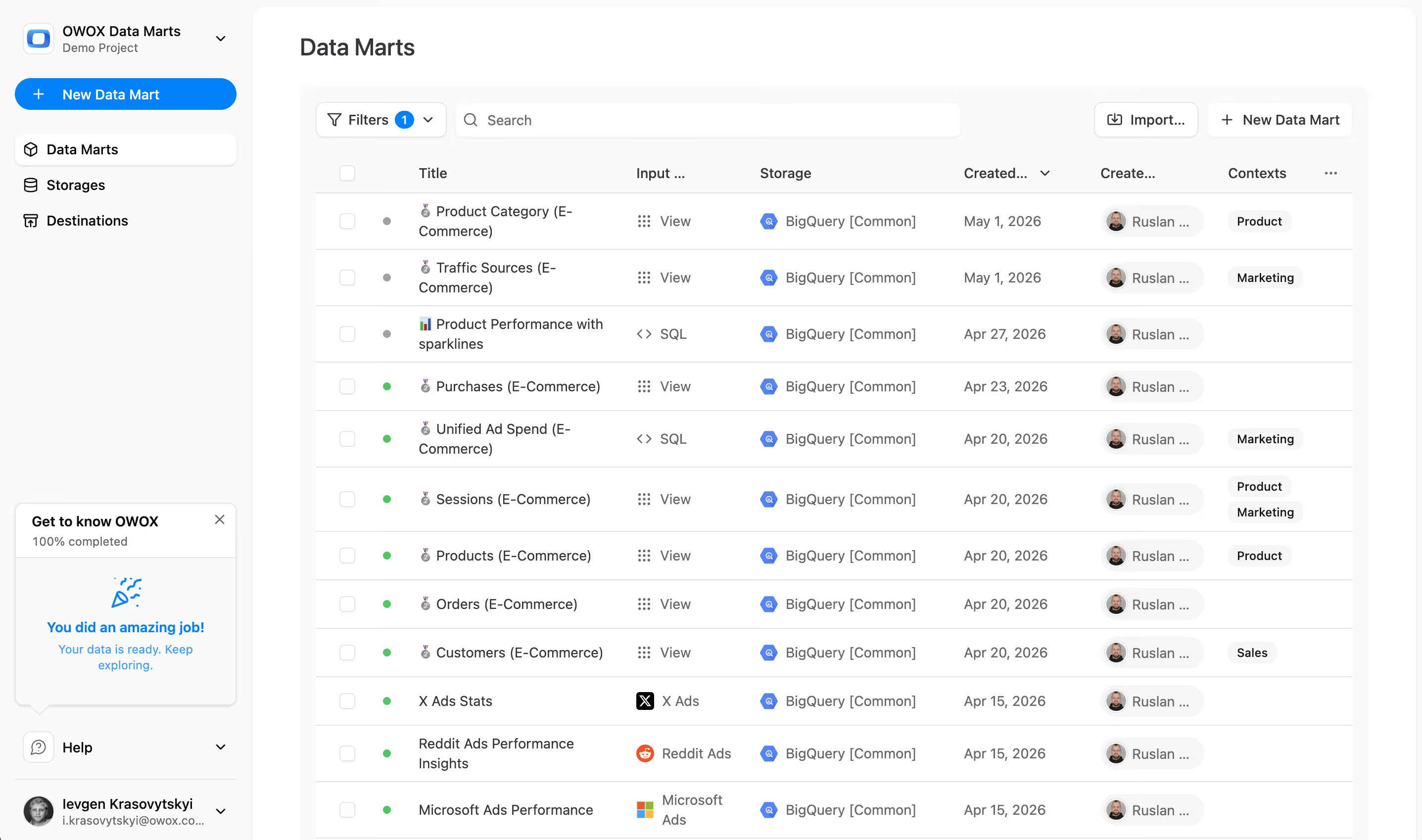
Data marts give teams subject-focused datasets built for analysis rather than raw system storage. In healthcare, that means analysts can work from standardized, query-ready tables for domains like encounters, claims, scheduling, or campaigns.
This approach supports cleaner BI workflows and fits well with modern data architectures for analytics at scale. Instead of rebuilding joins and definitions in every report, teams centralize logic once and reuse it across dashboards.
Examples of domain-specific marts (clinical, finance, marketing)
A clinical mart might organize admissions, diagnoses, procedures, and outcomes for quality reporting. A finance mart can focus on claims, reimbursement, denials, and cost analysis. A marketing mart may combine CRM, web, call tracking, and appointment data to measure channel performance and patient acquisition.
When these marts share consistent dimensions and definitions, cross-functional analysis becomes much easier. That is when healthcare analytics stops being a pile of disconnected reports and starts becoming a real decision engine.
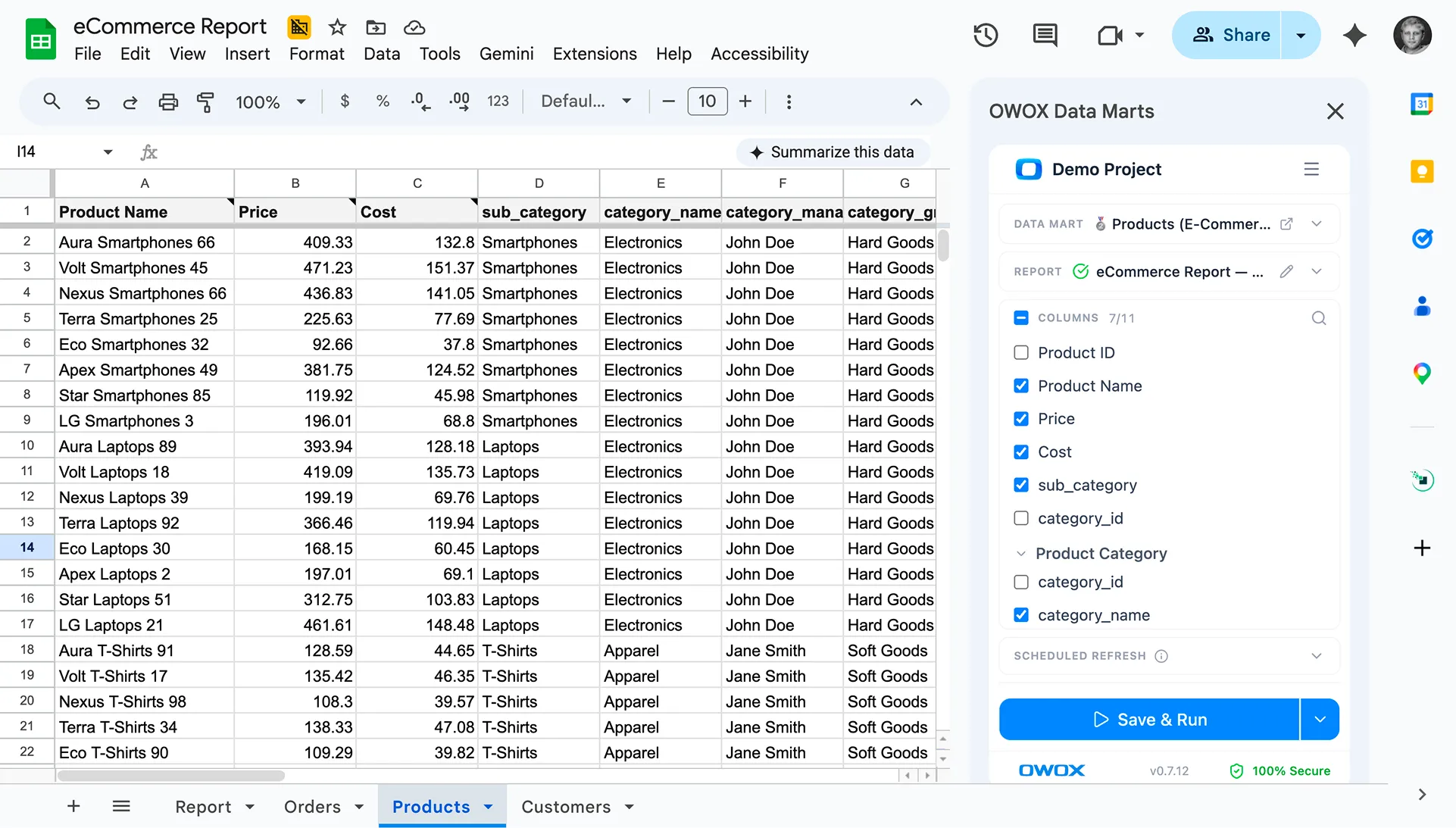
Want cleaner healthcare reporting workflows? Build focused data marts for clinical, finance, and marketing analytics so your team can move faster with trusted numbers. Explore OWOX Data Marts to organize analytics-ready datasets without the chaos.
%202.png)



"AI by its nature will hallucinate. You need guardrails so you can trust your data."
"We had six or seven different channels and no single source of truth. It was almost impossible"
"We regained time. And time is the one resource that never comes back."