

What Is Supply Chain Optimization?
Supply chain optimization means using data, models, and business rules to run inventory, production, and delivery in the smartest possible way so products arrive where they need to be on time, at the right cost, and with less risk.
What Is Supply Chain Optimization?
At its core, supply chain optimization is a decision-making discipline. It helps teams choose how much to buy, make, store, and ship based on demand, constraints, and service targets instead of guesswork.
Simple definition for analysts
For analysts, supply chain optimization is the process of turning operational data into better planning decisions. It connects demand signals, inventory levels, supplier lead times, transportation options, and business rules into one analytical framework. If you work with supply chain analytics, optimization is the next step: not just seeing what happened, but deciding what should happen next.
Optimization vs. "just making it cheaper"
Optimization is not the same as cutting costs at all costs. A cheaper route that causes delays, a lower inventory target that creates stockouts, or a slower supplier that hurts service levels can damage the business. Real optimization balances trade-offs.
The goal is usually to minimize total cost and risk while still meeting customer expectations. That means analysts often evaluate several variables together:
- Holding costs versus stockout risk
- Transport costs versus delivery speed
- Production efficiency versus flexibility
- Supplier price versus lead-time reliability
Where optimization fits in supply chain management
Supply chain management covers the full flow of goods, information, and planning across sourcing, production, warehousing, and fulfillment. Optimization sits inside that process as the analytical engine for making smarter choices.
It supports tactical and operational decisions such as reorder points, shipment allocation, production schedules, and fulfillment priorities. In mature teams, it also feeds strategic decisions like warehouse placement, supplier mix, and network design.
Key Components and Metrics in Supply Chain Optimization
Optimization only works when the main moving parts of the supply chain are measured together. Looking at one function in isolation can hide the true cost of a decision.
Inventory, production, logistics, and demand planning
Inventory optimization focuses on how much stock to hold and where to place it. Production planning decides what should be made, when, and on which line or plant. Logistics optimization covers shipment mode, route, carrier, and delivery timing. Demand planning estimates expected sales so the whole chain can prepare.
These areas are deeply connected. A promotion can spike demand, which affects replenishment, warehouse capacity, and delivery performance. That is why analysts need a shared data model rather than separate reports that never quite match.
Core KPIs: service level, stockouts, lead time, costs, OTIF
The most useful KPIs in supply chain optimization are usually cross-functional. They show whether the business is both efficient and reliable.
- Service level: the ability to fulfill demand as promised
- Stockouts: missed sales or unfulfilled orders caused by unavailable inventory
- Lead time: the time between order, production, shipment, and delivery events
- Costs: inventory holding, purchasing, production, transportation, and fulfillment costs
- OTIF: on-time, in-full performance for customer orders
Analysts often break these down by SKU, region, warehouse, supplier, channel, or customer segment. That is where hidden bottlenecks usually show up.
Data sources: ERP, WMS, TMS, CRM, marketing, and web analytics
Supply chain optimization depends on combining operational and commercial data. ERP systems usually hold purchase orders, production plans, and cost data. WMS platforms track stock movement and warehouse events. TMS tools capture shipment and carrier data.
But demand does not start in the warehouse. CRM, campaign, and web analytics data can reveal changing buying behavior earlier than fulfillment systems can. That makes integrated ERP analytics especially valuable when analysts need to connect operations with demand signals from sales and marketing.
How Data Analytics Powers Supply Chain Optimization
Optimization gets stronger as analytics maturity improves. The best teams move from reporting the past to recommending actions.
Descriptive, diagnostic, predictive, and prescriptive analytics
A simple way to frame this is by analytics type. Descriptive analytics shows what happened, such as fill rate by warehouse. Diagnostic analytics explains why it happened, such as a stockout caused by delayed inbound shipments. Predictive analytics estimates what is likely to happen next, such as next month’s demand. Prescriptive analytics recommends the best response under given constraints.
If you are explaining this to stakeholders, it helps to anchor the discussion in what data analytics is: using data systematically to generate insight and guide action.
Forecasting demand and simulating scenarios
Demand forecasting is one of the biggest drivers of supply chain performance. Bad forecasts lead to excess stock, rush shipments, lost sales, and planning chaos. Good forecasts do not eliminate uncertainty, but they make it measurable.
Analysts may compare baseline forecasts, promotional uplift, seasonality, and regional trends using different sales forecasting methods. From there, scenario modeling becomes possible. What happens if supplier lead time increases by five days? What if demand for a product category jumps after a campaign? What if one warehouse hits capacity?
From spreadsheets to data warehouses and Data Marts
Many supply chain teams start with spreadsheets because they are flexible and familiar. The problem appears when data volume grows, definitions drift, and multiple versions of the truth start circulating in email threads and disconnected files.
A data warehouse creates a central place for clean, consistent operational data. A Data Mart then organizes that data around a specific business problem such as inventory health, order fulfillment, or replenishment planning. This makes optimization metrics easier to trust, maintain, and reuse in reporting.
Common Supply Chain Optimization Techniques
There is no single optimization method for every business. The right approach depends on product complexity, demand volatility, lead times, and operational constraints.
Inventory optimization and safety stock models
Inventory optimization helps determine reorder points, target stock levels, and safety stock by item and location. It aims to reduce excess inventory without increasing the risk of lost sales or service failures.
Safety stock models usually consider variability in demand and lead time. Analysts also segment products, since a fast-moving staple item should not be planned the same way as a slow, seasonal SKU. If you want a deeper look at practical methods, see these inventory optimization techniques.
Network and route optimization
Network optimization looks at the structure of the supply chain: where inventory is stored, how goods move between locations, and which nodes handle demand most efficiently. Route optimization focuses more narrowly on shipment paths, carrier choice, and delivery sequencing.
Both techniques matter because transport decisions affect cost, lead time, and OTIF. A route that is cheapest on paper may increase delay risk or overload a warehouse downstream.
Constraint-based planning and what-if analysis
Real supply chains run into constraints constantly: supplier minimums, warehouse capacity, production limits, labor availability, and delivery cutoffs. Constraint-based planning builds those realities into the model instead of pretending ideal conditions exist.
What-if analysis lets analysts test alternatives before operations are disrupted. That could mean reallocating inventory, changing replenishment frequency, or shifting orders between suppliers. Fast scenario analysis is often the difference between reacting late and staying ahead.
Example: Using Analytics to Improve Supply Chain Performance
Here is what supply chain optimization looks like when it moves from theory into reporting and planning.
Business question and available data
An ecommerce retailer notices strong traffic and conversion on certain products, but fulfillment teams are still reporting frequent stockouts and expensive rush shipments. The business question becomes: which products and locations need different inventory targets to improve service level without bloating stock?
Available data may include ERP purchase orders, WMS inventory snapshots, TMS delivery events, sales transactions, campaign calendars, and web sessions by product category. This mix gives analysts a full path from demand signal to delivery outcome.
Building a supply chain optimization Data Mart
The team creates a Data Mart that joins product, warehouse, order, shipment, supplier, and demand tables at shared grain levels. Measures include daily on-hand stock, days of supply, stockout events, lead time, fill rate, OTIF, inbound delay, and total fulfillment cost.
A typical workflow starts with a solid data warehouse implementation so raw system data can be standardized before business logic is applied. Once modeled, the Data Mart becomes the source for recurring supply chain dashboards and scenario analysis.
Typical reports and dashboards for stakeholders
Operations managers may use SKU-by-location dashboards showing stock cover, service level, and exception alerts. Logistics teams may track carrier performance, delayed shipments, and cost per delivered order. Commercial teams may compare forecast, actual demand, and campaign impact.
Executives usually need a tighter summary: service level trend, OTIF, stockout cost risk, excess inventory exposure, and the biggest bottlenecks by region or product group. One shared model keeps all of those views aligned.
Supply Chain Optimization in OWOX Data Marts
In practice, optimization becomes much easier when business logic is documented once and reused everywhere reporting happens.
How optimization metrics are modeled in Data Marts
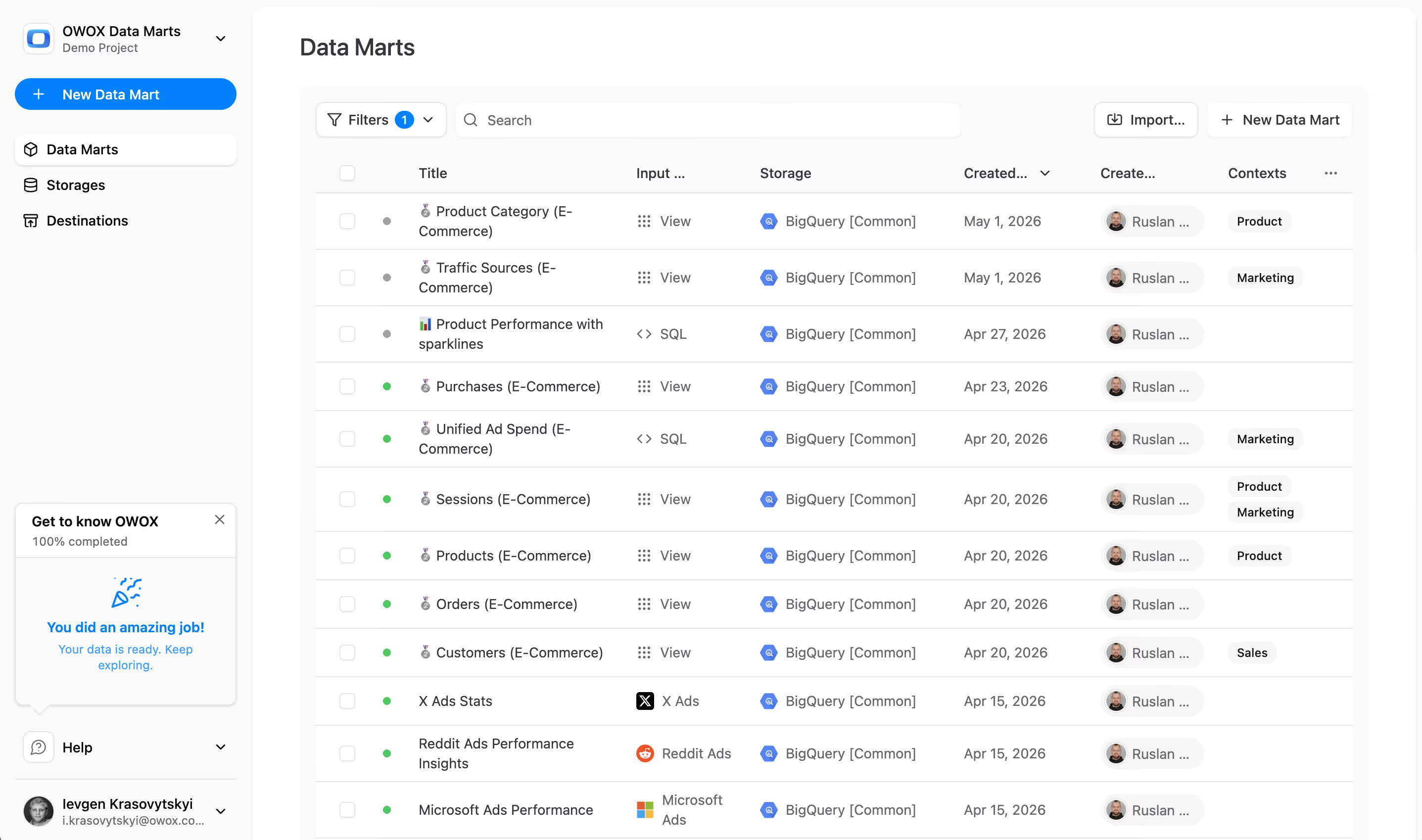
In OWOX Data Marts, supply chain optimization metrics can be modeled as reusable definitions across fact and dimension tables. That includes inventory balances, fulfillment events, delivery timing, cost components, and forecast-versus-actual measures. The main win for analysts is consistency: the same KPI logic can power multiple dashboards without manual rebuilding.
Where these marts show up in reporting workflows
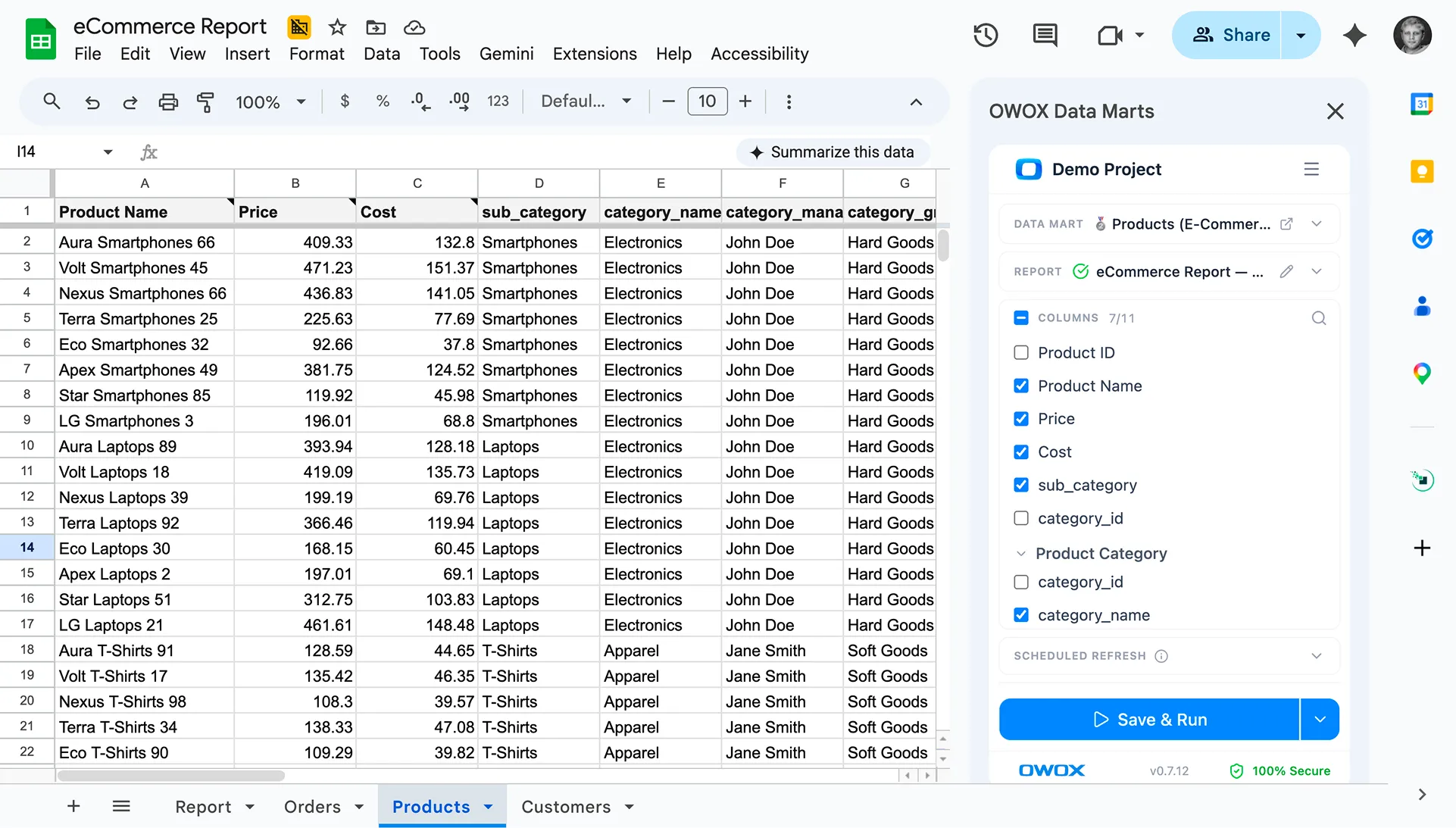
These marts typically sit between source systems and BI reporting layers. Analysts use them to prepare trusted datasets for operational dashboards, scheduled reporting, and deeper ad hoc analysis. Instead of stitching ERP, warehouse, and demand data together every time a new question appears, teams can work from a stable analytical foundation.
If you want cleaner Data Marts for supply chain reporting, faster analytics workflows, and reusable business metrics, explore OWOX Data Marts. It is a practical way to turn messy operational data into reporting-ready structure.
%202.png)



"AI by its nature will hallucinate. You need guardrails so you can trust your data."
"We had six or seven different channels and no single source of truth. It was almost impossible"
"We regained time. And time is the one resource that never comes back."