

What Is a Custom Query Connection?
A custom query connection is a way to connect reports to the result of your own SQL query, so instead of pulling entire tables or using a fixed connector, you send a shaped, filtered dataset that is ready for analysis.
What Is a Custom Query Connection?
At its core, a custom query connection lets an analyst define exactly what data a report should receive. Instead of choosing a single table and dealing with the mess later, you write SQL that joins sources, applies filters, calculates fields, and returns only the final dataset needed for reporting.
Plain-language definition
Think of it like a custom-built pipe between your database and your BI tool. The pipe does not move all the water. It delivers only what you ask for. That makes it incredibly useful for people doing the basics of data analytics and the analyst’s role: cleaning up data, combining context, and making numbers usable.
In practice, the “connection” points to a query, not just a table. When the BI tool refreshes, it runs that query and receives the output rows and columns as the reporting source.
How it differs from standard connections and canned datasets
A standard connection usually points to a predefined object such as a table, view, or native connector output. A canned dataset is even more fixed: someone already shaped it, and you work with what is available.
A custom query connection gives analysts more control. You can rename fields, merge sources, define metrics, and strip out irrelevant rows before the data ever hits a dashboard. That flexibility is powerful, but it also means the logic becomes part of the connection itself, so it needs more care, review, and maintenance.
Why Analysts Use Custom Query Connections
Analysts love speed, clarity, and control. A custom query connection delivers all three when standard datasets are too rigid or too noisy for the job.
Joining multiple tables and sources
Many business questions do not live in one table. Revenue may sit in order tables, ad spend in marketing platforms, sessions in web analytics exports, and customer status in the CRM. A custom query connection makes it possible to join these pieces into one result set before they reach the reporting layer.
That means fewer blend hacks inside dashboards and less confusion about which source is the “real” one.
Pre-aggregating data for faster dashboards
Dashboards get slow when they scan event-level or transaction-level data every time someone opens a report. Custom queries can summarize data ahead of time at the right grain, such as day, campaign, or channel.
This reduces the volume sent to the BI tool and often improves responsiveness. Instead of calculating totals from millions of rows on every chart load, the dashboard can work from a smaller, reporting-ready dataset.
Applying complex business logic close to the data
Some metrics are not simple sums. Analysts often need channel grouping rules, customer acquisition definitions, return exclusions, lead qualification logic, or attribution windows. A custom query lets you encode that logic where the data lives.
That is a big win because the same logic can feed every chart from one place, rather than being rebuilt inconsistently in multiple report widgets.
Reducing noise and limiting access to raw tables
Not every user should touch every raw table. A custom query connection can expose only the fields and rows needed for a specific report. That keeps sensitive columns out of sight and avoids giving dashboard builders direct access to sprawling source schemas.
It also creates a cleaner experience. Analysts and stakeholders see a focused dataset instead of dozens of similarly named fields and mystery columns.
How Custom Query Connections Work in Practice
The idea is simple. The execution can get spicy. Good custom query connections balance flexibility with performance and governance.
Typical workflow: from SQL in the warehouse to BI/report
A typical workflow starts in the warehouse. An analyst explores source tables, writes a query, validates row counts and business definitions, and then saves that query inside the BI tool or as a referenced object. The BI platform runs it during refresh and treats the output as the reporting source.
This setup works best when the warehouse is structured for analytics. If your tables are inconsistent, undocumented, or constantly changing, custom queries become fragile fast. That is why teams often pair them with better modeling and with work on implementing and structuring a data warehouse for analytics.
Performance considerations: query cost, caching, and limits
Custom query connections can be efficient, but they can also be expensive. A query that scans huge raw tables, performs many joins, or calculates row-level logic at refresh time may be slow and costly.
Key things to watch include:
- Whether the query reads more columns than necessary
- Whether filters are applied early
- Whether joins happen at the right grain
- Whether the BI tool reruns the query frequently
- Whether caching is available or limited
In other words: just because SQL gives you freedom does not mean every refresh should act like a full forensic investigation.
Governance: ownership, reviews, and documentation
Custom query connections need owners. Someone should know why the query exists, what metrics it defines, which reports depend on it, and what happens when source tables change.
Strong teams review SQL before it becomes a production source. They also document inputs, field definitions, refresh behavior, and downstream dependencies. Without that discipline, the connection may work today and quietly break trust tomorrow.
Example: Marketing Dashboard via Custom Query Connection
Here is one realistic setup where a custom query connection earns its keep.
Combining ads, web analytics, and CRM data
Imagine a marketing analyst building a dashboard for paid acquisition. Ad platforms provide spend and clicks. Web analytics provides sessions and conversions. The CRM provides opportunities and revenue. None of these sources alone can answer the real question: which campaigns drive profitable customers?
A custom query connection can join daily campaign spend to session and conversion data, then attach downstream CRM revenue by campaign key or attributed source. The output becomes one reporting table with dimensions like date, channel, campaign, and landing page.
Defining key metrics (ROAS, CAC, LTV) in SQL
Now the analyst can define core metrics directly in SQL. For example, ROAS may be revenue divided by ad spend, CAC may be spend divided by acquired customers, and LTV may be based on recognized customer revenue over a chosen period.
The query might aggregate all source data to campaign-day level first, then calculate these fields in one place. That matters because metric definitions stay consistent. Finance, marketing, and BI are no longer comparing different versions of “customer” or “revenue.”
Feeding a single, trusted dataset into reports
Once the query is validated, the BI tool connects to that result set instead of separate raw sources. Charts, scorecards, and drilldowns all read from the same prepared dataset. This reduces report logic, improves speed, and makes troubleshooting easier.
When someone asks why CAC changed, you inspect one query and one pipeline, not five dashboard formulas stitched together under pressure five minutes before a meeting.
Custom Query Connections and Data Marts
Custom queries are useful. But for core reporting, they should not become a substitute for good data modeling.
Why stable data marts beat ad-hoc queries for core reporting
Ad-hoc queries are great for exploration, prototyping, and one-off reporting needs. They are much less great as the invisible foundation of executive dashboards. Stable data marts usually win because they provide consistent grain, tested definitions, and predictable performance.
This is especially important when teams are moving from working with raw data vs. modeled datasets. Raw data is valuable, but it is rarely the ideal direct source for shared reporting.
Using custom queries on top of governed marts, not raw chaos
The strongest pattern is to use custom query connections on top of governed data marts or clean analytical models. That gives analysts flexibility without forcing every dashboard refresh to untangle raw event streams, inconsistent IDs, and half-documented business rules.
It also helps avoid the common data analytics challenges caused by ad-hoc queries: duplicate logic, broken trust, slow reports, and endless debates over whose number is right.
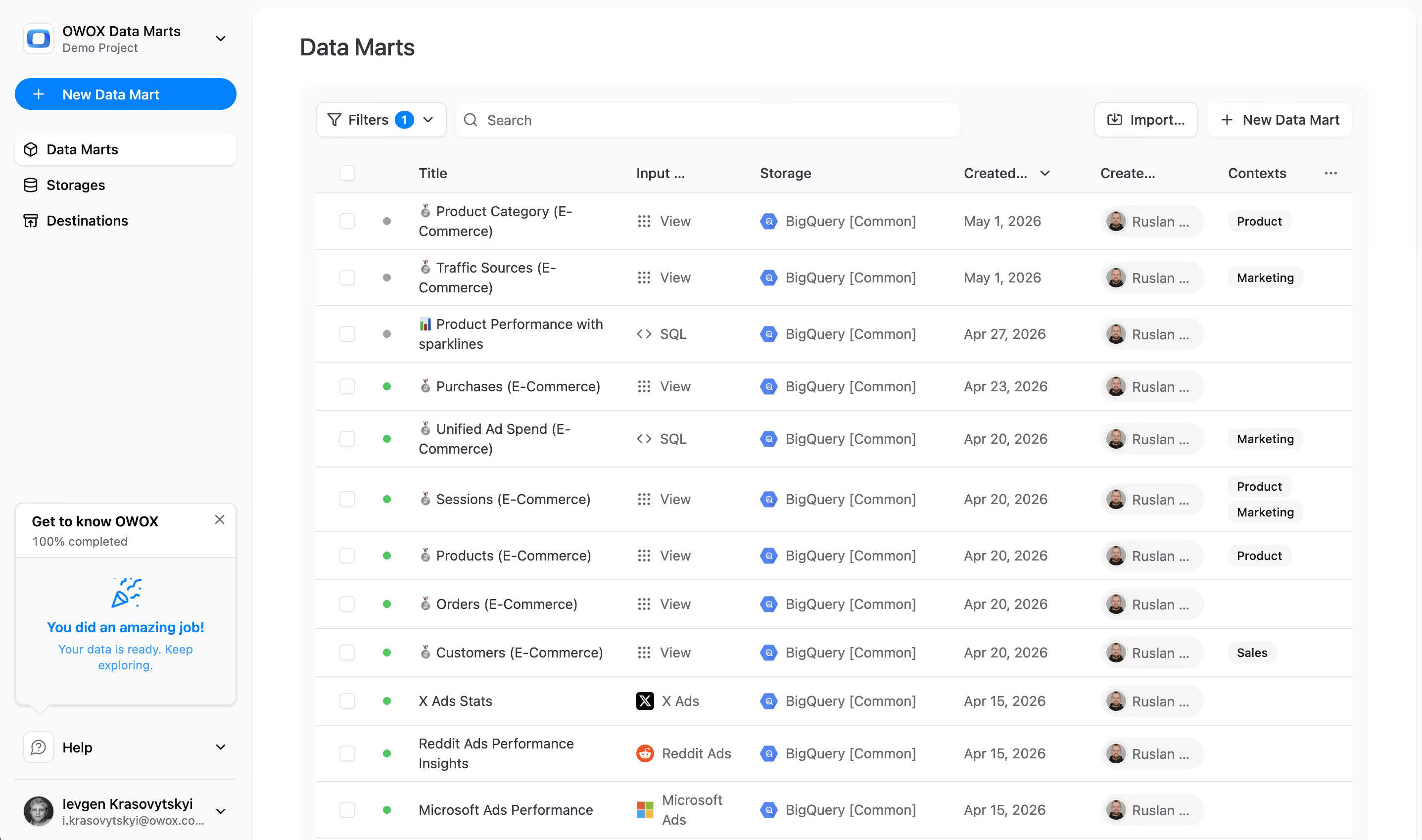
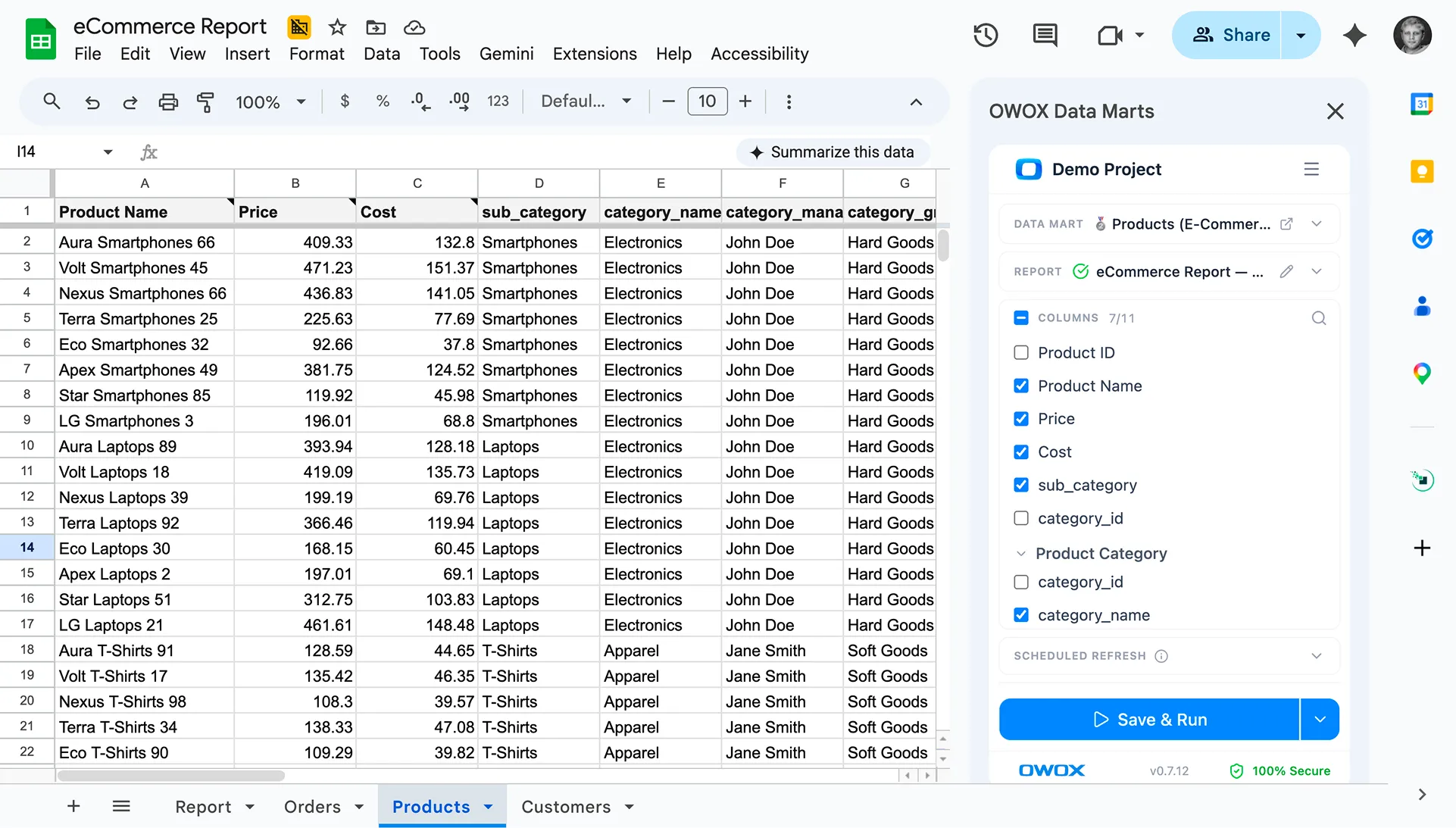
OWOX Data Marts in your analytics workflow
In a healthy analytics workflow, data marts act as the stable layer for trusted business entities and metrics. Custom query connections can then sit on top for report-specific shaping, filtering, or lightweight extensions.
That means less raw chaos, fewer fragile report definitions, and a much cleaner path from warehouse logic to dashboard output.
Best Practices for Reliable Custom Query Connections
If a custom query connection powers decisions, treat it like production logic, not a temporary shortcut that somehow became permanent.
Versioning and testing queries
Store queries in version control when possible. Even simple reporting SQL benefits from change history, reviews, and rollback options. Before publishing updates, test row counts, date ranges, null behavior, and metric outputs against trusted references.
It also helps to document data lineage and field definitions. Teams working on tracking data lineage and data quality are much better positioned to spot where a bad change originated.
Avoiding anti-patterns (SELECT *, heavy joins, row-level logic)
A few habits cause outsized pain:
- Using SELECT * instead of choosing needed columns
- Joining massive raw tables at report refresh time
- Mixing event-level and aggregated data carelessly
- Embedding too much row-level transformation inside BI-connected SQL
- Leaving business logic undocumented in nested query layers
Keep the query focused. If it starts looking like a full transformation pipeline, that is usually a signal the logic belongs in a model or mart instead.
Monitoring failures and unexpected result changes
Reliable reporting is not just about successful query execution. It is also about trustworthy output. Monitor refresh failures, schema changes, unusual row count shifts, and metric swings that do not match business reality.
A query can run perfectly and still return the wrong result after an upstream change. That is why alerting, validation checks, and regular ownership reviews are so important. Fast dashboards are nice. Fast dashboards with correct numbers are the real flex.
Want a cleaner foundation for custom query connections? Build data marts that are ready for reporting, then layer custom queries on top without the raw-data chaos. Explore OWOX Data Marts as part of your analytics workflow.
%202.png)



"AI by its nature will hallucinate. You need guardrails so you can trust your data."
"We had six or seven different channels and no single source of truth. It was almost impossible"
"We regained time. And time is the one resource that never comes back."