

What Are Data Quality Issues?
Data quality issues are flaws in data like missing fields, duplicates, wrong values, or mismatched formats that make reports, dashboards, and models less trustworthy.
What Are Data Quality Issues?
In analytics and BI, data quality issues are any conditions that make data unreliable for measurement, reporting, or decision-making. That includes records that are incomplete, inconsistent, outdated, duplicated, or simply wrong. If the data feeding your warehouse or dashboard is flawed, the output will be flawed too.
Formal definition in the context of analytics and BI
From an analytics perspective, data quality is about whether data is fit for use. Analysts need data that is accurate, complete, consistent, timely, and structured correctly across systems. When one of those dimensions breaks, a data quality issue appears. In practice, this often shows up during what data analytics is and how it works: collecting raw events, transforming them, joining sources, and turning them into business metrics.
Why analysts should care (broken dashboards & wrong decisions)
Because bad data does not stay small. One broken event, one changed field name, or one duplicated import can ripple through dashboards, attribution reports, forecasts, and executive summaries. Analysts end up defending numbers instead of explaining them. Stakeholders lose trust fast, and once that trust is gone, even correct reports get questioned.
Common Types of Data Quality Issues
Data quality problems come in different flavors, but they all create the same headache: metrics that stop reflecting reality.
Missing and incomplete data
This happens when required values are null, blank, or never collected at all. A purchase event without revenue, a lead without source, or a campaign row without spend can break calculations and funnel logic. Missing data is especially dangerous when it is silent. Reports still load, but key totals are lower than they should be.
Duplicate and inconsistent records
Duplicates inflate counts and distort conversion rates. Inconsistencies create confusion when the same thing is labeled in multiple ways, such as “Email,” “email,” and “E-mail.” Even if each record looks valid on its own, the dataset becomes messy when similar entities are stored differently.
- Duplicate transactions can overstate revenue
- Duplicate users can inflate acquisition metrics
- Inconsistent naming can split one channel into many fake categories
Incorrect, outdated, and misattributed values
Some values are present but wrong. Maybe a campaign was tagged with the wrong medium, maybe a timestamp shifted because of a timezone issue, or maybe a customer status was never updated after a refund. Misattributed values are brutal in marketing analytics because they send credit to the wrong touchpoint and make optimization look smarter than it really is.
Schema and formatting mismatches across sources
Different systems rarely agree by default. One platform stores dates as text, another uses timestamps, and a third changes column names without warning. A warehouse table may expect “user_id” as an integer while the source sends it as a string. These mismatches cause failed joins, missing enrichments, and transformations that quietly drop rows.
Typical Causes in Real Analytics Workflows
Most data quality issues are not random. They come from predictable breaks in collection, integration, and ownership.
Tracking setup and tagging mistakes
A missing tag on a landing page, a misconfigured event parameter, or inconsistent UTM naming can poison marketing data from the start. If collection is wrong, every downstream table inherits the error. Tracking changes made during launches are a classic trouble spot because speed usually beats documentation.
ETL/ELT and integration errors
Pipelines can fail in obvious ways, like a job not running, or in subtle ways, like a transformation using the wrong join key. Incremental loads may skip records. API connectors may return partial data. A source schema change can break a model without anyone noticing until the dashboard looks strange.
Manual data entry and spreadsheet chaos
Whenever humans copy, paste, rename, or manually upload data, quality risk jumps. Spreadsheets invite typos, inconsistent labels, overwritten formulas, and hidden rows. They are useful for quick work, but dangerous as a system of record. One stray change can create a reporting mystery that takes hours to untangle.
Lack of governance, ownership, and documentation
When nobody owns a metric, nobody protects it. Teams need clear rules for naming, definitions, source priority, and issue response. This is why understanding who is responsible for data quality in analytics teams matters so much. Good governance is not bureaucracy. It is how teams stop repeating the same data fires over and over.
How Data Quality Issues Impact Reporting and Decisions
Bad data creates bad reporting, but the real damage happens when people act on those reports with confidence.
Broken funnels, wrong attribution, and skewed KPIs
If events are missing between steps, funnels look worse than reality. If source data is wrong, attribution shifts budget to the wrong campaigns. If duplicates exist, KPIs like CAC, ROAS, conversion rate, and retention can all move in misleading directions. This is one reason data quality sits at the center of the top data analytics challenges businesses face.
Wasted time on debugging instead of analysis
Analysts are hired to find insights, not to spend half the week checking whether revenue doubled because of growth or because of a broken import. Poor data quality turns analysis into detective work. Teams lose momentum, reports get delayed, and stakeholders wait longer for answers.
Risk for forecasting, budgeting, and experimentation
Historical data feeds planning. If that history is inaccurate, forecasts become shaky. Marketing budgets get allocated based on false efficiency. A/B test results may point to the wrong winner if conversion data is incomplete or assigned incorrectly. The more strategic the decision, the more expensive the data issue becomes.
Detecting and Preventing Data Quality Issues
The goal is not perfection. The goal is to catch problems early, understand their source, and make them harder to repeat.
Data profiling and quality checks in the warehouse
Start with profiling: row counts, null rates, uniqueness checks, value distributions, freshness checks, and join coverage. These checks reveal what “normal” looks like so anomalies stand out quickly. Analysts can also review common data quality issues and how to overcome them to build practical quality routines into warehouse work.
Validation rules, monitoring, and alerts
Useful validation rules include required fields, accepted value ranges, schema expectations, and reconciliation between source systems and modeled tables. Monitoring turns these checks into a habit instead of a one-time audit. Alerts help teams react before broken data reaches decision-makers. It is also easier to fix an issue when you can trace where data came from using data lineage and data quality metrics.
Processes, ownership, and documentation best practices
Strong processes beat heroic debugging. Define metric owners. Document event names, field definitions, transformation logic, and source precedence. Review tracking changes before launch. Create simple incident response rules so the team knows what to do when numbers drift. Documentation may not feel exciting, but it saves real time when dashboards suddenly stop making sense.
Example: Diagnosing a Data Quality Issue in a Marketing Report
Here is a realistic analytics scenario that shows how fast a data quality issue can disrupt reporting.
The symptom: sudden drop in conversions in BI reports
A marketing analyst opens the weekly dashboard and sees conversions down 35% for paid social. Spend is steady, sessions are steady, and landing page traffic looks normal. That kind of drop could be a campaign problem, but it could also be a tracking problem. The first clue is that only BI reports show the decline, while the ad platform still reports healthy conversion volume.
The investigation: where the data broke in the pipeline
The analyst compares raw event tables, transformation outputs, and the final reporting mart. Raw website events still contain purchase activity, but a new campaign launch introduced a changed parameter name: “utm_campaign_id” became “campaign_id” on several landing pages. The transformation model still expected the old field, so conversions could not be joined correctly to campaign metadata. In the BI layer, those rows were grouped as null or “unassigned,” making paid social performance look much worse than it really was.
A quick warehouse check might look for a spike in unmapped records by date and source. Even a simple query counting null campaign identifiers before and after launch can reveal the break.
The fix: prevention steps for future campaigns
The team updates the transformation logic to support the new field, backfills affected dates, and restores the report. Then they add prevention steps: a tracking checklist before campaign launches, a schema change review, and a daily alert for spikes in unattributed conversions. The lesson is big and simple: data issues are often pipeline issues wearing a business-performance costume.
Data Quality Issues and OWOX Data Marts
Reliable reporting depends on stable, trusted data models, not just raw data flowing into a warehouse.
Why reliable Data Marts sit on top of clean, governed data
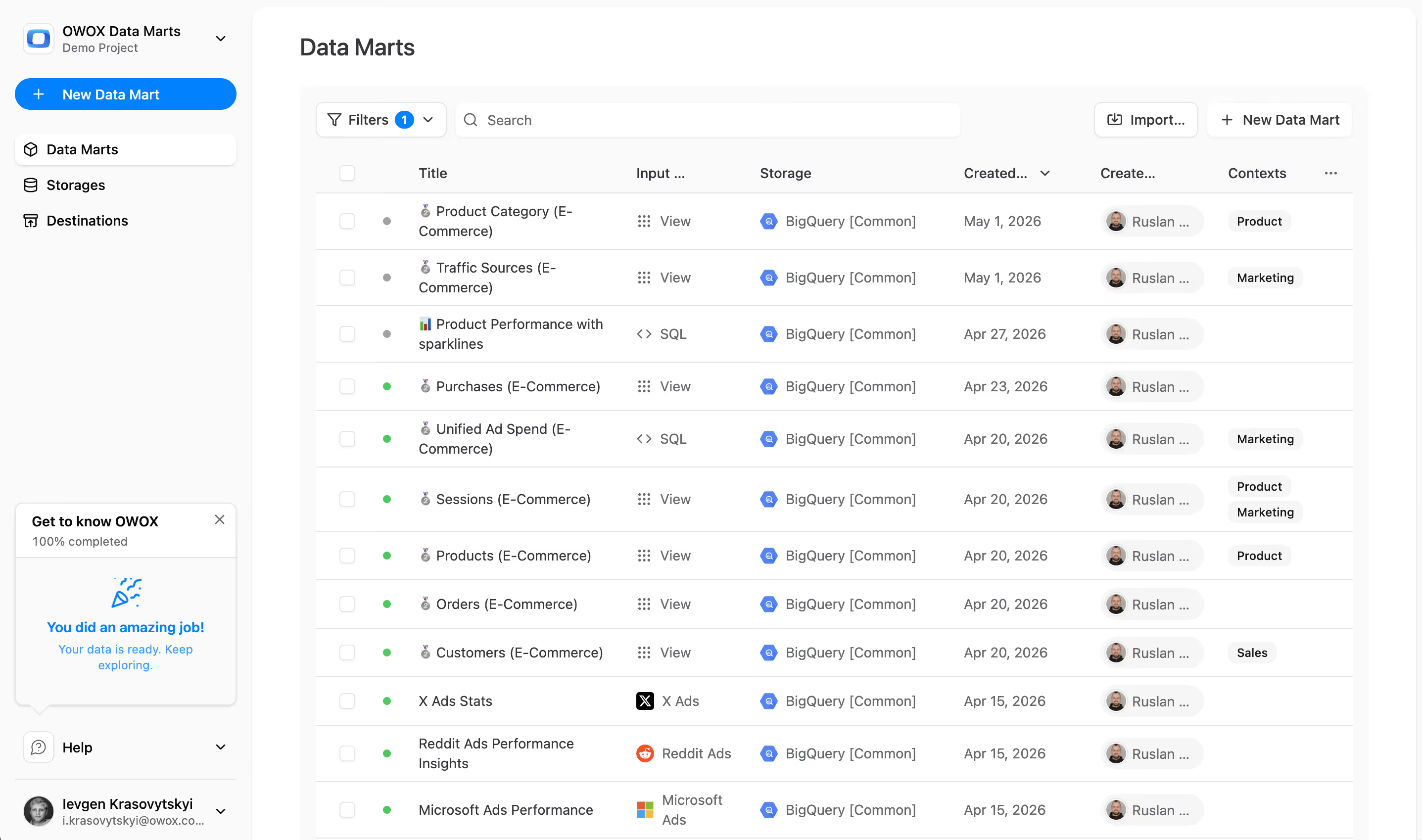
A Data Mart works best when the underlying data is cleaned, defined, and governed consistently. If source data is messy, the mart just packages the mess into a friendlier shape. But when naming rules, transformations, and ownership are clear, a Data Mart becomes a dependable layer for reporting and analysis.
How analysts can use Data Marts to standardize metrics and reduce recurring data quality firefights
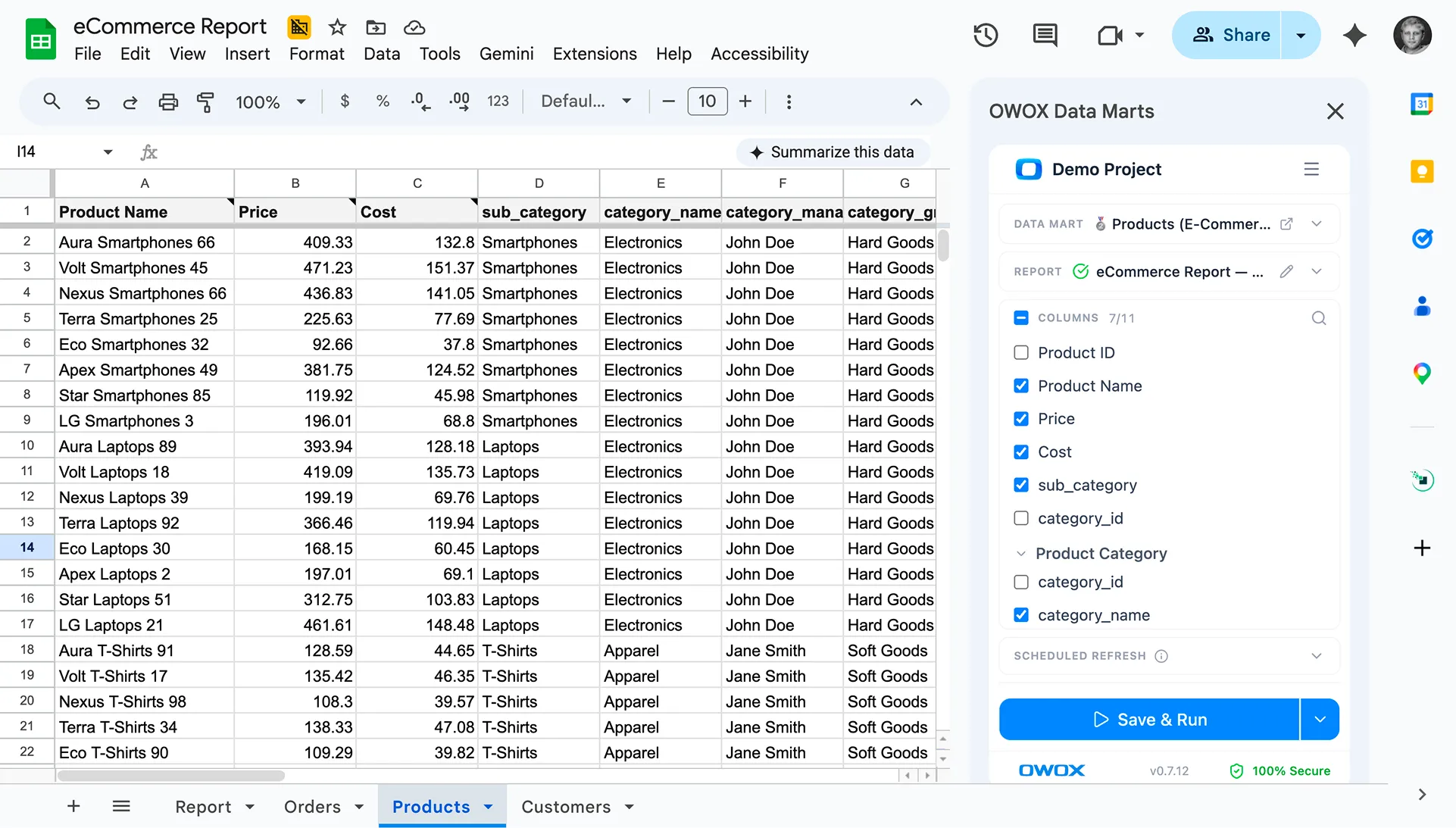
Data Marts help analysts centralize business logic, standardize KPI definitions, and reduce metric drift across dashboards. Instead of rebuilding the same fixes in every report, teams can create one trusted layer and reuse it. Want a cleaner path from raw data to consistent Data Marts, better metric standardization, and fewer recurring data quality firefights? Explore how OWOX Data Marts can help analysts work from governed, reporting-ready data.
%202.png)



"AI by its nature will hallucinate. You need guardrails so you can trust your data."
"We had six or seven different channels and no single source of truth. It was almost impossible"
"We regained time. And time is the one resource that never comes back."