

What Are Data Quality Metrics?
Data quality metrics are measurable checks that show whether your data is trustworthy enough for analysis, reporting, and decision-making.
What Are Data Quality Metrics?
In analytics, “good data” is not a vibe. It needs proof. Data quality metrics give you that proof by turning data health into something measurable: percentages, counts, rates, and trends. Instead of saying a table looks messy, you can show that 8% of orders are missing campaign IDs, duplicate customer records increased week over week, or yesterday’s revenue feed arrived three hours late.
Why data quality matters in analytics and BI
Every dashboard, attribution model, forecast, and stakeholder meeting depends on data quality. If the source data is incomplete or inconsistent, the output may still look polished, but the conclusions can be wrong. That is exactly why analysts care so much about quality metrics: they expose hidden issues before those issues distort reporting.
These metrics also support stronger modeling. When you understand what data modeling is and why it matters, it becomes obvious that clean, reliable inputs are the foundation of any useful model. Bad dimensions, duplicate facts, and delayed loads can break trust fast.
Data quality metrics vs. data quality rules vs. SLAs
These terms are related, but they are not the same. A data quality metric is the measurement itself, such as null rate, duplicate rate, or freshness lag. A data quality rule is the condition that defines what is acceptable, such as “customer_id must not be null” or “duplicate rate must stay below 0.5%.”
An SLA, or service-level agreement, is broader. It defines the expected level of data service, often around delivery time, uptime, or refresh frequency. For example, a revenue table may have an SLA to be updated by 8 a.m. each day. Timeliness metrics help you verify whether that expectation is being met.
Key Types of Data Quality Metrics
Not every dataset needs the same checks, but several metric categories show up again and again in BI workflows.
Accuracy
Accuracy measures whether values correctly reflect reality. In practice, this often means comparing warehouse data to a trusted system of record or validating that calculations produce expected results. If product prices in a reporting table do not match the source commerce platform, your accuracy metric reveals the gap.
Completeness
Completeness tracks whether required data is present. Common examples include the percentage of rows with non-null transaction IDs, campaign source values, or customer email fields. Missing data is one of the fastest ways to weaken segment analysis, attribution, and reconciliation.
Consistency
Consistency checks whether the same data agrees across tables, systems, or time periods. A customer’s country code should follow the same format everywhere. Revenue totals in a finance mart should align with the validated source after expected transformations. If definitions drift, consistency metrics catch the mismatch.
Timeliness and latency
Timeliness measures how current the data is, while latency measures the delay between an event happening and that event becoming available for reporting. A dashboard used for daily campaign optimization cannot rely on data that arrives half a day late. Freshness matters, especially when teams act on trends in near real time.
Uniqueness and deduplication
Uniqueness metrics show whether records that should appear once actually appear once. Duplicate orders, sessions, or leads can inflate KPIs and confuse joins. Measuring duplicate rates at the row or key level helps analysts catch both ingestion issues and transformation bugs.
Validity and conformity
Validity checks whether values follow allowed formats, ranges, or business definitions. Dates should be real dates. Currency codes should match approved values. Campaign medium should conform to naming conventions. These metrics are especially useful in pipelines that combine data from many tools and teams.
How to Define Data Quality Metrics for Your Data Model
The smartest metrics are not generic. They are tied directly to the way your data model supports decisions.
Aligning metrics with business use cases and reports
Start with the report, dashboard, or downstream model that people actually use. If executives rely on weekly revenue reporting, monitor the completeness, timeliness, and consistency of order and refund tables. If marketers rely on attribution, focus on session IDs, source/medium fields, conversion timestamps, and channel mapping logic.
This is where the benefits of good data modeling for reporting become practical. A well-structured model makes it easier to identify critical entities, define expected grain, and attach quality metrics to the fields that truly matter.
Choosing thresholds and acceptable error levels
Not every issue needs a zero-tolerance policy. Some fields are mission-critical, and others are informational. A missing order ID may be unacceptable, while a 1% null rate in an optional coupon field may be fine. Set thresholds based on business risk, report sensitivity, and how the data is used.
Useful thresholds often answer questions like:
- What level of error would change a decision?
- Which fields affect joins, aggregations, or finance numbers?
- How quickly does the issue need to be fixed?
Column-level vs. table-level vs. pipeline-level metrics
Column-level metrics focus on specific fields, such as null rate in customer_id or invalid values in campaign_name. Table-level metrics look at the whole dataset, including row counts, duplicate rows, or referential integrity coverage. Pipeline-level metrics evaluate the movement of data through the system, such as load success rate, processing duration, and end-to-end freshness.
Strong monitoring uses all three levels. A table may load on time, but still contain broken keys. A column may pass validation, while the overall row count drops unexpectedly. Quality needs multiple lenses.
Examples of Data Quality Metrics in Analytics Workflows
Here is how these metrics show up in real analytics scenarios.
Example: Marketing attribution data mart
Imagine a marketing attribution data mart that combines ad platform spend, web sessions, and conversions. Key data quality metrics might include session-to-conversion match rate, percentage of conversions with a valid source/medium, duplicate conversion rate, and freshness of the daily spend load.
A simple SQL check might count missing attribution fields:
1SELECT
2  COUNT(*) AS missing_source_rows
3FROM attribution_mart
4WHERE source IS NULL OR medium IS NULL;
If that count spikes after a tracking update, analysts know the attribution report is at risk before campaign performance appears to collapse for no reason. That is a huge win.
Example: Sales and revenue reporting data mart
In a sales mart, critical metrics often include duplicate order_id rate, refund completeness, consistency between line-item totals and order totals, and latency from transaction event to warehouse availability. If revenue is one of the most visible KPIs in the company, even small quality issues need fast detection.
For example, if row counts in the orders fact table suddenly drop while site traffic remains stable, that can indicate an ingestion or transformation failure rather than a true business decline.
Tracking data quality over time with dashboards
Quality metrics become far more useful when tracked as trends instead of one-off checks. A dashboard can show null rates, duplicate rates, freshness lag, and failed validation counts by day or by load. This helps teams spot gradual decay, identify recurring incidents, and prove that fixes actually worked.
In other words, data quality is not just pass or fail. It is something you monitor, improve, and defend continuously.
Data Quality Metrics in Data Warehouses and Data Marts
Quality should be measured throughout the stack, not only at the final dashboard layer.
Where to implement checks: ingestion, transformation, modeling
At ingestion, check source availability, schema changes, row counts, and basic field validity. During transformation, validate joins, business logic, aggregations, and type conversions. At the modeling layer, monitor metric definitions, dimensional relationships, and fact table grain.
This is especially important in warehouse environments built on dimensional data modeling concepts, where clean keys and stable dimensions directly affect reporting accuracy.
How poor metrics show up in reports and dashboards
When quality metrics are weak, the symptoms show up fast: missing rows in reports, inflated conversion counts, inconsistent totals between dashboards, broken drill-downs, and unexplained KPI swings. Stakeholders may not say “your completeness metric failed,” but they will say “why doesn’t this number match?”
That is why quality monitoring should connect directly to business reporting built on Data Marts. Report trust is a downstream effect of upstream data discipline.
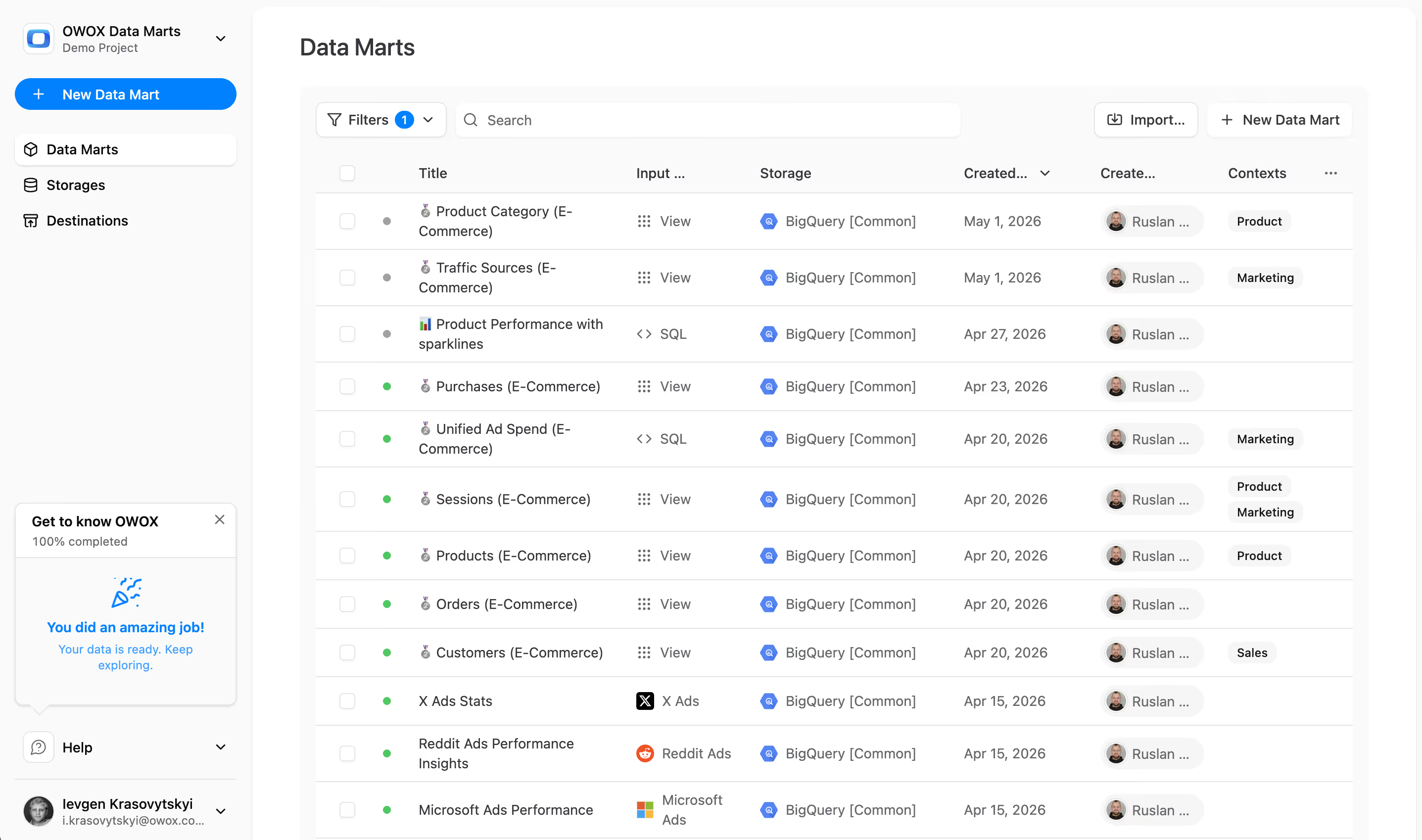
OWOX Data Marts note: monitoring quality at the mart level
Mart-level monitoring is powerful because it reflects the data exactly where business users consume it. Even if raw ingestion succeeds, a data mart can still have duplicate facts, missing dimensions, or broken transformations. Monitoring quality at this layer helps analysts protect the metrics that decision-makers actually see.
Best Practices for Monitoring and Improving Data Quality Metrics
The goal is not to create more manual checking. The goal is to make data quality visible, repeatable, and hard to ignore.
Automating checks and alerts
Automate as many checks as possible and trigger alerts when thresholds are breached. Focus first on high-impact datasets and high-risk fields. Timely alerts let analysts fix problems before reports spread confusion across the business.
Embedding metrics into data modeling standards
Build quality expectations into your modeling process from day one. Define required keys, accepted value formats, expected grain, and freshness targets as part of model design. This also helps teams avoid common data modeling mistakes that later show up as reporting defects.
Documenting and communicating data quality KPIs
Document what each metric means, where it is measured, what threshold applies, and who owns the response when it fails. Keep definitions simple and visible. When teams share the same language for data quality, troubleshooting gets faster and trust gets stronger.
Bottom line: data quality metrics turn vague concerns into operational signals. They help analysts move from “something feels off” to “here is the exact issue, its impact, and when it started.” That is how reliable analytics gets built.
Want a cleaner way to manage data marts, improve reporting quality, and keep analytics models under control? Explore OWOX Data Marts to organize trusted reporting layers with less chaos.
%202.png)



"AI by its nature will hallucinate. You need guardrails so you can trust your data."
"We had six or seven different channels and no single source of truth. It was almost impossible"
"We regained time. And time is the one resource that never comes back."