

What Is the PARSE_BIGNUMERIC Function in SQL?
PARSE_BIGNUMERIC is a BigQuery SQL function that takes a text value and turns it into a high-precision decimal number, which is perfect when your raw data arrives as strings but your analysis needs exact math.
What is PARSE_BIGNUMERIC in SQL?
In analytics, not every number shows up as a number. Revenue may come from a CSV as text, ROAS might be stored inside JSON, and imported platform data can mix valid values with blanks or malformed strings. PARSE_BIGNUMERIC helps fix that by converting a string into a BIGNUMERIC value.
The key idea is precision. BIGNUMERIC is designed for calculations where tiny decimal differences matter. That makes PARSE_BIGNUMERIC useful in reporting pipelines where a text field needs to become a real numeric field before totals, averages, ratios, or attribution logic can be trusted.
When and why analysts use PARSE_BIGNUMERIC
Analysts reach for this function when raw data is messy but the output needs to be reliable. It’s especially useful in warehouse workflows where imported source data is not strongly typed.
Handling high‑precision financial and marketing metrics
Some metrics cannot afford casual rounding. Revenue, margin, commission rates, currency conversions, and efficiency metrics often need exact decimal handling. If these values arrive as strings, PARSE_BIGNUMERIC gives analysts a way to convert them into a type built for precise arithmetic.
This is important in marketing analytics too. Fields like ROAS, blended CPA, or modeled revenue may be stored with many decimal places. Converting them to a lower-precision type too early can introduce subtle errors that get amplified in dashboards and stakeholder reporting.
Cleaning imported CSV/JSON data for reporting
CSV imports are famous for carrying numeric values as text. JSON event payloads do the same thing all the time. A metric may look like a number, but if it is technically a string, calculations will fail or require explicit parsing before use.
PARSE_BIGNUMERIC is often part of a cleanup step in staging queries or reporting views. Instead of letting messy text flow deeper into the model, analysts can convert the field once and make downstream reporting much cleaner.
Avoiding rounding errors in calculations
Floating-point types are fast and useful, but they are not always ideal for exact decimal math. When accuracy matters more than approximation, PARSE_BIGNUMERIC plus the BIGNUMERIC type can be the safer path.
This matters in cumulative reports. Small imprecision across millions of rows can lead to totals that do not match finance records or source platform exports. That is the kind of mismatch analysts hate, and PARSE_BIGNUMERIC helps reduce that risk when the source data starts as text.
Basic syntax and parameters of PARSE_BIGNUMERIC
The function is straightforward, but it still deserves careful handling because bad input strings can break a query.
Function signature and return type
The standard pattern is simple: PARSE_BIGNUMERIC(string_expression). It accepts a string and returns a BIGNUMERIC value.
That means the function is not for already-typed numeric columns. It is specifically for text input that should become a precise decimal. In practical terms, it is often used right after loading source files or extracting values from semi-structured data.
Supported input formats and limitations
PARSE_BIGNUMERIC is built for numeric-looking strings. If the string contains a valid decimal representation, the function can convert it. If the text includes unexpected characters, formatting artifacts, or a value outside the supported BIGNUMERIC range, the conversion will fail.
That is why analysts usually pair parsing with cleanup logic. Common prep steps include trimming spaces, removing currency symbols, or standardizing decimal formatting before parsing. The cleaner the input, the safer the transformation.
Common error cases (invalid strings, overflow)
The most common failures are easy to recognize:
- Strings that are not actually numeric, like N/A, null, or mixed text.
- Values with formatting symbols that were not removed first.
- Empty strings in imported flat files.
- Numbers too large or too precise for the target type.
When analysts expect bad input, they often validate first or isolate parsing inside controlled transformation steps instead of letting one bad row crash a production report.
Examples of PARSE_BIGNUMERIC in real queries
This is where the function gets exciting: it turns ugly source fields into analysis-ready metrics.
Converting string revenue and ROAS fields
Imagine an ad platform export lands in BigQuery with revenue and ROAS stored as strings. Before a reporting model can sum revenue or calculate average efficiency, those fields need to become proper numeric types.
Example:
1SELECT
2  campaign_id,
3  PARSE_BIGNUMERIC(revenue_text) AS revenue,
4  PARSE_BIGNUMERIC(roas_text) AS roas
5FROM marketing_staging;
This pattern is common in first-pass cleanup queries and is also a great candidate for generating and debugging SQL with AI when analysts need help spotting malformed fields or building repeatable parsing logic.
Parsing IDs or metrics from semi‑structured data
JSON attributes often come in as strings even when they represent numeric values. While IDs are not always ideal candidates for decimal types, high-precision metrics inside JSON absolutely are.
For example, a purchase event may store a decimal order value as text inside a payload. Parsing that field during transformation makes the metric ready for aggregation without forcing every downstream query to repeat the same extraction and conversion logic.
This keeps semantic layers cleaner and reduces repeated logic across dashboards.
Safely casting text metrics in reporting views
A strong reporting view can hide source-system messiness from analysts and stakeholders. Instead of exposing text fields like cost_string or revenue_string, the view can expose parsed BIGNUMERIC columns with business-friendly names.
Example:
1CREATE OR REPLACE VIEW reporting.daily_performance AS
2SELECT
3  date,
4  PARSE_BIGNUMERIC(cost_text) AS cost,
5  PARSE_BIGNUMERIC(revenue_text) AS revenue
6FROM raw.daily_ads;
This is especially useful when multiple people touch the same warehouse. A single trusted layer reduces the chance of inconsistent casting logic from report to report.
Best practices and pitfalls
PARSE_BIGNUMERIC is powerful, but like any parsing function, it works best with discipline.
Validating and pre‑cleaning input strings
Do not assume imported text is clean. Trim whitespace, standardize decimal notation, and remove non-numeric symbols before parsing. If the field may contain sensitive values or free-form content, governance matters too. Good transformation design should align with data masking for sensitive fields where needed.
Validation also supports stronger data quality. If a metric column is supposed to contain only numeric strings, document that expectation and enforce it in your models. This connects directly to broader ideas of SQL key constraints and data integrity, where structure and trust in the dataset go hand in hand.
Choosing between NUMERIC, BIGNUMERIC, and FLOAT
Use NUMERIC when regular fixed-precision decimal support is enough. Use BIGNUMERIC when the values are larger or need more decimal precision. Use FLOAT when approximate calculations are acceptable and exact decimal behavior is not required.
The wrong choice can create trouble. FLOAT may introduce precision issues. BIGNUMERIC may be more than you need. NUMERIC may not be wide enough for the source values. Analysts should choose based on the business meaning of the field, not just on what makes the query run.
Performance and maintainability tips in analytics SQL
Parsing the same raw string in every downstream query is a maintenance trap. Convert once in a staging or intermediate layer, then reference the parsed field everywhere else. That makes queries easier to read, easier to test, and less error-prone.
It also helps to name parsed fields clearly, such as revenue_bn or simply revenue once the raw text field is no longer needed. Clean naming plus centralized transformation logic makes warehouse models much easier to debug over time.
PARSE_BIGNUMERIC in data mart workflows
In production analytics, parsing should not be a one-off trick. It should be part of the repeatable pipeline.
Using PARSE_BIGNUMERIC in scheduled transformations
Scheduled SQL transformations often include a staging step that converts raw text fields into trusted typed columns. PARSE_BIGNUMERIC fits naturally here, especially when source systems export CSVs or event payloads with decimal metrics stored as strings.
Teams that automate this logic may also use patterns similar to using SQL stored procedures for data transformations to keep parsing, validation, and error handling organized in repeatable workflows.
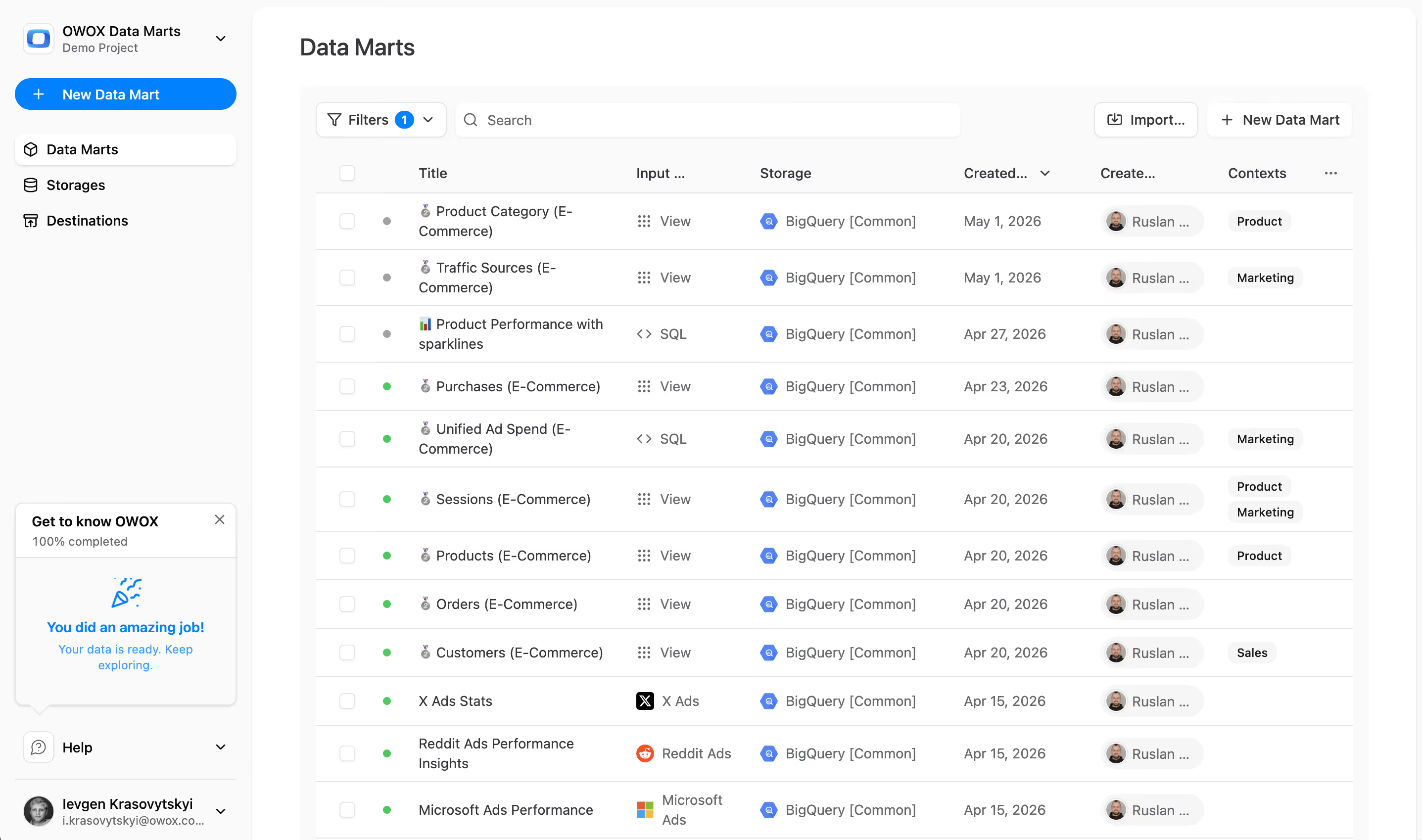
Why precise types matter in OWOX Data Marts reporting
Data marts work best when business metrics are already modeled in stable, trustworthy types. If a mart includes text-based revenue, margin, or cost fields, reporting becomes fragile fast. Parsing them into BIGNUMERIC early supports consistent aggregation and cleaner dashboard logic.
Precise typing also supports more dependable joins and modeling decisions around dimensions and facts, especially when data quality standards are tied to concepts like primary and foreign keys in SQL. In short: typed data is confident data, and confident data powers better analysis.
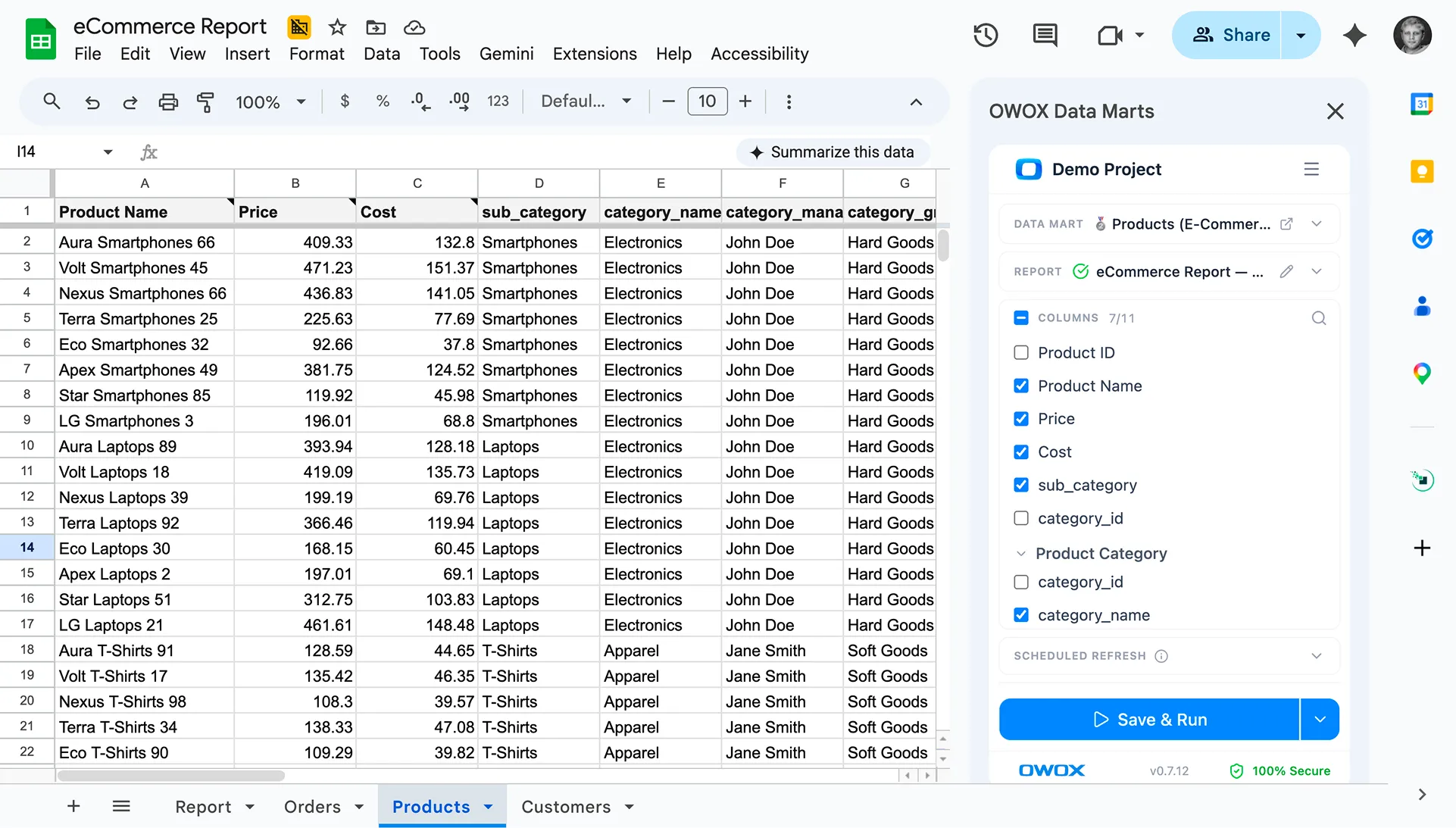
Want cleaner warehouse logic for high-precision reporting? Build your data mart, automate transformations, and turn raw text metrics into trusted reporting fields with OWOX Data Marts.
%202.png)



"AI by its nature will hallucinate. You need guardrails so you can trust your data."
"We had six or seven different channels and no single source of truth. It was almost impossible"
"We regained time. And time is the one resource that never comes back."