

What Is the ARRAY_CONCAT Function in SQL?
ARRAY_CONCAT is a SQL function that joins multiple arrays into one array, keeping the original element order so analysts can work with combined lists in a single query.
What is ARRAY_CONCAT in SQL?
In analytics SQL, arrays often store grouped values like product IDs, campaign tags, sessions, page categories, or event attributes. ARRAY_CONCAT helps you merge those separate lists without splitting them into rows first. That makes it a handy tool when you want one clean array for filtering, transformation, or downstream reporting.
Simple explanation in plain language
Think of ARRAY_CONCAT as a list combiner. If one array contains email campaign IDs and another contains paid social campaign IDs, ARRAY_CONCAT can stitch them together into one combined list. Instead of juggling multiple columns or repeated joins, you get one array that is easier to inspect and pass into the next step of your query.
Basic syntax and arguments
The basic idea is simple: pass two or more arrays into the function, and SQL returns a single array made from all of them in sequence. Conceptually it looks like ARRAY_CONCAT(array_1, array_2, array_3). Each argument should be an array, and in most SQL engines those arrays must contain compatible element types.
This is especially useful in analytical databases where array fields appear in event exports, attribution pipelines, and transformation models. Rather than rebuilding lists manually, you can combine them directly inside one SELECT statement.
How ARRAY_CONCAT Works
ARRAY_CONCAT is straightforward, but the details matter. Order, NULL handling, and type compatibility can all affect the final result and, if missed, can create messy reporting logic.
Order of elements and duplicates
ARRAY_CONCAT preserves order. Elements from the first array appear first, followed by elements from the second, then the third, and so on. That behavior is important when array position matters, such as touchpoint sequences in attribution analysis or event-step tracking.
It also does not automatically remove duplicates. If the same campaign ID appears in two arrays, the combined result will usually contain both copies. That is great when you need a full event trail, but not ideal if your goal is a distinct list. In that case, you may need an extra deduplication step after concatenation.
Handling NULLs and empty arrays
Empty arrays and NULL arrays are not always treated the same way. An empty array usually means “there are no values,” while NULL can mean “the value is unknown or missing.” Depending on your SQL engine, passing NULL into ARRAY_CONCAT may return NULL for the whole result or may require explicit handling.
To stay safe, analysts often normalize inputs before concatenating. A common pattern is to replace NULL arrays with empty arrays so the function still returns a usable result. That keeps your reporting logic more stable when some data sources send optional fields and others do not.
Array type and compatibility rules
ARRAY_CONCAT usually expects arrays with the same element type. An array of strings should be combined with arrays of strings. An array of integers should be combined with integer arrays. If you mix incompatible types, the query may fail or force you to cast values first.
This matters a lot in marketing and product analytics, where one source may store IDs as strings and another as numbers. Before concatenating, make sure your arrays follow a shared schema. A small type mismatch can break an otherwise clean model.
ARRAY_CONCAT Examples for Analytics
Now the fun part. ARRAY_CONCAT shows up in real analytical work whenever data arrives in fragments and needs to be unified for analysis.
Combining event parameters into one array
Imagine a web analytics table where one array stores product category tags and another stores search filters selected by the user. You can combine both into a single interaction array for segmentation. For example: SELECT ARRAY_CONCAT(category_tags, selected_filters) AS interaction_tags FROM events. That gives analysts one field to search for behavior patterns across multiple parameter groups.
If you want to move faster when building or validating this kind of logic, it can help to generate and debug SQL queries with AI before adding them to production transformations.
Merging marketing touchpoints from multiple sources
Suppose your attribution model collects one array of touchpoints from ad platform sessions and another from CRM interactions. ARRAY_CONCAT can merge them into a single ordered journey array. That makes it easier to evaluate the full path from first click to closed deal without manually unioning multiple detail tables for every report.
This approach is powerful when different systems capture different stages of the customer journey. By consolidating touchpoints into one array, you can feed a cleaner input into attribution logic, conversion path analysis, or QA checks.
Flattening multiple arrays for reporting
Here is one realistic example. You might first combine arrays, then expand them into rows for a reporting table:
1SELECT user_id, touchpoint
2FROM customer_paths,
3UNNEST(ARRAY_CONCAT(web_touchpoints, crm_touchpoints, offline_touchpoints)) AS touchpoint;
This pattern is useful when your raw model stores values as arrays, but your BI layer needs one row per item. ARRAY_CONCAT helps create the unified list first, and UNNEST turns it into a report-friendly structure.
Common Pitfalls and How to Avoid Them
ARRAY_CONCAT is easy to write and easy to misuse. A few checks up front can save hours of debugging later.
Type mismatches between arrays
One classic problem is combining arrays with different element types. For example, one array may contain integer campaign IDs while another holds text campaign IDs. SQL engines typically want consistency, so cast values to the same type before concatenating.
This gets even more important when table relationships depend on correctly structured identifiers. Clean typing supports joins, validation, and data integrity rules like those explained in key constraints in SQL.
Unexpected NULL behavior
Another trap is assuming NULL behaves like an empty array. It often does not. If one source sends NULL and another sends a valid array, your output may not match expectations unless you handle missing values explicitly.
It is also smart to check the content of arrays before exposing them in reporting layers. If arrays include personal or sensitive attributes, apply proper safeguards such as data masking for sensitive fields before building combined outputs.
Performance considerations with large arrays
Big arrays can become expensive, especially if you concatenate them repeatedly across large datasets and then immediately flatten them. That can increase memory use and make downstream queries harder to optimize.
A practical rule: concatenate only the arrays you truly need, and do it at the right stage of the pipeline. If a reporting view requires one compact list, build it once in a transformation layer instead of recreating it in every dashboard query.
ARRAY_CONCAT in Real Analytics Workflows
In modern warehouse workflows, ARRAY_CONCAT is less about fancy syntax and more about making semi-structured data usable. It shines when raw event data has nested lists that need to be standardized for analysis.
Using ARRAY_CONCAT in data warehouse transformations
Analysts often use ARRAY_CONCAT inside transformation models that prepare clickstream, transaction, or CRM data for business use. A transformation step might merge page-level labels, session attributes, and campaign markers into a unified behavior array. That one field can then power audience building, path analysis, or anomaly checks.
For more advanced logic, teams may also use stored procedures for complex SQL transformations when array processing becomes part of a larger repeatable workflow.
How it fits into Data Marts and reporting views
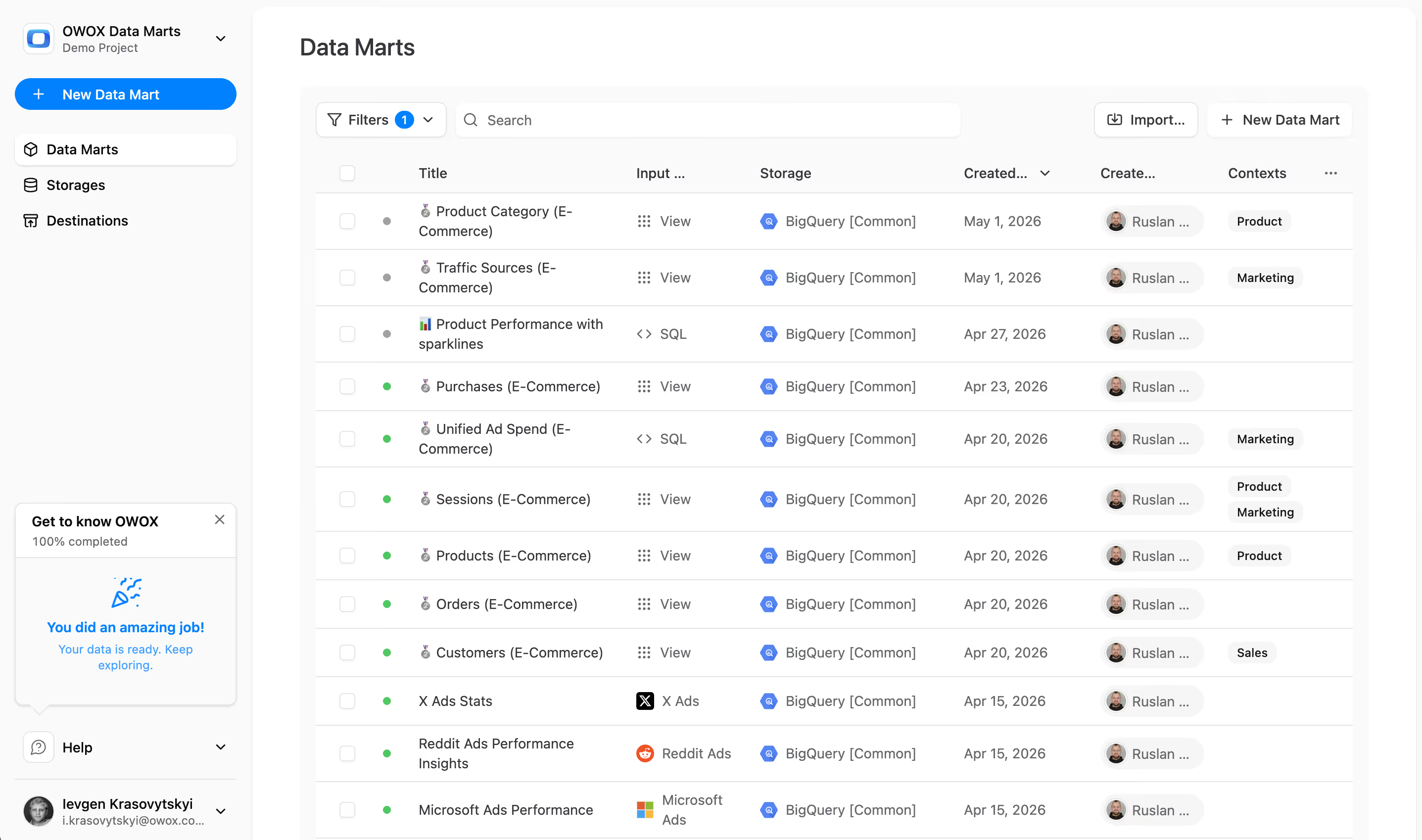
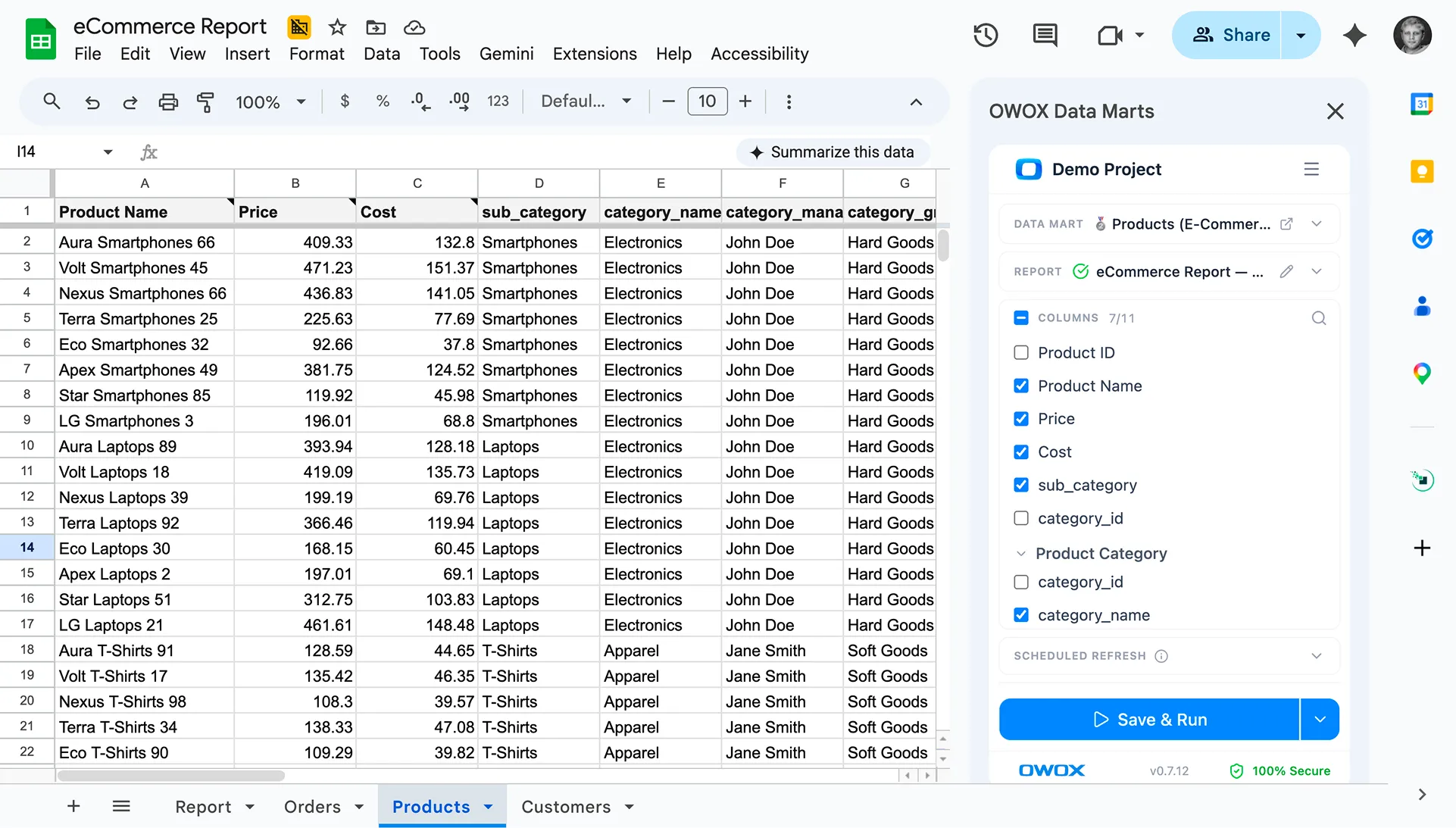
Inside a Data Mart, ARRAY_CONCAT can help turn fragmented source fields into analyst-friendly dimensions. Instead of forcing dashboard users to understand three separate arrays for traffic source, content engagement, and conversion context, a model can combine them into one curated field for exploration.
That said, not every reporting view should expose raw concatenated arrays. If the final dashboard depends on stable table relationships, it is still important to model entities clearly and preserve the primary and foreign keys that shape your tables.
OWOX Data Marts context note
In an OWOX-style analytics workflow, ARRAY_CONCAT fits naturally into the preparation layer where event fields, source metadata, and business dimensions are organized into cleaner structures for reporting. It is a practical function for turning scattered arrays into reusable analytical assets, especially when multiple systems contribute to one customer or session view.
Alternatives and Related Functions
ARRAY_CONCAT is powerful, but it works best as part of a bigger array toolkit. In many workflows, you will combine it with functions that inspect, filter, or expand arrays.
Other array operations (length, contains, UNNEST)
Common companion functions include array length checks, contains-style filtering, and UNNEST for expanding arrays into rows. A typical workflow might concatenate arrays, confirm the result is not empty, then flatten it for reporting or joining. These operations work together to move between compact storage and analysis-ready structure.
If you need distinct values, ranking, or row-based aggregations, ARRAY_CONCAT alone is not enough. It often acts as a middle step, not the final one.
When not to use ARRAY_CONCAT
Do not use ARRAY_CONCAT just because arrays exist. If your end goal is a normalized table with one row per event or one row per touchpoint, it may be better to transform data into rows directly. Likewise, if combining arrays hides important source boundaries or creates giant nested fields that are hard to debug, a more explicit model may be the smarter move.
Use ARRAY_CONCAT when it simplifies analysis. Skip it when it adds abstraction without making the data easier to trust, query, or explain.
Want to turn raw arrays into reporting-ready structures faster? Build cleaner Data Marts, streamline your SQL workflows, and organize analytics data with OWOX Data Marts.
%202.png)



"AI by its nature will hallucinate. You need guardrails so you can trust your data."
"We had six or seven different channels and no single source of truth. It was almost impossible"
"We regained time. And time is the one resource that never comes back."