

What Is CASE in ARRAY_LENGTH in SQL?
CASE in ARRAY_LENGTH means using a SQL CASE expression together with an array length function to make decisions based on how many items are inside an array, whether you are scoring users, grouping records, or cleaning nested analytics data.
What does CASE in ARRAY_LENGTH mean in SQL?
This pattern shows up whenever your data includes arrays, repeated fields, or list-like values and you want business logic to react to their size. Instead of only checking whether an array exists, you check how many elements it contains, then return a label, score, flag, or category.
Quick recap: CASE expressions
CASE is SQL’s built-in conditional logic tool. It lets you say “if this condition is true, return this value; otherwise return something else.” Analysts use it everywhere: channel grouping, lifecycle stages, data quality checks, and KPI bucketing.
In plain English, CASE turns raw rules into readable output. For example, a user can become “inactive,” “engaged,” or “power user” depending on how many actions are attached to their record.
Quick recap: ARRAY_LENGTH and similar functions
ARRAY_LENGTH returns the number of elements in an array. Some databases use different names, such as CARDINALITY, but the idea is the same: count items in a structured list without manually expanding it.
This is especially useful in event data, ecommerce line items, product attributes, page paths, and nested fields coming from analytics exports. If a row contains an array of events or IDs, the length tells you how much activity or structure is packed into that single record.
Why combine CASE with array length?
Because count alone is not enough. Analysts usually need a business-friendly result. CASE converts the raw array size into something actionable: a segment, warning, score, reporting bucket, or validation flag.
That makes this pattern practical for dashboards and data models. Instead of exposing “array length = 7,” you expose “high engagement” or “incomplete record.” Much better for reporting. Much better for decision-making.
Basic syntax: Using CASE with ARRAY_LENGTH
The core idea is simple: calculate the array size, compare it to conditions, and return the label you need. The exact function name depends on your SQL dialect, but the logic stays familiar.
Simple conditional check on array size
A typical pattern looks like this:
1CASE
2    WHEN ARRAY_LENGTH(event_list) = 0 THEN 'no events'
3    WHEN ARRAY_LENGTH(event_list) BETWEEN 1 AND 3 THEN 'light activity'
4    ELSE 'heavy activity'
5END
This works well when you want compact business logic right inside a SELECT statement. It is readable, easy to debug, and perfect for derived dimensions in reporting tables.
Handling NULL or empty arrays safely
This is where analysts need to stay sharp. In many SQL engines, a NULL array is not the same as an empty array. A NULL may mean the field is missing, while an empty array may mean the field exists but contains no elements.
To handle this safely, use CASE logic that checks both conditions explicitly when needed. For example, you may want one label for “missing data” and another for “known zero items.” That distinction matters in data quality monitoring and KPI calculations.
- NULL array: data may be absent, unavailable, or not loaded.
- Empty array: data is present, but there are zero elements.
- Populated array: one or more items exist.
If you skip this distinction, your reports can quietly mix missing records with true zero-activity records. That is how segments get messy fast.
Practical examples for analytics
This pattern becomes exciting when arrays represent real behavior: events, touched products, viewed pages, campaign interactions, or issue lists. Then CASE plus array length becomes a lightweight scoring engine inside SQL.
Classifying users by number of events
Imagine a user table where each row stores an array of event names for the last 7 days. You can classify users based on event volume:
1SELECT
2    user_id,
3    CASE
4        WHEN ARRAY_LENGTH(events_7d) IS NULL THEN 'unknown'
5        WHEN ARRAY_LENGTH(events_7d) = 0 THEN 'inactive'
6        WHEN ARRAY_LENGTH(events_7d) BETWEEN 1 AND 5 THEN 'engaged'
7        ELSE 'power user'
8    END AS activity_segment
9FROM
10    user_activity;
This kind of logic is common in product analytics, retention tracking, and lifecycle reporting. It is also a good candidate for generating complex SQL with AI assistance when your segmentation rules start branching across multiple fields.
Flagging records with missing or inconsistent array data
Arrays are powerful, but nested data can hide bad records. For example, an order may include an array of item IDs and a separate array of item quantities. If one exists and the other does not, something is off.
CASE with array length helps you surface those issues quickly. You can flag rows where one array is NULL, where both arrays are empty, or where related arrays have mismatched sizes. That gives analysts a fast audit layer before downstream reporting starts trusting the data.
This matters for pipelines handling orders, form submissions, or event parameters. One inconsistent nested field can throw off counts, revenue allocation, or attribution logic.
Creating buckets for marketing and product reporting
Array size is often a great bucketing signal. You might bucket sessions by number of viewed products, campaigns by number of tracked creatives, or users by number of completed steps in a funnel snapshot.
Those buckets make reports easier to scan:
- 0 items = no interaction
- 1–2 items = low interaction
- 3–5 items = medium interaction
- 6+ items = high interaction
Instead of exposing raw nested complexity to business users, you turn it into dimensions that fit neatly into BI dashboards and stakeholder discussions.
Common pitfalls and best practices
CASE in ARRAY_LENGTH is straightforward, but the details can bite. Most errors come from SQL dialect differences, hidden NULL behavior, or performance issues on large nested datasets.
Differences across SQL dialects (BigQuery, PostgreSQL, etc.)
Not every database treats arrays the same way. Some support native arrays directly. Others use repeated fields, JSON arrays, or different function names such as CARDINALITY. Return values for NULL inputs may also differ by engine.
That means you should always confirm syntax and behavior before standardizing logic across systems. If you package this logic into reusable transformations or using SQL logic in stored procedures, document the expected behavior clearly so nobody assumes cross-dialect compatibility that is not really there.
Performance considerations with nested and repeated fields
Checking array length is usually lighter than fully unnesting arrays, but it still depends on the shape of your data and the database engine. On very large tables with deeply nested fields, repeated calculations inside many CASE branches can add overhead.
A practical move is to calculate array size once in a subquery or model, then reference that value in your CASE logic. That keeps your query cleaner and can make optimization easier. It also helps maintain consistency across reports.
When arrays contain sensitive values, remember that logic built on them may still expose structural patterns. Governance still matters, including data masking for sensitive fields in arrays where appropriate.
Testing your CASE logic with edge cases
Never trust array logic until you test edge cases. You want sample rows for NULL arrays, empty arrays, one-element arrays, very large arrays, and inconsistent related arrays. Those cases reveal whether your business categories are actually correct.
Good testing also supports data quality controls tied to key constraints and data integrity in SQL. Even though arrays do not behave like classic relational columns, the same discipline applies: define valid states, identify invalid ones, and make them visible early.
If the logic will feed dashboards or recurring transformations, create a few validation queries and rerun them whenever the schema changes. Tiny array differences can create big reporting surprises.
How this shows up in real reports and Data Marts
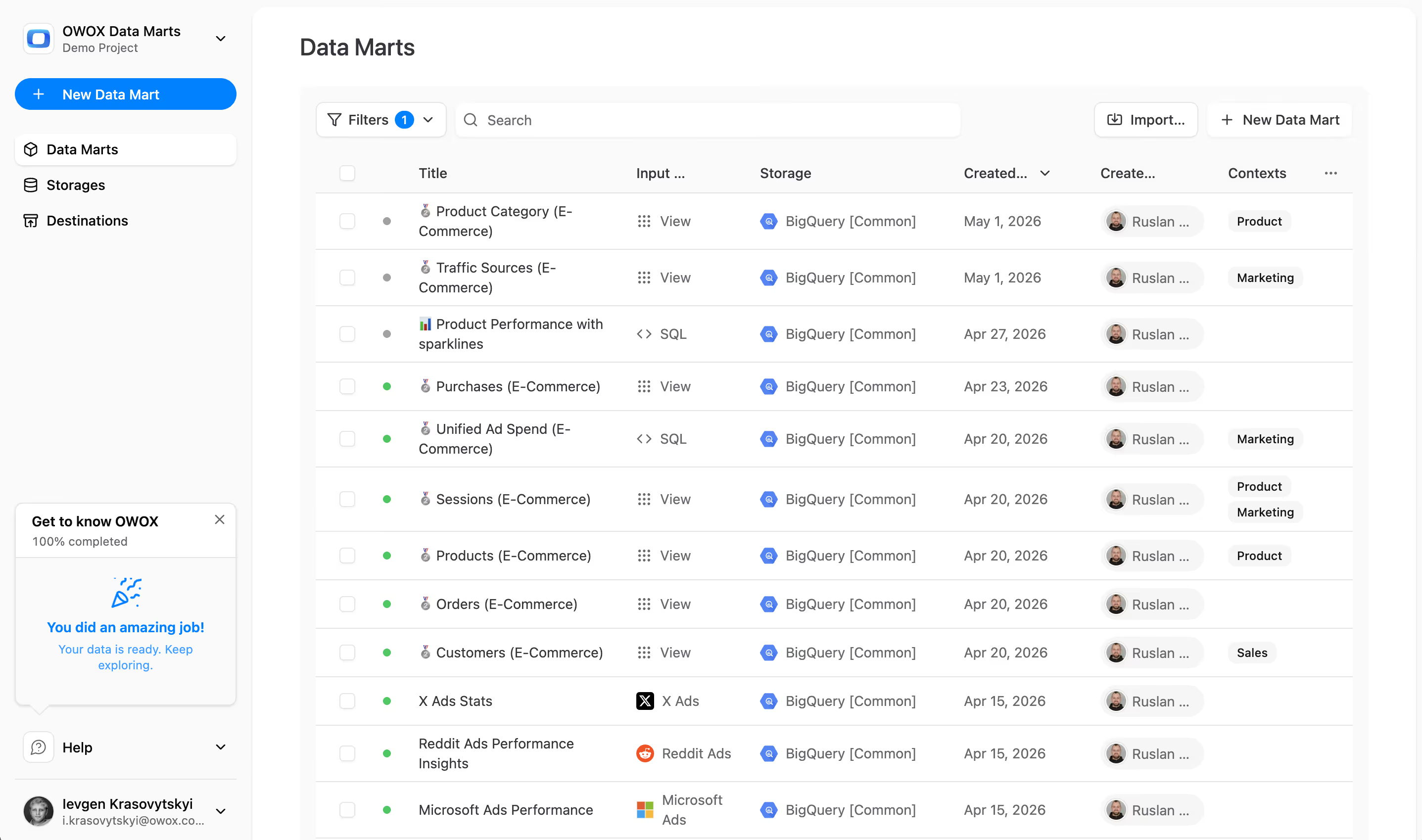
In real analytics work, this pattern is rarely the final output. It is usually an intermediate step that turns complex nested structures into reusable business fields. That is exactly where Data Marts shine.
Using array-based metrics in reusable Data Marts
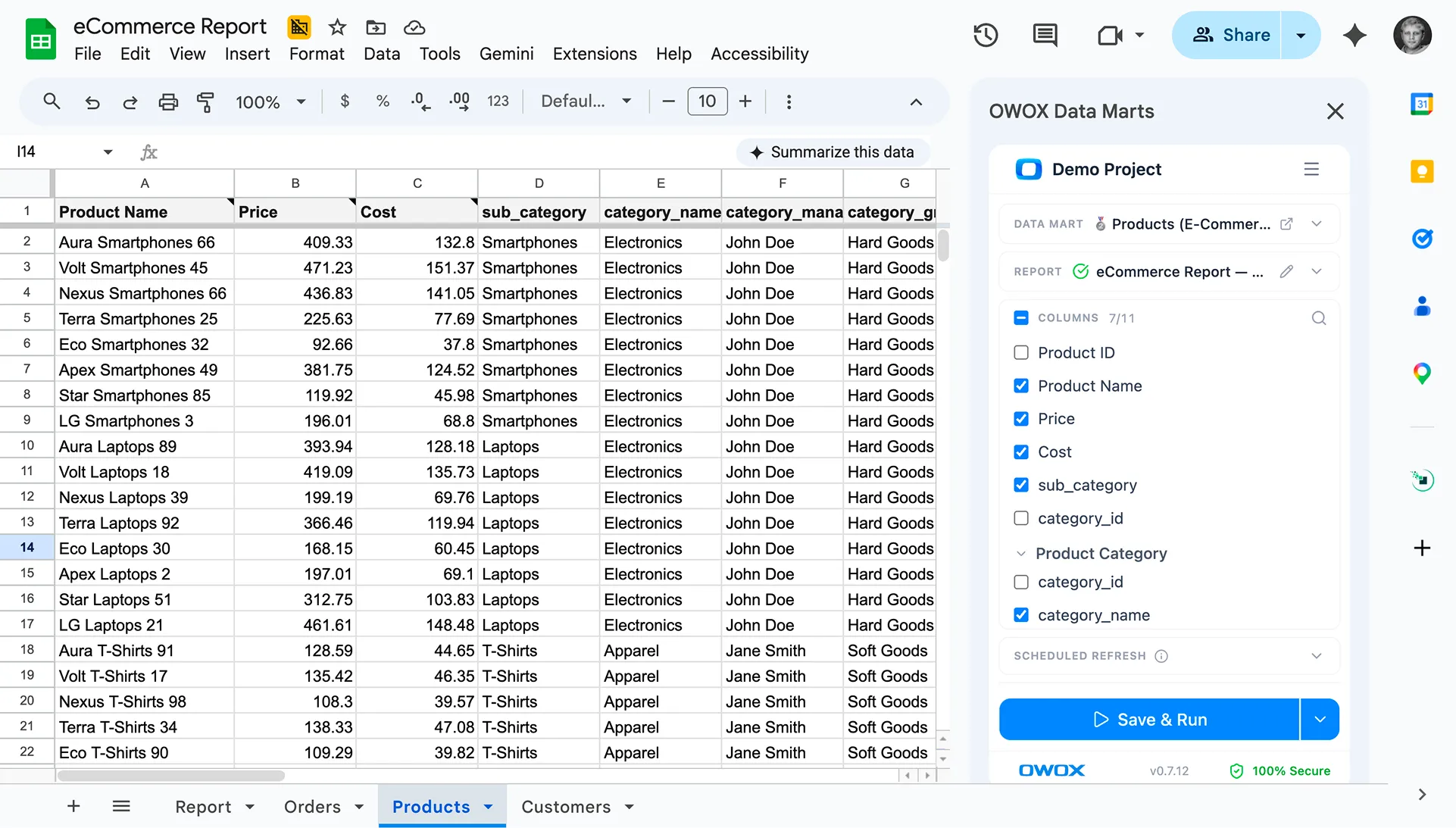
Suppose your raw source stores arrays of product impressions, clicked items, or triggered events. In a reusable mart, you can convert those arrays into stable columns like event_count, item_count_bucket, or data_quality_flag. Then every dashboard uses the same logic instead of rewriting it.
This is also where schema design matters. Clear joins and dependable relationships built with primary and foreign keys in your analytics schema make it easier to connect array-derived metrics with users, sessions, campaigns, or orders.
OWOX Data Marts context: building stable segments on top of array logic
In an OWOX Data Marts workflow, CASE plus array length can help define durable segments such as “users with multiple product interactions,” “orders with incomplete item arrays,” or “sessions with no tracked steps.” The goal is not just clever SQL. The goal is stable, repeatable reporting logic your team can trust.
When array-based conditions are modeled once and reused consistently, analysts spend less time rechecking nested fields and more time exploring insights. That is the big win: less chaos, more clarity, faster reporting.
Want to turn array logic into reusable reporting layers? Build cleaner segments and stable marts with OWOX Data Marts. Start shaping analytics-ready datasets and reporting workflows without reinventing the same SQL every time.
%202.png)



"AI by its nature will hallucinate. You need guardrails so you can trust your data."
"We had six or seven different channels and no single source of truth. It was almost impossible"
"We regained time. And time is the one resource that never comes back."