

What Is CAST AS DATETIME in SQL?
CAST AS DATETIME is an SQL expression that turns raw values like text timestamps or numeric date fields into real datetime values, so analysts can filter, join, group, and report on time without messy type issues getting in the way.
What does CAST AS DATETIME mean in SQL?
In SQL, CAST AS DATETIME means converting one data type into a datetime-type value. This usually happens when source data arrives as plain text, integers, or inconsistent timestamp formats. Instead of treating a value like 2024-01-15 09:30:00 as just a string, casting tells the database to recognize it as an actual point in time.
CAST vs CONVERT vs implicit conversion
CAST is the standard SQL way to change a value’s type. It is explicit, readable, and usually the safest choice when you want your query logic to be clear. A common pattern looks like casting a text field into DATETIME before using it in filters or calculations.
Some databases also support CONVERT, which does a similar job but may use database-specific syntax or formatting options. Then there is implicit conversion, where the database tries to convert values automatically. That can work, but it can also create surprises if the format is ambiguous or the engine guesses wrong. For analysis work, explicit casting is usually the smart move.
Common sources of datetime values (logs, events, marketing data)
Datetime values often enter analytics pipelines in raw, inconsistent ways. Event logs may store timestamps as strings. CRM exports may contain localized date text. Marketing platforms may send event times in different formats across sources. CSV uploads can be especially chaotic.
Typical examples include:
- Website event timestamps from tracking systems
- Ad platform export files with date text columns
- CRM activity logs with inconsistent time formatting
- API responses where timestamps arrive as strings or Unix time values
CAST AS DATETIME helps normalize these inputs into something the database can actually work with.
Basic syntax of CAST AS DATETIME
The core idea is simple: take a value in one type and convert it into a datetime type the database understands. Once converted, that field becomes much more useful for analysis, sorting, date filtering, and time-based functions.
General CAST syntax
The general syntax is:
1CAST(expression AS DATETIME)
The expression can be a column, a literal, or even the result of another function. For example, you might cast a VARCHAR column containing timestamps into DATETIME so it can be used in a WHERE clause or grouped by hour or day.
This is especially useful when imported source data was not typed correctly during ingestion. Instead of rebuilding the whole table immediately, analysts often cast fields on the fly while validating or transforming data.
Database-specific nuances (SQL Server, MySQL, PostgreSQL, BigQuery)
The exact type name and behavior vary by database. SQL Server commonly uses DATETIME or DATETIME2. MySQL supports DATETIME and TIMESTAMP with slightly different rules. PostgreSQL often uses TIMESTAMP instead of DATETIME. BigQuery usually works with DATETIME, DATE, or TIMESTAMP depending on whether time zone handling is needed.
That means the idea is universal, but the exact syntax may change. Some engines are strict about accepted input formats. Others allow more flexibility but may still fail on malformed values. Analysts should always check how their specific warehouse handles date parsing, nulls, and time zones before relying on a cast in production logic.
Practical use cases for analysts
CAST AS DATETIME is one of those tiny SQL tools that unlocks a lot of real work. If your time field is not typed correctly, almost every downstream analysis gets harder. Clean datetime values make reporting faster, joins safer, and trend analysis far less painful.
Filtering and grouping by date and time
One of the most common uses is filtering records within a time range. If a timestamp is stored as text, the database may compare it alphabetically instead of chronologically, which can break your results. Casting fixes that by turning the value into a real datetime type.
It also matters for grouping. Hourly traffic, daily conversions, weekly revenue, and monthly retention all depend on valid datetime fields. Once cast, the field can be used with truncation, extraction, and formatting functions to build clean time buckets.
Cleaning messy date strings from tracking and CRM systems
Raw exports are rarely perfect. One file may use YYYY-MM-DD, another may use MM/DD/YYYY, and another may attach time with different separators. Analysts often need to standardize these values before any serious reporting starts.
CAST is often part of that cleanup flow, sometimes after trimming, replacing characters, or parsing substrings. This is a big deal when combining data from web tracking, CRM tools, and backend systems into one reporting layer.
Preparing datetime fields for joins and window functions
Datetime casting also matters when joining tables or using analytical functions. If one table stores event time as text and another stores it as a proper timestamp, comparisons may fail or produce inconsistent results. Before joining on time windows or sequence logic, the fields need compatible types.
This becomes even more important when working with primary and foreign keys in SQL joins alongside session time, order time, or touchpoint time. Window functions like ROW_NUMBER, LAG, and running totals also behave more predictably when the ordering field is a validated datetime instead of a raw string.
Example: using CAST AS DATETIME in a query
Here’s a realistic analytics scenario: a table of marketing events stores event_time as text. Before filtering or grouping, you cast it into a datetime value inside the query.
Example: converting text timestamps to datetime
Imagine a table called marketing_events with a column event_time_text. A simple query might look like this:
1SELECT user_id, CAST(event_time_text AS DATETIME) AS event_time
2FROM marketing_eventsWHERE
3CAST(event_time_text AS DATETIME) >= '2024-01-01 00:00:00';
This turns the text field into a usable datetime value for filtering. In practice, many analysts first validate the source format, then move this logic into a cleaned model or staging table to avoid repeating casts in every report.
Example: combining CAST with DATE_TRUNC / FORMAT functions
Once the value is typed correctly, you can build time buckets for reporting. For example, you might cast the field first and then truncate it to the day or hour for aggregation.
1SELECT DATE_TRUNC('day', CAST(event_time_text AS DATETIME)) AS event_day, COUNT(*) AS events
2FROM marketing_events
3GROUP BY event_day;
This kind of pattern is everywhere in BI workflows. It is useful for campaign pacing, user activity trends, and operational dashboards. If you want help speeding up repetitive query writing or fixing syntax issues across dialects, it can also be helpful to explore generating and debugging SQL CAST expressions with AI.
Common pitfalls and best practices
CAST AS DATETIME is powerful, but it is not magic. If the source values are inconsistent or the query is written carelessly, conversion errors and performance problems show up fast.
Dealing with time zones and formats
A datetime value without clear time zone logic can create reporting chaos. One source may send UTC, another local time, and another may omit the offset completely. Casting alone does not solve that. You still need to know what the original value represents.
Format differences are another trap. A string like 01/02/2024 may mean January 2 or February 1 depending on the system. Before casting, normalize the format whenever possible. If timestamp fields contain user-level or operationally sensitive information, teams should also think about data masking and handling sensitive timestamp fields in shared datasets.
Performance considerations when casting in WHERE and JOIN
Casting directly inside WHERE and JOIN conditions can slow queries down, especially on large tables. When the database has to convert every row on the fly, indexes or partition pruning may become less effective.
A better approach is often to cast once in a staging model, derived table, or cleaned column and reuse that typed field downstream. Repeated conversion logic can also be centralized with using stored procedures for data cleaning and type casting when that fits your warehouse workflow.
Validating input before casting
Not every source value deserves your trust. Empty strings, malformed timestamps, unexpected separators, and invalid dates can all break casting. Before conversion, check for nulls, test patterns, and isolate bad records.
Best practice is simple:
- Profile the source values before writing production logic
- Standardize formats as early as possible
- Separate invalid rows for review instead of silently forcing them through
- Use safe parsing functions where your database supports them
That extra validation step prevents subtle reporting errors later.
CAST AS DATETIME in reporting and data marts
In reporting, time is everywhere. If datetime fields are inconsistent, your charts, cohorts, and performance summaries become fragile fast. Typed, trustworthy time fields are part of the foundation of any serious analytics model.
Why consistent datetime types matter in dashboards
Dashboards depend on stable definitions. Daily revenue, conversion lag, attribution windows, and retention curves all rely on consistent time logic. If one source stores text dates and another stores timestamps, the same metric can shift depending on who wrote the query.
Using proper datetime fields supports cleaner transformations, more reliable date dimensions, and stronger governance. It also works hand in hand with key constraints and data integrity in SQL, because trustworthy joins and trustworthy timestamps usually need to mature together.
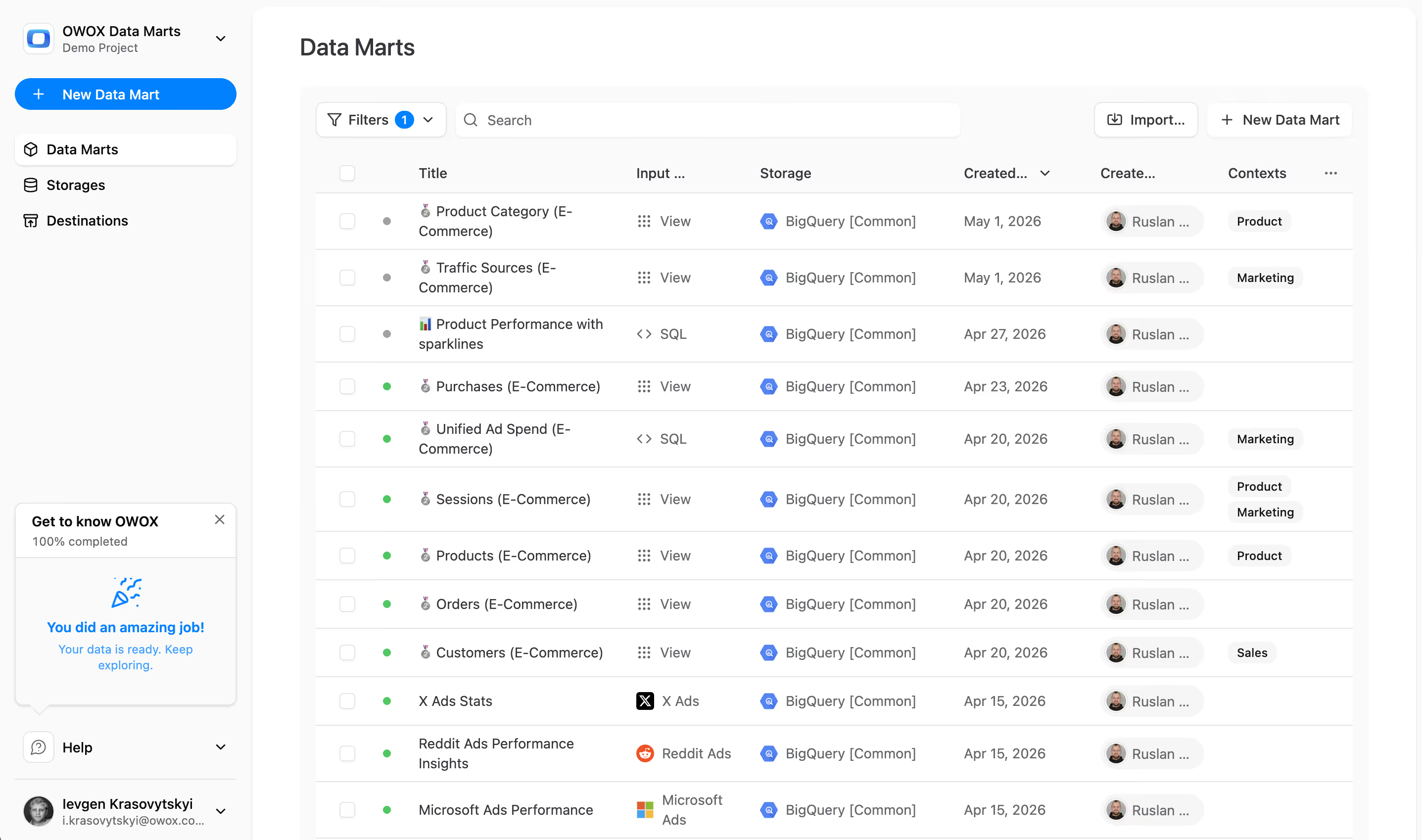
OWOX Data Marts context: building time-based metrics on clean datetime fields
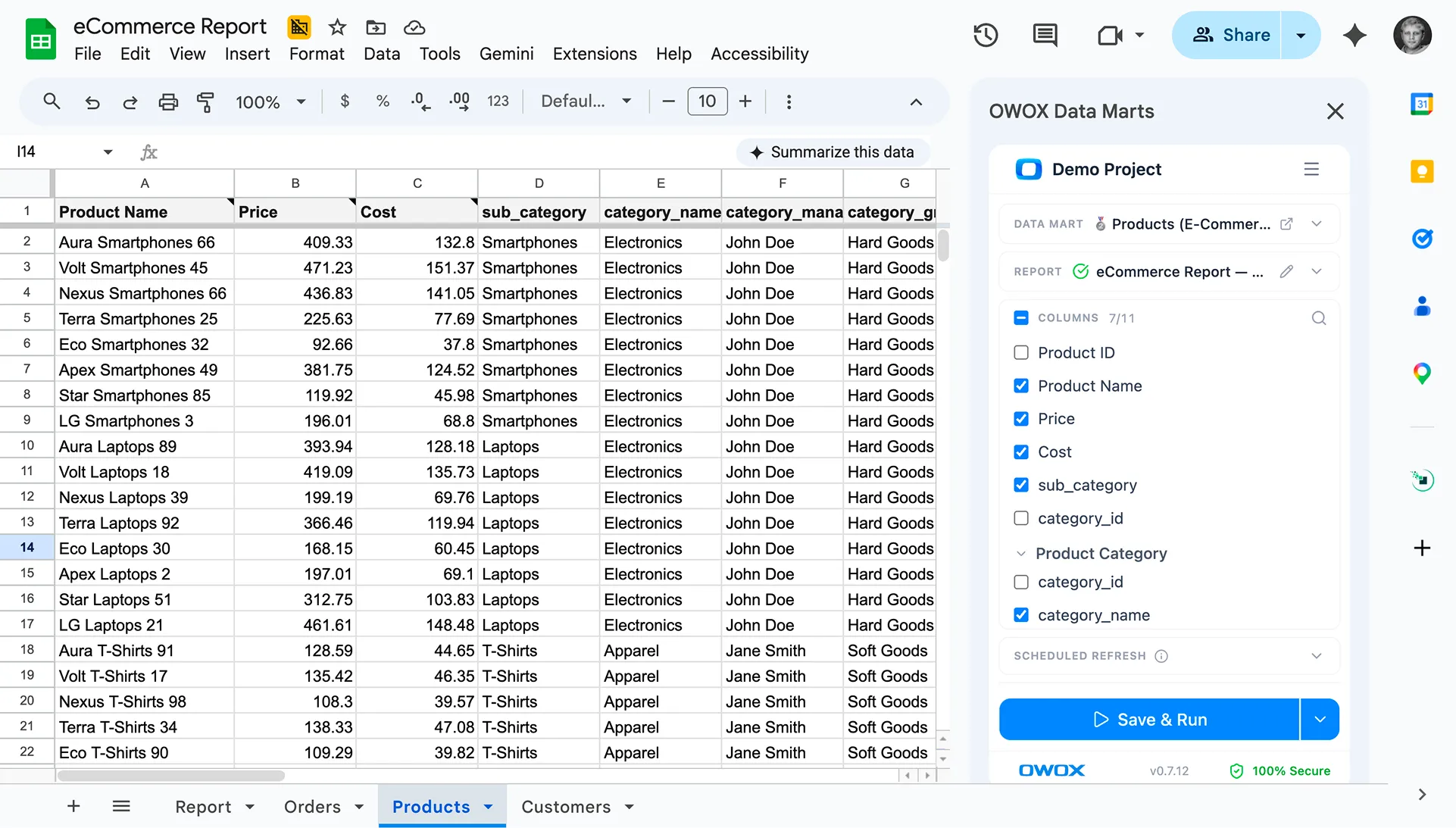
In a data mart context, CAST AS DATETIME is often part of the cleanup layer that turns raw source tables into analysis-ready models. Once event times, order times, and session times are properly typed, it becomes much easier to calculate time-to-conversion, daily active users, campaign windows, and period-over-period trends.
That is the real win: less wrestling with raw timestamp mess, more confidence in the numbers that show up in reports.
If you want a cleaner setup for data marts, time-based metrics, and analysis-ready reporting workflows, OWOX Data Marts is built for that kind of structured work. Clean datetime fields make everything downstream easier.
%202.png)



"AI by its nature will hallucinate. You need guardrails so you can trust your data."
"We had six or seven different channels and no single source of truth. It was almost impossible"
"We regained time. And time is the one resource that never comes back."