

What Is CAST AS INTERVAL in SQL?
CAST AS INTERVAL in SQL means converting a value into a time interval so you can add or subtract days, hours, minutes, or other time units from dates and timestamps in a clean, flexible way.
What is CAST AS INTERVAL in SQL?
Time-based analysis moves fast, and plain numbers are not always enough. CAST AS INTERVAL helps SQL understand that a value represents duration, not just a raw integer or string. Once converted, that value can be used in date arithmetic, timestamp logic, and reporting calculations.
Basic idea of INTERVAL type
An INTERVAL is a data type that represents a span of time. Instead of storing a fixed point in time like a DATE or TIMESTAMP, it stores duration such as 7 days, 2 hours, or 30 minutes. That makes it perfect for operations like “purchase date plus 30 days” or “session start minus 15 minutes.”
In analytics, this is a big deal because many business questions are based on relative time. Retention windows, attribution lookback periods, trial expiration dates, and rolling reports all depend on duration-based logic.
Why and when you need CAST AS INTERVAL
You need CAST AS INTERVAL when your duration value starts out as a string or another type and must be treated as an interval in the query. This often happens when time offsets come from parameters, lookup tables, configuration columns, or user input.
It is especially useful when building dynamic reporting logic. Instead of hardcoding every window, you can store values like “7 days” or “1 month” and cast them when needed. That keeps queries more reusable and easier to maintain.
CAST AS INTERVAL Syntax and Variations
The exact syntax depends on the SQL dialect, but the goal stays the same: turn a value into an INTERVAL so the database can apply it correctly in time calculations.
General CAST syntax
A common pattern looks like this:
1CAST('7 days' AS INTERVAL)
In systems that support it, the database reads the string and converts it into a real interval value. You can then use it in expressions such as:
order_date + CAST('7 days' AS INTERVAL)
This is cleaner than forcing SQL to guess what “7” means. Is it 7 days? 7 hours? 7 months? Casting removes that ambiguity.
Common interval literals and units
Common interval values include days, hours, minutes, seconds, weeks, months, and years. Typical examples are:
CAST('1 day' AS INTERVAL)CAST('7 days' AS INTERVAL)CAST('2 hours' AS INTERVAL)CAST('30 minutes' AS INTERVAL)
Be careful with months and years. They are calendar-based units, not fixed numbers of days, so their effect can vary depending on the starting date.
Vendor-specific differences (PostgreSQL, BigQuery, etc. — at a glance)
SQL engines do not all treat intervals the same way. PostgreSQL has strong native interval support and commonly uses CAST or interval literals directly. BigQuery often uses functions like DATE_ADD or TIMESTAMP_ADD with explicit units instead of relying on a generic INTERVAL cast pattern everywhere.
That means the concept is portable, but the exact syntax is not always copy-paste friendly. Before shipping a query to production, check how your warehouse handles interval parsing, supported units, and date arithmetic with timestamps versus dates.
Practical Use Cases for CAST AS INTERVAL
This is where CAST AS INTERVAL starts doing real work. It turns abstract time offsets into business logic you can actually measure.
Shifting dates in marketing funnels (e.g., +7 days, +30 days)
Marketing funnel analysis often asks questions like: Did the lead convert within 7 days? Did the user come back within 30 days of signup? With CAST AS INTERVAL, you can shift event dates forward or backward without hardcoding every condition.
For example, you can compare signup time to purchase time using a dynamic interval stored in a table. This is useful when different campaigns have different attribution windows or follow-up periods.
It also helps when events are connected through structured relationships. If you are working with primary and foreign keys in SQL, interval logic can be layered onto those joins to track time between linked records.
Building rolling windows and cohorts
Rolling 7-day, 14-day, or 30-day windows are everywhere in analytics. CAST AS INTERVAL makes those windows easier to parameterize. Instead of writing separate queries for each range, you can use one query with a variable duration.
Cohort analysis also benefits. You can define post-acquisition behavior windows, renewal periods, or inactivity thresholds using interval-based logic that stays readable instead of turning into a wall of date math.
Aligning events to reporting periods
Sometimes events need slight shifts before they fit reporting rules. Maybe billing closes at 6 a.m. instead of midnight. Maybe campaign performance should be grouped into business-defined weeks. Intervals let you move timestamps into the right reporting bucket before aggregation.
This is super practical when raw event time and business reporting time are not perfectly aligned. A small interval adjustment can prevent very large reporting confusion.
Examples of Using CAST AS INTERVAL
Here is one realistic analytics scenario. Imagine you want to find customers who purchased within 7 days after signup.
Adding and subtracting intervals to dates and timestamps
A query might look like this:
1SELECT user_id, signup_ts, purchase_ts
2FROM users
3WHERE purchase_ts <= signup_ts + CAST('7 days' AS INTERVAL);
You can also subtract intervals to build backward-looking conditions, such as finding sessions that happened within 30 minutes before a conversion:
conversion_ts - CAST('30 minutes' AS INTERVAL)
This pattern is simple, expressive, and perfect for event stream analysis.
Using CAST AS INTERVAL in WHERE and JOIN conditions
Intervals are often used in filters and joins, not just in SELECT expressions. For example, joining support tickets to orders created within 3 days of purchase can look like a time-bounded relationship instead of a plain key match.
1... ON t.user_id = o.user_id
2AND t.created_at BETWEEN o.order_ts
3AND o.order_ts + CAST('3 days' AS INTERVAL)
That kind of logic is powerful in attribution, support analytics, and lifecycle reporting where timing matters just as much as identity matching.
Common mistakes and type mismatch issues
The biggest trap is mixing incompatible types. A DATE plus an INTERVAL may return a TIMESTAMP in one system and a DATE in another. A string that looks like an interval may fail if the format is not supported by your SQL engine.
Another common mistake is assuming all units behave the same. Adding 1 month is not always equal to adding 30 days. Time zone handling can also create surprises when intervals are applied to TIMESTAMP values.
When something breaks, check three things first:
- Whether the source value is in a valid interval format
- Whether the target column is DATE, DATETIME, or TIMESTAMP
- Whether the SQL dialect supports CAST AS INTERVAL in that exact expression
CAST AS INTERVAL in Analytics and Reporting Workflows
In reporting pipelines, interval logic is not just a syntax trick. It becomes part of how metrics are defined, reused, and trusted.
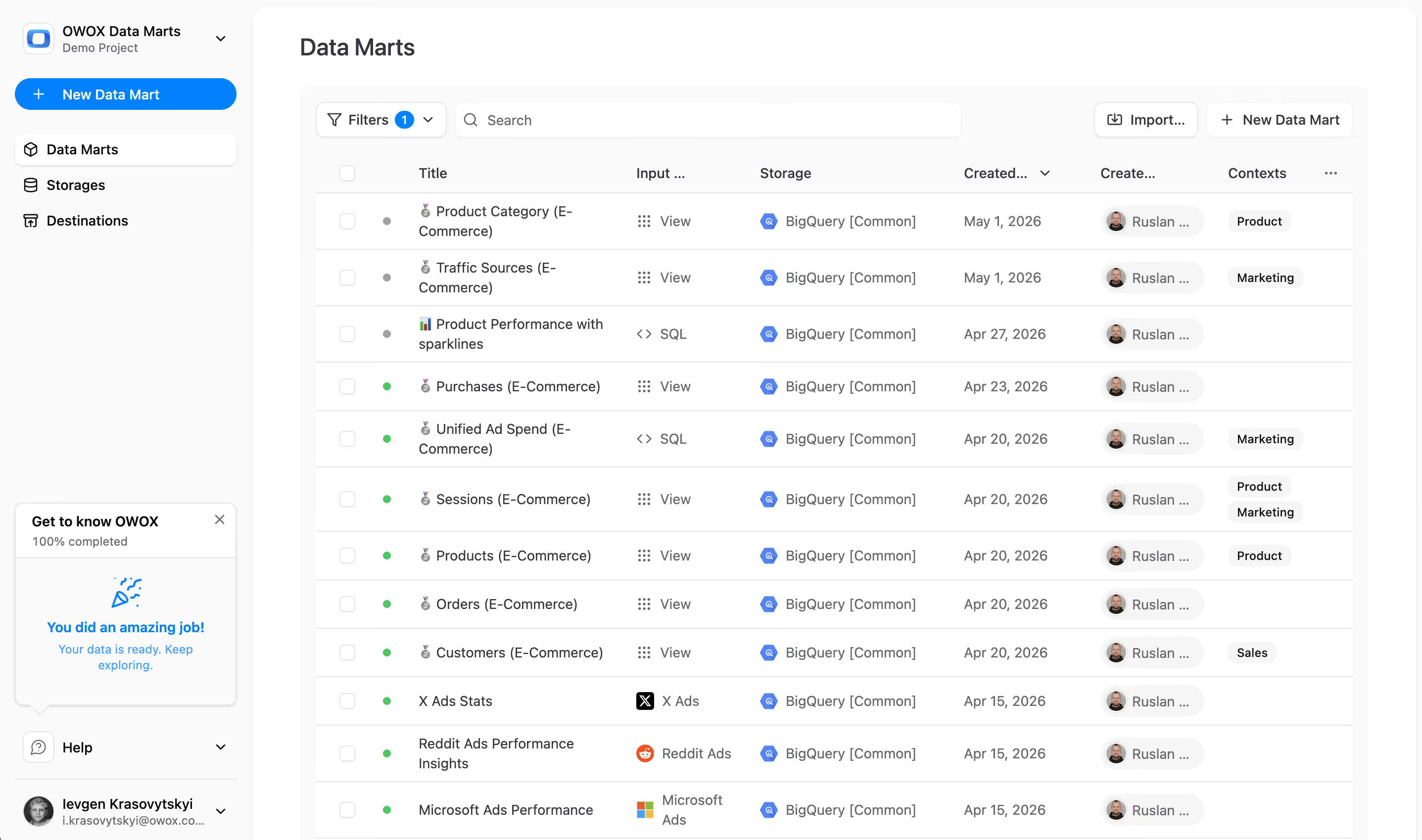
Working with time-based metrics in data marts
Data marts often contain business-ready tables for retention, conversion lag, subscription periods, and SLA tracking. CAST AS INTERVAL helps define these metrics consistently by making duration logic explicit instead of hidden in ad hoc calculations.
When time windows are reused across models, dashboards, and teams, standardizing them matters. It keeps the “7-day conversion” metric from quietly turning into five different versions.
Performance and readability tips for BI queries
Readable interval logic is easier to audit and debug. If the same date rule appears in multiple reports, centralizing it can reduce confusion. Teams often do this by using stored procedures to standardize complex date logic and by designing schemas with the right SQL key constraints so joins and temporal logic stay predictable.
Also remember that time-based filtering can affect performance. Applying functions to indexed date columns may reduce optimization opportunities in some databases. It is usually better to keep date predicates as direct and simple as possible.
OWOX Data Marts context
In a data mart workflow, interval logic often shows up in prebuilt reporting layers, campaign windows, and event transformation rules. It is also important to think about governance, especially when you are handling sensitive timestamps and user data with masking in analytical models.
The cleaner your interval logic is, the easier it becomes to trust the output across BI tools, recurring reports, and stakeholder questions.
FAQ: CAST AS INTERVAL
Here are the quick answers to the questions analysts run into all the time.
How is INTERVAL different from a simple integer offset?
An integer is just a number. An INTERVAL is a typed duration with units. That difference matters because SQL can apply an interval correctly to dates and timestamps, while a plain integer may be ambiguous or invalid depending on the expression.
Can I index or aggregate using INTERVALs?
You typically index date or timestamp columns rather than the interval itself. But yes, you can absolutely use intervals in aggregated logic, such as grouping users by time-to-conversion buckets or calculating average durations between events.
If you are exploring or validating this kind of logic, generating and debugging SQL date logic with AI can help speed up the rough draft stage before final review.
What to watch out for across different SQL dialects?
Watch for syntax differences, supported units, return types, and how each engine handles months, time zones, and timestamp arithmetic. The concept is the same, but the implementation details can shift fast. Always test interval-heavy queries in the exact warehouse where they will run.
If you want cleaner, reusable time-based reporting logic, OWOX Data Marts can help you organize models around real business metrics. Explore data marts, standardize recurring calculations, and keep your analytics workflows easier to trust.
%202.png)



"AI by its nature will hallucinate. You need guardrails so you can trust your data."
"We had six or seven different channels and no single source of truth. It was almost impossible"
"We regained time. And time is the one resource that never comes back."