

What Is CAST AS STRING in SQL?
CAST AS STRING means turning a number, date, boolean, or another SQL data type into plain text so you can compare it, combine it, display it, or export it more easily in analytics workflows.
What does CAST AS STRING mean in SQL?
In SQL, data types matter a lot. A value stored as an integer behaves differently from a value stored as a date or a text field. CAST AS STRING is the expression analysts use when they need SQL to treat a value as text instead of its original type.
General idea of type casting
Type casting is the process of converting one data type into another. For example, a customer ID might be stored as an INT in one table and as a text field in another. If you want to join them, build a readable label, or export values in a consistent format, you may need to cast one side into a string.
This is especially common in reporting queries, dashboards, and data marts where fields come from multiple systems. CRM tools, ad platforms, finance systems, and web analytics sources rarely agree on data types. Casting is what helps analysts bring order to the chaos.
CAST vs CAST AS STRING vs other conversions (high level)
CAST is the SQL function. CAST AS STRING is one specific use of it. In practice, you write something like CAST(order_id AS STRING) or CAST(order_id AS VARCHAR), depending on the SQL dialect.
Some databases also support shorthand operators or alternative functions such as converting with ::text or using engine-specific conversion functions. The exact syntax may vary, but the idea stays the same: tell the database to represent a value as text.
High level rule: use CAST when you want an explicit, readable conversion. It makes your query logic clearer and helps avoid silent type assumptions.
Why data analysts use CAST AS STRING
Analysts do not cast values to string just for style points. They do it because messy source systems and practical reporting needs demand it.
Preparing data for concatenation and labels
One of the most common reasons to cast as string is to build labels. A dashboard might need a field like “Campaign 2024-01” or “Order #12345.” If one part of that label is numeric or date-based, SQL often requires conversion before concatenation.
This makes report outputs easier to read and helps BI users scan tables and charts faster. Instead of showing separate fields, you can create one polished display value ready for presentation.
Avoiding type mismatch errors in joins and filters
CAST AS STRING also helps avoid type mismatch problems. If one table stores a key as text and another stores it as a number, the join may fail or behave unpredictably. Casting creates a common type so the database can compare values correctly.
This is tightly connected to understanding key constraints and data types in SQL. If your key fields are not aligned, joins, filters, and aggregations become fragile fast. Casting is often the quick fix, and sometimes the necessary bridge between systems.
Cleaning and standardizing identifiers from messy sources
Real-world identifiers are rarely clean. A product code may arrive as 10025 in one source, “10025” in another, and even “0010025” somewhere else. Casting to string is often the first step in standardizing these values before trimming, padding, or formatting them.
For marketing and BI teams working across spreadsheets, APIs, warehouse tables, and exported CSV files, that consistency is a big deal. Once an identifier is treated as text, you can apply string functions more predictably and preserve formatting that numbers might strip away.
Syntax examples of CAST AS STRING in different SQL dialects
The pattern is simple, but the exact target type name changes from database to database.
Standard CAST() syntax
The general SQL form looks like this:
1CAST(expression AS target_type)
When converting to text, the target type may be STRING, VARCHAR, CHAR, or TEXT depending on the engine. Example:
1SELECT
2    CAST(order_id AS STRING) AS order_id_text
This is the clean, explicit version analysts often prefer because it is easy to read and maintain.
Dialect-specific nuances (e.g., BigQuery, Snowflake, PostgreSQL, MySQL)
BigQuery commonly uses STRING, so CAST(session_id AS STRING) is familiar there. Snowflake often uses VARCHAR, and PostgreSQL commonly uses TEXT or shorthand like value::text. MySQL typically uses CHAR for string conversion in CAST expressions.
The important thing is not memorizing every variation forever. It is knowing that the target text type depends on the platform. If you work across multiple warehouses, even simple conversion logic can shift. This is one place where generating SQL queries with AI can speed up repetitive syntax work, especially when adapting one query to another dialect.
Common gotchas: length limits, encoding, NULL handling
Not every cast is harmless. Some text types have length limits, so converting into a fixed-length or shorter string type can truncate values. That is bad news for identifiers, JSON snippets, or long labels.
Encoding and character support can also matter when your data includes non-Latin characters, symbols, or imported values from external tools. And remember that NULL stays NULL when cast in most SQL engines. It does not magically become an empty string unless you explicitly handle it with COALESCE or similar logic.
Another gotcha: casting affects representation, not meaning. A date cast to string may display in a default format you did not expect. If formatting matters, combine casting with date or formatting functions carefully.
Practical examples for reporting and dashboards
This is where CAST AS STRING becomes very real for analysts building outputs people actually use.
Building readable labels from numeric or date fields
Suppose a dashboard needs a label like “Week 12 - 2024.” If week_number is numeric, you cast it to string before concatenating it with text. The same applies to order numbers, invoice labels, or campaign names built from date parts.
Example: an ecommerce analyst wants a chart label that combines an order date and store ID for quick troubleshooting. A query might build a field like “2024-03-01 | Store 42” by converting the date and integer values into text before combining them. That label can be used directly in a dashboard table without extra formatting downstream.
Converting IDs and keys for cross-source joins
Cross-source joins are a classic use case. Imagine ad platform data stores campaign_id as text, while your warehouse fact table stores it as an integer. To combine spend and revenue correctly, you may cast one field so both match.
This matters even more when you are working with primary and foreign keys. Keys need consistency. If different systems store the same business identifier in different types, CAST AS STRING can help create a common comparison layer before a proper normalization step is added to the data model.
Preparing string dimensions for BI tools and exports
BI tools often treat text dimensions differently from numeric measures. If a field is technically numeric but should behave like a category, casting it to string can make visualizations and exports cleaner. A zip code is a great example: it may look numeric, but analytically it often belongs in the text bucket.
Exports are another reason. CSV files, spreadsheets, and downstream tools may mangle long numbers, remove leading zeros, or display scientific notation. Casting to string before export helps preserve the form analysts and business users expect.
Best practices and pitfalls when casting to string
CAST AS STRING is powerful, but it is easy to overuse it or apply it in the wrong place.
When to cast in the data mart vs in the BI tool
If a field should consistently behave as text across reports, cast and standardize it in the data mart layer. That creates one trustworthy definition for everyone. If the conversion is only needed for a single chart label or one-off report, doing it in the BI layer may be enough.
For recurring transformations, many teams centralize that logic in models, views, or even workflows such as using CAST inside SQL stored procedures. The key is consistency: do not make every dashboard rebuild the same conversion logic from scratch.
Performance and storage considerations
Casting in a SELECT is usually straightforward, but repeated casting on large join keys or filter fields can add overhead. It may also reduce the database optimizer’s ability to use indexes or partition pruning effectively, depending on the system and query pattern.
Storing everything as text is not the answer either. Strings typically take more space and can be less efficient for calculations. Cast to string when the business meaning requires text behavior, not as a default habit.
Avoiding accidental data loss or wrong formatting
Be careful with formatting-sensitive values like account numbers, postal codes, phone numbers, and masked identifiers. Numeric conversion may remove leading zeros before you ever cast back to string, and then the original representation is gone.
This is also important when working with protected data and data masking and handling sensitive fields. If a field must be partially hidden or transformed for reporting, string conversion can be part of that process, but the sequence of operations matters. Format first, mask correctly, and document the logic so analysts do not accidentally expose or distort sensitive values.
How CAST AS STRING fits into Data Marts and OWOX workflows
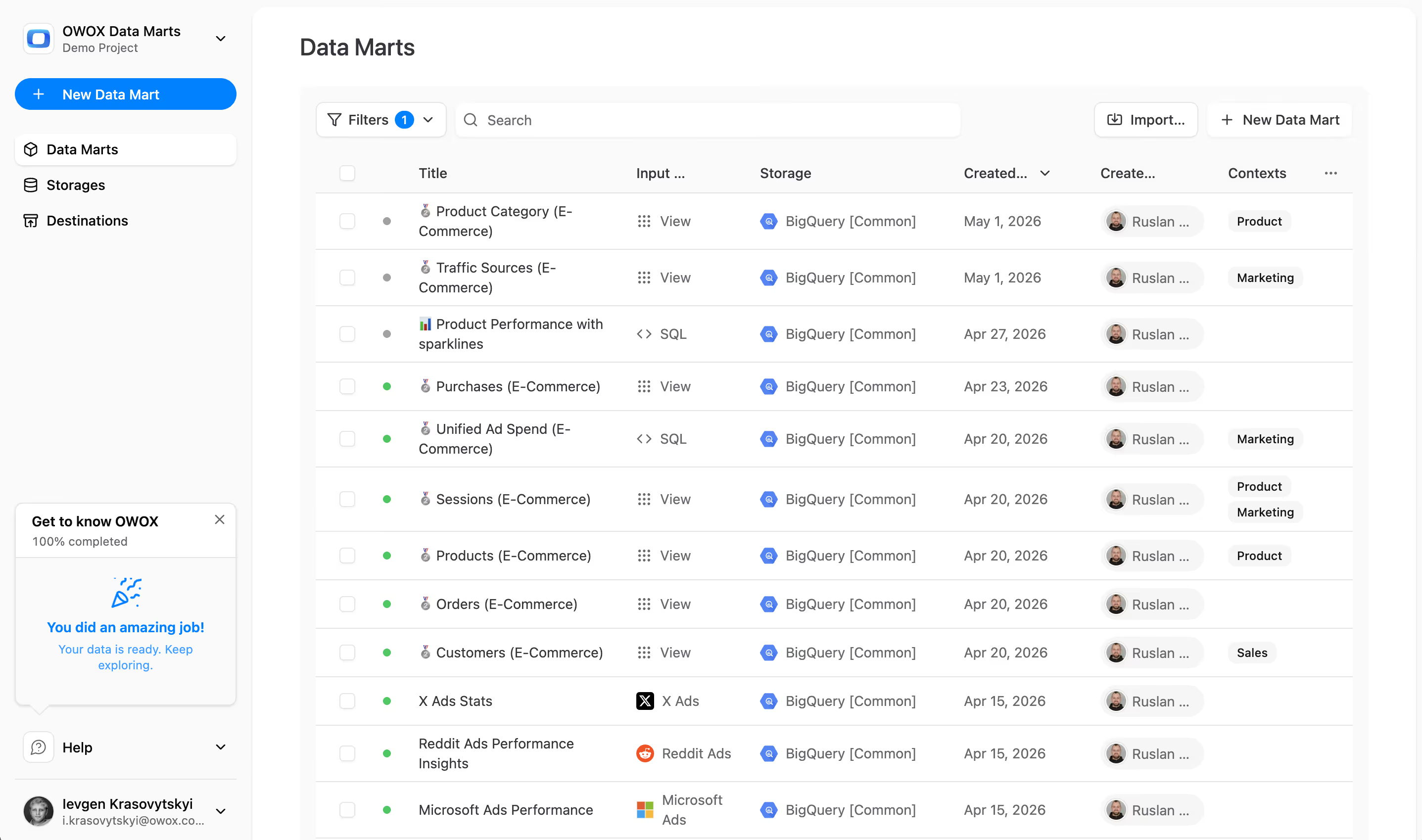
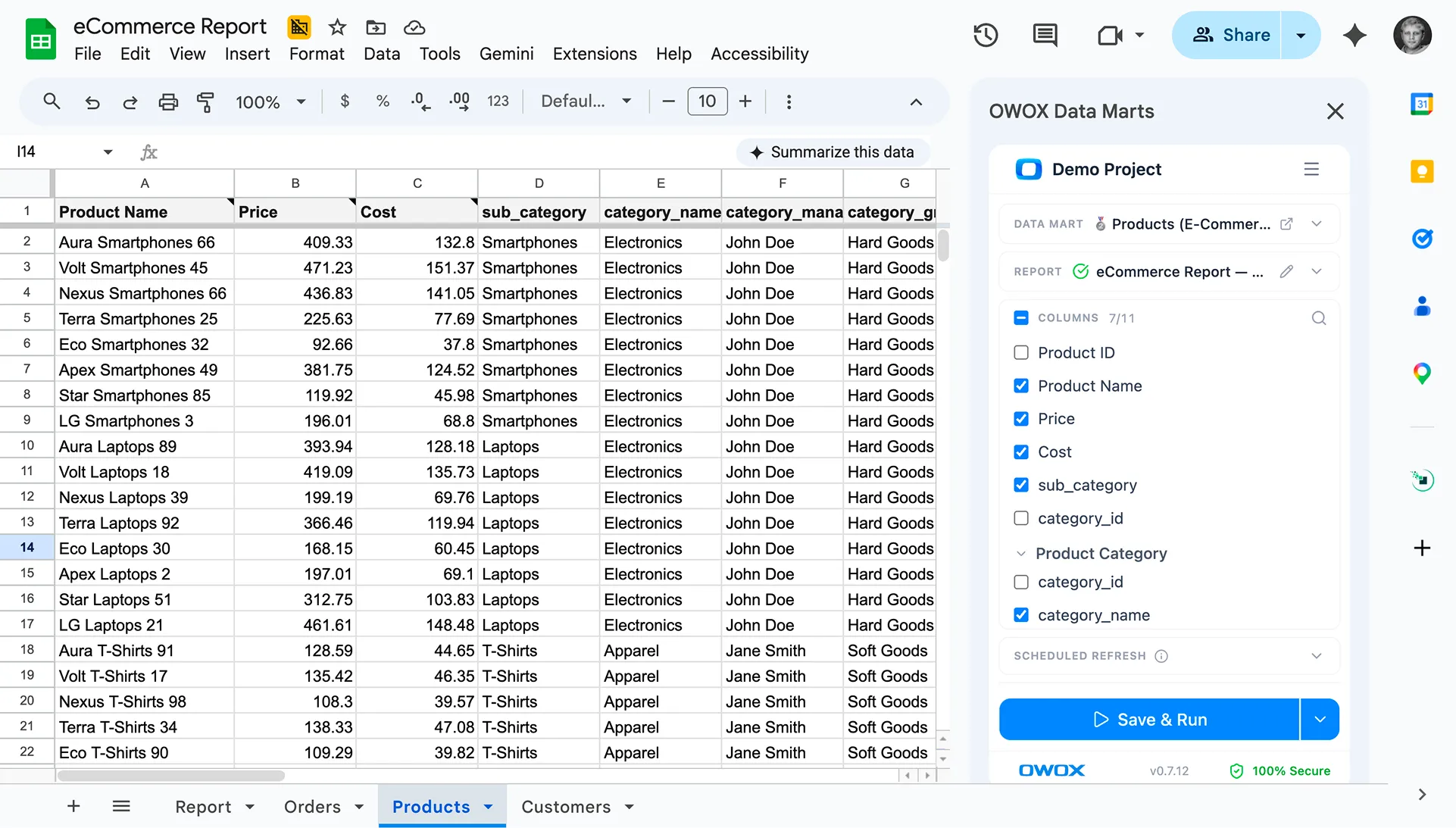
In a data mart, CAST AS STRING is part of the cleanup crew. It helps standardize dimensions, align keys across sources, and create dashboard-ready fields that behave consistently in reporting tools. Instead of fixing type issues in every new query, teams can resolve them once in curated models.
That is especially useful in marketing and analytics workflows where data comes from ad platforms, web events, CRM systems, and revenue tables all at once. String casting helps turn mismatched source fields into stable reporting dimensions, readable labels, and export-safe identifiers.
Want fewer last-minute fixes in reporting? Build cleaner text-ready dimensions and standardized keys in OWOX Data Marts. It is a practical way to prepare warehouse data for dashboards, exports, and analysis without repeating the same casting logic everywhere.
%202.png)



"AI by its nature will hallucinate. You need guardrails so you can trust your data."
"We had six or seven different channels and no single source of truth. It was almost impossible"
"We regained time. And time is the one resource that never comes back."