

What Is CAST AS TIME in SQL?
CAST AS TIME in SQL converts a value into a time-only field, keeping hours, minutes, and seconds while dropping the date so analysts can filter, group, and report on time of day consistently.
What is CAST AS TIME in SQL?
When analysts work with timestamps, raw strings, or imported logs, they often need just the clock time. That is where CAST AS TIME comes in. It turns a compatible value into the TIME data type, making the result easier to compare across rows, dashboards, and transformations.
Basic idea of CAST and TIME data type
CAST is a standard SQL expression used to change one data type into another. With CAST AS TIME, the target type is TIME, so SQL keeps the time portion of the input and removes the date portion if one exists.
A TIME value usually represents hours, minutes, and seconds. Some databases also support fractional seconds. This is useful when you want to analyze behavior by time of day rather than by full timestamp.
CAST vs CONVERT vs TIME() functions (high level)
CAST is the most portable and widely recognized option across SQL dialects. CONVERT can do similar work, but it is often more vendor-specific and may use different syntax or style options. Some systems also provide TIME() or related extraction functions that return the time component directly.
In practice, analysts often prefer CAST because it is readable and easy to spot in shared queries. But the exact choice depends on the database engine, input format, and whether you need strict conversion or more forgiving parsing.
CAST AS TIME Syntax and Parameters
The syntax is simple, but the behavior depends on the input value. A clean datetime usually converts smoothly. A messy string with inconsistent formatting may fail or require cleanup first.
General syntax with examples
The general pattern looks like this:
1CAST(expression AS TIME)
If expression is a datetime like 2025-03-10 14:23:45, the result is typically 14:23:45. If it is a string like '08:15:00', SQL attempts to interpret that string as a valid time.
Common examples include:
- Casting a timestamp column to show only time in reports
- Converting imported text fields into a standard time type
- Comparing event times against business-hour ranges
Vendor-specific nuances (MySQL, PostgreSQL, SQL Server, BigQuery – briefly)
MySQL supports CAST to TIME and also has a TIME() function that can return the time portion of a datetime expression. PostgreSQL supports standard CAST syntax and time-specific type casting with its own shorthand style as well.
SQL Server supports CAST and CONVERT, and both are common in production queries. BigQuery also supports CAST to TIME, but analysts should pay close attention to the input type and formatting, especially when working with strings and timestamps from multiple sources.
The big takeaway: the idea is consistent across vendors, but parsing rules and accepted formats can vary. Always test with real source values before locking the logic into production.
Practical Use Cases for Analysts
CAST AS TIME becomes powerful when you need a standard way to analyze time-of-day patterns without dragging full dates into every calculation.
Extracting time from datetime for reporting
Many event tables store full timestamps, but not every dashboard needs the date. If you are measuring when users most often start checkout, contact support, or trigger an app event, converting datetime to time makes the report cleaner.
This is especially useful for recurring patterns. A team might care that most purchases happen around lunch hours, not that they happened on a specific calendar date in the raw source table.
Normalizing string times from raw data
Raw exports are rarely perfect. CSV files, API payloads, and spreadsheet uploads may store time values as text. CAST AS TIME helps transform these values into a standard type that can be validated, compared, and reused in downstream models.
Before casting, analysts often trim spaces, replace separators, or rebuild the string into an expected format. Once standardized, the resulting time field becomes much safer for reporting logic.
Filtering and grouping by time of day
Time-only values are great for questions like:
- How many sessions start before 09:00?
- Which hour of the day gets the most support tickets?
- Do conversions spike during evening traffic?
By casting timestamps to TIME, you can filter on time ranges or group rows into hourly or minute-based buckets. That makes it easier to compare operational behavior across many dates.
Common Pitfalls and Edge Cases
CAST AS TIME looks straightforward, but a few sharp edges can break reports fast if you are not careful.
Time format mismatches and cast errors
The biggest issue is bad input format. A string like '9 PM' may not cast the same way as '21:00:00'. Some systems reject incomplete or localized formats entirely. Others may interpret them differently than expected.
That is why validation matters. Clean schemas, documented formats, and checks around source quality help prevent silent reporting problems. This connects closely to key constraints and data integrity in SQL, where structured rules help keep transformations dependable.
Time zone and date-loss gotchas
When you cast a timestamp to TIME, you lose the date. That sounds obvious, but it creates real analytical risks. Two events from different dates can end up looking identical if only the clock time remains.
Time zones make this even trickier. If your source timestamps are stored in UTC but your business reports in local time, casting before time zone adjustment can shift values into the wrong bucket. Always convert to the intended reporting zone first, then cast.
If those fields also contain sensitive scheduling or operational data, make sure transformation workflows follow the same protections used for data masking for sensitive fields in SQL.
Performance considerations when casting in WHERE and JOIN
Casting inside a WHERE clause or JOIN condition can hurt performance because the database may need to apply the conversion row by row. That can make indexes less useful and slow down large tables.
A common fix is to cast once during transformation and store the result in a dedicated column inside a model or mart. Then filters and joins can operate on the already-prepared field instead of repeating conversion logic in every query.
CAST AS TIME in Data Marts and Reporting
Once time-only values are cleaned and standardized, they become much easier to reuse in reports, metrics, and shared semantic layers.
Using time-only fields in dashboards and KPIs
Dashboards often need reusable dimensions like event time, order hour, or call start time. A dedicated TIME field supports charts that show activity by hour, service-level performance by shift, or conversion trends by daypart.
These fields are especially helpful in data marts where reporting tables are designed for stable reuse. Time-only columns can live alongside date keys and business entities, making them easier to join into fact and dimension models built on primary and foreign keys in SQL schemas.
Aligning CAST logic across transformations
Consistency is everything. If one team casts raw timestamps before time zone conversion and another does it after, the same KPI can produce different answers. That is chaos hiding in plain sight.
To avoid drift, teams often centralize conversion rules in shared transformation layers or reusable SQL logic. In many environments, that includes using stored procedures to standardize casting and data types so every report starts from the same assumptions.
CAST AS TIME Example Queries
Here are a few realistic ways analysts use CAST AS TIME in everyday SQL work.
Casting datetime to time in a SELECT
If you have a timestamp column called event_ts, you can extract the time portion directly in a query:
1SELECT
2    event_id,
3    CAST(event_ts AS TIME) AS event_time
4FROM
5    events;
This is handy when building exploratory reports or checking whether user activity clusters around certain hours.
Cleaning messy string times
Suppose a raw table stores values like ' 08:30:00 '. You may need light cleanup before casting:
1SELECT
2    CAST(TRIM(raw_time) AS TIME) AS clean_time
3FROM
4    staging_calls;
If formats vary more heavily, analysts may combine string functions, conditional logic, and parsing steps before the final cast. Tools can help speed that up too, especially when you generate and refactor SQL casting queries with ChatGPT.
Building hourly reports from event data
For an operations team, you might want to count orders by hour of day across many dates. One approach is to cast or extract the time portion and then bucket it into hours:
1SELECT
2    EXTRACT(HOUR FROM CAST(event_ts AS TIME)) AS event_hour,
3    COUNT(*) AS orders
4FROM
5    orders
6GROUP BY
7    event_hour
8ORDER BY
9    event_hour;
Example: an ecommerce analyst wants to know when checkout events peak so staffing and campaign scheduling can be adjusted. By standardizing timestamps into time-based buckets, the team can compare customer behavior across weekdays, promo periods, or device types without mixing in full timestamp noise.
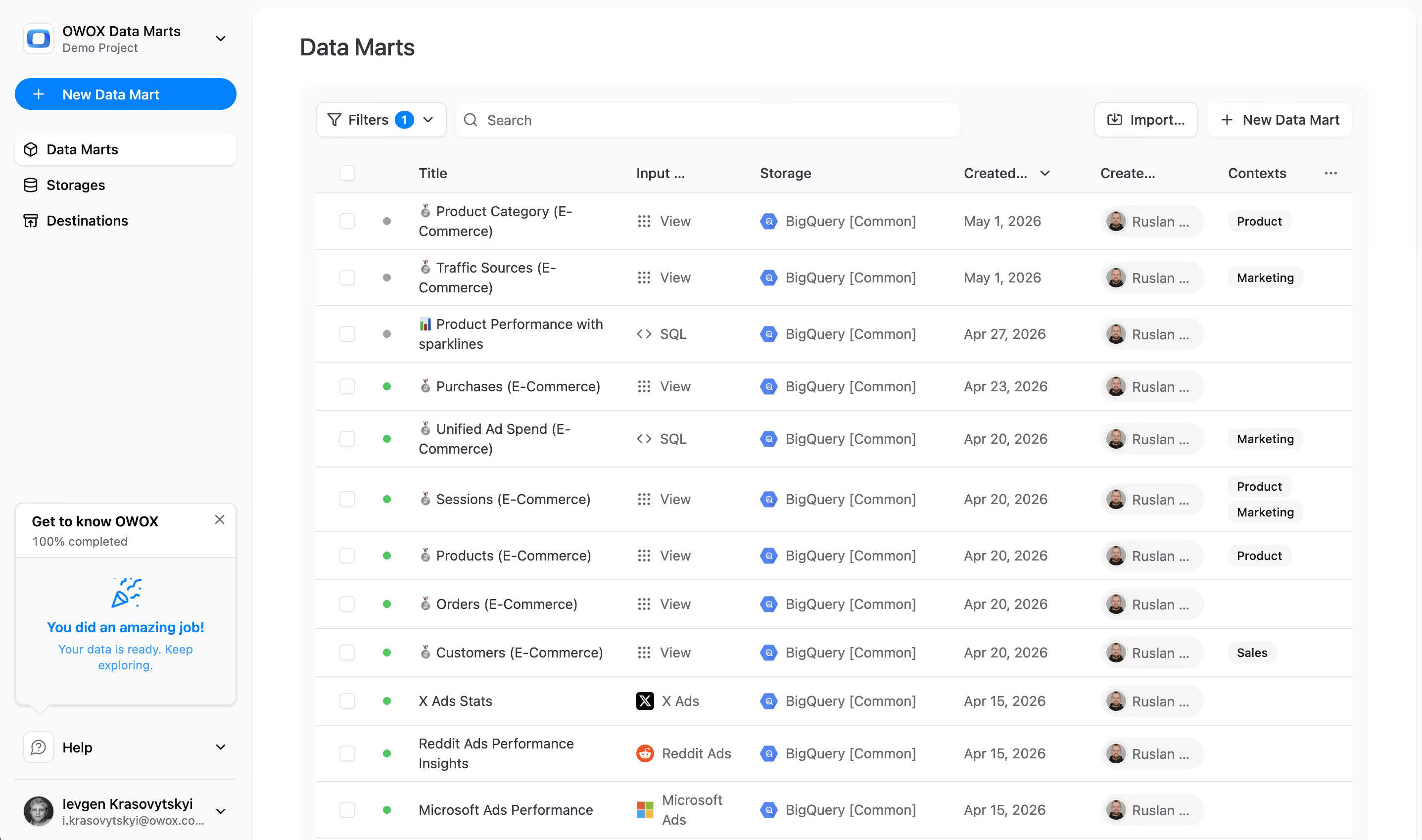
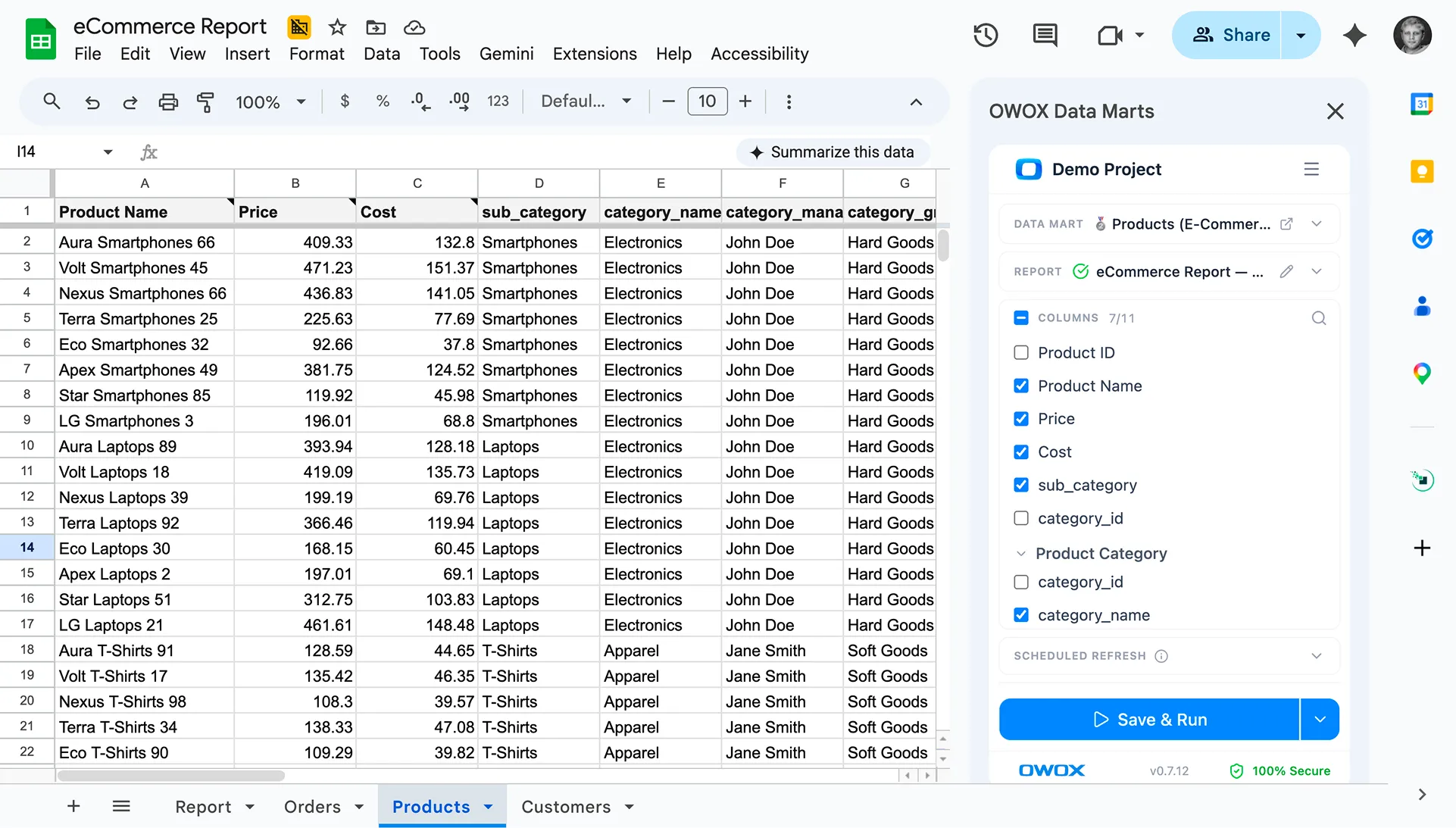
Need a cleaner place to standardize time fields, reporting tables, and repeatable SQL logic? Build it in OWOX Data Marts and keep your time-based transformations and reporting datasets consistent from source to dashboard.
%202.png)



"AI by its nature will hallucinate. You need guardrails so you can trust your data."
"We had six or seven different channels and no single source of truth. It was almost impossible"
"We regained time. And time is the one resource that never comes back."