

What Is CAST AS TIMESTAMP in SQL?
CAST AS TIMESTAMP is an SQL expression that turns a value like a text date, date field, or numeric time representation into a true timestamp, so analysts can work with consistent datetime data across queries, reports, and data models.
What is CAST AS TIMESTAMP in SQL?
Time data gets messy fast. One source sends 2024-01-31 14:05:00, another sends 01/31/2024, and a third stores only a date. CAST AS TIMESTAMP helps bring those values into one usable datetime type so SQL can compare, sort, join, and aggregate them correctly.
Basic idea of type casting
Type casting means converting one data type into another. In this case, SQL takes an existing value and tries to interpret it as a timestamp. That matters because a timestamp is not just text that looks like a date. It is a structured value that SQL engines can use for time logic.
For analysts, this is huge. Once a field is cast as a timestamp, you can filter sessions by hour, join ad spend to conversions by event time, calculate time between actions, and build cleaner reporting models. Without casting, time values often stay trapped as strings and behave like plain text instead of real time.
CAST vs TIMESTAMP literal vs CONVERT (high level)
CAST is the general-purpose, standards-based way to convert a value into a timestamp. A TIMESTAMP literal is different: it usually creates a fixed timestamp value directly in a query, such as a hardcoded datetime. CONVERT is another conversion function available in some SQL dialects, often with its own syntax and formatting rules.
In practice, analysts often prefer CAST because it is readable and portable. But exact behavior still depends on the database engine, especially when the source value has unusual formatting or includes time zone information.
Syntax and Common Variations
The core pattern is simple, but databases do not always agree on the details. That is where analysts need to stay sharp.
Standard SQL syntax: CAST(value AS TIMESTAMP)
The standard form looks like this:
1CAST(value AS TIMESTAMP)
The value can be a column, literal, or expression. If the database can interpret the input as a valid timestamp, the conversion works. If not, the query may fail or return an error, depending on the engine and function used.
This syntax is common in transformation queries, reporting layers, and data marts where multiple sources need to share one timeline.
Dialect-specific notes (BigQuery, PostgreSQL, SQL Server, etc.)
Different SQL dialects support CAST, but they may handle formats, time zones, and invalid inputs differently. BigQuery, PostgreSQL, and SQL Server all support timestamp conversion, yet they may also offer engine-specific parsing functions for more control.
Some platforms are strict about accepted formats. Others allow more flexible parsing or include safe-casting options that return null instead of failing. SQL Server users may also see CONVERT used often, while PostgreSQL and BigQuery teams frequently rely on CAST plus parsing functions when incoming strings are inconsistent.
The key point: CAST is familiar, but not universal in behavior. Always validate timestamp logic in the exact warehouse or database you use.
Input formats that usually work
Inputs that follow ISO-style datetime formats usually have the best chance of working cleanly. Examples often include values like:
2024-05-01 13:45:002024-05-01T13:45:002024-05-01when a date can be promoted to a timestamp
Problems usually start when strings are ambiguous, such as 05/01/2024, because the engine may not know whether that means May 1 or January 5. Timestamps with offsets, abbreviations, or nonstandard separators can also behave differently across systems.
Practical Use Cases for Analysts
This is where CAST AS TIMESTAMP stops being syntax trivia and starts doing real work.
Cleaning messy date strings from marketing platforms
Marketing exports are famous for mixed date formats. One file may store click time as text, another may split date and hour into separate fields, and a third may use a localized format. Analysts cast these values into timestamps so campaign data can be combined in one model.
That step is often part of a staging layer, where raw fields are standardized before they hit reporting tables. It turns “looks like a date” into “works like a date,” which is exactly what dashboards need.
Aligning time zones and truncating to date or hour
Once a value is a timestamp, it becomes much easier to align it to a common time zone or reduce it to the level needed for analysis. Analysts often cast first, then convert or truncate for daily, hourly, or session-based reporting.
This is especially useful when comparing activity across systems that log events in different zones. If one source uses UTC and another uses local account time, a consistent timestamp strategy prevents misleading spikes, gaps, or double counts.
Using CAST AS TIMESTAMP in joins, GROUP BY, and window functions
Joins based on time need matching data types. If one table stores event time as a string and another stores it as a timestamp, the relationship is shaky until the formats align. Casting makes time-based joins possible and more predictable.
The same goes for GROUP BY and window functions. Analysts cast event fields before grouping by hour, ordering user actions chronologically, or calculating lag between touchpoints. Time intelligence depends on timestamp integrity. No cast, no clean sequence.
Typical Pitfalls and How to Avoid Them
CAST AS TIMESTAMP is powerful, but it can also bite hard when source data is inconsistent or conversion happens too late in the pipeline.
Invalid date formats and parsing errors
If the input string does not match a format the database understands, the cast can fail. That usually happens with localized dates, mixed delimiters, missing time components, or impossible values. A field that contains both 2024-06-01 and 06/01/24 is asking for trouble.
The safest move is to standardize raw inputs before analysts rely on them downstream. Teams often automate this cleanup by using stored procedures to pre-cast timestamps and validate formats during transformation rather than inside every dashboard query.
Time zone surprises and implicit conversions
A timestamp may or may not include time zone context, depending on the system. That creates classic confusion: the value looks right in one tool and shifted in another. Some engines also perform implicit conversions behind the scenes, which can hide the problem until reporting goes live.
Analysts should define whether fields represent UTC, source-local time, or warehouse-local time, then document that choice. If timestamped fields contain personal or operationally sensitive activity data, consider data masking for sensitive timestamped data where access controls or privacy rules require it.
Performance considerations when casting on the fly
Casting inside every query can be expensive, especially on large event tables. When a database must repeatedly convert the same raw string column during joins and aggregations, performance can suffer.
A better pattern is to cast once in a staging or mart layer and store the cleaned timestamp as a proper field. That reduces repeated work and makes downstream SQL simpler. It also helps BI tools avoid complex logic in every chart.
Example: Using CAST AS TIMESTAMP in a Query
Here is what CAST AS TIMESTAMP looks like in a realistic analytics workflow.
Simple CAST example on a string column
Imagine a table where ad platform data lands with event time stored as text in a column called event_time_str. You can convert it like this:
1SELECT
2  event_time_str,
3  CAST(event_time_str AS TIMESTAMP) AS event_time_ts
4FROM marketing_events;
This gives you a timestamp field that can be sorted and filtered correctly. If you are moving fast and want help drafting this kind of logic, many analysts now generate SQL queries with AI assistance and then validate the final syntax in their own warehouse.
Casting inside a data mart or reporting query
Now picture a reporting query that joins ad clicks to conversions by hour. The clicks table stores text timestamps, while the conversions table already uses a timestamp type. In the mart layer, you cast the click time once, then group both sources to the same hourly grain before joining.
That approach keeps the reporting model stable. Instead of forcing every dashboard query to fix raw time data on the fly, the mart delivers one trusted event timestamp analysts can reuse across attribution, funnel analysis, and pacing reports.
CAST AS TIMESTAMP in Data Marts and OWOX Context
When data marts are built for analysis, timestamps need to be boring in the best possible way: standardized, predictable, and ready to use.
Why consistent timestamps matter in data marts
Data marts often combine sessions, orders, ad costs, CRM events, and product activity. If each source uses a different time format, every join becomes fragile. Consistent timestamps support cleaner relationships, more reliable aggregations, and less debugging.
This also connects to data model design. Stable time fields work better when your marts are structured with clear entity relationships and rules like key constraints in SQL and well-defined primary and foreign keys in SQL. Good timestamp hygiene strengthens the whole model.
How timestamp casting fits into analytics-ready datasets
Timestamp casting usually happens early: raw ingestion lands the source data, transformation logic standardizes time fields, and the final mart exposes trusted timestamps for analysis. That sequence makes dashboards cleaner and metric definitions easier to maintain.
For analysts, the win is simple. You spend less time fixing broken datetime fields and more time exploring trends, attribution paths, retention windows, and operational performance. CAST AS TIMESTAMP is a small expression with big warehouse energy.
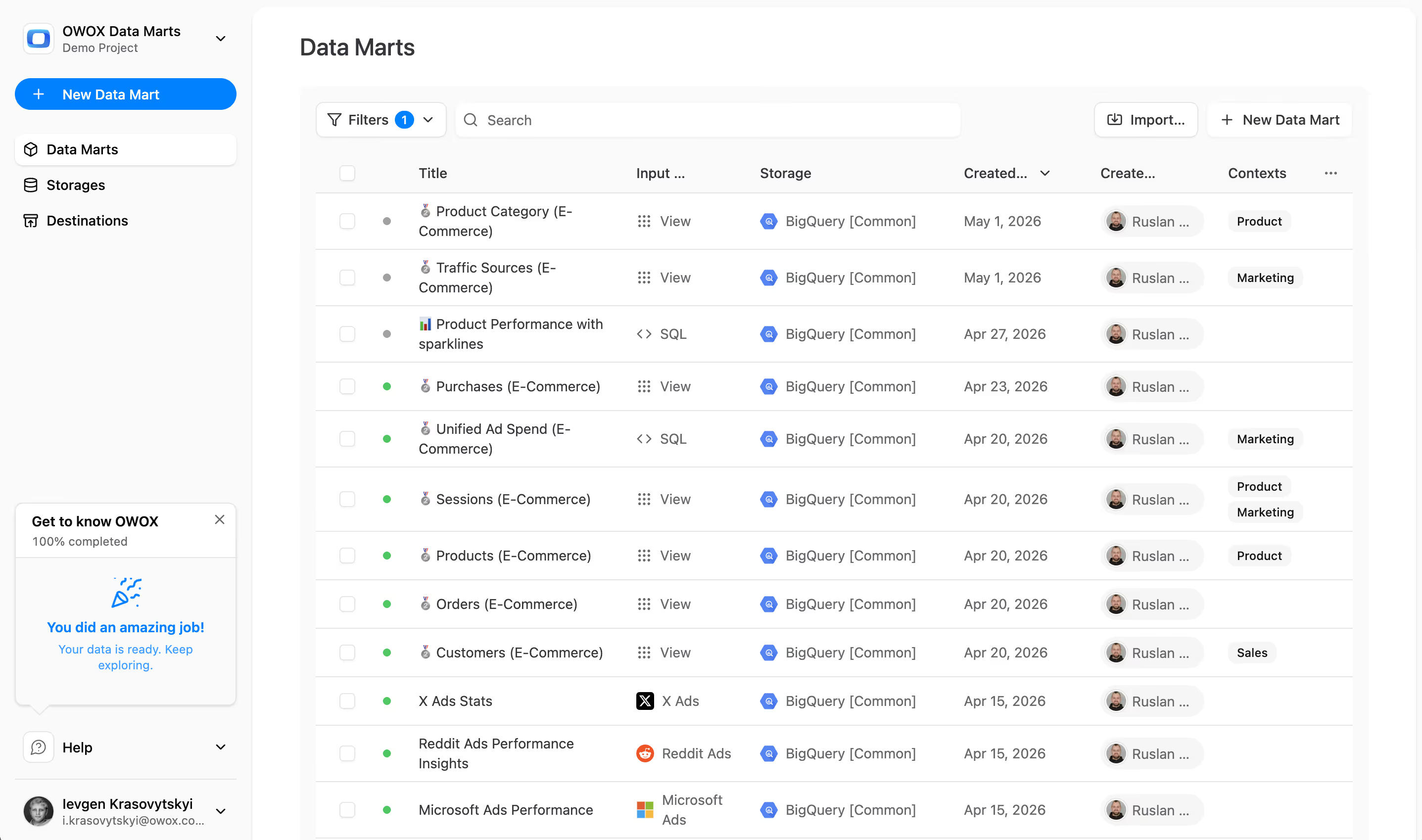
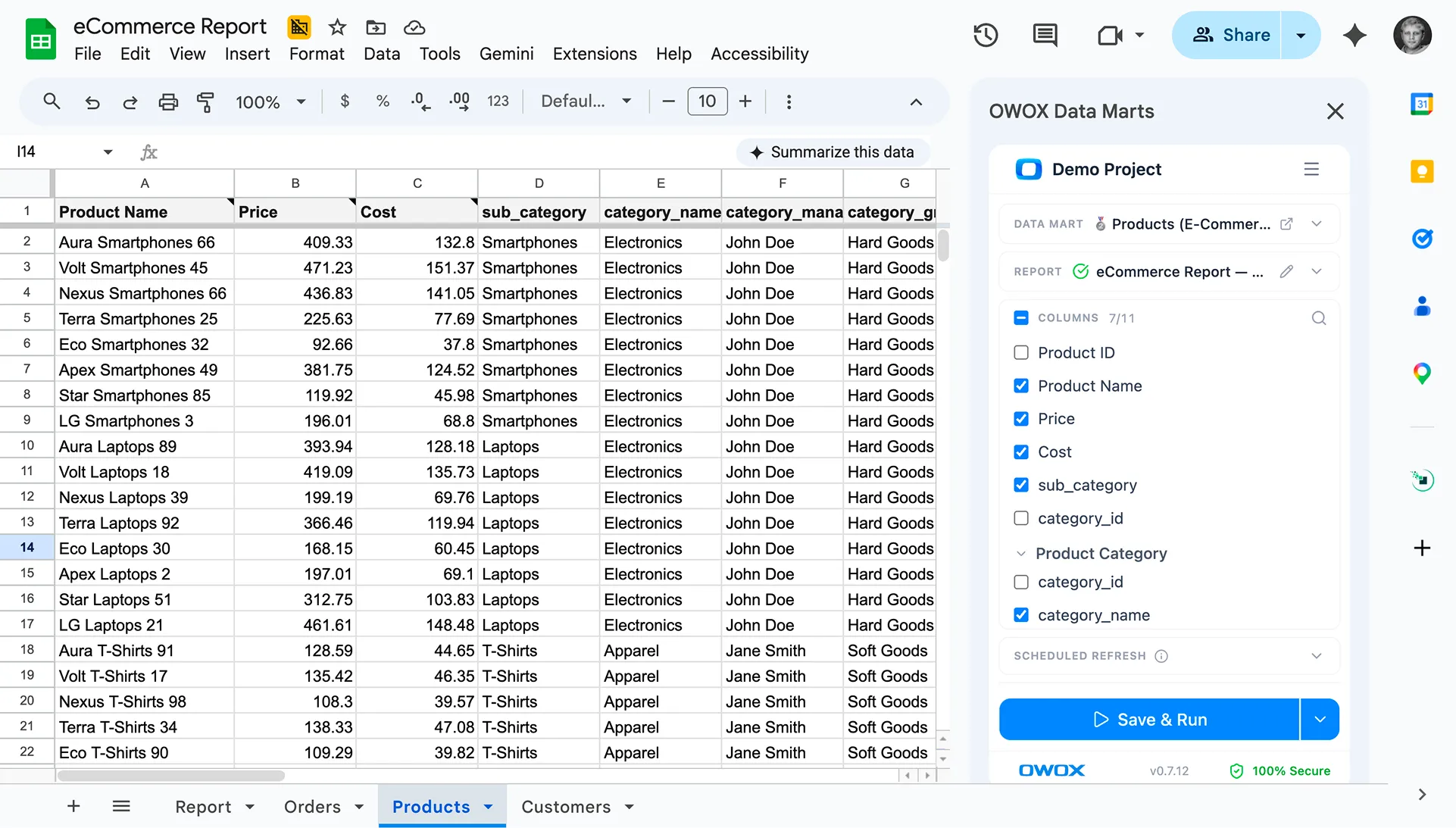
If you want cleaner, analytics-ready time fields without rebuilding the same logic in every report, explore OWOX Data Marts for faster data modeling and more reliable reporting workflows.
%202.png)



"AI by its nature will hallucinate. You need guardrails so you can trust your data."
"We had six or seven different channels and no single source of truth. It was almost impossible"
"We regained time. And time is the one resource that never comes back."