

What Is the CAST Function in SQL?
CAST in SQL is the function you use when a value is in the wrong format and needs to become the right one, like converting text into a number or a timestamp into a date so your query can work cleanly and return reliable results.
What is CAST in SQL?
CAST is one of those small SQL tools that does huge cleanup work behind the scenes. It changes a value from one data type to another so your database can treat it correctly in calculations, filters, joins, and reports.
Plain-language explanation
Think of CAST as a translator for your data. If a revenue field arrives as text like '199.99', SQL cannot always add it like a number until you convert it. If an event time includes hours and minutes but you only need the calendar day, CAST can turn that timestamp into a date.
This matters because databases store values with rules. Numbers behave differently from strings, and dates behave differently from timestamps. CAST tells SQL exactly how to interpret the value.
CAST vs data type compatibility
SQL expressions work best when the participating values are compatible. If one side of a comparison is numeric and the other is text, the database may throw an error, silently convert one value, or produce confusing results depending on the SQL dialect.
CAST helps remove that ambiguity. Instead of hoping the database guesses correctly, you define the intended type yourself. That makes logic more predictable and easier to debug, especially when source data comes from multiple systems with inconsistent schemas.
Why CAST matters for analysts
Analysts deal with messy inputs all the time: CSV imports, event logs, CRM exports, ad platform data, and warehouse tables built by different teams. CAST is often the difference between a dashboard that looks trustworthy and one that quietly lies.
Cleaning and standardizing data types
One table stores order IDs as integers. Another stores them as strings. A third stores dates as text. This is normal in real workflows, but it creates friction everywhere.
Using CAST during transformation helps standardize those values before analysis. That makes metrics easier to calculate and keeps downstream reporting more stable. It also supports stronger data modeling practices alongside data integrity constraints in SQL, where column types and relationships are expected to stay consistent.
Avoiding query errors and weird results
Without CAST, you can hit obvious failures like “cannot compare string to integer.” But even worse are the subtle issues. A sort on text values may place 100 before 20. A join may miss matching rows because one side is padded text and the other is numeric. An aggregate may skip values that never became valid numbers.
CAST reduces those surprises by making your intentions explicit. If a field should behave like a decimal, cast it. If a timestamp should be grouped by date, cast it. Fewer assumptions, fewer strange charts.
CAST vs implicit type conversion
Some databases try to help by automatically converting types when possible. This is called implicit conversion. It sounds convenient, but it can behave differently across SQL engines and can hide data quality problems.
Explicit CAST is safer because it documents your logic in the query itself. Anyone reviewing the SQL can see what type you expect and why. That makes maintenance easier and results more portable between platforms.
CAST syntax and common use cases
CAST is simple to write, which is probably why analysts use it so often. The basic idea is always the same: take a value and declare the type it should become.
Basic CAST syntax
The standard pattern is:
1CAST(expression AS data_type)
For example, you might cast a text field to an integer, or a timestamp field to a date. The exact data types available depend on your SQL dialect, but the structure is widely recognized across platforms. CAST is also common in transformations, views, and using CAST inside stored procedures when repetitive type cleanup needs to be automated.
Converting strings to numbers
This is one of the most common use cases. Marketing and product data often arrives as strings, even when the values are really numeric.
- Text revenue to DECIMAL for finance reporting
- Text quantity to INTEGER for order analysis
- Percentage strings to numeric values for calculations
Before casting, it is smart to check for bad input like empty strings, spaces, currency symbols, or nonnumeric characters. CAST cannot magically fix malformed values; it only converts values that fit the target type.
Working with dates and timestamps
Date logic gets messy fast, and CAST is often part of the cleanup. A timestamp includes date and time, but many reports only need the date. Casting can simplify grouping, filtering, and comparison.
For example, if you want daily sessions, daily sales, or daily ad spend, converting a timestamp to a date can make the grouping logic much cleaner. It also avoids mixing time granularity into a report where only the day matters.
Casting for joins and unions
Joins and unions require compatible column types. If two tables use different data types for the same business key, CAST can bridge the gap. That is especially common when joining legacy data with newer warehouse models.
Imagine one table stores customer_id as VARCHAR and another as BIGINT. A direct join may fail or behave inconsistently. Casting one side to match the other makes the relationship usable. This often appears in models built around primary and foreign keys, where type consistency is critical for accurate joins.
The same goes for UNION operations. If corresponding columns do not share compatible types, you may need CAST to align them before combining datasets.
Examples of using CAST in SQL
Here is a realistic analytics scenario. Say your ecommerce events table stores purchase value as text and event time as a timestamp, but your report needs daily revenue by date.
Formatting metrics for reporting
You might write something like this:
1SELECT
2    CAST(event_timestamp AS DATE) AS order_date,
3    SUM(CAST(order_value AS DECIMAL(10,2))) AS daily_revenue
4FROM
5    ecommerce_events
6WHERE
7    event_name = 'purchase'
8GROUP BY
9    CAST(event_timestamp AS DATE);
This query does two important things. First, it converts the timestamp into a date so records can be grouped at the day level. Second, it converts the order value from text into a decimal so SUM can calculate actual revenue.
This is exactly the kind of task analysts often speed up by using AI to generate SQL queries, then reviewing the generated CAST logic carefully to make sure the types match the warehouse schema.
Handling nulls and failed conversions
Not every value will convert cleanly. Blank strings, malformed dates, and unexpected symbols can break a CAST or produce nulls depending on the engine. Good practice is to clean the data before conversion or use conditional logic around suspicious fields.
For example, analysts may first replace empty strings with nulls, filter out invalid values, or separate questionable records into a QA dataset. That way, the final report is based on clean conversions instead of hidden failures.
The key idea: CAST is powerful, but it should be paired with validation. If the source type is chaotic, conversion alone is not enough.
CAST vs CONVERT and other type functions
CAST is not the only type conversion tool in SQL, but it is the most universal. Different databases offer additional functions that may support formatting options, safe conversion patterns, or shorthand syntax.
Standard SQL vs dialect-specific functions
CAST is part of standard SQL, which makes it a strong default choice when you want readable and portable queries. Other functions, such as CONVERT or engine-specific safe-casting helpers, may be useful in some systems, but they are not always transferable.
If your team works across multiple warehouses or frequently migrates queries, CAST keeps the logic easier to understand. It signals intent without tying the query too tightly to one dialect.
When not to overuse CAST
CAST solves type problems, but it should not become a bandage for broken modeling. If you cast the same columns in every dashboard query, that is usually a sign the data should be standardized earlier in the pipeline.
Overusing CAST can also make SQL harder to read and may affect performance if conversions happen repeatedly on large datasets. A cleaner fix is often to store values in the correct type in staging, transformation, or mart layers so analysts do less repair work at query time.
CAST in data marts and reporting
CAST is not just a query trick. It plays a real role in how clean, reusable reporting layers are built. In well-structured data marts, type consistency supports trusted metrics and smoother downstream analysis.
How CAST affects performance and storage
Frequent casting inside filters, joins, and aggregations can add processing overhead, especially on large tables. If a database must convert millions of values at runtime, queries may become slower than they need to be.
That is why many teams cast once during transformation and store the standardized result in a reporting-ready table. This can reduce repeated work and make dashboard queries simpler. It also helps when applying rules for data masking and protecting sensitive data, where consistent types matter for safe handling and controlled access.
OWOX Data Marts in real workflows
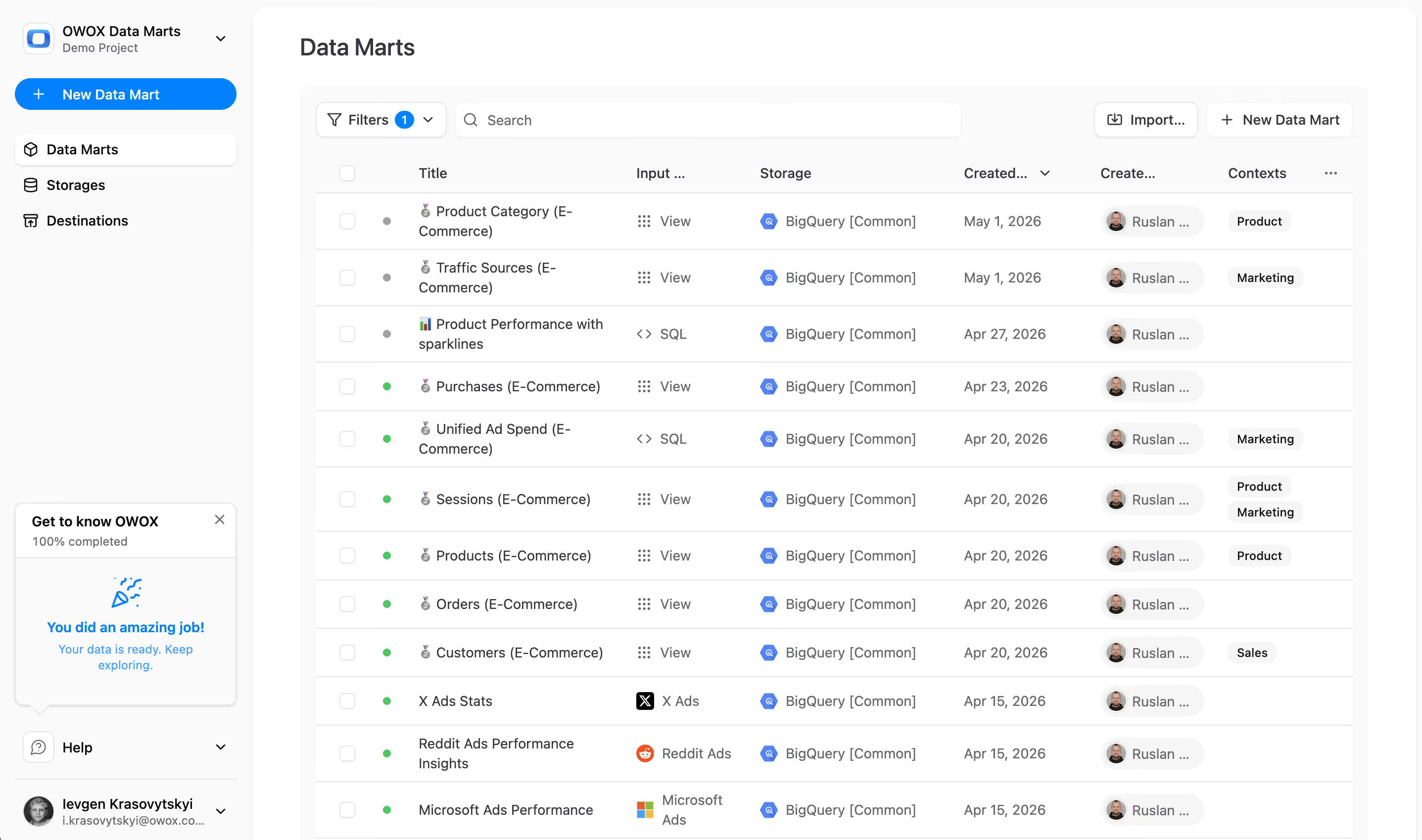
In real reporting workflows, CAST often appears during the step where raw data becomes analysis-ready. Event logs, ad costs, CRM updates, and order records may all arrive with different structures. Standardizing types in a data mart layer makes those sources easier to join, aggregate, and trust.
That means fewer last-minute fixes in BI tools, fewer duplicate calculations across teams, and more confidence that a metric means the same thing everywhere it appears. CAST is a small function, but in analytics workflows, it punches way above its weight.
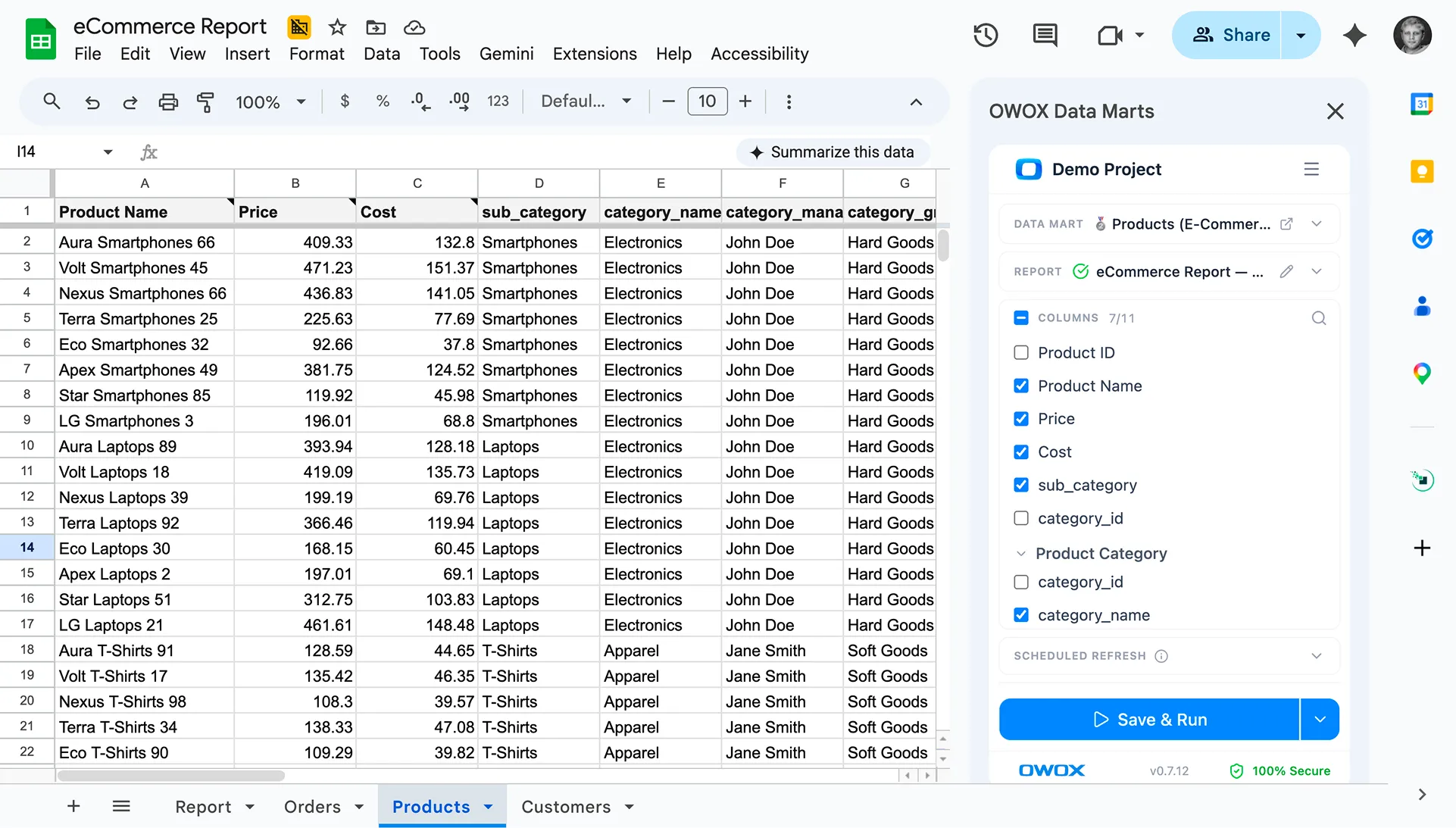
If you want a cleaner way to prepare reporting-ready tables, build data marts and standardize key metrics before they hit dashboards. Explore OWOX Data Marts to organize source data into analysis-friendly structures.
%202.png)



"AI by its nature will hallucinate. You need guardrails so you can trust your data."
"We had six or seven different channels and no single source of truth. It was almost impossible"
"We regained time. And time is the one resource that never comes back."