

What Is the CURRENT_DATE Function in SQL?
The CURRENT_DATE function in SQL gives you today’s date from the database server, without any time attached, making it a simple go-to for filters, reports, and date comparisons in analytics work.
What Is the CURRENT_DATE Function in SQL?
In analytics, a huge amount of reporting logic depends on knowing what “today” means at query runtime. That is exactly where CURRENT_DATE shines. It returns the current calendar date according to the database system, so you can build dashboards, recurring reports, and automated transformations without hardcoding a specific date.
Basic idea in plain language
Think of CURRENT_DATE as a built-in shortcut for “today.” Instead of manually updating a query every morning, you let SQL evaluate the current date for you. That makes it perfect for daily sales checks, campaign monitoring, data freshness validation, and period-based comparisons.
It is also one of those functions that helps keep SQL readable. When another analyst opens your query, CURRENT_DATE makes the intent obvious immediately. If you are building up your understanding of date logic alongside the key concepts of SQL and database design, this function is one of the essentials worth mastering early.
Typical return type and format
CURRENT_DATE usually returns a value of the DATE type. That means it contains only the year, month, and day, with no hours, minutes, or seconds.
The displayed format can vary by database or client tool, but it commonly looks like YYYY-MM-DD. What matters most is the data type, not just the way it appears on screen. Since it is a date-only value, it is often easier to use in business reporting than full timestamps when you only care about the calendar day.
CURRENT_DATE Syntax and Usage in Different SQL Dialects
The function is widely supported, but the exact syntax can differ a bit depending on the platform. That is where many analysts get tripped up, especially when moving between warehouses.
Standard SQL syntax
In standard SQL, CURRENT_DATE can often be used without parentheses. A simple query might select CURRENT_DATE directly or compare a date column against it in a WHERE clause.
The big advantage is simplicity. You do not need to pass arguments, and you usually do not need to cast the result if your comparison is already against a DATE field. It is meant to be immediate and convenient.
Common dialect differences (PostgreSQL, MySQL, BigQuery, etc.)
Different SQL engines follow slightly different conventions. PostgreSQL supports CURRENT_DATE directly and treats it as a date value based on the session setting. MySQL also supports CURRENT_DATE and often allows CURDATE() as an alternative. BigQuery supports CURRENT_DATE too, but it can also accept a timezone argument in some cases, which is especially useful for global reporting logic.
That means the idea is portable, but the details are not always identical. Some tools evaluate the date using the server timezone, while others let you be more explicit. If your team works across platforms, it is smart to confirm not only the syntax but also the timezone behavior before using CURRENT_DATE in production dashboards.
One more detail: many databases evaluate CURRENT_DATE once per query, not once per row. That is usually exactly what analysts want, because every row in the result set is compared against the same “today” value.
Practical Examples for Analytics and Reporting
This is where CURRENT_DATE stops being theory and starts doing real work. It is one of the most practical date functions in reporting SQL.
Filter rows for today’s data
A common use case is checking whether today’s data has arrived. For example, an analyst may want to review all orders loaded today or verify whether an event table contains records for the current date.
Example:
If your table has a DATE column called order_date, you might write a filter like: SELECT * FROM orders WHERE order_date = CURRENT_DATE;
If your table stores timestamps instead of dates, you may need to convert the timestamp before comparing it. That is often safer than assuming a timestamp equals a date directly.
This kind of logic is also handy when using CURRENT_DATE inside SQL stored procedures that automate routine checks, summaries, or data prep jobs.
Build rolling windows (last 7 / 30 days)
Rolling windows are analytics fuel. Whether you are tracking active users, ad spend, or revenue trends, you often need “last 7 days” or “last 30 days” relative to today.
A typical pattern is filtering rows where the date falls between CURRENT_DATE minus an interval and CURRENT_DATE. The exact interval syntax depends on the database, but the concept is the same: define a moving date range anchored on the current day.
- Last 7 days for campaign clicks
- Last 30 days for product revenue
- Last 14 days for retention checks
This is powerful because the query stays fresh automatically. No manual edits. No stale dashboards. Just a live rolling view of recent performance. If you want to speed up building this kind of logic, you can also generate and debug SQL date filters with AI and then validate them in your warehouse.
Compare current vs previous periods
CURRENT_DATE is also useful for period-over-period analysis. For example, you might compare revenue from the last 7 days with the 7 days before that, or today’s sessions with yesterday’s sessions.
A realistic analytics scenario would be a daily marketing dashboard that tracks conversions. You can define one range from CURRENT_DATE - 6 days through CURRENT_DATE, and another from CURRENT_DATE - 13 days through CURRENT_DATE - 7 days. That gives you a direct current-versus-previous comparison without hardcoded dates.
This is especially useful in automated BI reporting where stakeholders expect the comparison windows to move forward every day without anyone touching the query.
CURRENT_DATE vs Other Date/Time Functions
CURRENT_DATE is not the only date-related function in SQL, and choosing the wrong one can create subtle reporting bugs. The differences matter.
CURRENT_DATE vs CURRENT_TIMESTAMP / NOW
CURRENT_DATE returns only the date. CURRENT_TIMESTAMP or NOW usually returns the full current date and time. That means they solve different problems.
If you need calendar-based filtering, CURRENT_DATE is often the cleaner choice. If you need event-level precision, latency checks, or exact ingestion timing, a timestamp function is the better fit.
Using a timestamp where a date is enough can make filtering more complicated than necessary. It may force extra casting or truncation and can introduce confusion about whether the comparison includes time boundaries.
CURRENT_DATE vs local timezone functions
Some platforms offer functions that explicitly calculate the current date in a chosen timezone. That can be critical if your warehouse runs in one timezone while your business reports in another.
For example, a global ecommerce team may define “today” based on a business timezone rather than the warehouse default. In that case, a timezone-aware version of current date logic may be more accurate than plain CURRENT_DATE.
The key question is simple: whose “today” are you measuring? The server’s, the analyst’s, or the business unit’s? In international reporting, that answer changes everything.
Common Pitfalls and Best Practices
CURRENT_DATE is simple, but analytics environments are not. A few common issues can turn a straightforward date filter into a reporting headache.
Timezone and data warehouse considerations
The biggest pitfall is timezone mismatch. If your event timestamps are stored in UTC but your dashboard is expected to reflect a local business day, CURRENT_DATE might not align with the dates users expect. This can cause “missing” rows around midnight or incorrect daily totals.
It is also important to understand the relational structure of your analytical tables. Date filters often interact with joins, fact tables, and dimension tables, so one date condition can affect the entire shape of the result set.
Another consideration is governance. Some datasets include personal or regulated date-related information, so teams should handle sensitive date fields safely when building reporting layers and transformations.
Performance tips in large analytical queries
On large tables, performance depends less on CURRENT_DATE itself and more on how you use it. Comparing a raw timestamp column to a transformed expression can make queries harder to optimize. In many cases, it is better to avoid wrapping indexed or partitioned columns in functions if your platform relies on those structures for pruning.
A few practical habits help:
- Compare DATE columns directly to CURRENT_DATE when possible.
- Be careful when casting timestamp columns inside filters.
- Align your filter logic with partitioning or clustering rules in the warehouse.
- Test boundary behavior for “today” and “yesterday” around timezone cutoffs.
In short: keep the logic clear, keep the date boundaries intentional, and always validate with real data.
Where CURRENT_DATE Fits in OWOX Data Marts
In modern analytics workflows, CURRENT_DATE is a practical building block for recurring transformations, daily refreshes, and live reporting datasets.
Using CURRENT_DATE in scheduled transformations and reports
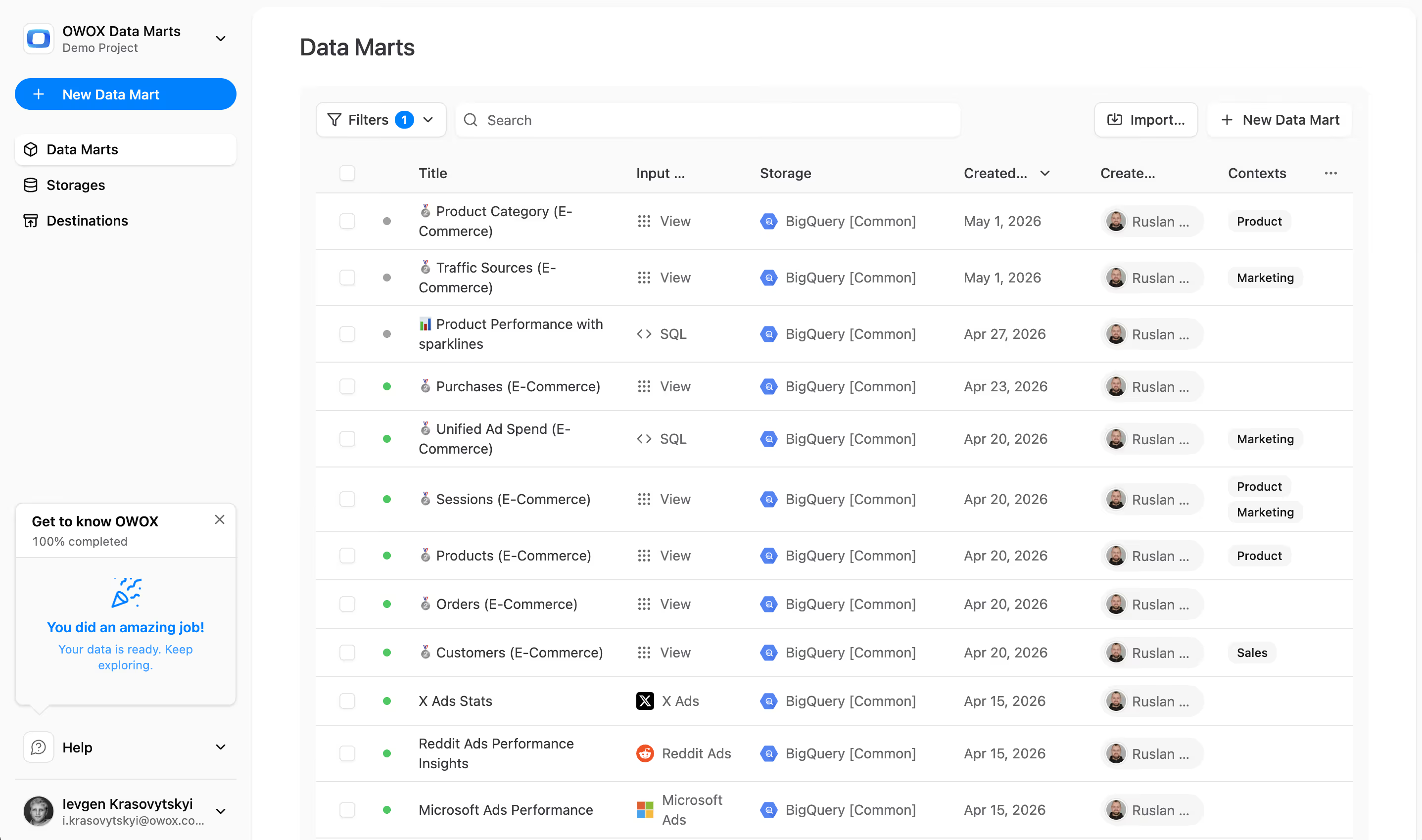
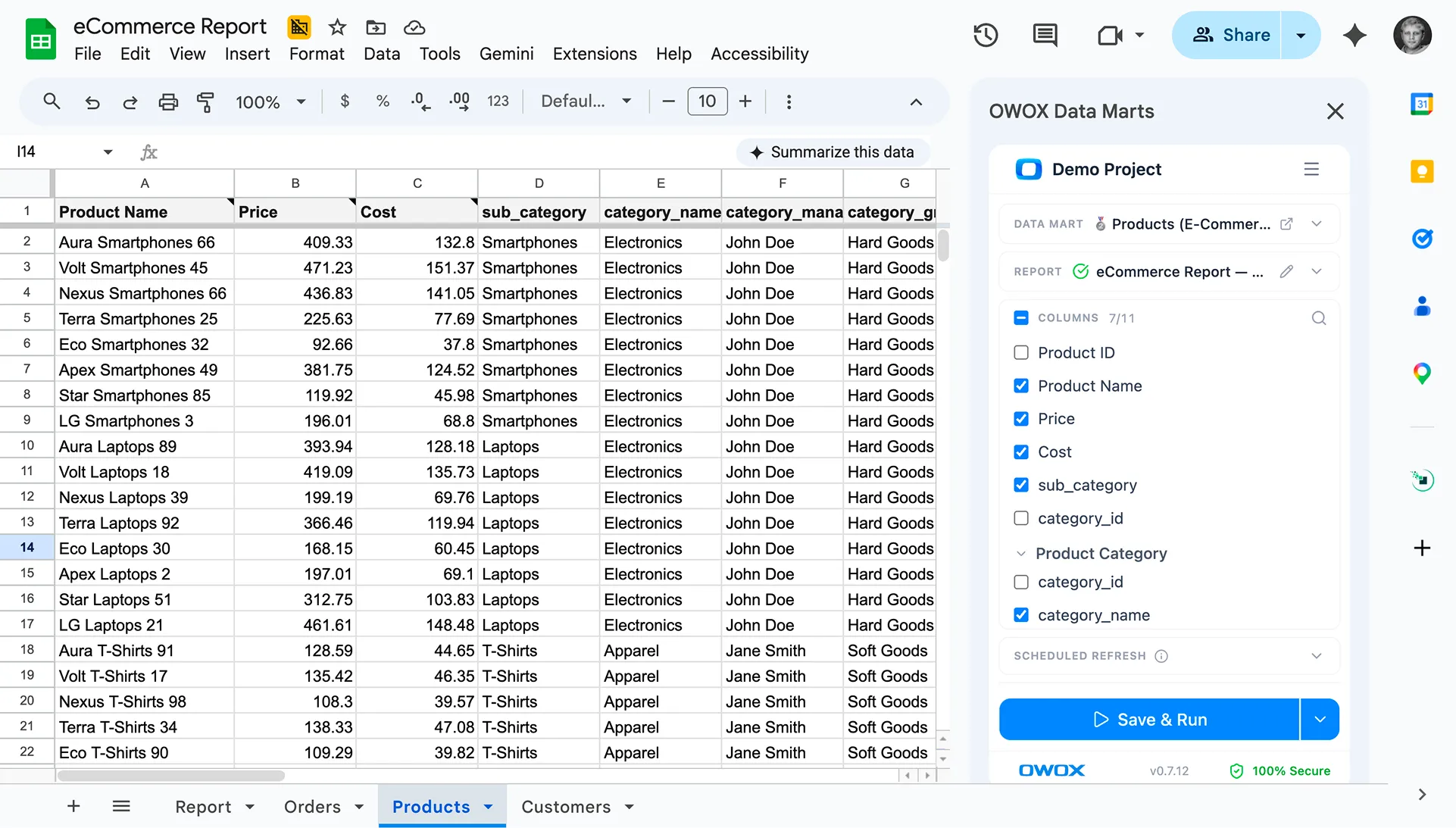
In OWOX Data Marts, CURRENT_DATE fits naturally into scheduled SQL logic that needs to stay dynamic over time. Analysts can use it to define rolling reporting windows, isolate today’s loads, or automate current-versus-previous period calculations without rewriting queries each day.
That is especially useful when reports are refreshed on a schedule and stakeholders expect them to reflect the latest complete business date. With clear date logic and consistent timezone handling, CURRENT_DATE helps keep recurring analytical workflows stable, transparent, and easy to maintain.
Want to make date-based reporting easier to manage? Build cleaner marts, scheduled transformations, and reusable reporting logic with OWOX Data Marts. Start organizing your SQL workflows and analytics reporting in one place.
%202.png)



"AI by its nature will hallucinate. You need guardrails so you can trust your data."
"We had six or seven different channels and no single source of truth. It was almost impossible"
"We regained time. And time is the one resource that never comes back."