

What Is Data Modeling for Business Reporting?
Data modeling for business reporting is the practice of organizing warehouse data so business teams can answer real questions with clear, consistent, and fast reporting.
What Is Data Modeling for Business Reporting?
Business reporting gets messy fast when raw data is pushed straight into dashboards. Data modeling brings order to that chaos. It defines how tables relate, what each metric means, and how reporting data should be shaped so teams can trust the numbers they see.
How data modeling differs from general database design
General database design usually focuses on storing operational data efficiently. Think transactions, app activity, updates, and system performance. Reporting models have a different mission: they are built to make analysis easier, not just storage cleaner.
That means a reporting model is structured around business questions such as revenue by region, campaign performance by channel, or retention by cohort. It often simplifies raw structures, combines sources, and creates analytics-ready tables. If you want a broader view of what data analytics is and how it turns raw data into insights, this is the layer where that transformation becomes usable for reporting.
Core goals: reliable KPIs, consistent logic, faster reports
A strong reporting model has three big goals. First, it makes KPIs reliable by giving every metric one agreed definition. Second, it keeps logic consistent across teams, so finance, marketing, and product are not all calculating “conversion” differently. Third, it makes reports faster by preparing data in structures BI tools can query efficiently.
When modeling is done well, dashboards stop being endless debates about which table is right. Analysts spend less time fixing broken charts and more time finding insights. That is the real power move.
Key Components of a Reporting Data Model
A reporting model is not just a pile of cleaned tables. It is a deliberate structure made of reusable building blocks that support recurring analysis.
Dimensions and fact tables
Most reporting models are built around dimensions and facts. Fact tables store measurable business events such as orders, sessions, clicks, shipments, or invoices. Dimension tables add context, such as customer, product, campaign, geography, or date.
This separation makes reporting flexible. You can slice one fact table by many dimensions without rebuilding the logic every time. It also reduces duplication and keeps dashboard filters meaningful.
Business metrics and calculation logic
Metrics are where reporting models either shine or break. A good model defines calculations clearly: revenue, gross margin, return rate, ROAS, active users, churn, and so on. It also makes the logic reusable, so each report is not reinventing formulas from scratch.
For example, “net revenue” may need to subtract refunds, discounts, and tax depending on the reporting goal. If that logic lives only inside one dashboard, confusion is guaranteed. If it is modeled centrally, everyone works from the same rules.
This is also where typical data quality issues that impact your models become impossible to ignore. Missing IDs, duplicate events, bad timestamps, and inconsistent naming can quietly destroy trust in reporting.
Granularity and time handling
Granularity means the level of detail in a table. One row per order is different from one row per customer per month. One row per ad click is very different from one row per campaign per day. Choosing the right grain is critical because it determines what questions the model can answer accurately.
Time handling matters just as much. Reporting models often need standard date dimensions, fiscal calendars, attribution windows, and rules for late-arriving data. If time logic is inconsistent, trend reporting becomes a battlefield.
Documentation and naming conventions
Even the smartest model fails if nobody understands it. Clear table names, field names, metric definitions, and relationship descriptions help analysts move faster and reduce reporting errors.
- Use names that reflect business meaning, not source-system mystery codes.
- Document metric formulas and exclusions.
- Define table grain explicitly.
- Keep naming patterns consistent across marts and domains.
Good documentation turns a model from “tribal knowledge” into a shared analytics asset.
Common Data Modeling Approaches for BI
There is no single perfect model for every team. The right approach depends on reporting needs, source complexity, and how self-service your BI environment needs to be.
Star schema and snowflake schema
The star schema is a classic BI favorite. It places a central fact table in the middle and connects it to dimension tables around it. This makes reporting logic easier to understand and often works well in dashboards.
A snowflake schema normalizes some of those dimensions into additional related tables. That can reduce redundancy, but it can also make querying more complex. In business reporting, star schemas are often preferred when simplicity and speed matter most.
Wide tables and semantic layers
Some teams use wide tables that combine many business attributes into one analytics-ready dataset. This can be convenient for fast dashboard building, especially for common use cases. The tradeoff is that wide tables can become harder to maintain as business rules evolve.
Another option is a semantic layer, where metrics and business definitions are standardized above the raw or modeled tables. This helps ensure that “orders,” “pipeline,” or “active customers” mean the same thing everywhere, even across multiple tools.
Event-based vs entity-based models
Event-based models are built around actions: page views, purchases, support tickets, deliveries, and so on. They are powerful for behavioral analysis and time-series reporting.
Entity-based models focus on business objects such as customers, products, accounts, or stores. They are useful for lifecycle reporting, master data analysis, and current-state views.
Many strong reporting environments use both. Events explain what happened. Entities explain who or what it happened to. Together, they create a fuller picture.
How Data Modeling Fits into the Analytics Workflow
Data modeling is not an isolated task. It sits in the middle of the analytics workflow and connects raw ingestion with business-facing reporting.
From raw data to prepared tables
Raw data is rarely ready for analysis on day one. It usually needs cleaning, deduplication, standardization, joins, and logic for missing values or broken fields. That preparation stage is the launchpad for useful modeling. If you want to go deeper into data preparation and structuring before modeling, this is where reporting quality starts getting real.
The underlying platform matters too. Many teams now build reporting on top of flexible storage patterns and modern data architectures like data lakehouses, where raw and curated layers can coexist.
Modeling as the bridge between storage and dashboards
Warehouses store data. Dashboards display data. Modeling is the bridge that makes those two worlds work together. It transforms technical source structures into business-friendly objects that BI tools can use without constant manual fixes.
This bridge also supports governance. It creates traceable logic from source fields to final metrics, which is why data lineage and how logic flows into final reports is so important in mature analytics teams.
Typical stakeholders: analysts, engineers, business owners
Reporting models usually involve multiple roles. Data engineers manage pipelines and transformations. Analysts define reporting needs, metrics, and usability. Business owners validate whether the model reflects real processes and decision-making.
The best models come from collaboration. If engineering builds without business context, the model may be technically sound but practically useless. If business teams define metrics without technical input, reporting may become inconsistent or hard to scale.
Examples of Data Models for Business Reporting
Different business functions need different reporting models, but the goal is always the same: make recurring analysis stable, trusted, and easy to use.
Marketing performance reporting model
A marketing model often combines ad spend, clicks, impressions, sessions, leads, and conversions. Common dimensions include campaign, channel, source, device, geography, and date. A fact table may store daily campaign performance, while dimensions provide campaign metadata and attribution groupings.
Example: a team wants weekly ROAS by channel. Instead of joining ad platform exports and conversion tables inside every dashboard, the model provides a prepared fact table at the grain of campaign by day. That makes reporting faster and keeps attribution logic consistent.
For teams working on retention and customer value reporting, this can extend into an example of building governed LTV models for reporting.
Sales and revenue reporting model
A sales model often includes opportunities, orders, invoices, payments, refunds, and customer accounts. Dimensions may cover sales rep, region, product, customer segment, and sales stage. The model needs clear rules for booked revenue, recognized revenue, and pipeline value because those are not interchangeable.
A realistic example might use one fact table for closed orders and another for monthly subscriptions, then standardize both into a reporting mart for executive dashboards. That avoids mixing one-time and recurring revenue in ways that distort trends.
Operations and supply chain reporting model
An operations model may track inventory movements, purchase orders, shipments, warehouse receipts, stockouts, and delivery times. Dimensions often include supplier, warehouse, SKU, carrier, and calendar.
The challenge here is usually timing and status changes. A shipment can be created on one date, dispatched on another, and delivered later. The model must reflect those process stages cleanly so teams can monitor delays, fulfillment speed, and inventory risk without confusion.
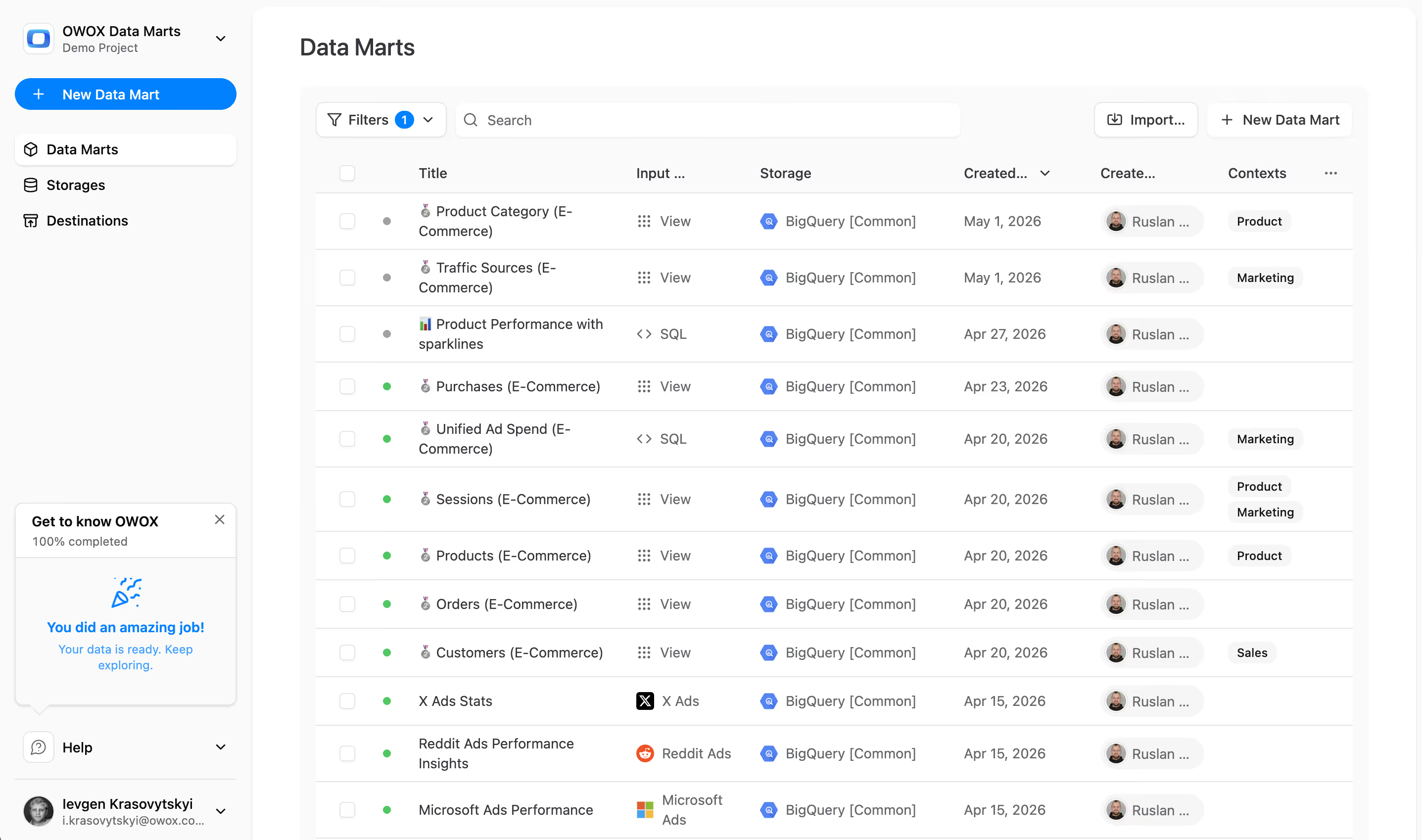
Data Modeling and OWOX Data Marts
Data marts become useful when they reflect the way the business actually reports, not just the way source systems happen to store records.
Why data marts are built on clear business data models
A data mart should not be a random subset of warehouse tables. It should be a focused reporting layer built around a clear business model for a domain such as marketing, sales, finance, or operations.
That means defining grain, relationships, dimensions, and metrics before dashboard building begins. With that foundation in place, teams get more reliable self-service analysis and fewer metric mismatches across reports.
How modeled data powers day-to-day reports and dashboards
Day-to-day reporting depends on consistency. Teams need the same KPI definitions in executive summaries, weekly check-ins, and deep-dive analysis. Modeled data makes that possible by giving dashboards stable, reusable inputs.
When the model is solid, reporting becomes dramatically less painful. Filters work as expected. Trends make sense. Stakeholders stop questioning every total and start acting on insights.
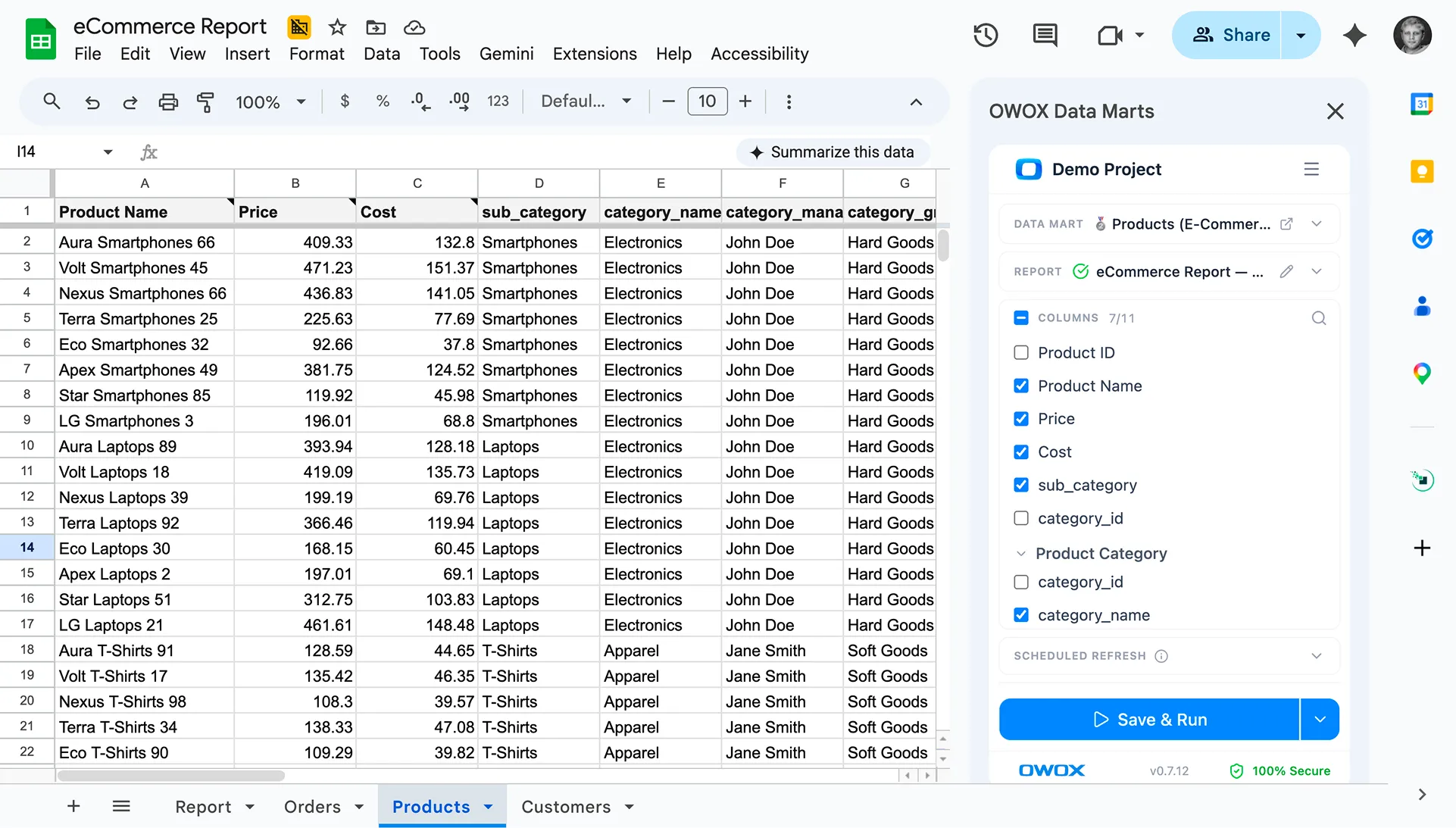
Want to make reporting easier to trust and faster to build? Explore how OWOX Data Marts can help you organize modeled data for everyday dashboards and more consistent business reporting.
%202.png)



"AI by its nature will hallucinate. You need guardrails so you can trust your data."
"We had six or seven different channels and no single source of truth. It was almost impossible"
"We regained time. And time is the one resource that never comes back."