

What Is the GENERATE_ARRAY Function in SQL?
GENERATE_ARRAY is a SQL function that builds a list of evenly spaced numbers between a start and end value, so analysts can create sequences on the fly for joins, testing, date offsets, and reporting logic without needing a physical helper table.
What is GENERATE_ARRAY in SQL?
GENERATE_ARRAY is a handy SQL function most often associated with Google BigQuery. It returns an array of numeric values based on a starting point, an ending point, and an optional step value. Instead of storing a separate table of numbers, you can create the sequence directly inside your query. That makes it fast to prototype, easier to debug, and super useful when building flexible analytics logic.
Where GENERATE_ARRAY is commonly used (e.g., BigQuery)
This function is commonly used in BigQuery, where arrays are a native part of the SQL workflow. Analysts often pair it with UNNEST to turn generated values into rows. In practice, that means you can create temporary ranges for reporting, produce helper dimensions, or drive calculations without depending on extra tables in your warehouse.
Basic idea: generate numeric sequences on the fly
The core idea is simple: you define a start, an end, and sometimes a step. SQL then returns a sequence like 1, 2, 3, 4, 5 or 0, 5, 10, 15. That sequence can stay as an array or be expanded into rows for filtering, joining, or filling in missing values. It is a small function with big energy because it removes friction from many repetitive analytics tasks.
GENERATE_ARRAY Syntax and Parameters
Before using it in dashboards, transformations, or ad hoc analysis, it helps to understand how the function behaves. Small details like step direction and NULL handling can completely change your result.
Standard syntax and arguments
The standard pattern is straightforward: GENERATE_ARRAY(start_expression, end_expression[, step_expression]). The first argument sets the first value in the array. The second sets the boundary. The third is optional and controls the spacing between values. If no step is provided, the function typically uses a default increment of 1.
This gives analysts a compact way to create sequences for test cases, simulated IDs, ranking logic, and offset calculations. It is especially useful when you need a quick numeric driver table without permanently creating one.
Inclusive vs. exclusive range behavior
One important detail: the generated range is inclusive when the sequence lands exactly on the end value. So if you start at 1, end at 5, and step by 1, the result includes 5. If the step does not land exactly on the boundary, the array stops before overshooting it.
This matters in reporting logic. A sequence from 0 to 10 by 3 returns 0, 3, 6, 9, not 12. Analysts should always check whether the final value is expected to be included, especially when using the output to create date offsets or scaffolding rows.
Supported data types and limits
GENERATE_ARRAY is designed for numeric sequences, so it is commonly used with integer-like and other numeric values depending on the SQL engine. In BigQuery workflows, it is best used when the sequence stays reasonably sized and purposeful.
The real limit is practical, not just technical. Very large arrays can make queries harder to read and more expensive to process once unnested. If you are generating thousands or millions of values just to support a simple report, that is usually a sign to rethink the design.
Common Use Cases for Analysts and BI Teams
GENERATE_ARRAY shines when you need structure fast. It helps turn rough logic into clean, repeatable query patterns that analysts and BI teams can reuse.
Creating numeric ranges for testing and debugging
Need ten sample values to test a CASE expression? Need a predictable range to validate window logic? GENERATE_ARRAY gives you an instant input set. Instead of depending on production data, you can create controlled sequences and verify how your SQL behaves under known conditions.
This is great for debugging calculations, checking thresholds, or building small proof-of-concept queries before applying logic to real tables.
Building helper arrays for UNNEST and JOINs
One of the most practical patterns is generating an array and then expanding it with UNNEST. That turns the sequence into rows you can join against other datasets. Analysts use this to build temporary lookup ranges, assign buckets, or connect generated rows to fact tables.
It can also help when working through structural logic tied to primary and foreign keys, especially when you want to simulate record relationships or test joins before introducing permanent schema objects.
Generating offsets for date and time calculations
Although GENERATE_ARRAY creates numeric values, those numbers are perfect for date math. For example, you can generate offsets from 0 to 29 and add them to a base date to produce a rolling 30-day range. This makes the function extremely useful for retention analysis, calendar expansion, cohort windows, and trend reporting.
Instead of manually listing offsets or maintaining a numbers table, you generate the needed range inside the query and let date functions do the rest.
Filling gaps or scaffolding result sets
Reporting often breaks when data is missing. If one day has no orders, some charts skip it entirely. A generated sequence can act as scaffolding, creating expected values first and then left joining actual data onto that structure. The result is a complete time series or complete bucket set, even when the source data is sparse.
This pattern is incredibly helpful for dashboards where consistency matters more than raw table shape.
Example: Using GENERATE_ARRAY in a Query
Let’s make this real with a simple analytics scenario: building a complete 7-day reporting window even if some days have no sessions.
Simple numeric sequence example
A basic query can return a numeric array directly, such as GENERATE_ARRAY(1, 5), which produces values from 1 through 5. If you set a step, like GENERATE_ARRAY(0, 20, 5), you get 0, 5, 10, 15, 20. This is the simplest way to create predictable values inside a query.
Using GENERATE_ARRAY with UNNEST
To turn those values into rows, analysts usually combine the function with UNNEST. That is where things get exciting. Once the array becomes rows, you can join it, filter it, or aggregate it like any other table-shaped result.
For example, you might generate numbers 1 to 7 and unnest them to create seven helper rows for a weekly report. If you want to move even faster when drafting this kind of logic, it can help to generate SQL queries with AI and then refine the output for your warehouse conventions.
Combining GENERATE_ARRAY with date functions
Here is a realistic BigQuery-style pattern for generating the last 7 calendar days:
1SELECT DATE_SUB(CURRENT_DATE(), INTERVAL day_offset DAY) AS report_date
2FROM UNNEST(GENERATE_ARRAY(0, 6)) AS day_offset
3ORDER BY report_date;
This creates a clean list of dates from today back to six days ago. You can then left join session, order, or ad spend data to those dates so the final report includes every day, even when a metric is zero. That is a classic BI move: build the expected frame first, then layer the facts onto it.
Tips, Pitfalls, and Performance Considerations
GENERATE_ARRAY is lightweight, but like any powerful helper, it can create messy queries if used carelessly. A few guardrails keep it fast and readable.
Avoiding huge arrays and unnecessary scans
The biggest mistake is generating far more values than the analysis needs. A short helper range is useful. A massive unnested array joined to large fact tables can explode row counts and slow everything down. Keep the generated range tight and aligned with the actual business question.
If the same sequence logic is reused often, consider wrapping it in a controlled pattern with using stored procedures in SQL or another reusable transformation layer.
Working with NULLs and edge values
Always validate your inputs. If start, end, or step values are NULL, the result may not behave as expected for your workflow. Edge cases also matter: a step that moves in the wrong direction can produce an empty result, and a zero step is typically invalid.
When generating helper values tied to sensitive datasets, make sure your query logic supports privacy-safe outputs too. This is especially relevant when test data or reporting layers involve data masking techniques in SQL.
Readability and maintainability best practices
Use clear aliases like day_offset, bucket_id, or seq_num so other analysts instantly understand the role of the generated values. Keep the generation logic close to where it is used, and avoid stacking too many nested functions in one line.
When a query relies on generated scaffolding, add enough structure that future maintainers can see why the sequence exists. Clean naming and simple boundaries make a huge difference when dashboards evolve over time.
GENERATE_ARRAY in Data Marts and Reporting
In reporting workflows, GENERATE_ARRAY often plays a support role rather than a starring one. But that support role is crucial because it helps make reports complete, consistent, and easier to automate.
How it fits into analytics and reporting workflows
Analysts use it to create temporary dimensions, fill timeline gaps, build metric buckets, and prepare data for chart-friendly outputs. In a data mart context, generated sequences can support transformations that standardize report structure before metrics reach BI tools.
It also fits naturally alongside warehouse design concepts like key constraints in SQL, because reliable reporting depends on both sound relational structure and smart helper logic inside transformations.
OWOX Data Marts context
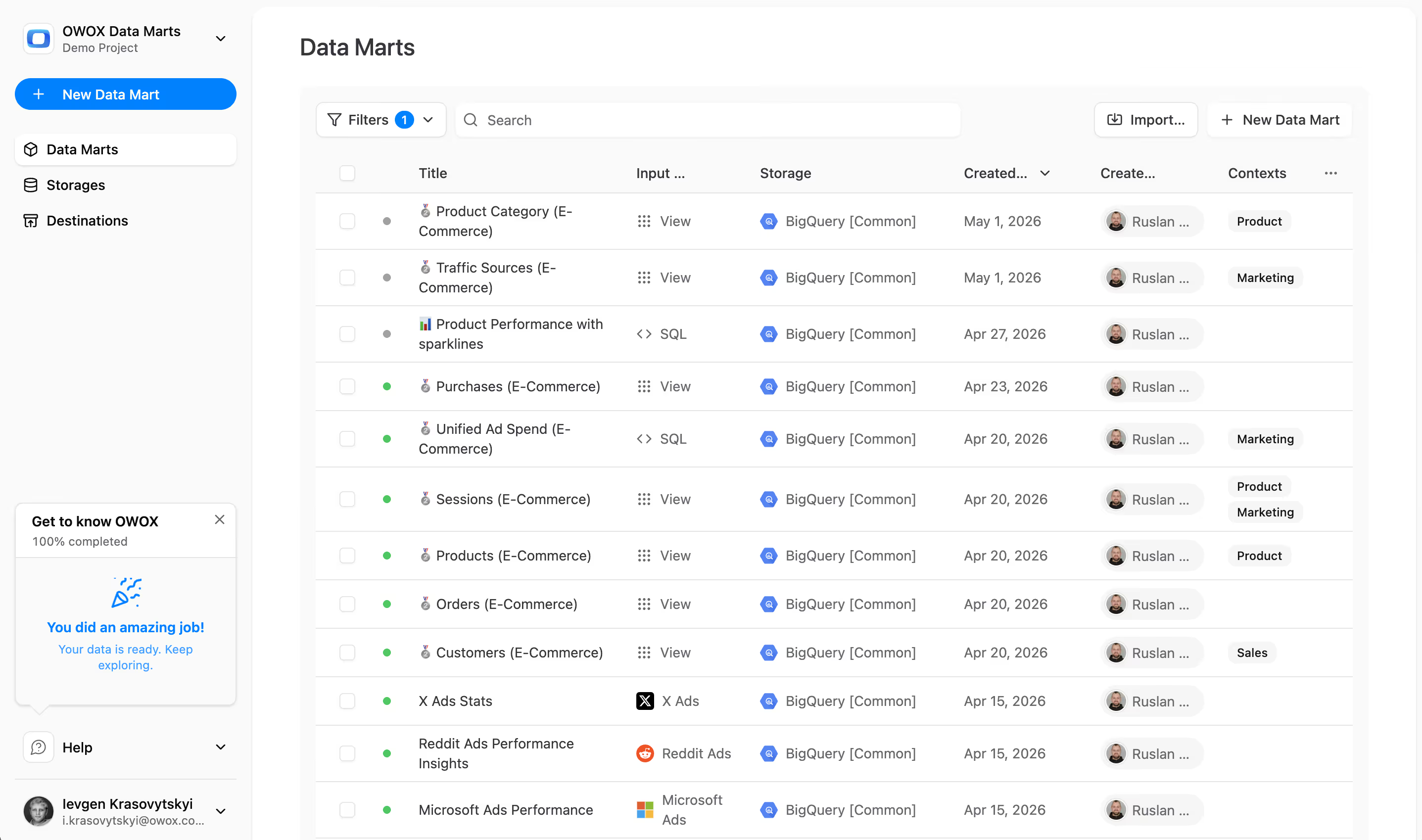
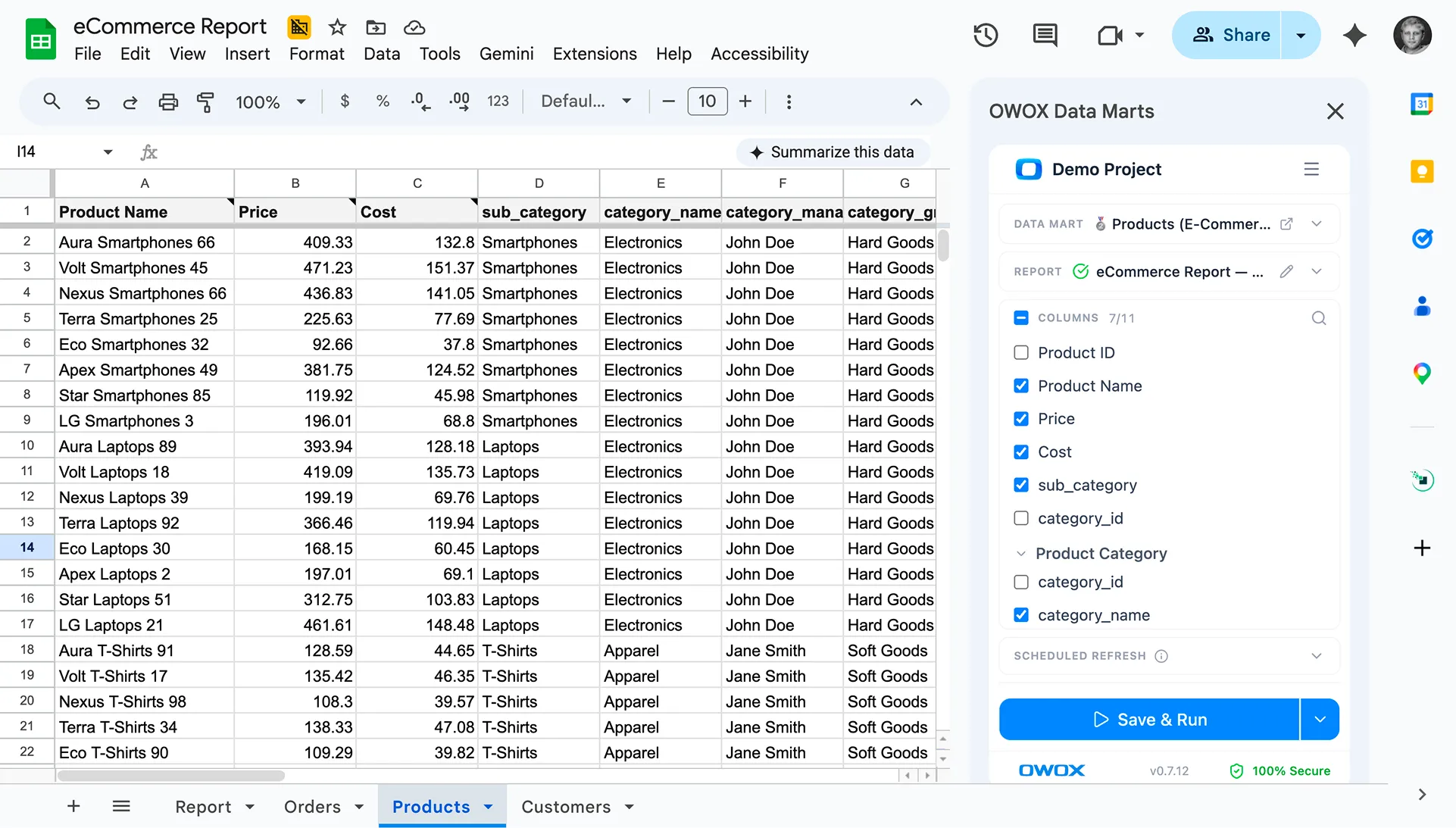
In OWOX Data Marts workflows, functions like GENERATE_ARRAY can help shape reporting-ready datasets without adding unnecessary physical tables. That is useful when analysts need quick scaffolding for date ranges, data completeness checks, or temporary helper sets during transformation design.
The function is not about flashy complexity. It is about building flexible, controlled logic that keeps reporting stable while staying close to the warehouse.
If you want to turn warehouse logic into cleaner data marts and faster reporting workflows, explore OWOX Data Marts. It is a practical way to organize analytics-ready data without overcomplicating the process.
%202.png)



"AI by its nature will hallucinate. You need guardrails so you can trust your data."
"We had six or seven different channels and no single source of truth. It was almost impossible"
"We regained time. And time is the one resource that never comes back."