

What Is Server-Side Tracking?
Server-side tracking is a way to collect analytics data by sending events from your own server to analytics or ad platforms instead of relying only on the user’s browser or app, which means more control, cleaner data, and fewer gaps when client-side scripts fail or get blocked.
What Is Server-Side Tracking?
At its core, server-side tracking changes where measurement happens. Instead of a browser firing every event directly to multiple tools, your backend or a tracking server receives the event first, processes it, and then forwards it where it needs to go. That extra step is a big deal for analysts because it creates a controllable layer between raw user activity and reporting systems.
Basic idea in plain language
Think of it like this: client-side tracking lets the user’s device talk directly to analytics platforms, while server-side tracking routes the conversation through your infrastructure first. When a user views a product, adds an item to a cart, or completes a purchase, that action can be captured by your application, validated, enriched, and then sent onward.
This setup is especially useful when browser restrictions, ad blockers, network issues, or script failures make client-side collection unreliable. It does not magically solve every measurement problem, but it gives data teams a stronger foundation to work from.
Server-side vs client-side tracking at a glance
Client-side tracking is usually faster to launch because tags run in the browser. But it can be fragile. Events may disappear if JavaScript breaks, cookies are restricted, or requests are blocked. Server-side tracking is more technical to implement, yet it often improves consistency because event handling happens in an environment you control.
- Client-side: easy to deploy, but more exposed to blockers and browser limits.
- Server-side: more setup, but better control over validation, routing, and enrichment.
- Client-side: useful for immediate UI interaction tracking.
- Server-side: powerful for transactions, subscriptions, lead events, and backend-confirmed actions.
How Server-Side Tracking Works Technically
Under the hood, server-side tracking is a pipeline. Events are generated, captured, transformed, stored, and distributed. For analysts, understanding that pipeline matters because reporting quality depends on every step working in sync.
Event flow: from user action to server to destination tools
A user performs an action, such as submitting a signup form or confirming a payment. Your application records that action and sends an event payload to a server-side endpoint. The server can then validate required fields, attach internal IDs, standardize timestamps, and forward the event to analytics, advertising, or warehouse destinations.
This flow creates a central event source. Rather than each destination tool receiving slightly different versions of the same action, the server can distribute one normalized version. That makes downstream comparison far less painful.
Key components: endpoints, queues, ETL, and APIs
Most server-side tracking systems include a few common building blocks. An endpoint accepts incoming event data. A queue may temporarily hold events to prevent data loss during traffic spikes. ETL or ELT logic transforms the data into a usable structure. APIs deliver the final event payloads to destination systems.
These components help analysts and engineers separate collection from reporting logic. If event routing changes, you do not necessarily need to redesign every dashboard. If a field needs cleaning, you can handle that in the pipeline rather than patching it in five different tools.
Where SQL enters the picture in your data pipeline
SQL becomes critical once events land in your warehouse. This is where raw payloads turn into reporting-ready tables. Analysts use SQL to flatten nested structures, deduplicate events, classify channels, map anonymous users to known customers, and create reusable models for marketing and product reporting.
Even if event delivery is handled by APIs and backend services, the truth is won or lost in warehouse logic. If your SQL transformations are sloppy, server-side tracking can still produce messy reporting. If they are solid, the pipeline becomes much more trustworthy.
Benefits and Limitations for Analysts
Server-side tracking sounds exciting because it gives teams more control. That hype is deserved. But analysts still need to understand where the gains are real and where the tradeoffs start creeping in.
Data quality, consistency, and attribution
The biggest win is often cleaner data. Server-side events can be validated before they are sent, which reduces malformed payloads and inconsistent naming. You can standardize event schemas, enrich records with backend context, and use the same logic across multiple destinations.
This also helps attribution analysis. If order confirmations are tracked on the server, they are less likely to be lost than browser-only purchase tags. That means fewer unexplained gaps between transaction systems and analytics reports.
Privacy, consent, and data governance
More control also means more responsibility. Server-side tracking can support stronger governance because teams can decide exactly which fields are forwarded, stored, or masked. Sensitive attributes can be removed or transformed before they enter downstream tools. If you are designing controls for event payloads, it helps to understand data masking for server-side event streams so privacy protections are built into the pipeline instead of bolted on later.
Consent handling still matters. Server-side tracking is not a shortcut around legal or policy requirements. Analysts need clear rules for which events can be collected, how identifiers are handled, and which destinations are allowed to receive them.
Common pitfalls: duplication, sampling, and data loss
The biggest traps are operational. Duplication happens when the same conversion is sent from both the browser and the server without proper deduplication logic. Data loss happens when retries fail, queues overflow, or event IDs are missing. Sampling can appear when downstream tools aggregate or restrict large event volumes.
Another common pitfall is assuming server-side means perfect. It does not. If timestamps arrive in mixed time zones, if user identity stitching is weak, or if schema versions drift over time, reporting will still break. The pipeline is stronger, but it still needs monitoring.
Using SQL With Server-Side Tracking Data
Once the events are in your warehouse, SQL becomes the engine that makes them usable. This is where analysts turn event streams into sessions, funnels, conversion tables, and channel-ready reporting models.
Designing warehouse tables for events
A strong event model usually includes event_id, event_name, event_timestamp, user_id, anonymous_id, source, platform, and a structured payload for event properties. Reliable schemas matter. Defining key constraints in SQL for reliable event schemas can help prevent bad joins and duplicate records, while using primary and foreign keys for event and user tables makes identity relationships easier to trust.
Some teams keep raw events in one table and create cleaned, modeled tables on top. Others partition by date and cluster by event name or user ID for faster reporting. The exact design varies, but consistency beats cleverness every time.
Joining server-side events to marketing and product data
The real power appears when event data connects to campaign spend, CRM records, subscriptions, or product catalog tables. A purchase event becomes far more valuable when joined to order margins, acquisition source, and customer lifecycle stage.
These joins often depend on disciplined transformation logic. Teams may use using stored procedures to process event data to standardize recurring steps like deduplication, session stitching, or revenue allocation across reports.
Typical SQL queries for reporting and debugging
Analysts typically write SQL to count event volumes by day, compare raw versus processed records, detect missing required fields, and calculate conversion rates. Debugging queries often look for spikes in null user IDs, duplicate transaction IDs, or event timestamp delays.
When teams need to move faster, they may also explore generating SQL queries for event analytics with AI as a way to speed up first drafts for validation and reporting logic. The key is still review: fast SQL is useful only if it matches the event model correctly.
Example: Simple Server-Side Tracking Workflow
Let’s make it concrete. Imagine an ecommerce team tracking completed purchases on the server after payment is confirmed. That means the purchase event is generated from backend order data, not just from a browser thank-you page.
Example event schema for a purchase event
A simple purchase event might include fields like event_id, event_name, event_timestamp, order_id, user_id, currency, revenue, tax, shipping, and source_channel. It could also include an array of items with product_id, quantity, and item_revenue. Because the event comes from the server, the order_id and revenue values can align more closely with the transaction system.
This structure makes it easier to compare warehouse events to finance or ecommerce records. If the purchase exists in the order database but not in the event table, you have a measurable gap to investigate.
Example SQL snippets for validation and reporting
A validation query might count distinct order IDs in the purchase event table and compare that to the orders table for the same date. Another query might flag duplicate purchases where one order_id appears more than once. For reporting, a daily revenue query could group purchase events by date and source_channel to show server-confirmed revenue by acquisition source.
Analysts might also write a debugging query that finds purchase events with null user_id values, or events arriving more than one hour after order confirmation. Those checks are simple, but they are exactly how trustworthy reporting is built.
Server-Side Tracking in Data Marts and Reporting
Raw events are useful, but decision-making usually happens in modeled tables. That is where server-side tracking delivers its biggest payoff for BI teams.
How server-side events feed analytics-ready Data Marts
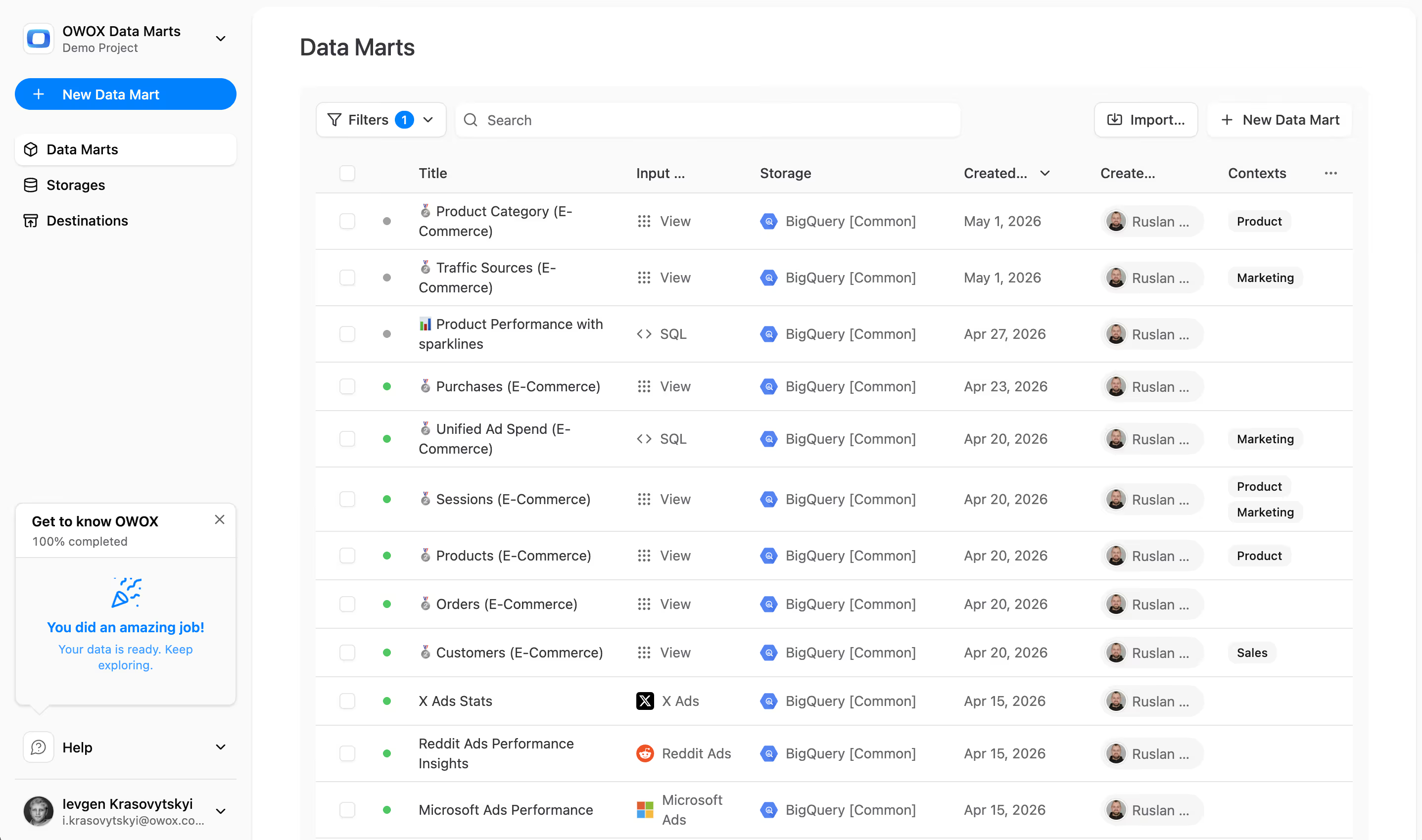
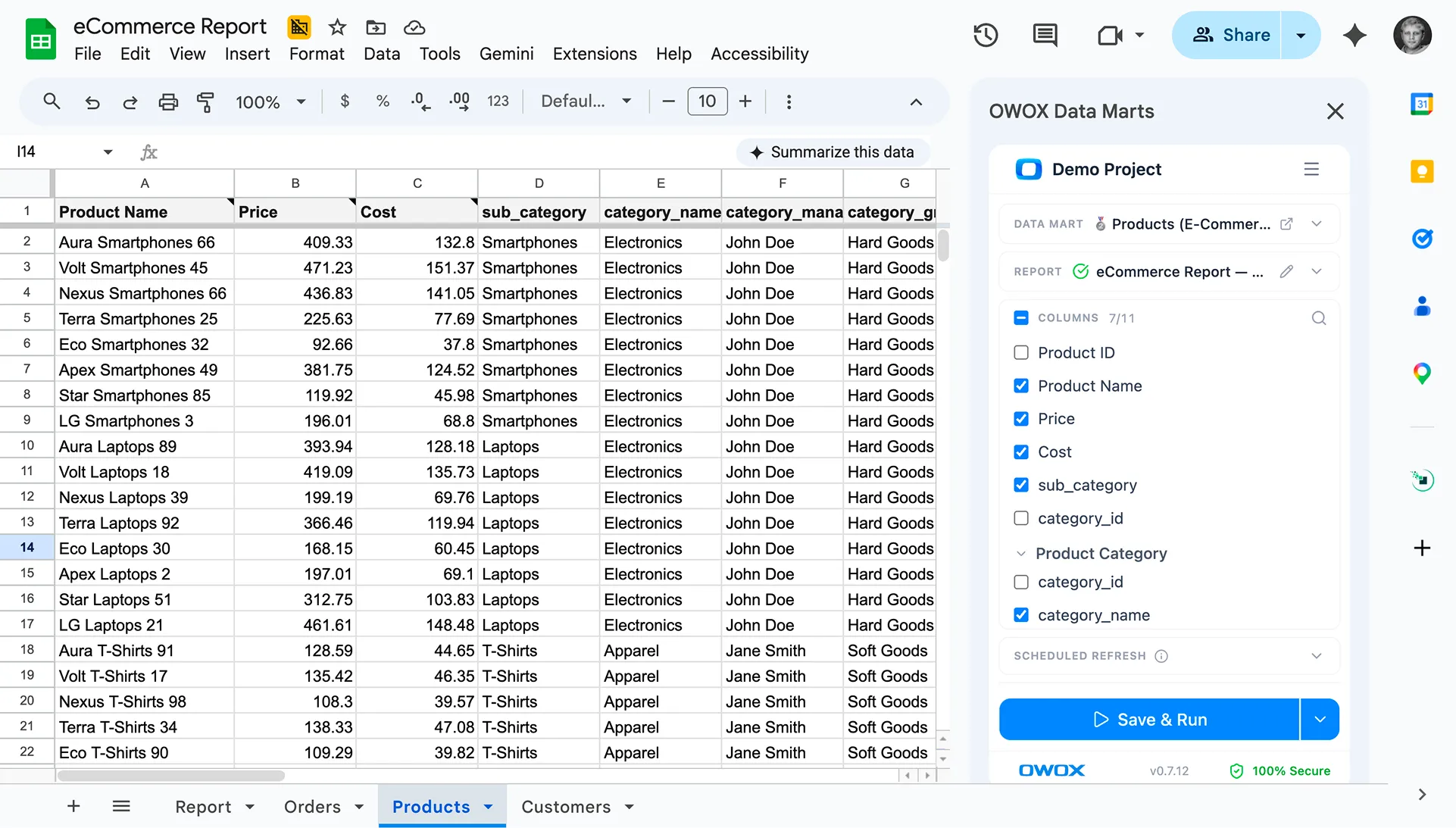
In a Data Mart, server-side events are transformed into business-friendly tables such as daily conversions, marketing attribution summaries, product funnel stages, or customer lifecycle snapshots. Because the source events are validated and standardized earlier in the pipeline, the resulting marts are usually easier to maintain and reconcile.
That means fewer last-minute dashboard fixes, fewer unexplained mismatches between tools, and more time spent on analysis instead of cleanup. Clean event inputs create reporting that can actually hold up under pressure.
OWOX Data Marts context: building reporting around clean event data
When teams build reporting around server-side event streams, the goal is not just to collect more data. It is to make that data analysis-ready: structured, governed, and connected to the metrics the business actually uses. That is exactly where Data Marts become practical, turning event logs into repeatable reporting layers for marketers and analysts.
Want to move from raw event chaos to reporting-ready structure? Explore OWOX Data Marts to organize server-side tracking data, build cleaner analytics reporting, and make warehouse events easier to use every day.
%202.png)



"AI by its nature will hallucinate. You need guardrails so you can trust your data."
"We had six or seven different channels and no single source of truth. It was almost impossible"
"We regained time. And time is the one resource that never comes back."