

What Is the TIME_DIFF Function in SQL?
The TIME_DIFF function in SQL measures how much time passes between two time or datetime values, letting analysts turn raw timestamps into usable durations like seconds, minutes, hours, or days.
What is the TIME_DIFF function in SQL?
TIME_DIFF is a practical SQL function for comparing two time-based values and returning the gap between them in a unit you choose. Instead of manually converting timestamps or subtracting values in messy ways, analysts use TIME_DIFF to calculate elapsed time directly in a query.
That makes it incredibly useful in analytics. You can measure how long a session lasted, how much time passed between a click and a purchase, how quickly a support ticket was resolved, or how late a delivery was. Anywhere you have event timestamps, TIME_DIFF helps transform them into something measurable and reportable.
Different SQL engines may use slightly different function names, argument order, or supported units. But the core idea stays the same: compare two points in time and return the difference in a format your analysis can use.
TIME_DIFF syntax and supported arguments
Before using TIME_DIFF in production queries, it helps to understand how the function is typically structured and what kinds of inputs it expects.
Basic syntax structure
A common pattern looks like this:
1TIME_DIFF(end_time, start_time, unit)
In this structure, the first two arguments are the values being compared, and the last argument defines the output unit. Depending on your SQL dialect, the exact order may vary, so always check the syntax used by your warehouse or database engine.
This is one of those situations where generating SQL queries with AI assistance can speed up drafting, but validation still matters. A query that looks right can still return incorrect durations if argument order or unit handling differs in your environment.
Supported data types and units
TIME_DIFF usually works with time, datetime, or timestamp values. In some systems, it can also be used with dates, especially when the desired result is in days. The most common units include:
- Seconds
- Minutes
- Hours
- Days
Some SQL engines also support milliseconds, weeks, months, or other granularities. Analysts should pay attention to input precision. If your data includes full timestamps with seconds or fractions of seconds, rounding behavior may affect the result.
It is also important to make sure both compared fields are in compatible formats. Comparing a time-only value with a full timestamp can lead to unexpected results or failed queries, depending on the platform.
Common pitfalls and edge cases
The biggest trap is reversed argument order. If the function expects end time first and start time second, flipping them may produce a negative value. Sometimes that is useful, but often it is just a hidden bug.
Another common issue is time zones. If one timestamp is stored in UTC and another is in local time, the calculated difference may be misleading. This matters a lot in cross-region reporting and event tracking systems.
NULL values are another edge case. If one side of the comparison is missing, the result is usually NULL too. Analysts often need COALESCE or filtering logic to avoid gaps in reports.
Finally, watch out for day boundaries and midnight rollovers when working with time-only values. A difference between 23:55 and 00:05 may not behave as expected unless the date context is included.
Practical use cases for TIME_DIFF in analytics
TIME_DIFF is one of those functions that shows up everywhere once you start looking for event timing patterns.
Session duration and user behavior
Web and app analysts often use TIME_DIFF to estimate session length by comparing a session start timestamp with a session end timestamp. This helps measure engagement, content consumption, and drop-off behavior.
You can also use it to calculate time between page views, time to first interaction, or delays between repeated actions. Those metrics are useful for understanding whether users move smoothly through a journey or get stuck.
When session logs contain sensitive timestamp details tied to user activity, teams may also apply data masking for sensitive timestamps before sharing outputs more broadly.
Funnel and conversion time lags
TIME_DIFF is perfect for funnel analysis. Analysts can compare timestamps from lead creation, first visit, checkout start, purchase, or subscription activation to see how long each stage takes.
This helps answer high-impact questions fast:
- How long does it take users to convert after their first visit?
- Which traffic source drives the fastest purchases?
- Where do long delays appear in the funnel?
Those time-lag insights can reveal friction that basic conversion rates miss. A channel may convert well overall but take much longer to close, which changes how marketers evaluate campaign quality.
Operational and SLA monitoring
Outside marketing analytics, TIME_DIFF is a workhorse for operations. Teams use it to measure ticket response times, order fulfillment delays, shipment processing windows, and resolution speed against SLA targets.
Because the result is numeric and easy to group, it fits neatly into service monitoring workflows. You can flag breaches, calculate average handling time, or compare actual durations with expected thresholds across teams, queues, or regions.
TIME_DIFF examples in SQL queries
Here is where TIME_DIFF becomes real: turning timestamp columns into metrics that analysts can sort, segment, and aggregate.
Calculating differences between timestamps
Example: imagine an ecommerce events table with cart_created_at and purchase_at. You want to measure how many minutes it takes users to complete a purchase after creating a cart.
A query pattern could look like this:
1SELECT
2  user_id,
3  TIME_DIFF(purchase_at, cart_created_at, MINUTE) AS minutes_to_purchase
4FROM orders;
This kind of calculation is common in behavioral analytics because it converts event sequences into a simple metric. You can immediately spot unusually fast or slow conversions, then segment by device, source, or campaign.
If the logic becomes part of repeatable transformation workflows, teams often explore using SQL functions inside stored procedures to standardize the calculation and reduce duplication.
Grouping and aggregating by time differences
Once you have a duration field, you can summarize it for reporting. For example, you might group users into buckets based on hours to convert, or calculate average fulfillment time by warehouse.
A simple aggregation pattern could be:
1SELECT
2  campaign_id,
3  AVG(TIME_DIFF(conversion_at, click_at, HOUR)) AS avg_hours_to_convert
4FROM campaign_events
5GROUP BY campaign_id;
This lets analysts compare speed, not just volume. A campaign with fewer conversions may still be valuable if it brings users through the funnel much faster.
You can also build duration bands such as 0 to 1 hour, 1 to 24 hours, or more than 24 hours. Those buckets are especially useful in dashboards because they make time-lag distributions easier to read at a glance.
TIME_DIFF in data marts and reporting
In reporting environments, TIME_DIFF often moves from an ad hoc query trick to a standard transformation used across teams.
Where TIME_DIFF usually appears in data models
TIME_DIFF commonly appears in fact tables, derived event models, session summaries, conversion tables, and operational marts where multiple timestamps exist for the same entity. It is often used to create derived fields such as session_duration_seconds, time_to_purchase_hours, or ticket_resolution_minutes.
For those calculations to stay trustworthy, the underlying data model needs clean joins and stable relationships. That is why concepts like key constraints and data integrity in SQL matter so much. If timestamps are linked to the wrong event or entity, the time difference metric becomes meaningless.
The same applies to model design with primary and foreign keys in SQL data models. Reliable keys help ensure start and end events are matched correctly before TIME_DIFF is applied.
How it supports BI dashboards and reports
In BI dashboards, TIME_DIFF powers trend charts, SLA scorecards, funnel timing views, and engagement summaries. Analysts use it to surface average duration, median delay, time-to-convert distributions, and threshold-based KPIs.
It is especially helpful because duration metrics are easy for stakeholders to understand. Saying a campaign generated 300 conversions is useful. Saying those conversions happened in an average of 2.4 hours adds speed, urgency, and process insight.
Well-modeled TIME_DIFF calculations also reduce dashboard complexity. Instead of repeating logic in every chart, teams can define duration fields upstream and reuse them consistently across reports.
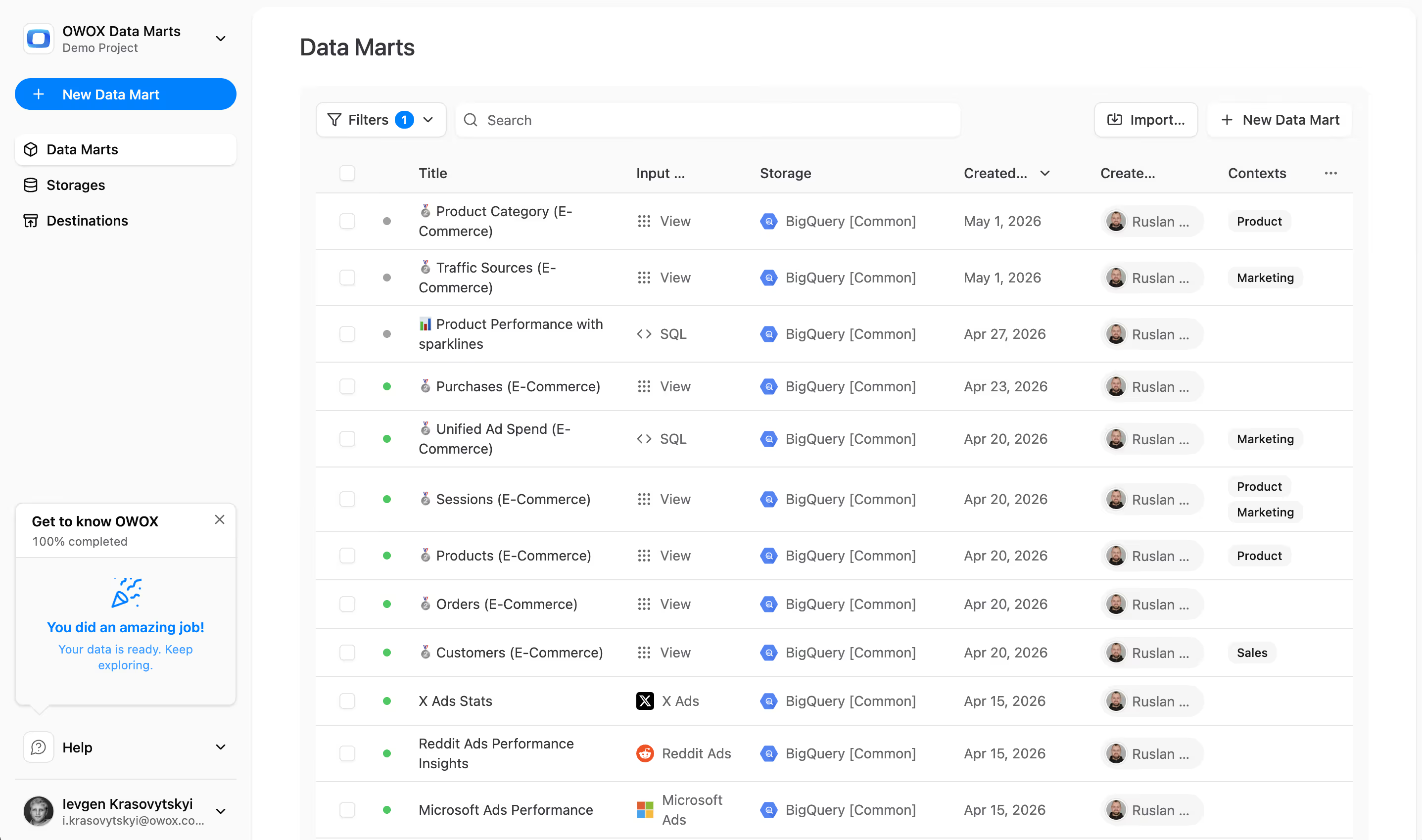
OWOX Data Marts context note
In a data mart context, TIME_DIFF is typically part of the transformation layer that turns raw timestamped events into analysis-ready metrics. It helps standardize how teams calculate durations across sessions, funnels, operations, and reporting models.
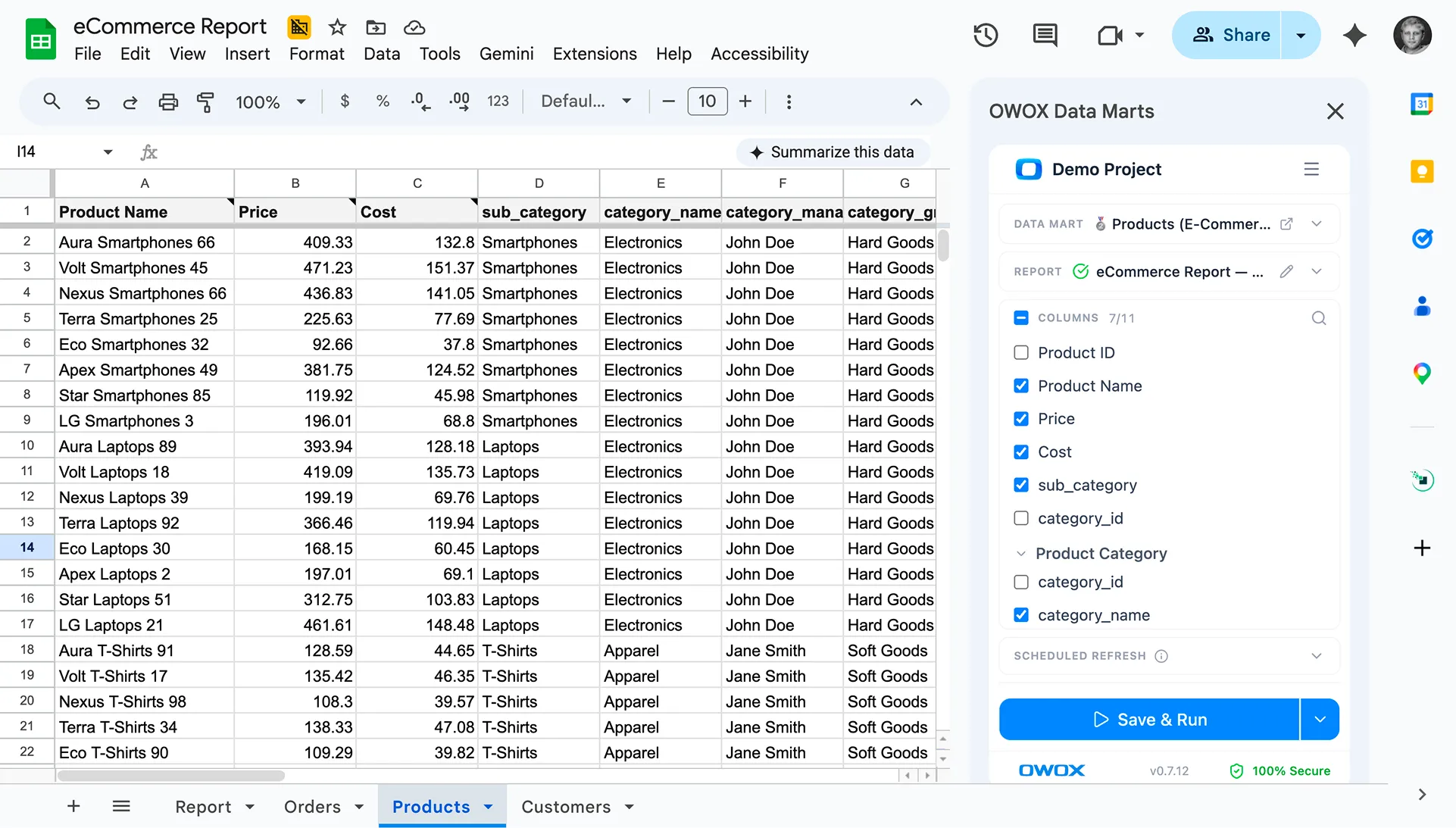
If you want to organize time-based metrics in one place, OWOX Data Marts can help centralize prepared datasets for reporting. Explore data marts, streamline recurring transformations, and make duration-based analytics easier to reuse across dashboards.
%202.png)



"AI by its nature will hallucinate. You need guardrails so you can trust your data."
"We had six or seven different channels and no single source of truth. It was almost impossible"
"We regained time. And time is the one resource that never comes back."