

What Is the UNNEST Function in SQL?
UNNEST in SQL is a way to take arrays or nested fields and turn them into regular rows, so analysts can filter, join, and aggregate semi-structured data with standard SQL.
What is UNNEST in SQL?
Modern analytics data is often messy in a very useful way. Instead of storing everything in one flat row, warehouses may keep lists of products, event parameters, tags, or attributes inside array-like fields. That structure is great for data collection, but not always great for analysis. That’s where UNNEST steps in.
Basic idea: turning arrays into rows
At its core, UNNEST expands a nested value into a row set. If one event contains an array of three purchased products, UNNEST can convert that one row into three rows, one for each product. Suddenly, product-level analysis becomes possible without manual parsing or awkward string logic.
This is the big unlock: data that was trapped inside a single record becomes queryable like a normal table. You can count items, group by attributes, filter specific values, and join them to dimensions.
Where you’ll see UNNEST in modern SQL warehouses
UNNEST shows up in analytical databases that support arrays, repeated fields, or nested record structures. It’s especially common in event-based schemas where one row may contain multiple items, parameters, or user properties.
Analysts run into UNNEST when working with clickstream events, ecommerce purchases, app telemetry, survey answers, and imported JSON-like data. If your warehouse stores rich events instead of fully flattened records, chances are high that UNNEST is part of your daily toolkit.
Why analysts use UNNEST
UNNEST is not just a syntax trick. It solves a real analytics problem: nested raw data is compact and flexible, but dashboards and ad hoc analysis usually need flat, row-level structures.
Flattening nested event data (sessions, products, attributes)
Many event tables include repeated elements inside a single event or session. A purchase event may have many products. A session may contain multiple traffic touchpoints. A user profile may include several interests or permissions. UNNEST breaks those collections apart so you can analyze each element separately.
This is huge for marketing and product teams because the most valuable insights are often hidden inside these repeated details, not the top-level event row.
Making arrays aggregatable and filterable
Without UNNEST, arrays are awkward to summarize. You can’t easily ask questions like “Which products appeared most often?” or “How many users have the attribute premium?” if those values live inside nested structures.
After flattening, standard SQL works again. You can use GROUP BY, WHERE, COUNT, SUM, and joins just like you would on any other table. That’s what makes UNNEST so powerful: it turns semi-structured data into analysis-ready rows.
Typical UNNEST use cases in marketing and product analytics
Common use cases include:
- Exploding product arrays from ecommerce events
- Breaking out event parameters for campaign analysis
- Analyzing user traits stored as repeated attributes
- Flattening page tags, categories, or content labels
- Building product-, session-, or attribute-level reporting tables
If your reporting logic depends on “one event, many details,” UNNEST is often the bridge between raw collection format and useful analysis.
How UNNEST works: syntax and patterns
The exact syntax varies a bit across SQL engines, but the idea stays the same: point UNNEST at an array column and treat the result as rows. Once you get the pattern, it becomes one of those tools you reach for constantly.
Simple UNNEST on a single array column
The simplest case is taking one array column and expanding it into rows. For example, an event with an array of product IDs can be transformed so each product ID becomes its own row. That row set can then be selected, grouped, or joined.
This is often the first step in turning nested raw events into reporting-friendly structures. If you want to generate and debug complex UNNEST queries with AI assistance, it helps to start from this smallest pattern and build up carefully.
UNNEST with CROSS JOIN / LEFT JOIN
In many warehouses, UNNEST is used together with CROSS JOIN or LEFT JOIN. CROSS JOIN expands each input row by the number of elements in the array. If an event has five items, that single event turns into five result rows.
LEFT JOIN patterns are useful when you want to preserve rows even when the array is empty or missing. That matters in reporting pipelines where dropping original rows can silently skew totals. Choosing the right join pattern depends on whether empty arrays should disappear or remain visible in the result.
UNNEST multiple arrays with WITH OFFSET or WITH ORDINALITY
Things get more advanced when you need to unnest multiple arrays or preserve the position of elements. Features like WITH OFFSET or WITH ORDINALITY let you capture the original array index, which is helpful when order matters or when two arrays need to be aligned by position.
For example, one array may store attribute names and another may store attribute values. The index helps pair them correctly. Without that positional logic, it’s easy to create incorrect combinations and completely scramble meaning.
Common pitfalls (row explosion, duplicates, performance)
UNNEST is exciting, but it can get wild fast. The biggest risk is row explosion. If each event contains many repeated elements, your result set can multiply dramatically. Unnesting two repeated fields at once can create a combinational blow-up if they are not aligned correctly.
Duplicates are another common issue. If you join unnested rows back to a broader table without the right keys, counts and revenue can inflate. Performance also matters: flattening large nested fields across huge date ranges can be expensive.
The smart move is to filter early, project only needed columns, and validate row counts before trusting the output.
UNNEST examples for analytics
Here’s what UNNEST looks like in real analytical work, where the goal is not just flattening data but keeping it useful for downstream reporting.
Example: exploding a products array from events
Imagine an ecommerce events table where each purchase event contains a products array with product_id, quantity, and price. You can unnest that array to get one row per purchased product, then aggregate revenue by product or category.
A typical pattern looks like selecting event_id and event_date from the event table, cross joining UNNEST(products) as product, and then grouping by product.product_id. That turns a single purchase event with four products into four analyzable rows. Perfect for item-level performance reporting.
Example: analyzing user attributes stored as arrays
Suppose a user table stores interests as an array like [sports, finance, travel]. UNNEST makes it possible to count how many users belong to each interest group. You can also filter to just one value, such as users tagged with “travel,” without building custom parsing logic.
This is especially useful in audience analysis, lifecycle segmentation, and campaign targeting studies where repeated attributes need to behave like normal categorical dimensions.
Example: preserving original row context after UNNEST
The key to safe analysis is keeping the original context while flattening details. When you unnest products from events, keep identifiers like event_id, session_id, user_id, and event_timestamp in the result. That way, each product row still knows where it came from.
This makes it possible to roll back up later, join to dimensions, or rebuild session-level metrics without losing traceability. In analytics, flattening is only half the battle. Keeping context is what prevents chaos.
UNNEST in reporting and Data Marts
Raw nested data is great for ingestion. Reporting, not so much. Most dashboards, BI models, and reusable analytical datasets work better with stable, flat structures.
Designing flat tables from nested raw data
A common pattern is to take nested source data and transform it into flat fact tables at the right grain. For example, event-level raw data can become an item-level purchases table or an attribute-level events table. UNNEST is often the transformation step that makes this possible.
Instead of asking BI users to unnest data every time they write a query, data teams usually do it once in a curated layer and expose a cleaner table for reporting.
How UNNEST fits into your data mart modeling workflow
In a data mart workflow, UNNEST often appears during staging or intermediate transformations. Raw nested events are flattened, cleaned, and joined to dimensions before landing in a reporting-ready model. This is where choosing strong keys matters. If you need a refresher on primary and foreign keys for joining unnested tables, get that foundation right before scaling your model.
Once the unnested layer is stable, downstream analysts can use it without worrying about repeated fields, positional joins, or row multiplication.
OWOX Data Marts context
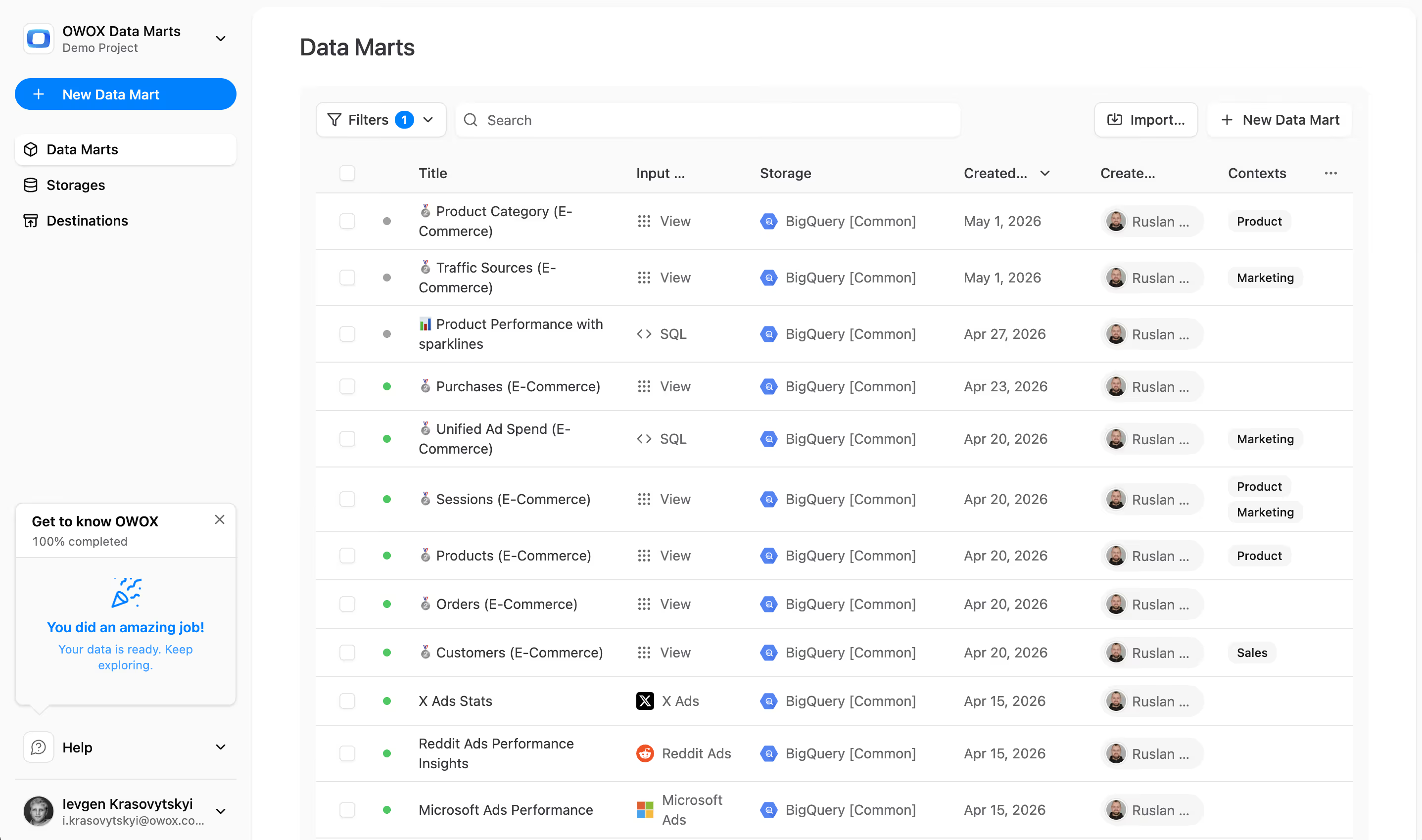
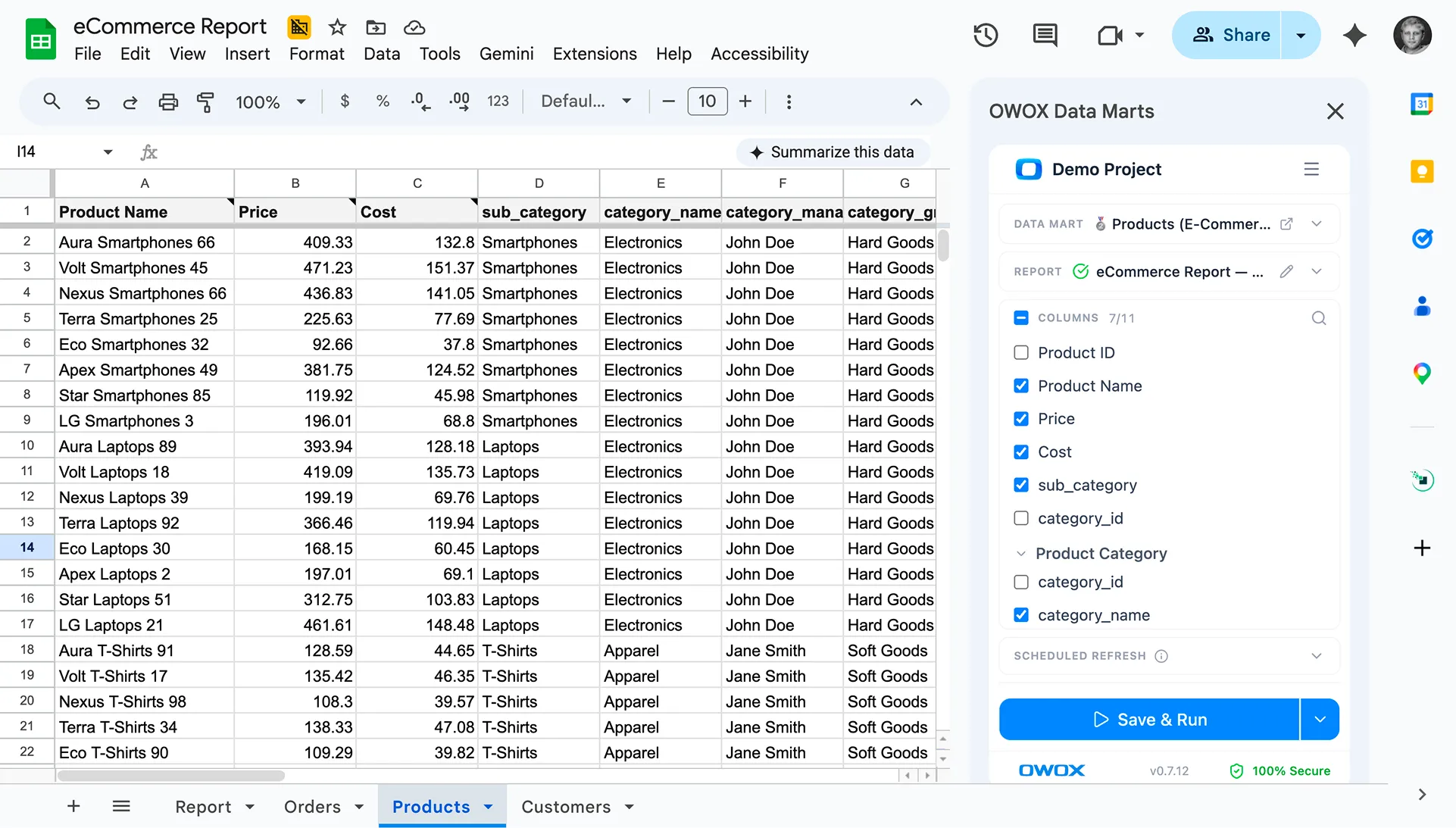
In the context of OWOX Data Marts, UNNEST is part of the practical reality of shaping raw event data into flat, analysis-ready datasets. It helps bridge the gap between nested source structures and the tables analysts actually want to use in reporting, attribution, and performance analysis.
That means less wrestling with repeated fields at dashboard time and more focus on metrics, segments, and decisions.
Best practices when using UNNEST
UNNEST is powerful, but the best results come from discipline. A few habits can save you from broken totals, bloated tables, and painful debugging sessions.
Controlling data volume and row explosion
Always estimate how many rows your query will create. Filter source data before unnesting whenever possible, and select only the nested fields you actually need. If transformation logic gets too complex, consider using stored procedures to manage complex SQL transformations in a repeatable way.
For sensitive event-level detail, flatten carefully and apply data masking when working with detailed unnested events if the output exposes fields that should not be widely visible.
Choosing keys to join unnested data back
Keep durable identifiers from the original table every time you unnest. Event IDs, session IDs, user IDs, and timestamps are often essential for joining back or validating totals later. To keep flattened models trustworthy, use key constraints in SQL to keep your flattened data consistent where your platform supports them.
If you skip key design, your unnested table may look right at first glance but produce wrong answers once joins begin.
Testing UNNEST logic before production
Before productionizing an UNNEST query, test it on a small sample and compare row counts before and after flattening. Check whether totals match expectations. Verify that empty arrays, nulls, and repeated elements behave the way you intend.
The hype is real: UNNEST can unlock incredibly rich analysis. But only if you validate the grain, preserve context, and prove the logic before pushing it into dashboards or data marts.
Want to make nested raw data easier to work with? Explore OWOX Data Marts to build cleaner reporting datasets and shape analytics-ready tables from complex source data.
%202.png)



"AI by its nature will hallucinate. You need guardrails so you can trust your data."
"We had six or seven different channels and no single source of truth. It was almost impossible"
"We regained time. And time is the one resource that never comes back."