AI agents don't replace your analyst — they replace your backlog
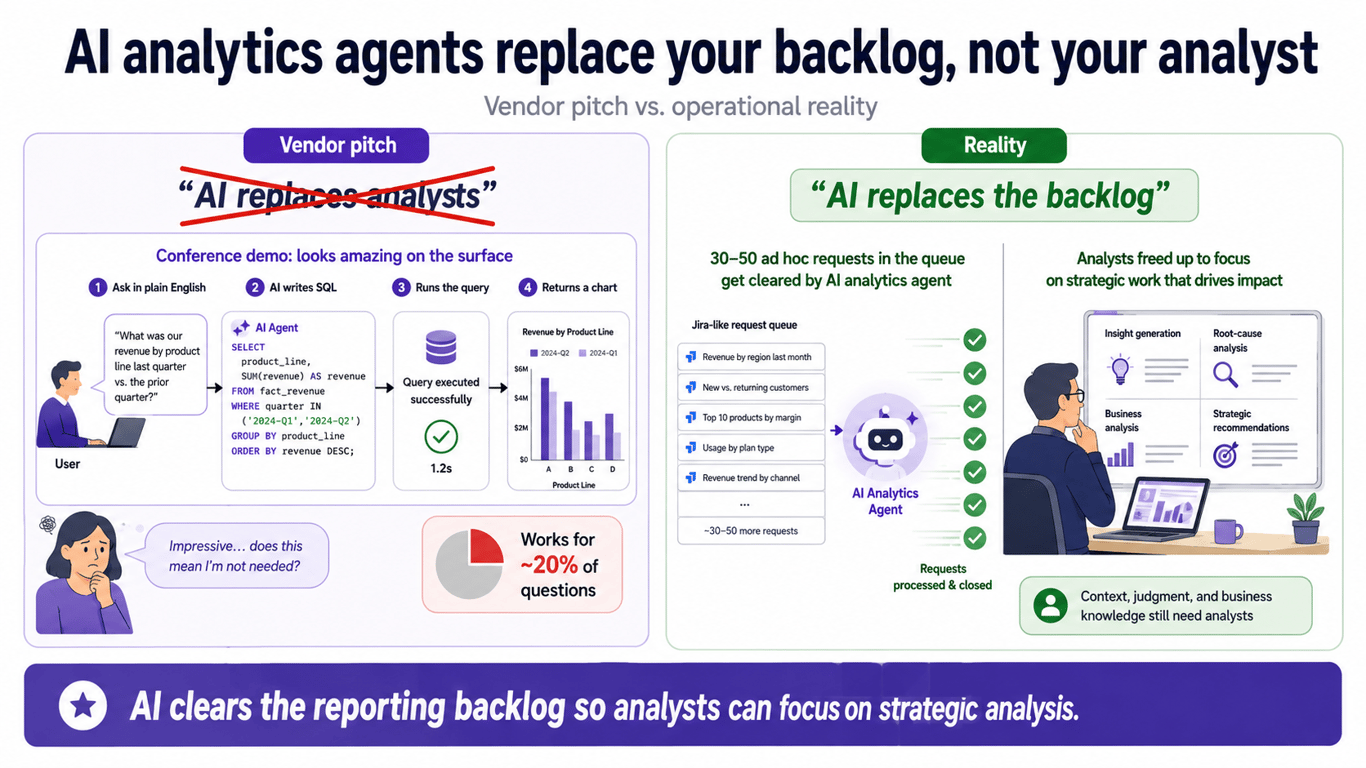
Every vendor at every data conference is pitching the same story: “Our AI agent replaces your data analyst.” The demo looks impressive. You type a question in plain English, the agent writes SQL, runs it, and returns a chart. The audience nods. The analyst in row three quietly panics.
Here is the problem with that pitch: it works for about 20% of the questions your business actually asks. The other 80% – the ones requiring business context, institutional knowledge, and judgment calls – break the agent in ways that create more work for your team, not less.
The real story is more interesting and more useful. AI analytics agents are not replacing analysts. They are replacing the reporting backlog – the 30 to 50 ad hoc requests sitting in Jira that nobody has time to work on. And that changes everything about how analytics teams should think about AI.
The “AI replaces analysts” narrative is wrong
The “AI replaces analysts” narrative is wrong
The analyst replacement narrative has been building for two years. It peaked in early 2026, and it is worth understanding why it caught on before explaining why it is wrong.
What every vendor is pitching right now
The pitch follows a predictable pattern. A BI platform or AI-native startup shows a demo where a business user types “What was our revenue last month?” into a chat interface. The AI analytics agent generates a SQL query, executes it against the data warehouse, and returns a formatted answer in seconds. No analyst needed.
Some demos go further: “Show me a trend of monthly active users for the past 12 months.” The agent produces a chart. The presenter says something about “democratizing data” and “eliminating the analyst bottleneck.”
The kernel of truth is real. For simple, well-defined lookups – one metric, one time range, one data source – AI agents work. They work fast, and they work reliably enough to be useful.
The problem is that simple lookups are not what keeps your analytics team underwater.
Why the “replace vs. not replace” debate misses the point
Every SERP result for “AI replace data analyst” answers the same binary question: will they or won’t they? The consensus is “no, but the role will change.” That answer is correct and completely unhelpful.
The more useful question is: what specific work can AI reliably take off an analyst’s plate today? Not theoretically. Not in a demo. In production, against real data, with real business users asking real questions.
When you frame it that way, the answer stops being about the analyst and starts being about the backlog.
What AI analytics agents can actually do today
What AI analytics agents can actually do today
Before deciding how to deploy AI agents, you need a clear-eyed view of where they work and where they fall apart. The gap between the two is larger than most vendor demos suggest.
Simple lookups – where AI agents shine
AI agents perform well on questions that meet three criteria: a well-defined metric, a clear time range, and a single data source with no ambiguity.
Examples that work reliably:
- “What was total revenue last month?”
- “How many new users signed up this week?”
- “Show me top 10 products by units sold in Q2.”
- “What is our current churn rate?”
These succeed because they require no interpretation. The metric is defined. The time range is explicit. The AI agent translates the question into SQL, runs it, and returns a number. There is no judgment involved.
This is genuinely valuable work. These lookups take an analyst 5–15 minutes each. When you have 10 of them per day, that is half a workday consumed by data retrieval.
Business context questions – where AI agents break
Now consider the questions that actually fill your analytics team’s backlog:
- “Why did revenue drop last week?”
- “Are we on track for Q3?”
- “Which campaigns are actually working?”
- “Should we increase spend on paid search?”
Each of these requires business context that does not live in the data warehouse. “Why did revenue drop?” demands knowing which revenue definition to use (gross, net, ARR, recognized), which comparison period matters, which segments to isolate, and whether there was a known event (a pricing change, a holiday, a product launch) that explains the shift.
The AI agent does not know any of this. So it picks a definition – usually the wrong one – generates a plausible-looking answer, and delivers it with confidence.
The analyst now has a new problem: debugging AI output instead of building the report themselves. The net time savings is negative.
The hallucination problem with ungoverned data
When an AI agent queries raw, ungoverned data, the failure mode gets worse. The agent may:
- Join tables that should not be joined
- Pick a staging table instead of the production table
- Apply filters that exclude critical segments
- Double-count revenue by misunderstanding the schema
The output looks professional – formatted, labeled, sometimes even chartable. It is also wrong. And because it looks authoritative, business stakeholders may act on it before anyone catches the error.
I have seen teams where the analyst spent more time cleaning up after the AI agent than they would have spent answering the question directly. That is not augmentation. That is technical debt with a chatbot interface.
OWOX Data Marts
See your first report built in real time. 15 minutes.
- Connect your data warehouse
- Pick your metrics
- Get a live Google Sheets report
In the time it takes to write a ticket. Then imagine never writing that ticket again.
Book a DemoWe'll use your actual use case
The real problem AI solves – your reporting backlog
The real problem AI solves – your reporting backlog
Here is the reframe that changes the conversation: stop asking whether AI replaces the analyst. Start asking whether AI can clear the queue.
The anatomy of the analytics backlog
Every analytics team has one. It is the Jira board, the Linear project, the shared Slack channel, the inbox full of “hey, can you pull something for me?” messages. At any given time, most teams are sitting on 30 to 50 open ad hoc requests, and the number only grows.
Typical backlog requests look like this:
- “Can you pull last quarter’s CAC by channel?”
- “What is our MRR trend for the past 6 months?”
- “How many users completed onboarding last week?”
- “What was the conversion rate for the spring campaign?”
These are legitimate questions from legitimate stakeholders. They deserve answers. They are also not strategic work. Each one takes 15–30 minutes. Multiply by 10 per day, and your analyst team is spending 60–70% of their capacity on data retrieval.
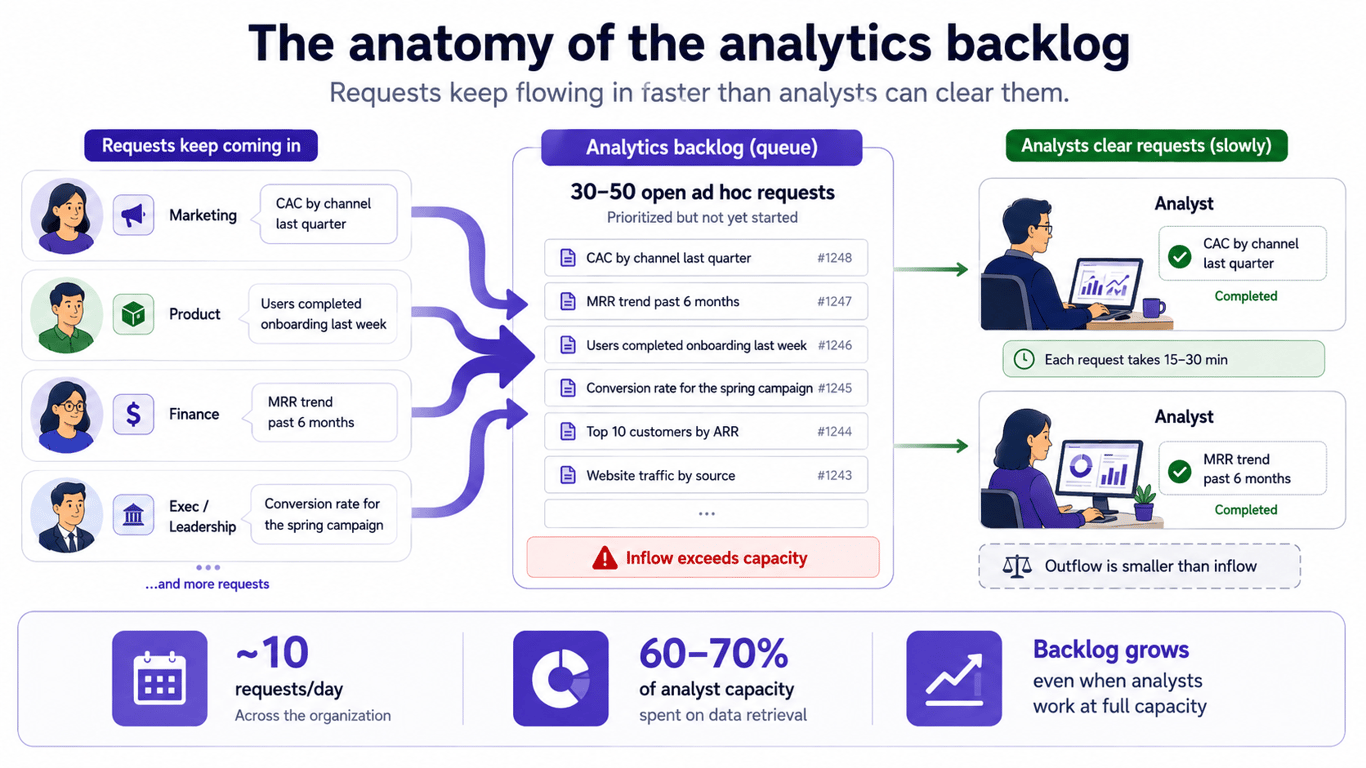
How much time analysts actually spend on ad hoc requests
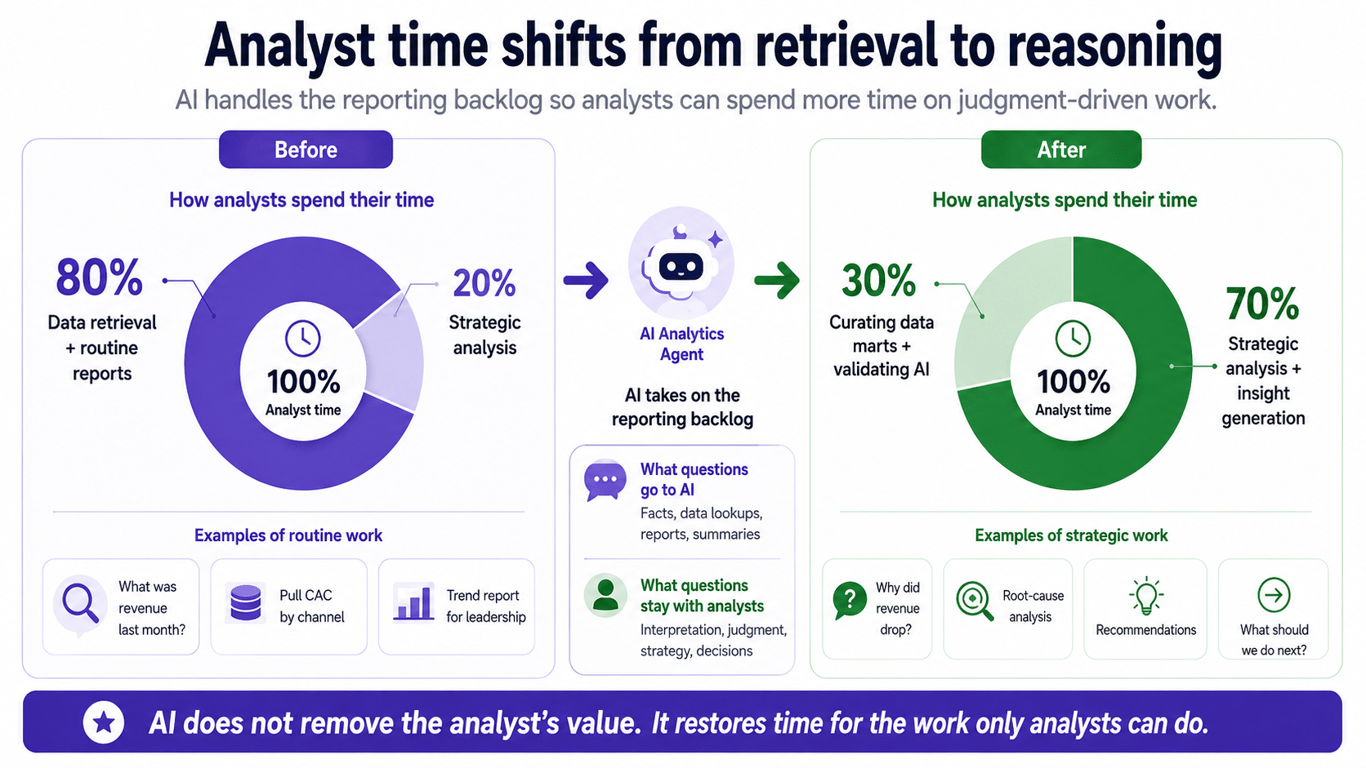
The numbers are well documented. Data analysts spend roughly 80% of their time on data preparation and routine queries, leaving only 20% for the strategic analysis that actually drives business decisions. McKinsey’s 2024 Global Survey on AI found that 78% of companies use AI to augment analytics teams – not replace them – because the bottleneck is not analyst capability. It is analyst capacity.
Gartner’s 2025 data and analytics trends report found that organizations using autonomous agentic pipelines achieved a 48% reduction in decision latency and a 35% improvement in policy compliance versus batch analytics environments.
The math is straightforward: if AI agents can handle the 60–70% of backlog requests that are simple lookups, analysts reclaim the majority of their week for work that actually matters.
What happens when the backlog never shrinks
When the analytics backlog stays permanently full, three things happen – all of them bad:
1. Business stakeholders stop asking. They make decisions without data because they know the answer will take too long. This is invisible and dangerous.
2. Shadow analytics emerges. Marketing builds their own spreadsheets. Finance creates their own revenue calculations. Product pulls numbers from a different source. Now you have five versions of “revenue” and no one agrees on reality.
3. Trust in the data team erodes. The analytics team is perceived as slow, unresponsive, and disconnected from business needs – even though they are working at full capacity. Strategic projects never get started because the queue never clears.
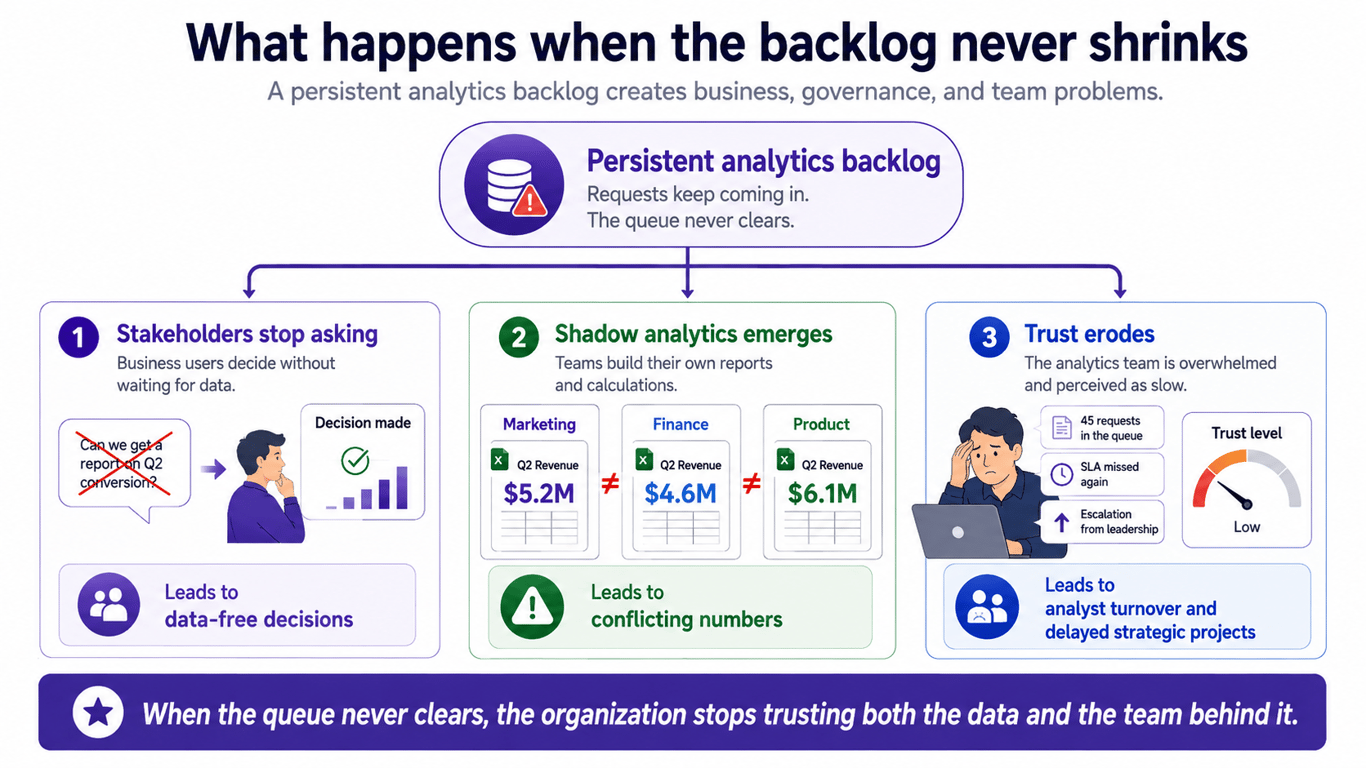
Why governed data marts are the missing prerequisite
Why governed data marts are the missing prerequisite
AI agents without a governed data layer are a liability. They are fast, confident, and wrong – which is the most dangerous combination in analytics.
AI without governance = faster hallucinations
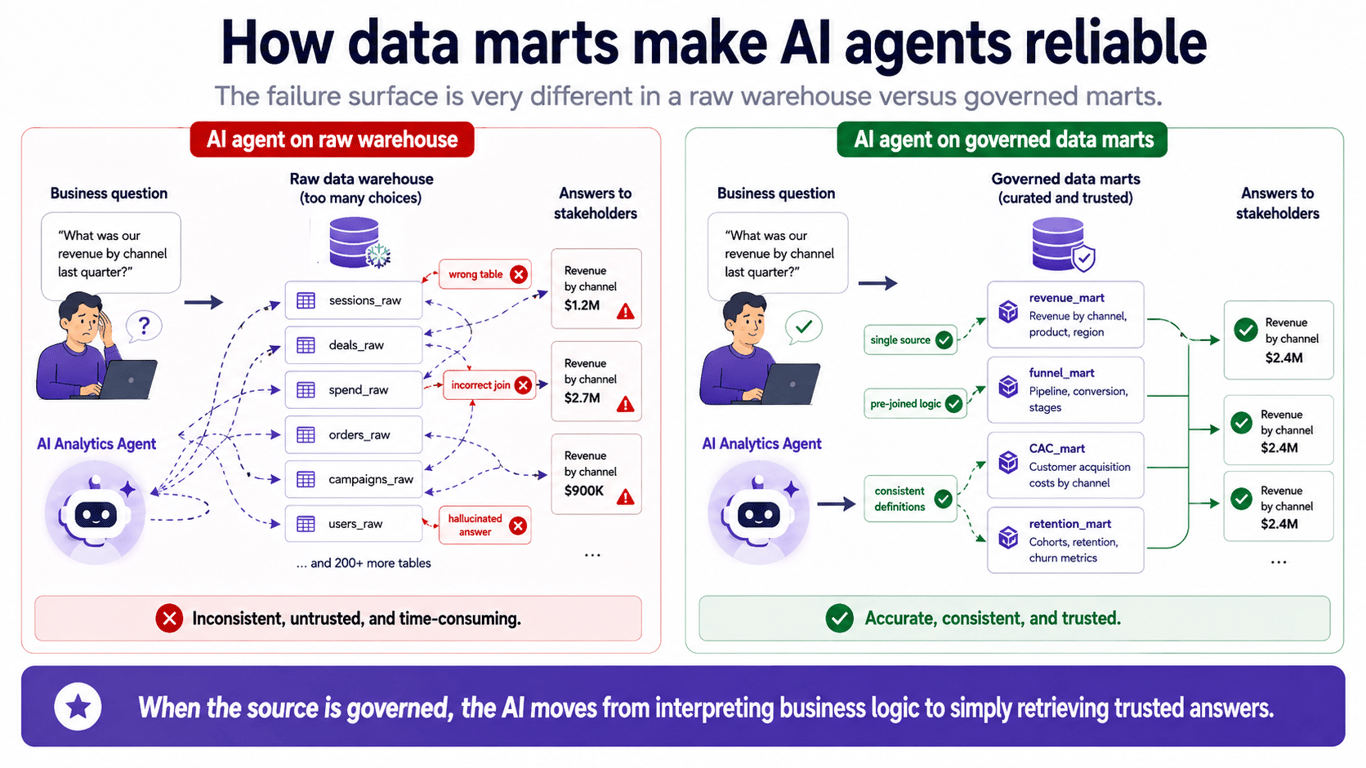
Point an AI agent at a raw data warehouse and tell it to answer business questions. What you get is an agent that:
- Does not know which “revenue” table is the source of truth
- Cannot distinguish between a staging schema and a production schema
- Has no concept of data access controls
- Invents joins that produce technically valid but semantically meaningless results
Speed without accuracy is not a feature. It is a risk. Every incorrect answer that reaches a stakeholder erodes trust in both the AI tool and the data team behind it.
What a governed data layer looks like
A governed data layer is a set of curated data marts where the hard decisions have already been made:
- Metric definitions are locked. “Revenue” means one thing. “Active user” means one thing. There is no ambiguity for an AI agent to misinterpret.
- Business logic is pre-encoded. Segment rules, attribution windows, exclusion criteria – all baked into the data mart, not left for the AI to figure out.
- Access controls are enforced. The AI agent can only query data marts it is authorized to access. No accidental exposure of sensitive data.
This is architectural work. It is not glamorous. It is also the difference between an AI agent you can trust and one you have to babysit.
How data marts make AI agents reliable
When an AI agent queries a governed data mart instead of a raw warehouse, the failure surface shrinks dramatically:
- The agent cannot pick the wrong table – there is only one “revenue” mart
- The agent cannot invent joins – the mart is pre-joined and validated
- The agent cannot apply incorrect business logic – the logic is encoded in the mart definition
The AI agent’s job reduces from “interpret the question, find the right data, apply the right logic, and format the answer” to simply “retrieve the answer from a governed source.” That is a much simpler task, and AI is very good at simple tasks.
The new analyst role – from report builder to AI orchestrator
The new analyst role – from report builder to AI orchestrator
If AI handles the backlog, what do analysts do? The answer is: the work they were hired to do in the first place but never had time for.
Curating data marts instead of writing one-off queries
The analyst’s highest-value contribution shifts from answering individual questions to building the system that answers them at scale. This means:
- Defining metric standards and encoding them into joinable data marts
- Validating data quality at the mart level (not row by row, report by report)
- Designing data marts that anticipate stakeholder questions before they are asked
This is architectural, strategic work. It requires deep business context – exactly the thing AI agents lack.
Validating AI outputs instead of building reports
As AI agents handle more lookups, analysts take on a new responsibility: quality assurance. This includes:
- Spot-checking AI answers against known benchmarks
- Building automated validation rules that flag anomalies in AI outputs
- Creating feedback loops where business users can report suspicious answers
The analyst becomes the guarantor of data quality – the human check in an increasingly automated pipeline.
Focusing on “why” instead of “what”
The most important shift: analysts finally have time for the questions that require human judgment.
- “What was revenue last month?” – the AI handles this.
- “Why did revenue drop, and what should we do about it?” – the analyst handles this.
“What” questions are retrieval. “Why” questions are analysis. The entire premise of hiring an analyst was that they could do the second. The backlog forced them to spend most of their time on the first. AI changes that ratio.
How to deploy AI agents against your backlog (without chaos)
How to deploy AI agents against your backlog (without chaos)
Deploying AI agents is not a flip-the-switch decision. Teams that succeed follow a structured approach. Teams that skip steps end up with the hallucination and trust problems described above.
Start with the highest-volume, lowest-complexity requests
Audit your backlog first. Pull the last 90 days of analytics requests and categorize each one:
| Category | Example | AI-ready? | Typical share |
|---|---|---|---|
| Simple lookup | What was CAC last quarter? | Yes | 40–50% |
| Templated report | Weekly channel performance summary | Yes (with governed data marts) | 15–25% |
| Context-required analysis | Why did retention drop in segment X? | No – analyst required | 20–30% |
| Strategic project | Build a churn prediction model | No – analyst required | 5–10% |
The 60–70% of requests that are simple lookups or templated reports are your AI agent candidates. Do not try to automate context-required analysis first – that is where the hallucination risk lives.
Build the governed data mart layer first
Before you deploy any AI agent, your data marts need to be governed:
1. Define your metrics. Revenue, users, conversions, CAC – each one gets a single definition in a data mart.
2. Encode business logic. Attribution windows, segment rules, exclusion criteria – all baked in.
3. Set access controls. The AI agent queries only what it is authorized to access.
4. Validate data quality. Automated checks that verify mart data before AI agents serve from it.
With OWOX, this setup takes 2–5 minutes per data mart. The prebuilt data marts come with business logic already encoded, so you are not building from scratch.
Measure backlog velocity, not just AI accuracy
Most teams measure AI agent deployments by accuracy – “how often does the AI get the right answer?” That matters, but it is not the most important metric. Track these instead:
| Metric | What it measures | Target |
|---|---|---|
| Requests resolved / week | Backlog throughput before vs. after AI | 2–3x increase |
| Time-to-answer (simple lookups) | How fast stakeholders get answers | Minutes instead of hours |
| Analyst hours on strategic work | Time freed for analysis, not retrieval | 50%+ of total hours |
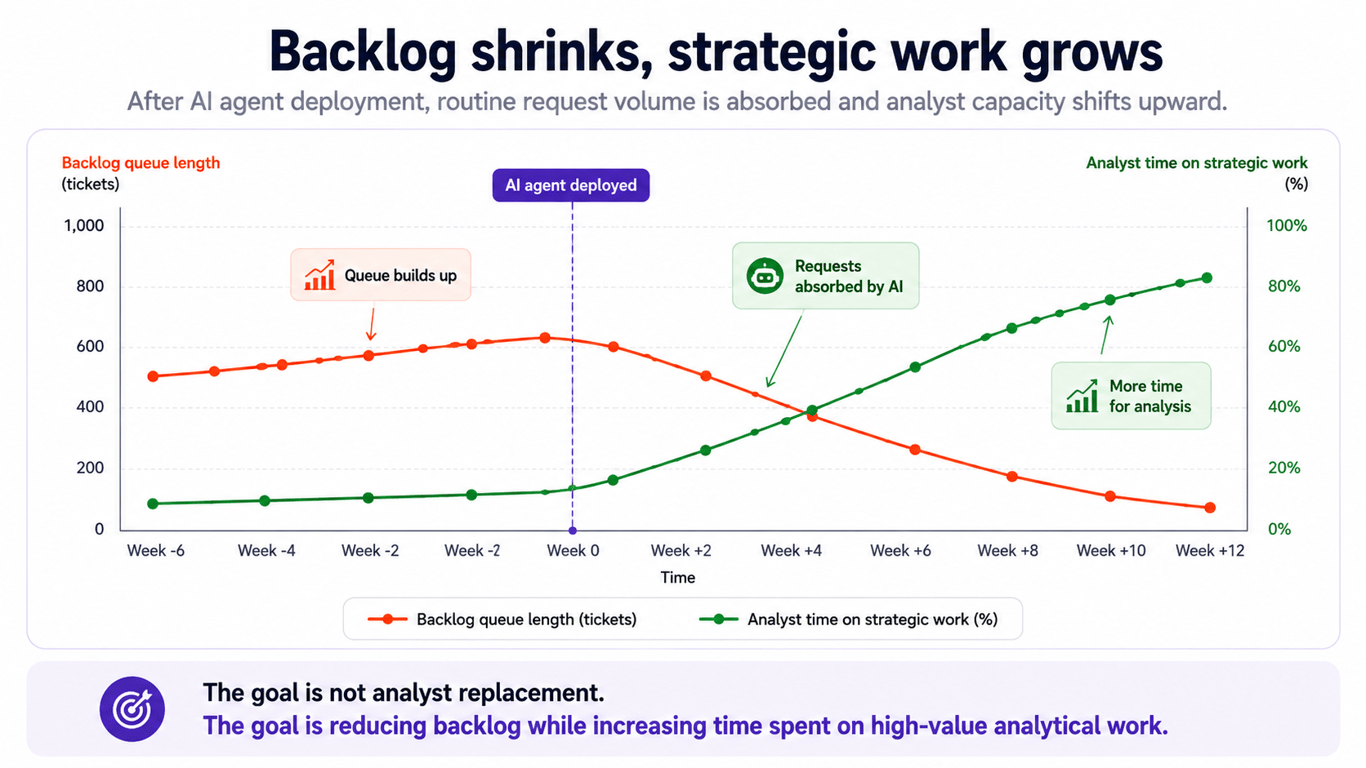
| Backlog queue length | Are requests clearing faster than arriving? | Steady decline |
Success is not “the AI got the answer right.” Success is the backlog shrinks, analysts do more strategic work, and stakeholders get faster answers.
What this looks like in practice
What this looks like in practice
Theory is useful. Seeing the transformation in practice is more convincing.
Before and after – the analytics team workflow
Before AI agents handle the backlog:
The analyst arrives, opens Slack, sees six new data requests. Opens Jira, sees 12 more in the queue. Spends the morning writing SQL queries for simple lookups. Formats the results into Sheets or Slides. Sends them to stakeholders. Gets three follow-up questions. Repeats. By end of day, zero strategic analysis has happened. The backlog has grown by two requests.
After AI agents handle simple lookups from governed data marts:
The AI agent resolves simple lookups directly from governed data marts. Stakeholders get answers in minutes through a conversational interface. The analyst reviews flagged anomalies in AI outputs (10–15 minutes per day). Spends the rest of the day on causal analysis, strategic recommendations, and data mart curation. The backlog shrinks by 60%. The analyst finally does the job they were hired for.
The OWOX approach – governed data marts + MCP
OWOX builds the governed data layer that makes AI agents trustworthy. The approach is straightforward:
1. Connect your data warehouse as a Storage – BigQuery, Snowflake, Redshift, Athena, or Databricks
2. Build governed data marts with prebuilt business logic – metric definitions, segment rules, and access controls encoded from the start
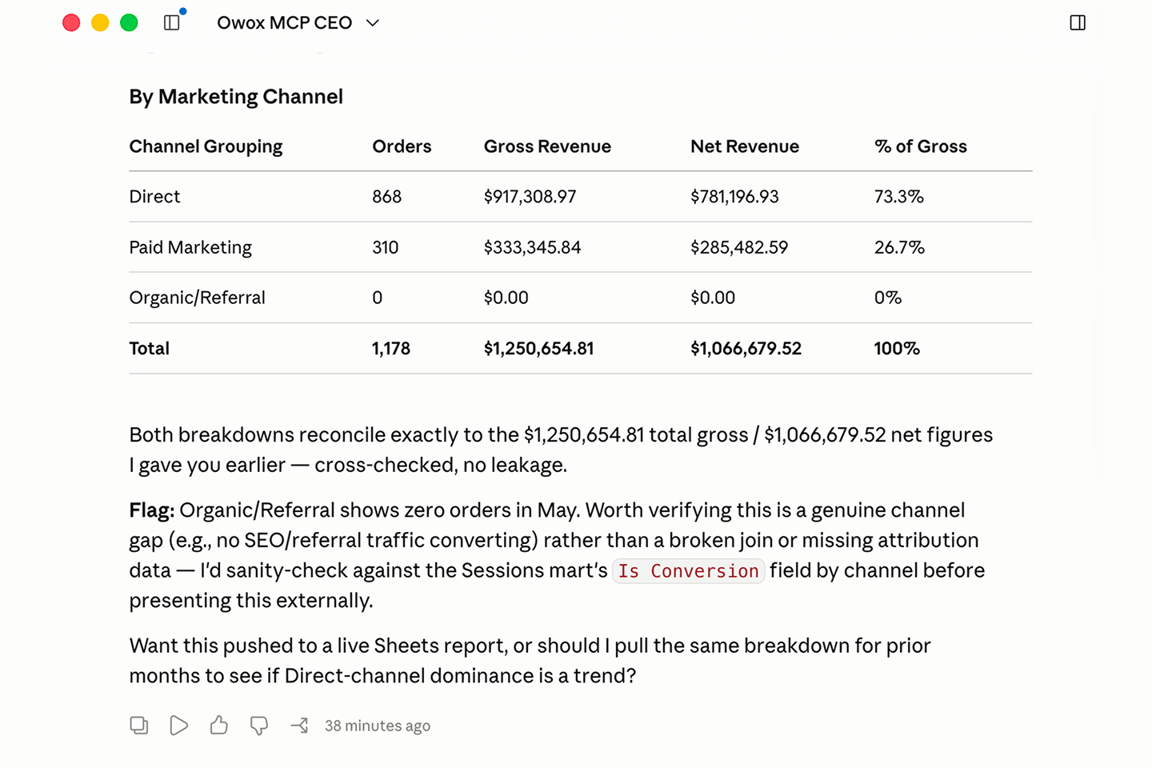
3. Deploy AI agents that query these data marts using MCP – not raw tables, not ungoverned schemas
4. Deliver answers in Google Sheets or dashboards where business users already work
The setup takes 2–5 minutes. No months-long implementation. No migration project. Analysts curate data marts, AI serves from them, and business stakeholders get answers when they need them.
Stop debating replacement – start clearing the backlog
Stop debating replacement – start clearing the backlog
The “will AI replace data analysts?” debate is a distraction. It has consumed two years of conference panels, LinkedIn threads, and blog posts (this SERP has ten results arguing about it). The answer has always been the same: no, but the role will change. That answer is not wrong – it is just not useful.
Here is what is useful: your analytics backlog is real, it is growing, and AI agents can clear 60–70% of it – if you give them governed data to work with.
The prerequisite is not better AI. It is better data architecture. Build governed data marts with defined metrics and encoded business logic. Then point AI agents at those data marts. The simple lookups get handled instantly. The queue shrinks. Your analysts finally have time for the strategic work you hired them to do.
Stop debating whether AI replaces analysts. Start [clearing the backlog](https://www.owox.com/blog/reducing-reporting-backlog-guide).
Turn your data into decisions.
Governed data marts give you the clean foundation ML needs to actually work.
- No AI hallucinations
- Analyst-governed definitions
- Every number traces to SQL
Frequently Asked Questions
Can AI analytics agents work with Google Sheets?
Yes. AI analytics agents can deliver answers directly into Google Sheets when connected to governed data marts. OWOX, for example, lets business users query data marts through a conversational interface and receive results in their existing spreadsheets. This means stakeholders get answers where they already work without learning new tools.
What is the difference between AI analytics and traditional BI?
Traditional BI relies on pre-built dashboards and scheduled reports that answer predefined questions. AI analytics agents respond to ad hoc natural language questions in real time. The key difference is flexibility: AI agents handle the long tail of one-off data requests that dashboards were never designed to cover, reducing the reporting backlog for analytics teams.
How long does it take to deploy AI analytics agents?
Deployment time depends on your data infrastructure. If you already have governed data marts, an AI agent can start resolving simple lookups within days. Building the governed data mart layer first is essential. With platforms like OWOX, data mart setup takes 2 to 5 minutes per mart, making the total deployment timeline weeks rather than months.
How do governed data marts make AI analytics agents more reliable?
Governed data marts contain curated data with locked metric definitions and pre-encoded business logic. When an AI agent queries a governed data mart, it cannot pick the wrong table, invent joins, or apply incorrect logic. The agent retrieves from a trusted source rather than interpreting raw warehouse schemas, dramatically reducing hallucination risk.
Why do AI analytics agents hallucinate on business data?
AI agents hallucinate when querying raw, ungoverned data warehouses because they lack business context. They may join incorrect tables, pick staging data instead of production tables, or apply wrong filters. The output looks professional but contains errors. Governed data marts solve this by pre-encoding metric definitions and business logic so the AI retrieves validated answers.
What types of questions can AI analytics agents answer reliably?
AI analytics agents work best on simple lookups with well-defined metrics, clear time ranges, and single data sources. Examples include total revenue for a given month, weekly signups, or top products by units sold. They struggle with questions requiring business context, such as explaining why a metric changed or recommending strategic actions.
Will AI analytics agents replace data analysts?
No. AI analytics agents handle simple data lookups reliably – metrics with clear definitions and time ranges. But they break on questions requiring business context, like why revenue dropped or which segments to prioritize. McKinsey found that 78% of companies use AI to augment analytics teams, not replace them. The real value is clearing the ad hoc reporting backlog so analysts can focus on strategic analysis.