

Snowflake vs BigQuery: A Detailed Comparison
Explore how Snowflake and BigQuery compare in real workloads, costs, performance, and governance to help data teams choose the right cloud warehouse.

Choosing between Snowflake and BigQuery is rarely just about features. For data analysts, it’s about how the warehouse behaves under real workloads – dashboards, ELT, ad hoc SQL, cost spikes, and governance pressure.
Both platforms are powerful, elastic, and enterprise-ready. But their architectural models, pricing mechanics, and governance patterns create very different day-to-day realities.
.png)
This guide breaks down Snowflake vs BigQuery through the lens that matters most to analysts – performance, cost control, and building reusable data marts on top. The goal is not to crown a universal “winner,” but to help you understand which trade-offs align better with your stack, team, and roadmap.
Who This Comparison Is For
This guide is written primarily for:
- Data analysts and analytics engineers designing reporting layers
- Data leaders evaluating warehouse strategy
- Marketing and product analytics teams concerned with cost and concurrency
- BI developers using Looker Studio and Google Sheets for reporting
We’ll assume you already understand basic data warehousing concepts (tables, partitions, storage vs compute) and are more interested in how Snowflake and BigQuery behave in practice.
What This Article Covers (and What It Doesn’t)
To keep this comparison actionable, we’ll focus on five lenses that matter most in production environments:
1. Architecture and performance
How each platform separates storage and compute, handles concurrency, and optimizes queries – and what that means for common workloads like dashboarding, ad-hoc analysis, and ELT.
2. Pricing and cost management
Not just list prices, but how billing behaves with frequent small queries, scheduled transformations, and unpredictable analyst workloads – plus how to avoid common cost surprises.
3. Governance, security, and collaboration
How each warehouse handles access control, data sharing, lineage, and safe self-service, especially when multiple teams and tools are involved.
4. Ecosystem and integration patterns
How Snowflake and BigQuery fit into typical modern data stacks, including ingestion tools, BI platforms, notebooks, and reverse ETL.
5. Enabling governed self-service analytics
How to expose trusted, reusable metrics and data marts to business teams without losing control or inflating warehouse costs.
What we won’t do:
- A feature-by-feature matrix trying to list every knob and toggle
- A deep dive into every edition, SKUs, or partner offering
- Benchmark wars based on synthetic workloads that don’t resemble your data
Instead, we’ll anchor the comparison in real-world analytical scenarios, including marketing attribution, user behavior analysis, revenue reporting, experimentation, and cross-channel performance tracking.

How We’ll Compare Snowflake and BigQuery
To make the trade-offs easier to follow, each major section will answer three practical questions:
What’s the underlying design choice?
For example, how BigQuery’s serverless, slot-based model contrasts with Snowflake’s multi-cluster virtual warehouses.
How does it affect your day-to-day workflows?
What happens to dashboard refreshes when traffic spikes? How painful is it to onboard new domains or brands? How easy is it to isolate costs by team?
Where do problems usually show up – and how can you mitigate them?
For instance, query bloat from self-service users, underutilized warehouses, or escalating on-demand query costs.
Whenever relevant, we’ll also look at how a semantic or data mart layer above the warehouse can soften sharp edges – for example, by centralizing core metrics, exposing only curated tables to BI tools, and limiting ad-hoc hits on raw tables.
Where OWOX Data Marts Fit in
Both Snowflake and BigQuery are powerful, but neither is a complete self-service analytics solution out of the box.
Teams commonly run into:
- Conflicting metric definitions across tools and dashboards
- Analysts repeatedly rebuilding similar queries and models
- Business users querying raw tables with expensive, inefficient queries
- Difficulty enforcing consistent governance across many BI tools and teams
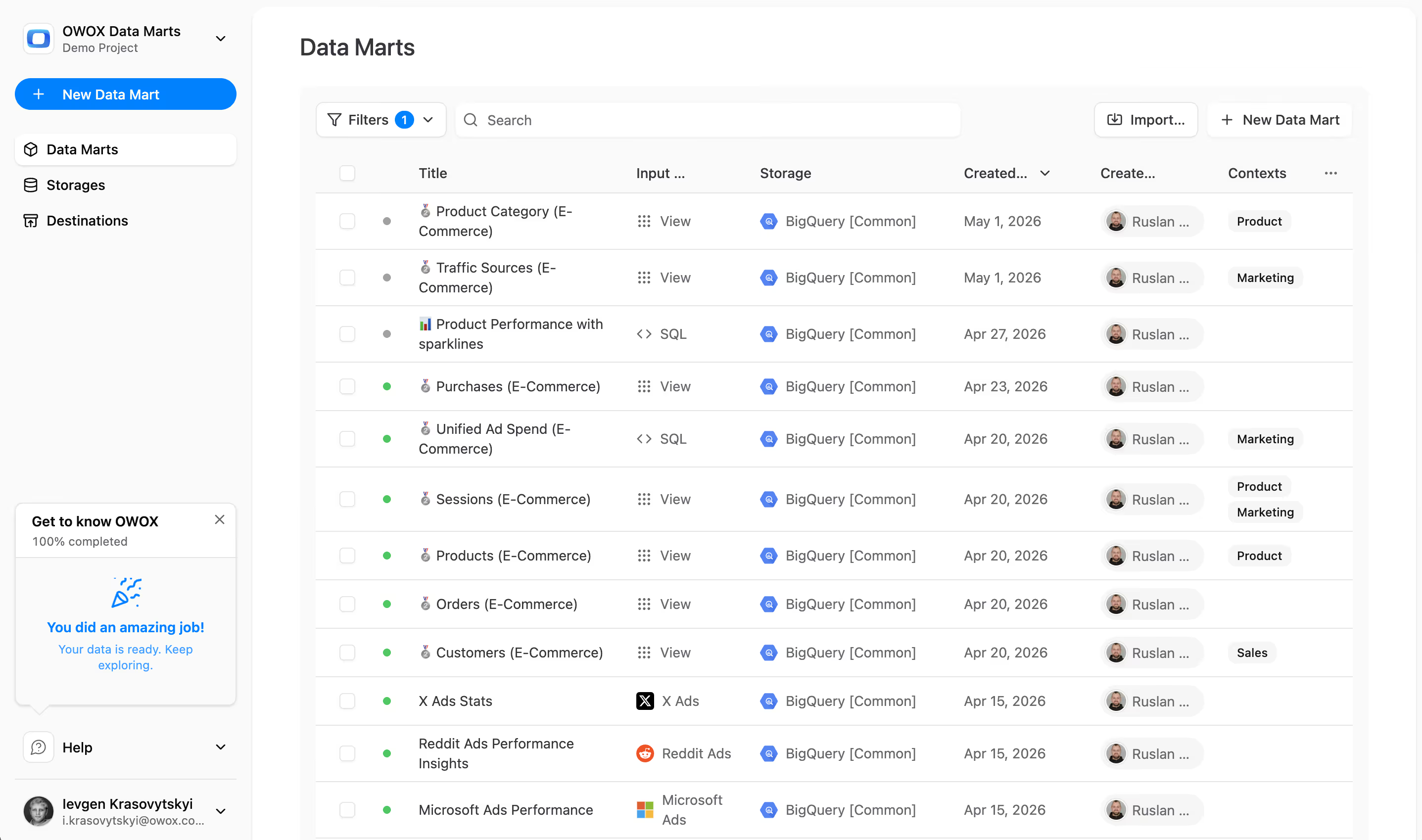
OWOX Data Marts sits on top of Snowflake or BigQuery as your single source of truth and transforms the warehouse into a governed, reusable analytics environment.
It enables you to:
- Publish curated, documented data marts by domain
- Standardize business metrics and logic across tools and teams
- Expose self-service analytics interfaces without giving up control over warehouse complexity and costs
If you’re already on Snowflake or BigQuery and want to make governed self-service analytics a reality without rebuilding your stack, you can start exploring OWOX Data Marts for free right now.
How to Think About Choosing Between Snowflake and BigQuery
Choosing a cloud data warehouse is less about “who has more features” and more about how well a platform fits your existing strategy, skills, and constraints. Most organizations looking at Snowflake vs BigQuery already have data in the cloud, several analytics tools in place, and growing pressure to deliver trusted insights quickly – without losing control of costs or governance.
Instead of treating this as a binary, one-time bet, it’s more useful to frame the decision around a few durable dimensions:
- How each platform is built
- How it charges you
- How it behaves under real workloads
- How it helps you protect and operationalize your data.
Common Reasons Teams Evaluate Snowflake and BigQuery
Organizations typically compare Snowflake and BigQuery when they:
- Outgrow legacy on-prem warehouses or single-node databases
- Need to consolidate fragmented data sources
- Face rising costs or operational overhead
- Want to enable self-service analytics without sacrificing control
On the business side, executives look for better cost predictability, faster time to insight, and clearer ownership of metrics. On the technical side, teams care about handling concurrency spikes, supporting complex transformations, integrating with existing cloud services, and enforcing consistent security and access control.
Both platforms can solve these problems, but they do so with different trade-offs that become visible only when you look at your specific workloads and team structure.
Key Decision Dimensions: Architecture, Cost, Performance, Governance
You can simplify the comparison by evaluating four core dimensions:
- Architecture – How storage and compute are separated, how clusters or slots are allocated, and how multi-tenancy is managed. This shapes elasticity, workload isolation, and integration patterns.
- Cost – How you’re billed for compute, storage, and data access – and how predictable those costs are under scheduled jobs, BI dashboards, and ad hoc analysis.
- Performance – How each platform handles concurrency, query optimization, and mixed workloads (ELT + BI + data science). This is where users feel the difference – dashboard refresh times, SLA adherence, and responsiveness.
- Governance – How you define and enforce access, data classification, auditability, and cross-team collaboration. Governance is not just security; it’s also about consistent metrics, lineage, and controlled self-service.
Each dimension will matter differently depending on your maturity, regulatory environment, and the analytical use cases you prioritize.
Where OWOX Data Marts Reduces Long-Term Platform Risk
Choosing Snowflake or BigQuery is not just a technical decision – it’s a strategic commitment.
Over time, business logic tends to spread across dashboards, notebooks, and transformation layers tightly coupled to the warehouse.
That’s where long-term risk appears:
- Metrics hard-coded inside BI tools
- Reporting logic tied to warehouse-specific patterns
- Cost optimizations that only work on one platform
- Migration or hybrid strategies becoming expensive to execute
OWOX Data Marts helps decouple business semantics from infrastructure.
Instead of embedding logic directly inside Snowflake or BigQuery-specific workflows, you can:
- Centralize metric definitions in reusable data marts
- Standardize reporting logic above the warehouse layer
- Isolate warehouse-specific optimizations from business-facing tables
- Preserve flexibility if your cloud or pricing strategy changes
This approach does not replace your warehouse. It protects your ability to evolve it.
At a high level, choosing between Snowflake and BigQuery typically comes down to the following strategic trade-offs:
If you’re evaluating Snowflake or BigQuery and want to reduce long-term lock-in while maintaining governed analytics, you can get started free with OWOX Data Marts today.
Architecture Deep Dive: Comparing Snowflake and BigQuery
For analytics teams, architecture isn’t an abstract concern – it determines how easily you can scale, control costs, and support governed self-service. Snowflake and BigQuery both separate storage and compute, but they operationalize that principle in very different ways.
Those differences show up in how you manage workloads, deal with concurrency spikes, and integrate with your broader cloud ecosystem.
Core Architectural Models: Storage, Compute, and Separation
Both platforms implement a logical separation of storage and compute, but the mechanics are distinct.
Snowflake: virtual warehouses on top of shared storage
Snowflake uses cloud object storage (e.g., S3, GCS, Azure Blob) as its persistent layer. On top of that, you provision virtual warehouses – independent compute clusters sized (XS–4XL and beyond) and scaled per workload.
- Storage is shared and compressed in Snowflake-managed micro-partitions. It’s relatively cheap and independent of computing.
- Compute is explicitly provisioned by you via warehouses. You decide size, auto-suspend, and auto-resume settings.
- Separation in practice means you can attach multiple warehouses to the same data, isolating teams and workloads without copying tables.
This model gives you fine-grained control over workload isolation: finance can have a small, always-on warehouse, while data engineering spins up a massive cluster for nightly transformations without impacting BI queries.

BigQuery: serverless, slot-based execution over managed storage
BigQuery stores data in a proprietary, columnar, distributed storage layer fully managed by Google. Compute is abstracted through slots - units of computational capacity allocated to queries.
- In on-demand mode, you don’t manage to compute directly; BigQuery allocates slots behind the scenes, and you pay per TB processed.
- In flat-rate or capacity modes, you reserve slots and optionally assign them to projects or reservations to shape capacity.
- There’s no concept of user-managed clusters; Google handles scaling and resource allocation.
The separation is more opaque to you as a customer. You focus on query design and reservations (if applicable), not cluster sizing. This can reduce operational overhead, but gives you less explicit, “tangible” control compared with Snowflake’s warehouses.
Scalability and Workload Isolation Implications
- Snowflake scales by adding or resizing warehouses; you shape isolation by having more/smaller warehouses with well-defined purposes.
- BigQuery scales elastically within project and reservation limits; isolation is controlled more by project-level design, reservations, and query governance rather than distinct clusters.
For governed self-service, this matters: Snowflake encourages explicit compute boundaries per domain or team; BigQuery encourages designing around projects, reservations, and query quotas.
Concurrency, Isolation, and Workload Management
Concurrency is where architectural philosophy becomes very visible to your end users.
Snowflake: multi-cluster warehouses and explicit routing
Snowflake manages concurrency through:
- Warehouse sizing: Larger warehouses provide more resources to handle heavier queries.
- Multi-cluster warehouses: A single logical warehouse can auto-scale out to multiple clusters when concurrency thresholds are met.
- Workload-specific warehouses: You can dedicate warehouses per use case (e.g., “BIREAD”, “ELTTRANFORM”, “DATA_SCIENCE”), each with its own scaling rules.
This approach gives you clear levers:
- If dashboards slow down during business hours, you can increase the BI warehouse size or enable multi-cluster.
- If batch jobs interfere with interactive analytics, you move them to separate warehouses.
The downside is more operational responsibility: someone must design and maintain a warehouse topology that matches your workloads.
BigQuery: Queueing, Reservations, and Fairness
BigQuery handles concurrency largely under the hood:
- Automatic scaling: For on-demand projects, BigQuery allocates resources dynamically; you rarely think in terms of “clusters.”
- Reservations and assignments (in capacity-based models): You allocate slots to reservations and assign projects or folders to them, effectively shaping guaranteed capacity for specific workloads.
- Fair scheduling and queueing: If queries exceed available slots, they may be queued or aborted, depending on priorities and limits.
For interactive analytics, this can feel simpler: BI tools just send SQL, and BigQuery figures out execution. However, heavy batch workloads or poorly optimized queries can still compete with dashboards, especially if reservations aren’t designed carefully.
Impact on user experience
- In Snowflake, poor warehouse design often shows up as contention or overprovisioning; you fix it by adjusting warehouse sizes or adding new ones.
- In BigQuery, poor workload design often appears as unpredictable query latency or throttling; you fix it by tuning reservations, budgets, and query patterns.
In both cases, having a curated layer for self-service – where business users query optimized, denormalized tables instead of raw schemas – helps limit concurrency issues and spikes.

Ecosystem Alignment and Integration with Cloud Services
Architecture also includes how well the warehouse plugs into your broader stack.
BigQuery: deeply integrated into Google Cloud
As a native Google Cloud service, BigQuery benefits from:
- Tight integration with Cloud Storage, Pub/Sub, Dataflow, Composer, Vertex AI, and Looker/Looker Studio.
- Simplified IAM through Google Cloud IAM roles, making it easier to align with existing org policies.
- Native access to Google Marketing Platform data (e.g., GA4 export) and many GCP-managed connectors.
This makes BigQuery particularly attractive if you’re already invested in GCP, running workloads like streaming ingestion, ML, and dashboards all within the same ecosystem.
Snowflake: cloud-agnostic and ecosystem-centric
Snowflake runs on AWS, Azure, and Google Cloud, with a focus on being a cross-cloud data platform:
- You choose the underlying cloud and region; multi-cloud strategies or migrations are feasible without changing your analytical layer.
- Snowflake integrates with a wide ecosystem of ETL/ELT, BI, and reverse ETL tools; many vendors treat it as a first-class target.
- Features like Snowflake Marketplace and data sharing support cross-organization collaboration regardless of cloud provider.
If your organization is multi-cloud or wants to avoid tight coupling to a single provider, Snowflake’s architecture aligns better with that strategy.
Where a governed analytics layer fits
In both ecosystems, analytics teams end up orchestrating many tools: ingestion pipelines, transformation jobs, BI platforms, and notebooks. A governed layer for reusable data marts can:
- Sit on top of either Snowflake or BigQuery
- Standardize business-ready tables and metrics that downstream tools consume
- Reduce the need for every tool and user to understand warehouse-specific nuances
This can soften the impact of architectural differences: your data warehouse becomes the execution engine and source of truth, while OWOX Data Marts exposes a consistent, governed interface to analytics consumers.
At a high level, the architectural differences between Snowflake and BigQuery can be summarized as follows:
If you’re evaluating how such a layer would fit into your Snowflake or BigQuery stack, you can get started with OWOX Data Marts for free right now.
Pricing and Cost Management in Snowflake and BigQuery
Both Snowflake and BigQuery can be cost-efficient at scale – or surprisingly expensive if left unmanaged. Their pricing models encourage different behaviors, and understanding those mechanics is critical for planning budgets, designing workloads, and enabling safe self-service analytics.
How Snowflake Pricing Works: Warehouses, Credits, and Storage
Snowflake pricing has two primary components: compute credits and storage.
Compute: virtual warehouses consuming credits
Each virtual warehouse consumes credits while it is running. Credits are billed per second (with a minimum per run period) based on:
- Warehouse size: Larger sizes (e.g., XL vs S) consume more credits per hour. The relationship is typically exponential (doubling size roughly doubles credits/hour).
- Runtime: Credits accrue only while a warehouse is “on.” When auto-suspended, it stops consuming compute credits.
- Edition and cloud region: Enterprise features and certain regions may have different per-credit list prices.
Implications:
- A small warehouse running all day can cost more than a large warehouse that spins up briefly for heavy transformations.
- Many warehouses with poor auto-suspend settings often lead to unnecessary idle-time spend.
Storage: compressed data and time travel
Snowflake charges for storage based on:
- Data at rest: The compressed size of your tables stored in Snowflake-managed storage.
- Time Travel and Fail-safe: Historical data retained for recovery and auditing also contributes to storage usage.
Nuances to watch:
- Frequent micro-batch loads and large transient datasets can inflate storage (and sometimes compute) if not managed.
- Longer Time Travel windows provide resilience but increase storage costs.
Overall, Snowflake encourages you to think in terms of right-sizing and right-timing compute, and periodically cleaning or optimizing stored data.

How BigQuery Pricing Works: On-Demand, Flat Rate, and Storage
BigQuery pricing is built around query processing and storage, with multiple options for compute.
Query pricing: on-demand (per TB processed)
In on-demand mode, BigQuery charges per byte processed by each query:
- You pay for the amount of data scanned, not for runtime or cluster size.
- Pruned partitions and filtered columns reduce bytes processed and therefore cost.
- Cached results (within a short window) are typically free if enabled.
This model is attractive for variable or low-volume workloads: you don’t manage clusters or reservations; you just pay for what you query. The trade-off is that poorly written queries (e.g., SELECT * without partition filters) can become expensive quickly.
Capacity / Flat-rate pricing
For more predictable or heavy workloads, BigQuery offers:
- Dedicated slots (capacity): You purchase a pool of slots (compute units) and assign them to reservations for projects or teams.
- Flex and long-term commitments: Different commitment terms with varying discounts; longer commitments lower the effective rate.
- Resource control: Reservations let you guarantee a baseline of compute for specific workloads (e.g., BI vs ELT).
This model makes sense when:
- You have a stable or growing query volume that would make on-demand unpredictable or expensive.
- Multiple teams or critical workloads need guaranteed performance.
Storage costs
BigQuery charges for:
- Active storage: Data that has changed recently (frequently updated).
- Long-term storage: Data unchanged for a defined period is billed at a lower rate automatically.
- Streaming inserts: Real-time streaming can incur separate costs compared with batch loads.
Partitioned tables and lifecycle policies help you control storage and query processing costs together.

Cost Control Strategies and Typical Cost Pitfalls
The key to avoiding bill shock is aligning your workload patterns with each platform’s incentives.
Cost control in Snowflake
Recommended practices:
- Aggressive auto-suspend and auto-resume: Configure warehouses to suspend after short idle periods (e.g., 5–10 minutes) and automatically resume when needed.
- Right-size warehouses: Start small and scale up only for proven heavy workloads. Bigger is not always faster if queries are I/O-bound or poorly optimized.
- Separate warehouses by workload: Isolate ELT, BI, and ad-hoc analysis to avoid overprovisioning compute for light users.
- Monitor credit consumption: Use Snowflake’s ACCOUNT_USAGE views and custom dashboards to track which warehouses, roles, and queries drive spend.
Common pitfalls:
- Leaving warehouses running 24/7 for sporadic workloads.
- Allowing unrestricted ad-hoc querying on large raw tables from the same large warehouse used for transformations.
- Over-retaining historical data without reviewing Time Travel and Fail-safe needs.
Cost control in BigQuery
Recommended practices:
- Optimize queries for bytes processed: Avoid SELECT *, use column pruning, and always filter on partition and clustering keys.
- Leverage partitions and clustering: Design schemas so that common filters (e.g., event_date, customer_id) minimize the data BigQuery has to scan.
- Use cost controls and quotas: Set per-user or per-project budgets, alerts, and query limits to protect against runaway usage.
- Choose pricing mode carefully: Use on-demand for spiky or exploratory workloads; consider capacity if you have sustained volume and need predictable spend.
Common pitfalls:
- Allowing self-service users to query massive unpartitioned tables.
- Migrating all workloads to flat-rate capacity without understanding baseline utilization (leading to over-provisioned slots).
- Ignoring storage lifecycle leads to large volumes of rarely used data in expensive storage tiers.
Reducing cost risk with a governed data mart layer
Many cost issues in both platforms stem from ungoverned access to raw data. By exposing curated, denormalized data marts for common analytics use cases, you can:
- Limit the number of large tables that users query directly
- Pre-aggregate heavy metrics to reduce per-query compute or bytes processed
- Apply consistent partitioning and clustering strategies in a single, governed layer
OWOX Data Marts is designed to provide exactly this kind of governed layer on top of Snowflake or BigQuery. It helps teams standardize metrics, publish optimized data marts for BI and self-service, and reduce the volume of expensive, ad-hoc warehouse queries.
At a high level, Snowflake and BigQuery differ in how they incentivize and control spending:
If you want to see how this could work in your environment, get started with OWOX Data Marts for free right now.
Performance Behavior and Workload Patterns
Snowflake and BigQuery are both highly performant at scale, but they behave differently under real workloads. Understanding how each executes queries, caches data, and scales helps you decide which environment better matches your mix of ad hoc analysis, dashboards, and batch pipelines.
Query Execution Models, Caching, and Scaling
Performance differences become clearer when you examine how each platform executes queries and manages scaling under load.
Snowflake: warehouse-centric execution with result and data caching
In Snowflake, every query runs on a specific virtual warehouse:
- The warehouse loads micro-partitions from storage into the local SSD cache as queries run.
- Subsequent queries that touch the same data benefit from data cache at the warehouse level, reducing I/O and improving latency.
- Snowflake also has a result cache per account: identical queries (same text, same role, unchanged data) can be served entirely from cache, returning results almost instantly and at no additional compute cost.
- Scaling is explicit: you can scale up (larger warehouse) or out (multi-cluster) to handle heavier workloads or concurrency spikes.
Performance is thus closely tied to warehouse configuration and workload consistency.
BigQuery: distributed execution with slot-based scaling and caching
In BigQuery, queries are executed on a distributed execution engine using slots:
- The engine automatically partitions work across many nodes; you don’t manage clusters.
- BigQuery uses query result caching: if you rerun an identical query and the underlying data hasn’t changed, it can return cached results for free.
- There is also storage-level optimization through columnar formats, partitioning, and clustering, which reduce bytes scanned and improve performance when used correctly.
- Scaling is largely automatic: with on-demand pricing, BigQuery dynamically allocates slots; with capacity reservations, you control how many slots are available and to whom.
Here, performance depends heavily on schema design (partitioning/clustering) and query patterns (pruning, avoiding unnecessary scans), rather than any explicit cluster sizing.

Performance for Ad Hoc Analytics, Dashboards, and Batch Workloads
Different workload types reveal different strengths in each platform.
Ad hoc analytics
- Snowflake performs well for analysts who reuse the same warehouse and query similar data; warehouse cache accelerates repeated scans. Very small warehouses can become CPU-bound on complex joins.
- BigQuery is well suited for exploratory queries over large datasets when partition filters are used. Poorly filtered queries over massive tables can become slow and expensive.
Dashboards and BI workloads
- Snowflake: edicated BI warehouses provide stable performance; multi-cluster absorbs concurrency spikes. Risk arises when BI and heavy ELT share compute.
- BigQuery: Optimized, partitioned tables can deliver low-latency dashboard queries. Poor reservation design or heavy competing queries can impact BI performance.
Batch transformations and ETL/ELT
- Snowflake: Dedicated large warehouses for short windows allow predictable performance and cost control.
- BigQuery: Capacity reservations guarantee throughput; on-demand requires careful tuning for very large transformations.
Real-World Scenarios Where One Platform Has an Edge
Performance advantages are rarely absolute; they depend on workload patterns.
Scenario 1: High-concurrency dashboards for many business users
A global sales org hitting dozens of dashboards every morning at 9 AM.
- Snowflake advantage: A dedicated, multi-cluster BI warehouse can scale out to handle the surge without impacting other workloads. You tune only that warehouse’s size and auto-scale rules.
- BigQuery consideration: With capacity reservations, you can also protect BI workloads, but misconfigured reservations or unexpected heavy queries from other teams can still compete for slots.
Scenario 2: Occasional, very large ad hoc queries over massive histories
The data science team occasionally scans years of event data or logs.
- BigQuery advantage: On-demand querying with aggressive partitioning and clustering lets you leverage BigQuery’s parallel engine without managing infrastructure. You pay per TB processed, which can be efficient if such queries are infrequent but large.
- Snowflake consideration: You’ll need to scale warehouses up or use a separate large warehouse for these heavy jobs. This is manageable, but adds operational decisions.
Scenario 3: Heavy nightly batch transformations with predictable volume
Daily ELT builds many derived tables and data marts overnight.
- Snowflake: A scheduled XL or 2XL warehouse dedicated to transformations can complete jobs quickly and then suspend, making cost and performance predictable.
- BigQuery: Flat-rate capacity with a dedicated reservation for ELT provides guaranteed throughput; if your nightly workload is stable, this can be very efficient.
Scenario 4: Wide, uncurated self-service access to raw data
Many analysts and marketers are directly exploring raw event or log tables.
- Snowflake risk: If they share a large warehouse, complex, inefficient queries can saturate compute and degrade performance for others.
- BigQuery risk: SELECT * on unpartitioned tables can explode bytes processed, slowing queries and driving up costs.
In both cases, the best performance strategy is architectural, not just technical: expose curated, denormalized data marts tuned for common questions, and keep raw data behind a more controlled interface.
A governed data mart layer, such as OWOX Data Marts, can help here by:
- Providing optimized, business-ready tables for BI and self-service
- Encapsulating complex joins and filters so end users run simpler, faster queries
- Reducing pressure on the warehouse engine for every exploratory question
At a high level, performance differences emerge from how each platform handles execution, scaling, and workload isolation:
If you’re considering how to pair Snowflake or BigQuery with a governed analytics layer, you can explore OWOX Data Marts.
Governance, Security, and Self-Service Analytics
Modern data warehouses are not just about speed and scale; they also need to enforce who can see what, how data is used, and whether results can be trusted across teams.
Snowflake and BigQuery both offer rich governance and security capabilities, but they plug into different identity models and require different design decisions to support governed self-service analytics.
Roles, Permissions, and Access Controls in Snowflake and BigQuery
Both platforms implement role-based access control, but in different ways.
Snowflake: role-centric, inside the platform
Snowflake uses a hierarchical role model:
- Users are assigned one or more roles.
- Roles own and grant privileges on objects (databases, schemas, tables, views, warehouses, etc.).
- You can create domain-specific roles (e.g., MARKETING_ANALYST, FINANCE_AUTHOR) and assign granular privileges like SELECT, INSERT, OPERATE on warehouses, and more.
This approach is powerful for modeling least privilege and clear data domains inside the warehouse. Object ownership and grants are explicit, which is good for audits but requires disciplined role design and ongoing maintenance.
BigQuery: IAM-driven with fine-grained controls
BigQuery relies heavily on Google Cloud IAM:
- Permissions are granted via roles at the organization, folder, project, dataset, or table level.
- Built-in roles (e.g., bigquery.dataViewer, bigquery.dataOwner) and custom roles can be combined.
- You can also use authorized views and column-level security to restrict access to sensitive fields.
This model fits naturally into organizations that already manage GCP IAM centrally. Access policies can be enforced consistently across services, which simplifies security posture but can make data-team-specific governance feel more abstract if not well-documented.
Key impact on security posture
- Snowflake centralizes governance inside the warehouse, with a clear lineage of grants and roles.
- BigQuery centralizes governance in the cloud platform, aligning data access with broader infrastructure policies.
Both approaches are secure; the main question is whether your security and data teams are more comfortable driving policy from within the warehouse or from the cloud provider’s IAM layer.

Data Quality, Lineage, and Auditability Considerations
Governed analytics requires more than access control; you also need to know what data means, where it comes from, and how it’s changing.
Snowflake
- Provides account usage views for tracking query history, access patterns, warehouse usage, and object changes – useful for internal audits and monitoring.
- Integrates with external data catalogs and governance tools (e.g., Collibra, Alation, Atlan) to capture lineage and metadata.
- Supports features like tags and masking policies to classify and protect sensitive data (e.g., PII).
BigQuery
- Offers Audit Logs in Cloud Logging for detailed records of queries, data access, and administrative actions.
- Integrates well with Data Catalog, Dataplex, and other GCP-native tools for metadata management, policy enforcement, and lineage.
- Supports row-level and column-level security, letting you express governance rules close to the data.
In both ecosystems, data quality and semantic governance (consistent definitions of “revenue,” “active user,” “session,” etc.) are usually handled above the raw tables – through transformation frameworks (dbt, custom pipelines) and catalogs or semantic layers. The warehouse provides the plumbing; your modeling and governance processes determine trustworthiness.
Enabling Governed Self-Service with a Shared Data Mart Layer
The biggest governance challenges rarely come from the warehouse engine itself. They come from the uncontrolled proliferation of logic:
- Multiple teams redefining the same metrics in different BI tools.
- Ad hoc queries that bypass vetted transformations and join logic.
- Dashboards that “work” but compute KPIs differently, leading to conflicting numbers in leadership meetings.
A practical pattern to address this is to introduce a shared data mart layer:
- Curated schemas for specific domains (marketing, product, finance).
- Denormalized, business-friendly tables where joins and filters are already encoded.
- Centralized metric definitions (e.g., “LTV”, “CAC”, “active user”) are exposed consistently across tools.
At a high level, governance differences reflect where control is anchored – inside the warehouse or within the cloud platform:
How OWOX Data Marts supports governed self-service
OWOX Data Marts is built to sit on top of Snowflake or BigQuery and act as that governed analytics layer:
- Centralized metric definitions: Business logic is defined once and reused across dashboards, reports, and tools, reducing discrepancy risk.
- Curated access surfaces: Business users and BI tools connect to well-defined data marts instead of raw schemas, limiting the chance of mis-joins or querying sensitive tables directly.
- Simplified governance operations: Data teams govern a smaller set of public-facing tables, while internal transformations and raw data remain controlled and more flexible.
This approach lets Snowflake and BigQuery focus on what they do best – secure, scalable data storage and processing – while OWOX helps you operationalize trustworthy, reusable analytics for non-technical stakeholders.
If you’re looking to pair your warehouse with a governed self-service layer, you can start using OWOX Data Marts for free right away.
Decision Scenarios: Mapping Platforms to Your Context
Snowflake and BigQuery both cover a wide spectrum of use cases. The “better” choice depends less on benchmarks and more on your size, skills, risk tolerance, and cloud strategy. Translating architectural differences into a concrete decision starts with understanding where you are today – and where you want to be in 2–3 years.
Scenarios by Company Size, Team Skills, and Cloud Commitments
Different organizational contexts highlight different strengths in each platform.
Smaller teams / early-stage companies
- Limited data engineering capacity, a few analysts, and a strong need for low-ops simplicity.
- If you’re already on Google Cloud and using GA4, Google Ads, or other GMP products, BigQuery often provides the smoothest path: minimal infra to manage, native integrations, straightforward on-demand pricing.
- If you value multi-cloud flexibility from day one (e.g., customers demand different clouds), Snowflake may align better with your go-to-market, though it may require more deliberate warehouse/role design.
Mid-sized organizations with growing analytics teams
- Dedicated analytics engineers, dbt or similar tooling, multiple BI tools, and rising governance expectations.
- Snowflake can be attractive if you want explicit control over compute, strong workload isolation, and flexibility across clouds.
- BigQuery works well if your infrastructure and data products are already built on GCP and you want tight integration with services like Dataflow, Vertex AI, and Pub/Sub.
Enterprises and regulated environments
- Multiple business units, strict compliance, and complex identity/governance requirements.
- If you have a multi-cloud mandate or significant presence across AWS/Azure/GCP, Snowflake’s cloud-agnostic model and cross-cloud data sharing can be a major plus.
- If you’re deeply standardized on Google Cloud (e.g., central security and networking teams already enforce GCP-wide policies), BigQuery’s IAM model and native governance tooling are powerful.
In all cases, your team’s skills matter: if your SRE/security teams live in GCP IAM, BigQuery may feel more natural; if your data team is used to role-driven, warehouse-centric patterns, Snowflake might be easier to operationalize.

Checklist of Questions to Narrow Down Your Choice Objectively
Use these prompts to clarify your direction:
Cloud and ecosystem
- Which cloud(s) are strategic for the next 3–5 years?
- Do you need multi-cloud or cross-region strategies beyond what a single CSP offers?
Workloads and usage patterns
- Is your workload mostly dashboards and light ad hoc queries, or heavy batch processing and data science?
- Are query volumes predictable enough for capacity-style pricing, or highly spiky?
Team and operations
- Do you want more explicit control over compute (Snowflake warehouses / BigQuery reservations) or prefer a more hands-off model?
- How mature is your role/permission design and governance practice?
Data products and governance
- How many tools (BI, notebooks, reverse ETL) will read from your warehouse?
- Do you have, or plan to have, a standardized semantic layer or data mart strategy?
Financial and procurement constraints
- Is cost predictability more important than pure pay-as-you-go flexibility?
- Are you comfortable committing to longer-term contracts, or do you need maximal elasticity?
At a high level, the right choice depends on how your organizational context aligns with each platform’s strengths:
How an Abstraction Layer Like OWOX Data Marts Reduces Lock-In
Many of the real risks in choosing a warehouse are not technical; they are organizational:
- Business logic and metrics get hard-coded into dashboards, reports, and notebooks tied to a specific platform.
- Every migration or multi-warehouse experiment becomes a “rebuild everything” project.
- Governance rules and quality checks are duplicated across tools.
An abstraction layer, such as OWOX Data Marts, helps decouple business semantics from the underlying warehouse:
- Unified data marts across platforms: You define curated data marts and metrics once, with Snowflake or BigQuery as the execution engine underneath.
- Consistent metrics in every tool: BI platforms, spreadsheets, and notebooks consume the same governed data marts, reducing discrepancies regardless of where the data physically lives.
- Easier platform evolution: Because your business layer is centralized, experimenting with a second warehouse, shifting workloads, or renegotiating contracts becomes more feasible – you’re not rewriting logic in dozens of downstream tools.
In practice, this means you can choose Snowflake or BigQuery based on today’s best fit, while preserving optionality for the future.
If you want to see how a shared data mart layer can sit on top of your chosen warehouse and reduce lock-in risk, start exploring OWOX Data Marts here.
Next Steps: Operationalizing Your Chosen Warehouse
Once you’ve selected Snowflake or BigQuery, the real work begins: turning a powerful warehouse into a reliable, governed analytics engine that non-technical teams actually use.
The most effective way to do this is to design your workflows around reusable data marts and a clear semantic layer, rather than exposing raw schemas directly to every tool.
Aligning Your Warehouse with a Reusable Data Mart Strategy
Start by defining a small set of core domains (e.g., marketing, product, finance, sales) and design data marts around the questions those teams ask most often:
- Model business-friendly tables (e.g., marketing_performance_daily, user_cohort_metrics, bookings_by_customer) with intuitive naming and minimal joins needed by end users.
- Encode metric logic once in these data marts (LTV, CAC, churn, active users) instead of letting every BI developer reimplement it.
- Establish clear ownership and SLAs per data mart so stakeholders know which tables are “official” for reporting.
Whether you run Snowflake or BigQuery, you can then treat these data marts as the primary contract between data teams and the rest of the organization, simplifying governance and cost management.
Delivering Metrics and AI Insights to Business Users at Scale
A successful warehouse surfaces insights where people already work:
- BI tools (Looker Studio and others) connect to curated data marts rather than raw schemas, ensuring consistent KPIs across dashboards.
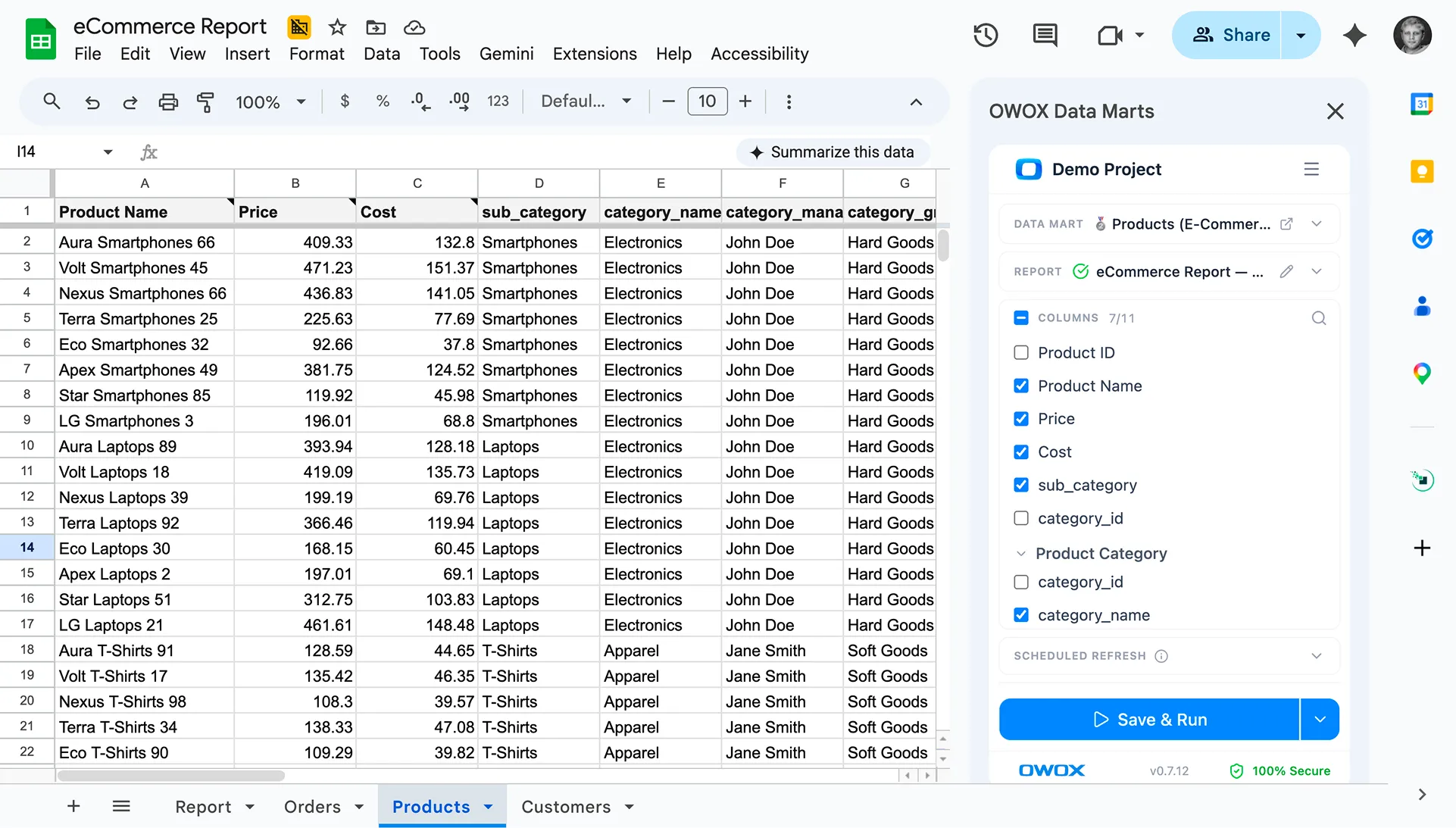
- Spreadsheets (Google Sheets, Excel) can connect via add-ons or connectors so analysts and managers can explore governed data without exporting CSVs.
- Collaboration tools like Slack or Microsoft Teams can surface alerts, metric digests, and simple “ask a question” experiences backed by the same data marts.
- AI-driven analysis – becomes more reliable when it’s powered by standardized, high-quality data marts instead of noisy raw data.
OWOX Data Marts is designed to sit between your warehouse and these interfaces, so you can expose trustworthy, optimized data marts and AI insights without rebuilding for each tool.
Try OWOX Data Marts on Snowflake or BigQuery Without Rework
If you already run Snowflake or BigQuery, you don’t need to re-platform to get governed self-service analytics:
- Connect your existing warehouse to OWOX Data Marts.
- Define or import your core domain data marts and metrics.
- Expose them to BI tools, spreadsheets, and collaboration platforms as a single, governed layer.
This lets you standardize metrics, control warehouse usage, and reduce lock-in risk while keeping your current data stack intact.
If you want to see how a shared data mart layer would work in your environment, you can get started with OWOX Data Marts for free right now.
Frequently asked questions


.png)


"AI by its nature will hallucinate. You need guardrails so you can trust your data."
"We had six or seven different channels and no single source of truth. It was almost impossible"
"We regained time. And time is the one resource that never comes back."