

What Is Predictive Data Modeling?
Predictive data modeling means using past data to estimate what is likely to happen next, helping analysts forecast outcomes like revenue, churn, demand, or conversion with more confidence.
What Is Predictive Data Modeling?
At its core, predictive data modeling turns historical patterns into forward-looking estimates. Instead of only asking, “What happened?” analysts ask, “What will probably happen next?” That shift is huge for planning, optimization, and decision-making.
Basic idea in plain language
A predictive model looks at known outcomes from the past, finds relationships in the data, and uses those relationships to score or forecast future cases. If a business has years of transaction, campaign, or product data, a model can use it to estimate things like next month’s sales, the chance a lead will convert, or which customers are at risk of leaving.
This is a practical extension of what data analytics is and how it works. The goal is not magic. It is structured probability based on evidence already stored in your systems.
Predictive vs descriptive vs prescriptive analytics
Descriptive analytics explains what already happened. Predictive analytics estimates what is likely to happen. Prescriptive analytics goes one step further and recommends what action to take.
- Descriptive: Last quarter paid search brought 20% of conversions.
- Predictive: This campaign is likely to miss its conversion target next week.
- Prescriptive: Shift budget to higher-performing audiences and channels.
In real reporting stacks, these three often work together. Teams first organize and explain performance, then forecast it, then decide how to respond.
Key Components of a Predictive Data Model
Every predictive model has a few building blocks. Get these right, and the model becomes useful. Get them wrong, and even a fancy algorithm will produce noisy results.
Target variable (what you predict)
The target variable is the outcome you want to estimate. It could be revenue, probability of churn, number of orders, or whether a user will convert within seven days. A clear target keeps the modeling process focused and measurable.
The target also determines the type of model you need. Predicting a number, such as weekly sales, is different from predicting a category, such as churned versus retained.
Features (what you use to predict)
Features are the inputs the model uses to make predictions. These can include traffic source, product category, purchase history, session count, geography, discount level, or time since the last order. Good features capture meaningful signals related to the target.
This is where understanding raw data and why it matters becomes critical. Raw source data often needs to be standardized, joined, and transformed before it becomes reliable model input.
Training, validation, and test data
Models should not be evaluated on the same data used to train them. Analysts usually split data into training, validation, and test sets.
- Training data is used to fit the model.
- Validation data helps tune settings and compare approaches.
- Test data provides a final, more honest performance check.
This setup reduces the risk of overfitting, where a model memorizes the past but fails on new data.
Common algorithms (regression, trees, time series, etc.)
The best algorithm depends on the question and the shape of the data. Linear and logistic regression are popular because they are interpretable and practical. Decision trees and tree-based ensembles can capture more complex relationships. Time series models are useful when trends, seasonality, and calendar effects matter.
The exciting part is not choosing the most advanced method. It is choosing the method that matches the business problem, the data volume, and the reporting needs.
How Predictive Data Modeling Works in Practice
Predictive modeling in analytics is rarely a one-click process. It is a workflow that combines data engineering, statistical thinking, business context, and constant validation.
Data preparation and feature engineering
Before any model is trained, analysts clean source data, handle missing values, align date ranges, remove duplicates, and create useful derived fields. They may aggregate daily transactions into weekly metrics, calculate rolling averages, or encode campaign dimensions into model-friendly features.
This stage often takes the most effort. Strong models are usually built on strong prep work, which is why data preparation and cleaning is such a decisive part of the analytics process.
Model training and evaluation
Once features and targets are ready, the model is trained on historical data. Analysts then evaluate how well it predicts unseen cases using metrics that fit the task. For numeric forecasts, they may look at forecast error. For classification tasks like churn risk, they may review precision, recall, or ranking quality.
Evaluation should always connect back to business usefulness. A model can score well in technical terms but still fail if it is hard to interpret, too slow to update, or impossible to operationalize.
Deployment into dashboards and reports
A predictive model becomes valuable when its outputs appear where teams already work. That often means writing forecasted values, propensity scores, or risk labels back into warehouse tables that feed BI dashboards, planning reports, or campaign monitoring views.
Instead of showing only actual performance, dashboards can include expected revenue, likely demand, or accounts with the highest churn probability. That gives decision-makers something better than hindsight.
Typical pitfalls for analysts
Common mistakes include using leaked variables that would not be available at prediction time, ignoring changing business conditions, and relying on stale training data. Another major pitfall is building a model no stakeholder can actually use.
Predictive work should challenge assumptions, not create false certainty. If the business process changes, the model may need to change too. Fast.
Examples of Predictive Data Modeling in Analytics
Predictive modeling shows up across marketing, sales, and customer analytics. The use cases are practical, measurable, and often directly tied to budget decisions.
Marketing and campaign performance
Marketing analysts use predictive models to estimate conversion probability, return on ad spend, or the likelihood that a campaign will hit pacing goals. Features might include channel, audience, creative type, weekday, spend level, and historical conversion lag.
These outputs help teams prioritize campaigns before performance problems become obvious in the rearview mirror.
Sales and revenue forecasting
Revenue forecasting is one of the most common predictive use cases. Analysts combine historical orders, seasonality, promotions, and pipeline signals to estimate future sales by week, month, region, or product line. If you want a broader foundation, it helps to review sales forecasting methods alongside modeling techniques.
Example: A retail analyst builds a weekly revenue forecast using past transactions, holiday flags, and ad spend. The model writes predicted revenue into a reporting table, and finance compares forecast versus actual each Monday. If a region is expected to underperform, the team can react before the month closes.
Customer behavior and churn risk
Churn models score customers based on signals such as declining purchase frequency, lower engagement, support activity, or longer gaps between orders. The output is often a risk score or probability that can be used in CRM or retention reporting.
Analysts can also predict repeat purchase likelihood, upsell potential, or expected customer lifetime behavior. The trick is to make scores understandable and actionable, not just statistically interesting.
Predictive Data Modeling in Data Warehouses and Data Marts
Modern predictive workflows depend on data infrastructure just as much as they depend on algorithms. Clean pipelines, trusted tables, and accessible outputs are what make model results usable across teams.
Where models live in the modern data stack
In many organizations, source data lands in cloud storage or a warehouse, transformations prepare curated datasets, and modeling happens in notebooks, SQL-based workflows, or integrated analytics environments. This setup often fits broader modern analytics architectures like data lakehouses, where raw and structured data support both analysis and modeling.
The exact toolset varies, but the pattern is familiar: centralize data, prepare features, train models, then publish outputs back into governed tables.
Storing model outputs in data marts for BI and reporting
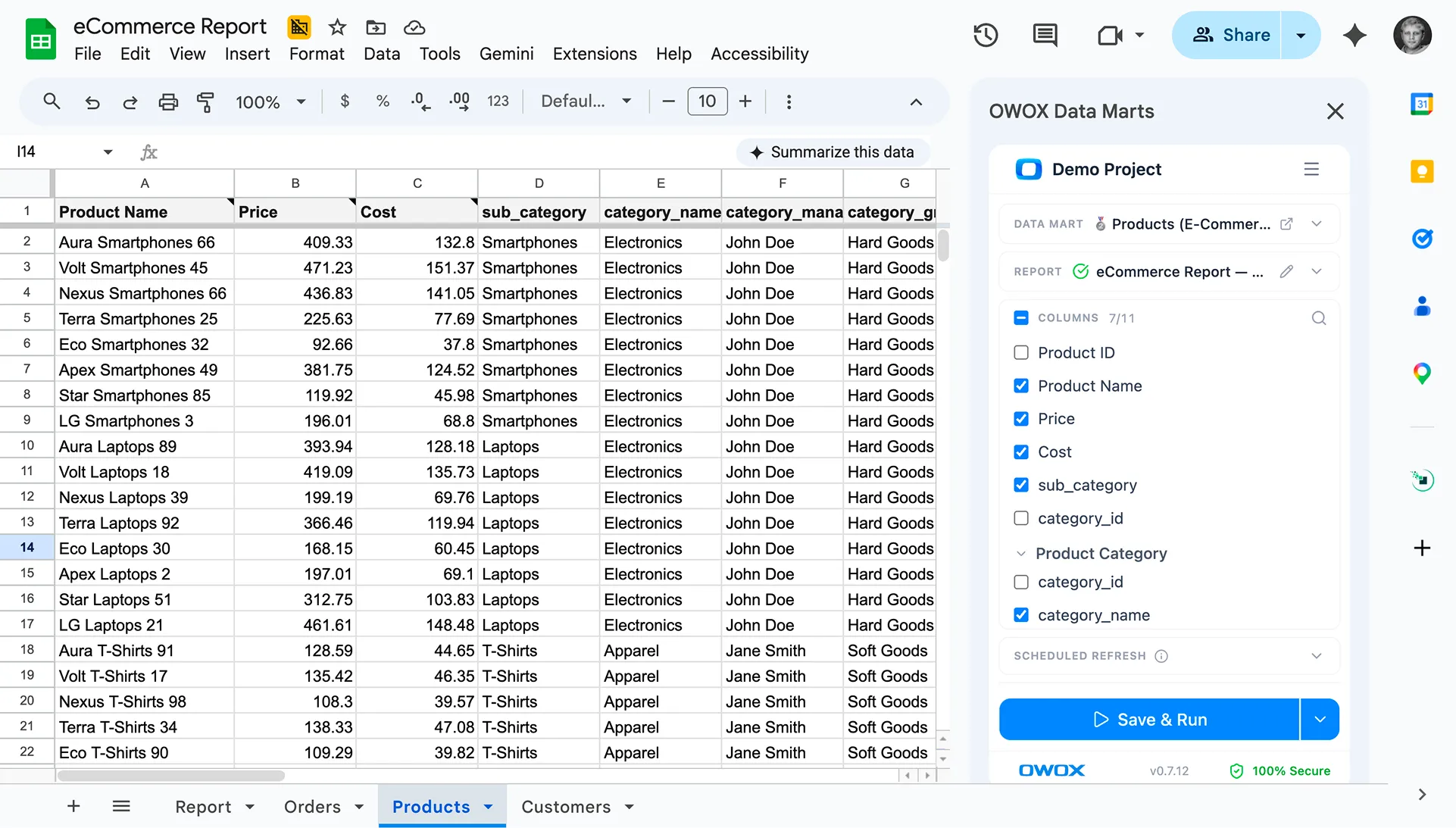
Data marts are a strong home for prediction results because they present business-ready tables to downstream dashboards. Instead of exposing raw model artifacts, analysts can publish clear fields such as forecast_amount, churn_risk_band, or expected_conversion_rate.
This makes predictive outputs easier to join with dimensions like campaign, region, product, or customer segment. BI users get the benefit of model insights without needing to understand the modeling logic in detail.
How OWOX Data Marts fit into predictive workflows
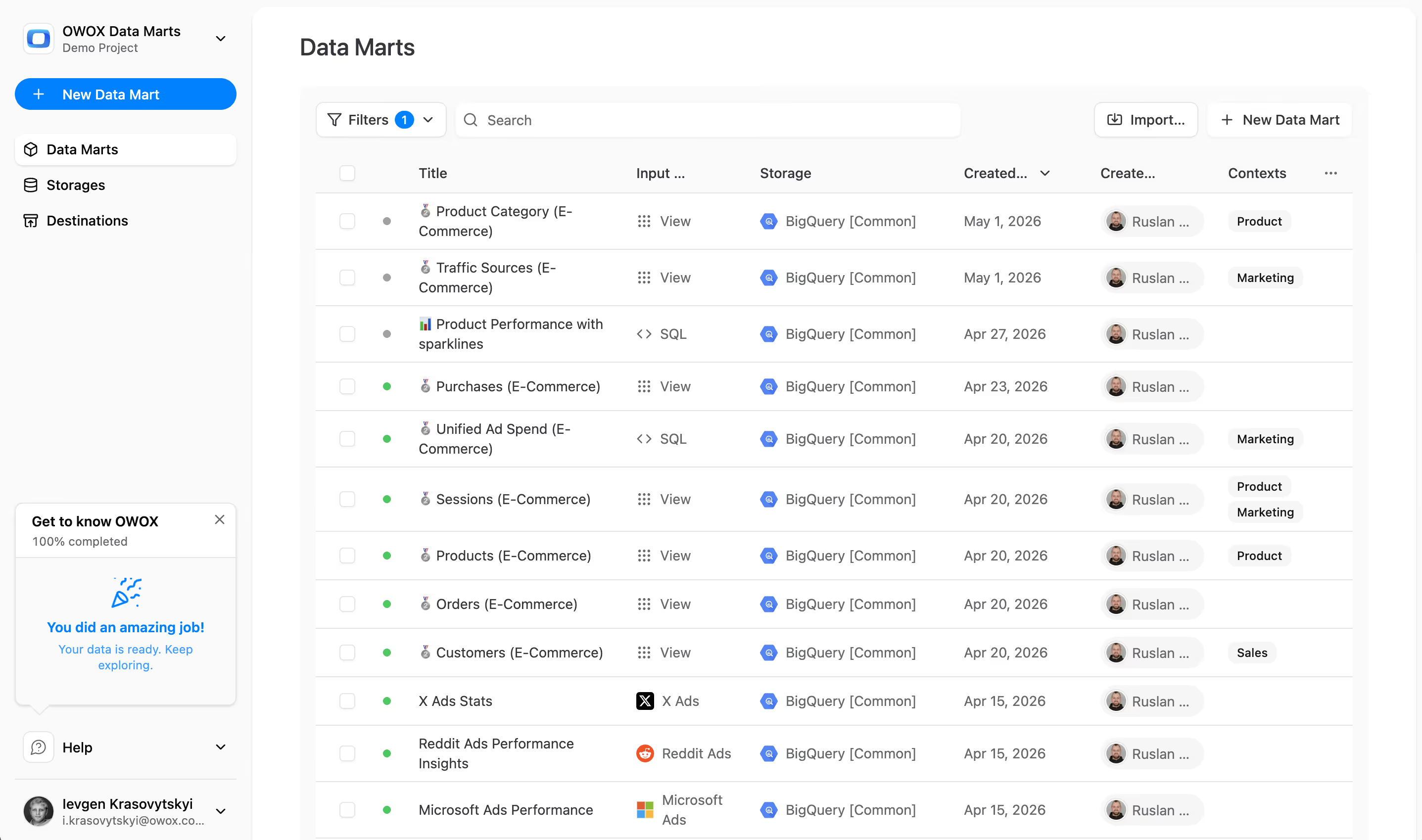
OWOX Data Marts can support the reporting side of predictive workflows by organizing model-ready data and making prediction outputs easier to consume in BI. Analysts can structure marts around business entities and metrics, then use those curated datasets for forecasting, scoring, and dashboarding.
That means predictive insights do not stay trapped in notebooks. They become part of regular reporting, planning, and performance review.
Best Practices for Reliable Predictive Models
Useful predictive models are not just accurate once. They stay trustworthy over time, survive changing conditions, and communicate their limits clearly.
Data quality and freshness requirements
Prediction quality depends on input quality. If source systems are delayed, inconsistent, or incomplete, model outputs will drift away from reality. For many business cases, freshness matters just as much as historical depth, especially when demand, traffic, or customer behavior changes quickly.
That is why teams should align modeling workflows with strong standards for data freshness for better decisions.
Model monitoring and recalibration
Models degrade. New products launch, channels change, seasonality shifts, and customer behavior evolves. Analysts should regularly compare predictions with actual outcomes, track error trends, and retrain or recalibrate when performance drops.
Monitoring should be built into the workflow, not treated as an afterthought. A model that worked six months ago is not automatically safe today.
Communicating uncertainty to stakeholders
Predictions are probabilities, not promises. Stakeholders should know the expected range, confidence level, and major assumptions behind a forecast or score. Presenting a single number without context can create overconfidence and bad decisions.
The strongest analysts combine technical rigor with honest communication. They explain what the model suggests, where it is reliable, and where human judgment still matters.
Want to turn predictive outputs into reporting-ready tables faster? Explore OWOX Data Marts for cleaner analytics workflows and easier delivery of BI-ready data.
%202.png)



"AI by its nature will hallucinate. You need guardrails so you can trust your data."
"We had six or seven different channels and no single source of truth. It was almost impossible"
"We regained time. And time is the one resource that never comes back."