

What Is the DATE_DIFF Function in SQL?
The DATE_DIFF function in SQL tells you how much time passed between two dates or timestamps, making it a go-to tool for measuring durations like days since purchase, hours between events, or months in a customer lifecycle.
What is the DATE_DIFF function in SQL?
Time is everywhere in analytics, and DATE_DIFF is one of the simplest ways to turn raw timestamps into useful business signals. Analysts use it to compare two points in time and return the gap in a specific unit, such as days, weeks, or hours.
General idea and purpose
At its core, DATE_DIFF answers one question: how far apart are these two dates? That sounds basic, but it powers a huge share of reporting logic. It helps you calculate delivery delays, customer recency, onboarding speed, subscription age, and campaign run time without building messy manual formulas.
Instead of eyeballing dates in a table, you can turn them into a clean metric that is easy to filter, group, and chart. That is why DATE_DIFF shows up constantly in dashboards, retention models, and warehouse transformations.
Different names in different SQL dialects (DATEDIFF, DATE_DIFF, DATE_DIFF())
Here is where things get fun: not every SQL engine names or structures this function the same way. Depending on the platform, you may see DATEDIFF, DATE_DIFF, or the same name with a different parameter order.
That means the idea is consistent, but the exact syntax is not. BigQuery commonly uses DATE_DIFF, while SQL Server often uses DATEDIFF. Snowflake also supports DATEDIFF. If you switch between tools, always check the local documentation before pasting a query.
Basic syntax and parameters
The function usually needs three things: a start value, an end value, and a unit. The engine then returns an integer that represents the difference in that unit.
Typical syntax patterns by SQL dialect (BigQuery, Snowflake, SQL Server, etc.)
A common pattern looks like this: DATE_DIFF(end_date, start_date, DAY). In some systems, the unit may come first, like DATEDIFF(day, start_date, end_date). Same mission, different wiring.
This is exactly why syntax checks matter when you work across warehouses. If you generate SQL queries with AI, review the output for the target dialect before running it in production. Small differences in parameter order can flip the result or break the query entirely.
Supported date and timestamp types
DATE_DIFF is typically used with DATE values, but many platforms also support TIMESTAMP or DATETIME variations through related functions or overloaded behavior. In practice, analysts often compare signup_date to order_date, or event_timestamp to conversion_timestamp.
The key is to make sure both arguments are compatible types. Comparing a plain date to a timezone-aware timestamp can produce confusing results unless you cast or normalize the values first.
Common units: day, hour, week, month, year
The most common unit is day, because many business questions are date-based. But hour is useful for operational and product analytics, week helps with cohort reporting, and month or year is common in subscription and lifecycle analysis.
- Day: days since last purchase
- Hour: hours between order and shipment
- Week: weekly retention windows
- Month: customer age in months
- Year: contract duration or account age
Practical use cases for analysts
DATE_DIFF is one of those functions that quietly supports half the metrics in a typical analytics backlog. If you work with event, user, order, or campaign data, you will use it a lot.
Measuring time between events (sign‑up to first purchase)
A classic example is the time from user registration to first order. That number can reveal onboarding friction, acquisition quality, or differences across channels. Shorter gaps often suggest users are getting to value faster.
This logic is also useful inside automation pipelines and stored procedures in SQL, where recurring transformations calculate time-to-convert metrics on a schedule.
Calculating campaign durations and delays
Marketing teams can use DATE_DIFF to measure how long a campaign ran, how many days passed between launch and first lead, or whether reporting updates arrived late. It turns date columns into operational visibility.
For project and media analysis, this helps compare planned versus actual timelines. If one campaign launched three days late and another ran two weeks longer than expected, DATE_DIFF makes that measurable immediately.
Building retention, recency, and cohort metrics
Retention analysis often depends on finding the number of days or weeks since a user’s first event. Recency scoring depends on how long it has been since the latest purchase or session. Cohorts also rely on grouping users by elapsed time from a starting event.
This is where DATE_DIFF goes from handy to essential. It helps create standardized elapsed-time fields that can be reused across models, reports, and segments.
Detecting stale records or inactive users
If you need to find records that have not been updated recently, DATE_DIFF is your friend. Analysts often flag users as inactive if their last_seen_date is more than 30 days ago, or identify stale rows in operational tables where the last_modified timestamp has gone quiet.
That kind of freshness logic is useful for product analytics, CRM cleanup, and data quality monitoring.
DATE_DIFF examples
Let’s make it real with a few common reporting scenarios.
Simple day difference example
If a customer signed up on 2025-01-01 and made their first purchase on 2025-01-06, the day difference is 5. In a dialect like BigQuery, that could look like:
1DATE_DIFF(
2  DATE '2025-01-06',
3  DATE '2025-01-01',
4  DAY
5)
The result helps you create time-to-first-purchase metrics at the user level.
Using DATE_DIFF with timestamps and time zones
Suppose an app stores event timestamps in UTC, but campaign reporting is reviewed in a local business timezone. A user may click just before midnight in one timezone and convert just after midnight in another. That can change the reported day difference.
In those cases, normalize timestamps before calculating the gap. The exact method depends on the SQL engine, but the principle is simple: convert both timestamps to the same timezone or cast them consistently before applying DATE_DIFF.
Combining DATE_DIFF with GROUP BY for reporting
Example: you want to see how quickly users convert after signup, grouped by channel. You can calculate the gap per user, then aggregate by source.
1SELECT
2  acquisition_channel,
3  AVG(
4    DATE_DIFF(
5      first_purchase_date,
6      signup_date,
7      DAY
8    )
9  ) AS avg_days_to_purchase
10FROM
11  users
12GROUP BY
13  acquisition_channel
This kind of reporting turns raw event timing into a comparison metric that is easy to visualize in BI.
Common pitfalls and gotchas
DATE_DIFF is straightforward, but a few edge cases can quietly distort your analysis if you are not careful.
Inclusive vs. exclusive date differences
One frequent surprise is whether the function counts full boundaries crossed or “calendar distance” in the way you expect. For example, from January 1 to January 2 is typically 1 day, not 2. If your business logic expects both start and end dates to be counted, you may need to add 1 manually.
This matters in campaign reporting, contract periods, and SLA tracking where the business definition may differ from the SQL function’s default behavior.
Negative values and argument order
If you reverse the arguments, you may get a negative number. That is not always wrong, but it is often unexpected. A negative result can be useful for spotting impossible timelines, like purchases recorded before signup.
When you see strange negatives, do not just patch them with ABS(). First verify whether the event order is valid and whether the data model respects key constraints in SQL that help preserve consistency across tables.
Dialect differences that break copy‑pasted SQL
Copy-paste SQL is risky here because syntax, unit names, and supported types vary. One engine may accept TIMESTAMP input directly, while another may require a different function. Even the order of parameters can change.
Also, if date columns are masked, shifted, or transformed for privacy, your duration logic may no longer represent real business time. That is why analysts should understand any applied data masking techniques before building delay or recency metrics.
DATE_DIFF in data mart–driven analytics
In a mature warehouse setup, DATE_DIFF is rarely just a one-off calculation. It often becomes part of the reusable semantic layer that powers reporting across teams.
Where DATE_DIFF shows up in typical data marts (user, orders, events)
In user marts, you will see metrics like days since signup or days since last session. In order marts, common fields include fulfillment lag, payment delay, or time between orders. In event marts, analysts use DATE_DIFF to track steps in funnels and product journeys.
To make those calculations reliable, joins between user, order, and event tables must be clean. Strong modeling with primary and foreign keys helps ensure the dates you compare really belong to the same entity.
Using DATE_DIFF‑based fields in BI dashboards and reports
Once calculated in a mart, time-difference fields become powerful dashboard ingredients. You can filter users by recency bucket, chart average days to convert by channel, or monitor delayed shipments by region.
Predefined duration fields also make self-service BI easier. Instead of rewriting logic in every chart, teams can use the same trusted measure across reports.
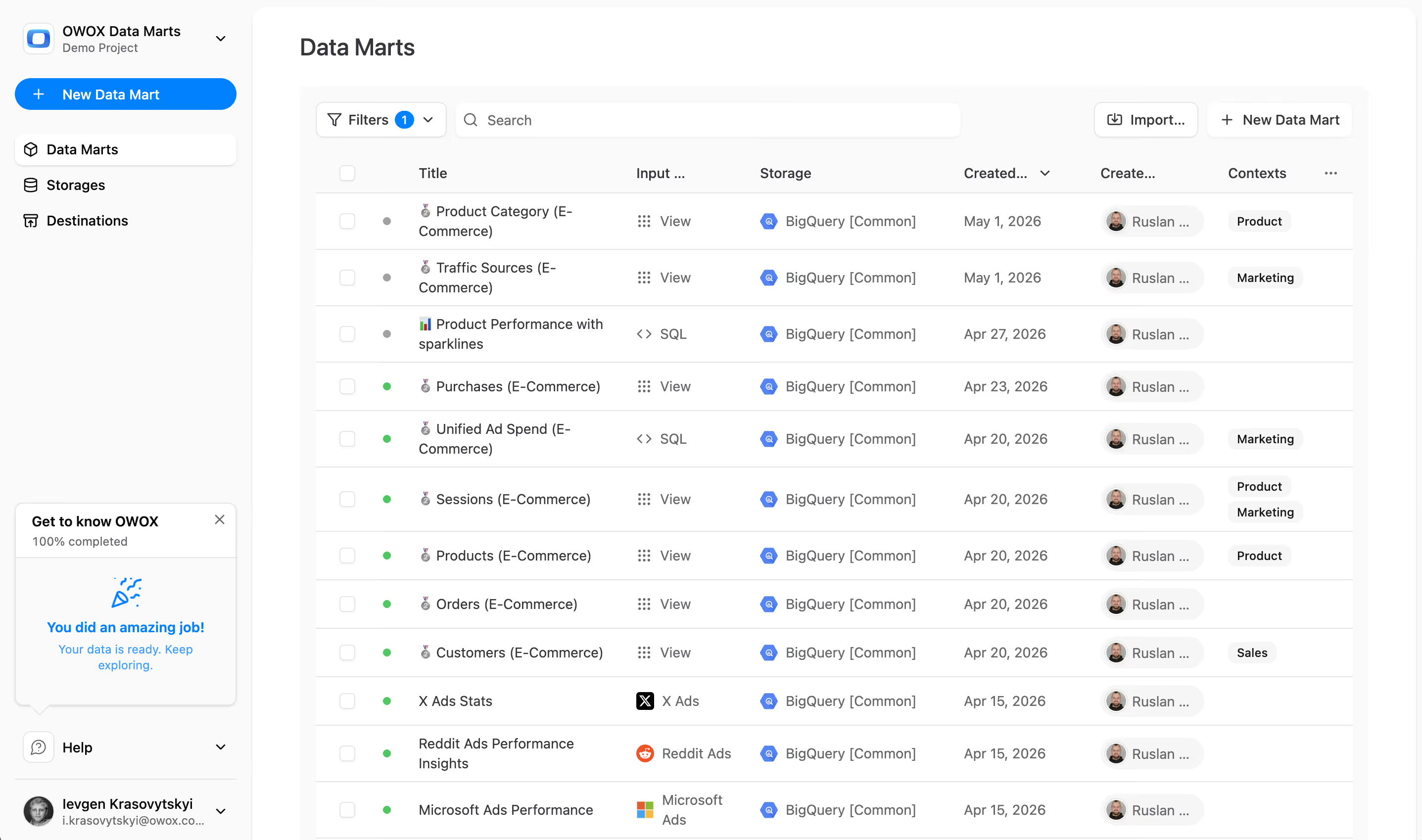
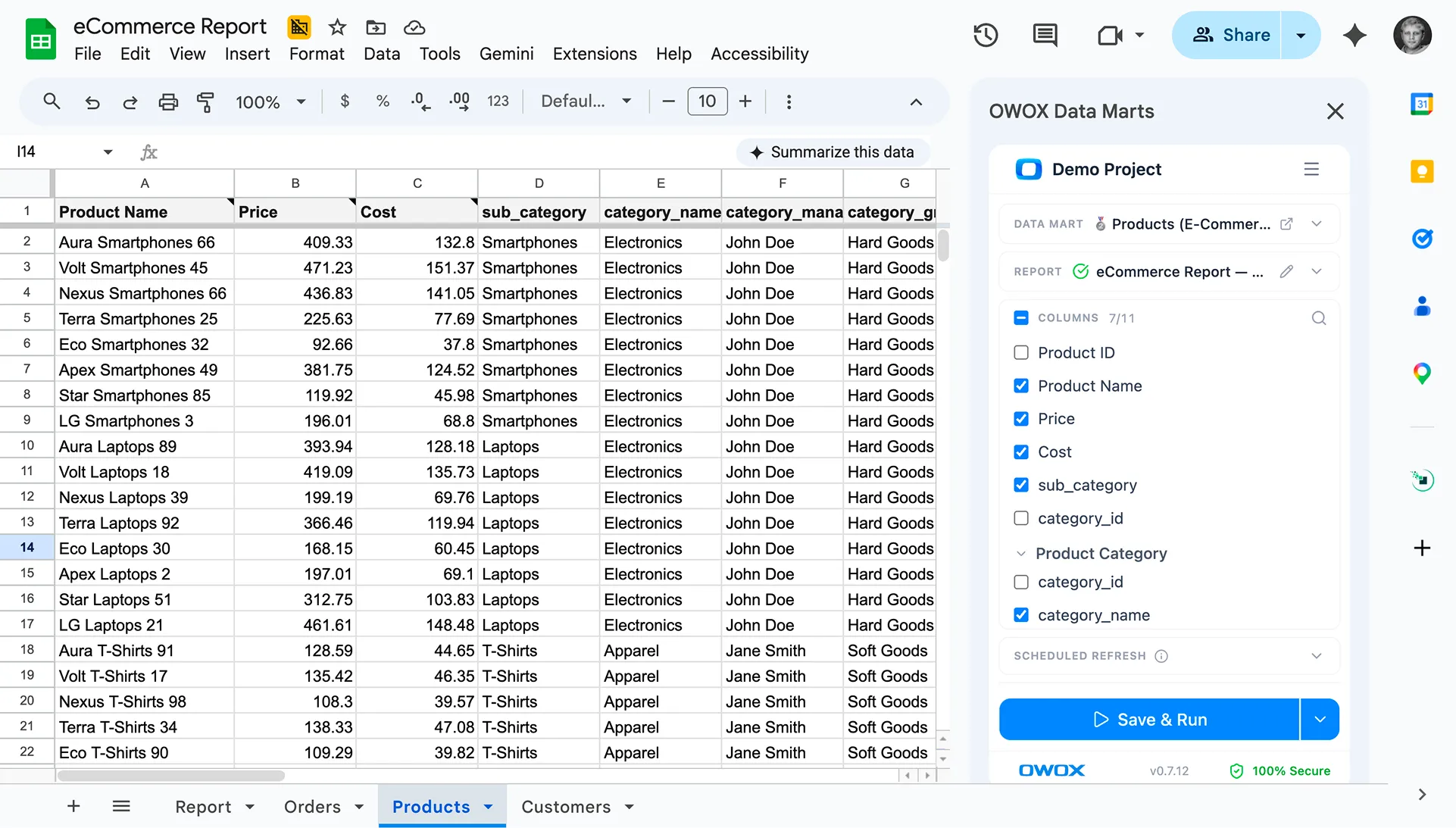
OWOX Data Marts note: building reusable time‑difference metrics
Reusable metrics win. When elapsed-time fields are defined once in a data mart, analysts spend less time rebuilding logic and more time interpreting results. DATE_DIFF is a perfect candidate for that approach because the same business questions come up again and again.
Want cleaner reporting on recency, delays, and time-to-conversion? Build reusable metrics in OWOX Data Marts and keep your date logic consistent across dashboards.
%202.png)



"AI by its nature will hallucinate. You need guardrails so you can trust your data."
"We had six or seven different channels and no single source of truth. It was almost impossible"
"We regained time. And time is the one resource that never comes back."