

What Is the DATE_SUB Function in SQL?
The DATE_SUB function in SQL subtracts a defined time interval from a date or datetime, making it a go-to tool for analysts who need fast, repeatable time-based filters like the last 7 days, previous month, or rolling reporting windows.
What is the DATE_SUB function in SQL?
DATE_SUB is a date function used to move backward in time from a known date value. Instead of hardcoding calendar dates into a query, you can tell SQL to subtract 7 days, 1 month, or 1 year from a reference date and return the adjusted result.
That sounds simple, but it unlocks a huge amount of analytics work. DATE_SUB helps automate recurring reports, create dynamic comparison periods, and keep dashboards current without constant query edits. If you work with campaign data, product events, subscriptions, or revenue reporting, this function shows up everywhere.
It also fits naturally into broader SQL fundamentals like key constraints, because date logic is often combined with joins, filters, and aggregations across multiple related tables.
DATE_SUB syntax and parameters
Before using DATE_SUB in production queries, it helps to understand the core pattern: a date input plus a time interval to subtract.
Basic syntax
The exact syntax depends on the SQL dialect, but the common idea looks like this: a function receives a date or datetime value and an interval expression, then returns the earlier date.
In many systems, you will see patterns such as DATE_SUB(order_date, INTERVAL 7 DAY) or DATE_SUB(CURRENT_DATE(), INTERVAL 1 MONTH). Analysts often pair it with CURRENT_DATE or CURRENT_TIMESTAMP to build relative filters that update automatically every day.
Supported interval types (DAY, MONTH, YEAR, etc.)
Most SQL engines support common interval units such as DAY, WEEK, MONTH, QUARTER, and YEAR. Some also allow HOUR, MINUTE, and SECOND for timestamp-based analysis.
The available options depend on the platform, but these interval types cover the majority of BI and marketing use cases:
- DAY for last 7, 30, or 90 days
- WEEK for weekly trend comparisons
- MONTH for previous month and rolling monthly windows
- QUARTER for business performance reporting
- YEAR for year-over-year analysis
Month and year subtraction can be especially useful because they align better with business reporting than a fixed number of days.
Return type and NULL behavior
DATE_SUB typically returns the same general type as the input. If you pass a DATE, the result is usually a DATE. If you pass a DATETIME or TIMESTAMP, the result often remains a datetime-style value.
If the input date is NULL, the result is usually NULL as well. That matters when you work with incomplete source data or optional event timestamps. In analytics pipelines, NULL-safe logic is important so missing dates do not quietly break filters or distort counts.
Common use cases for DATE_SUB in analytics
DATE_SUB is one of those functions that looks tiny but powers a surprising amount of reporting logic.
Last N days reporting (last 7, 30, 90 days)
This is the classic use case. Analysts use DATE_SUB to filter a table down to the last 7, 30, or 90 days of activity. That makes it ideal for monitoring traffic, conversions, ad spend, retention, and support activity.
Because the filter is relative to the current date, the report stays fresh without manual updates. That is exactly what you want in scheduled dashboards and recurring stakeholder reports.
Previous month and previous year comparisons
DATE_SUB also helps define comparison periods. Want to compare this month’s revenue to last month’s? Need to measure sessions against the same period last year? Subtracting one month or one year gives you a clean starting point.
This makes side-by-side reporting easier and reduces the risk of using mismatched date ranges. It is especially useful for marketing teams tracking seasonality, campaign pacing, and year-over-year performance shifts.
Rolling and cohort windows in marketing analytics
Rolling windows are everywhere in analytics. A rolling 30-day revenue metric, a 14-day active user count, or a 60-day customer reactivation segment all depend on relative date logic.
DATE_SUB is also useful in cohort analysis. For example, you might define a post-acquisition window by checking whether a purchase happened within 30 days of the first visit or signup date. That kind of logic helps marketers measure activation, conversion speed, and customer lifecycle behavior.
DATE_SUB examples in SQL queries
Here is where DATE_SUB gets practical. These examples show how analysts use it in real reporting tasks. If you want help drafting or refining date logic faster, it can also be useful to generate and optimize SQL date queries with ChatGPT.
Filter events from the last 7 days
A simple event filter often looks like this:
1SELECT event_name, COUNT(*) AS events
2FROM analytics.events
3WHERE event_date >= DATE_SUB(CURRENT_DATE(), INTERVAL 7 DAY)
4GROUP BY event_name;
This query keeps only records from the last 7 days and counts events by type. It is perfect for quick trend checks in product and marketing dashboards.
Compare current period vs. previous period
Example: compare revenue from the last 30 days with the 30 days before that. One approach is to define two ranges using DATE_SUB and aggregate each separately.
1SELECT
2SUM(CASE WHEN order_date >= DATE_SUB(CURRENT_DATE(), INTERVAL 30 DAY) THEN revenue ELSE 0 END) AS current_30d,
3SUM(CASE WHEN order_date >= DATE_SUB(CURRENT_DATE(), INTERVAL 60 DAY)AND order_date < DATE_SUB(CURRENT_DATE(), INTERVAL 30 DAY) THEN revenue ELSE 0 END) AS previous_30d
4FROM sales.orders;
This pattern is powerful because it creates aligned windows for fair comparison. No guesswork. No manual date editing. Just repeatable period logic.
Build a rolling 30-day revenue metric
Example: a finance or ecommerce team wants a daily view of rolling 30-day revenue. DATE_SUB can define the moving boundary for each reporting date.
1SELECT report_date,SUM(revenue) AS rolling_30d_revenue
2FROM sales.daily_revenue r1
3JOIN sales.daily_revenue r2
4ON r2.report_date BETWEEN DATE_SUB(r1.report_date, INTERVAL 29 DAY) AND r1.report_date
5GROUP BY report_date;
This is a realistic analytics scenario where each day includes the prior 30-day total. It smooths daily volatility and helps teams spot true performance direction instead of noisy spikes.
DATE_SUB vs alternative date functions
DATE_SUB is not the only way to shift dates, but it is often one of the clearest and most readable options.
DATE_SUB vs manual date arithmetic
Some SQL dialects allow direct arithmetic on dates, such as subtracting an integer number of days. While that can work, DATE_SUB is usually more explicit. It clearly communicates that the query is applying a time interval, not just doing numeric subtraction.
That readability matters in shared analytics codebases. When multiple analysts maintain the same reporting logic, DATE_SUB makes the intent easier to understand and review. It also handles larger units like months and years more naturally than manual arithmetic in many systems.
Differences across SQL dialects (MySQL, BigQuery, etc.)
Here is the catch: SQL date functions are not fully standardized. MySQL, BigQuery, and other platforms may use slightly different syntax, interval formats, or function names for similar operations.
For example, one system may support DATE_SUB with an INTERVAL expression, while another may have separate functions for DATE and TIMESTAMP subtraction. Some dialects are strict about data types, so subtracting from a TIMESTAMP may require a timestamp-specific function rather than a date-only one.
The core concept stays the same, but syntax details matter. When you move queries between environments, always check how the target dialect handles intervals, date boundaries, and return types.
Using DATE_SUB in data marts and BI reports
In modern analytics workflows, DATE_SUB is rarely used in isolation. It is usually part of a bigger reporting layer that powers dashboards, scorecards, and reusable transformed tables.
Typical patterns in marketing and product dashboards
In BI reports, DATE_SUB often appears in filters for recent periods, prior-period comparisons, re-engagement windows, and attribution lookback logic. Marketing dashboards may use it to show leads created in the last 30 days, conversions from the previous month, or active campaigns with spend in the last 7 days.
Product teams use similar logic for active users, feature adoption windows, churn risk flags, and retention milestones. These patterns work best when the underlying data model is stable, which is why designing relational schemas for analytics is so important.
When these queries feed operational reports, teams may also encapsulate date logic and refresh processes through SQL automation. In that case, it helps to understand how to use DATE_SUB inside SQL stored procedures. And when date-based reports include customer-level data, governance still matters, including data masking and governance in SQL.
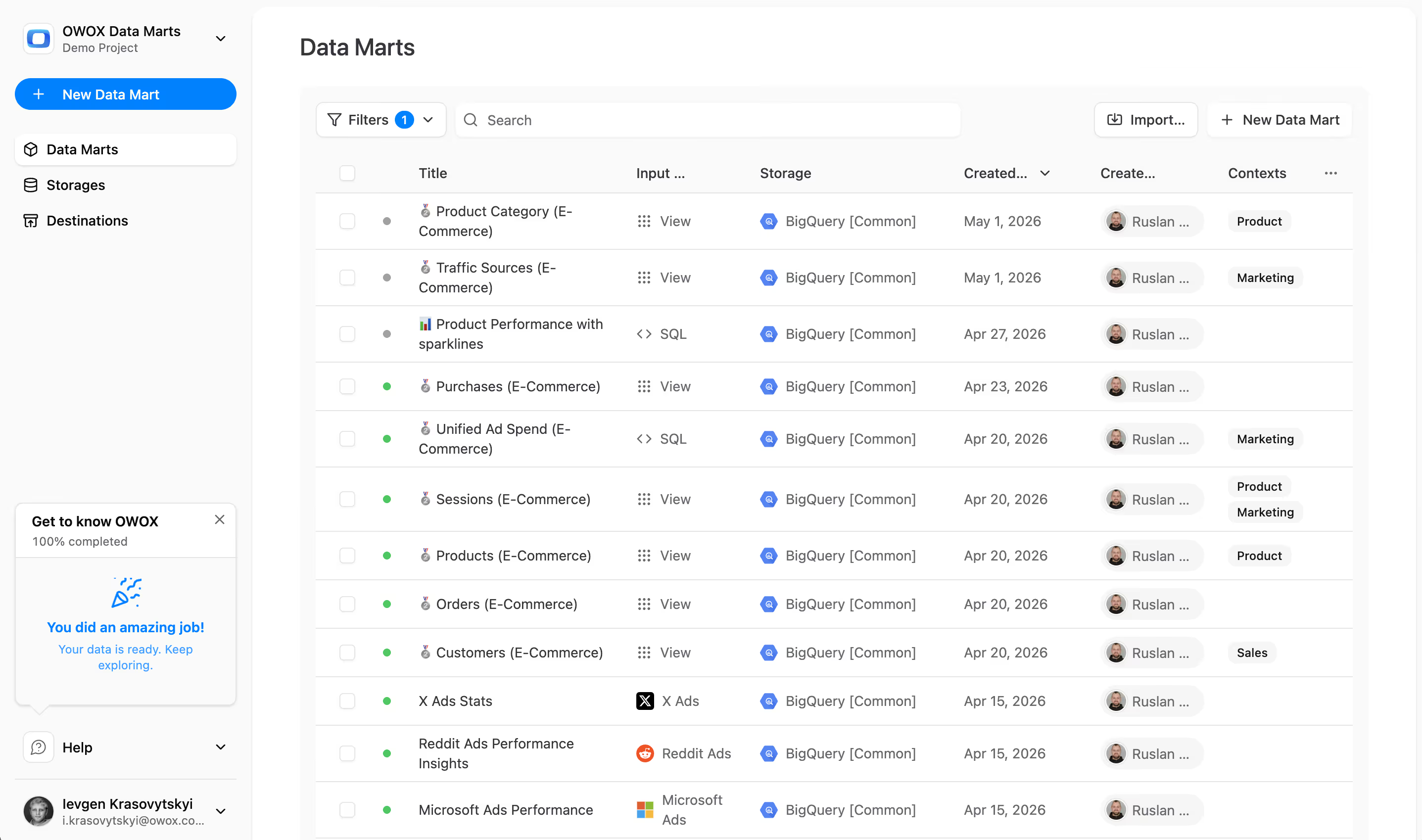
OWOX Data Marts context: how date offsets power ready-to-use reporting tables
In data marts, date offsets help define reusable reporting logic once so dashboards do not have to rebuild it every time. A table might already contain flags for last 7 days, previous month, or rolling 30-day metrics, making BI tools faster and easier to maintain.
That is especially useful when multiple teams need consistent definitions for recent activity, comparison periods, and trend windows. DATE_SUB helps create those standardized cutoffs inside transformation layers, so reports stay aligned instead of drifting across teams.
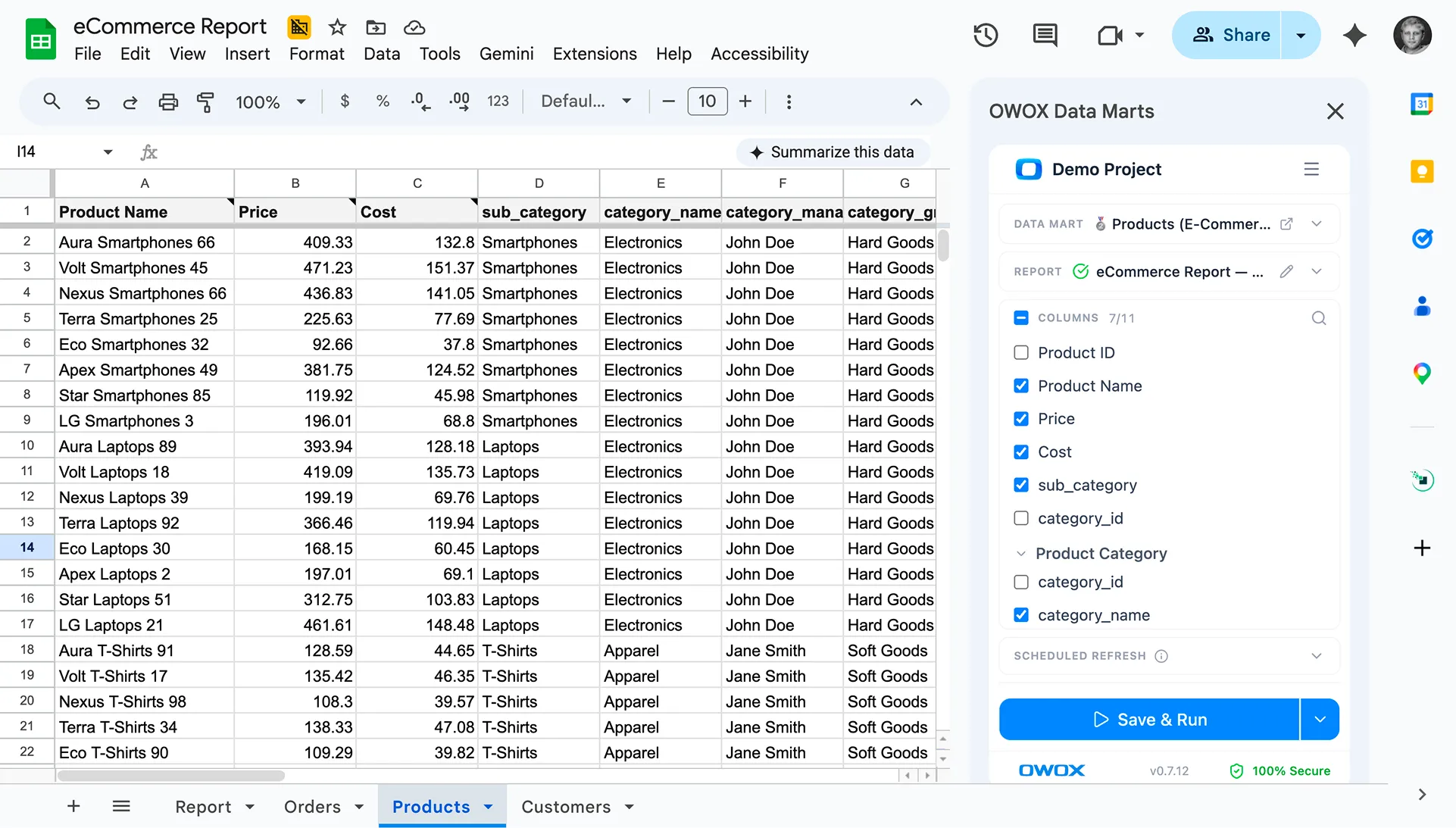
Want cleaner reporting windows without rebuilding date logic in every dashboard? Explore OWOX Data Marts to centralize reporting tables and simplify time-based analytics.
%202.png)



"AI by its nature will hallucinate. You need guardrails so you can trust your data."
"We had six or seven different channels and no single source of truth. It was almost impossible"
"We regained time. And time is the one resource that never comes back."