

What Is the Facebook Ads Access Token?
A Facebook Ads access token is the secure credential that lets an app, script, or data pipeline connect to the Facebook Marketing API and pull ad data for reporting, warehousing, and analysis.
What is a Facebook Ads Access Token?
Think of a Facebook Ads access token as the API pass that proves your tool has permission to request marketing data. Instead of manually exporting reports from the ad platform, analysts use a token to fetch data automatically and move it into dashboards, spreadsheets, or a warehouse.
This matters because modern analytics runs on repeatable pipelines. If you want campaign, ad set, ad, audience, or conversion data to land in SQL tables every day, your connector needs a valid token. Without it, API requests fail, refreshes stop, and reporting breaks right when someone asks for yesterday’s performance.
In practice, the token is tied to a user, page, or system identity and comes with specific permissions. Those permissions define what data you can access and what actions are allowed. For analysts, the key job is usually read access for reliable reporting rather than campaign management.
Types of Facebook Ads Access Tokens
Not all tokens behave the same way. The right one depends on who owns the data, how automated the workflow is, and how often you need to refresh reports.
User access token
A user access token is issued on behalf of a person who has access to the ad account or business assets. This is common when an analyst signs into a connector or authorizes a reporting tool to read campaign data.
It is often useful for quick setup and testing because it reflects the permissions of a real user. But it can also be fragile in production workflows if that user changes roles, loses access, resets credentials, or leaves the company.
Page access token
A page access token is associated with a Facebook Page and is typically used when workflows need page-level data. In marketing analytics, it may support use cases that combine ad data with page interactions or engagement reporting.
For pure ads reporting, a page token is usually not the main credential. Still, it can matter in broader attribution and content-performance setups where paid and owned data need to be analyzed together.
System user (long-lived) token
A system user token is designed for more stable, automated business workflows. This type is often preferred when pipelines run on schedules and should not depend on one employee’s personal login.
Because it is built for server-to-server access, it is a stronger fit for ETL and ELT jobs that load data into a warehouse every day. Analysts and engineers still need to manage it carefully, but it reduces the risk of refreshes failing due to individual user account changes.
How Facebook Ads Access Tokens Are Used in Analytics
Once a token is in place, it becomes the unlock key for a full reporting pipeline. That pipeline can start with API calls and end with clean SQL tables, dashboards, and executive summaries.
Pulling data into a data warehouse
The most common use is extracting data from the Marketing API and loading it into a warehouse such as BigQuery, Snowflake, or another analytics database. Instead of working from static CSV exports, teams can ingest fresh campaign data on a schedule and model it for deeper analysis.
This is where table design starts to matter fast. Clean warehouse structure depends on stable IDs, relationships, and normalized objects. When building ad reporting tables, it helps to understand key constraints in SQL for clean Facebook Ads tables and designing primary and foreign keys for ad, campaign, and account tables.
Scheduling ETL/ELT jobs and SQL reporting
Access tokens are also what make repeatable automation possible. A scheduled connector, script, or orchestration job uses the token to request data at set intervals, such as hourly or daily. That keeps reporting datasets current without manual exports.
After loading, analysts can transform raw API results into reporting-ready models. For example, they may aggregate spend by campaign, join ads data to web sessions, or compare conversion metrics across attribution windows. The token itself is not the analysis, but it is the quiet enabler behind every refresh.
Typical fields and objects you fetch with a token
With the right permissions, teams often fetch objects such as accounts, campaigns, ad sets, ads, creatives, and insights. Common fields include IDs, names, status, spend, impressions, clicks, reach, date ranges, and selected conversion metrics.
Many pipelines pull both metadata and performance data. Metadata gives context like campaign names or objective, while insights provide the metrics needed for trend analysis. Together, they support reporting from account level down to ad level.
- Account and campaign identifiers
- Ad set and ad metadata
- Daily or intraday performance metrics
- Selected breakdowns and attribution-related fields
Security and Best Practices
Access tokens are powerful, which means they deserve the same care as other sensitive credentials in your stack. If token handling is messy, even a well-built pipeline becomes risky.
Where (and where not) to store tokens
Store tokens in secure secret managers, protected environment variables, or controlled credential vaults. They should not live in SQL scripts, notebooks shared across teams, version control, screenshots, email threads, or plain-text documentation.
Even in internal environments, avoid exposing token values in logs or debug output. If your workflow includes staging tables, support tickets, or analyst handoffs, apply the same mindset you would use for data masking for sensitive credentials and identifiers.
Rotation, expiration, and access scope
Tokens can expire, be revoked, or lose usefulness if permissions change. That is why production pipelines need a process for monitoring token validity and refreshing credentials before failures hit dashboards.
Keep scope as narrow as possible. If the pipeline only needs read access for reporting, do not grant broader permissions than necessary. Smaller scope lowers risk and makes permission reviews easier when governance questions come up.
Common mistakes analysts make
One common mistake is treating a token like a permanent setup step instead of a credential with a lifecycle. Another is building a pipeline around a personal user token and assuming it will always keep working.
Analysts also run into trouble when they ignore account relationships, fetch too many fields without a clear schema plan, or fail to handle token errors in scheduled jobs. A few practical habits help:
- Use production-friendly credentials for automated jobs
- Document token ownership and renewal steps
- Limit access scope to what reporting actually needs
- Monitor refresh failures and API authentication errors
Example: Using an Access Token in a Data Pipeline
Here is a realistic pattern: a daily job calls the API with an access token, pulls campaign insights for yesterday, lands the response in a raw table, and then transforms it into a reporting mart.
High-level API call example
A high-level request might ask for campaign insights with fields like campaign_id, campaign_name, date_start, impressions, clicks, and spend. The token is passed as the authentication credential, and the API returns structured results for the selected account and date range.
From there, the pipeline usually writes the raw payload into a landing table before applying transformations. If refreshes run on a schedule, teams often use stored procedures for scheduled Facebook Ads data refreshes to standardize load logic and reduce manual work.
Loading data to a table and querying with SQL
Once loaded, the raw data can be transformed into a table like facebook_ads_campaign_daily with one row per campaign per day. That table might include account_id, campaign_id, report_date, impressions, clicks, spend, and conversions, depending on the available fields.
An analyst could then run a SQL query to compare daily spend and click-through trends by campaign, join it to website conversion tables, or build a model for return on ad spend. If the team wants to speed up query creation, they may generate SQL queries for your Facebook Ads mart and adapt them to the warehouse schema.
This setup is simple but powerful: token for access, API for extraction, warehouse for storage, SQL for analysis. That is the pipeline game in one clean loop.
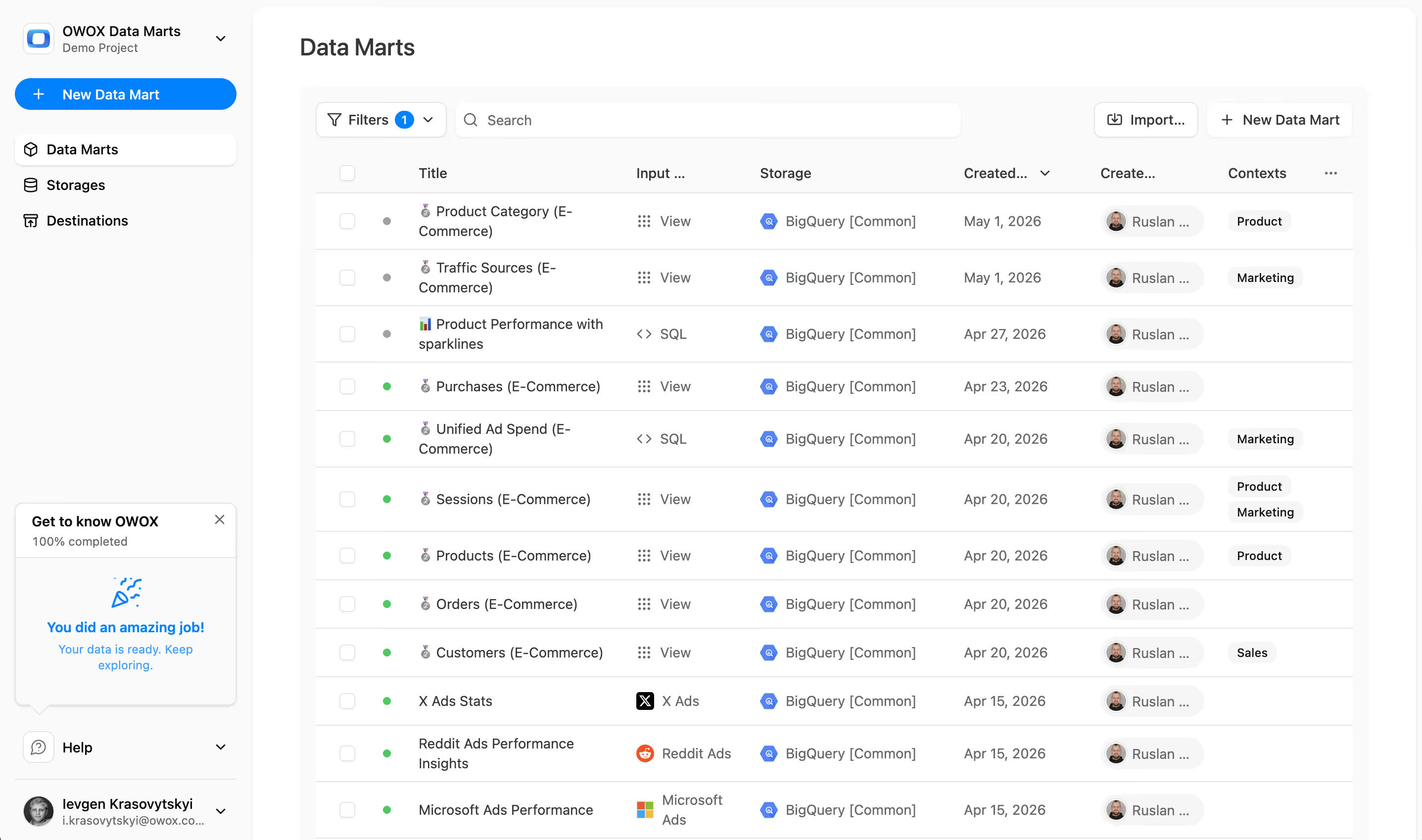
Where Facebook Ads Access Tokens Fit in OWOX Data Marts Workflows
In OWOX Data Marts workflows, a Facebook Ads access token fits at the ingestion layer. It is the credential that allows data collection from the source before modeling, joining, and reporting begin.
Once the token-backed connection is working, the bigger analytics job becomes structure and consistency: landing raw data, organizing campaign hierarchies, shaping warehouse tables, and building reusable SQL logic. The token opens the door, but the value comes from what happens after the data enters the mart.
If you want to streamline Facebook Ads ingestion and build cleaner reporting datasets faster, explore OWOX Data Marts. It’s a practical way to connect source data, shape your marketing data mart, and support repeatable SQL reporting workflows.
%202.png)



"AI by its nature will hallucinate. You need guardrails so you can trust your data."
"We had six or seven different channels and no single source of truth. It was almost impossible"
"We regained time. And time is the one resource that never comes back."