

What Is the SAFE_CAST Function in SQL?
SAFE_CAST is a SQL function that changes one data type into another without crashing your query when the value is invalid, returning NULL instead of an error so reports and dashboards keep running.
What is SAFE_CAST in SQL?
In analytics work, data is rarely clean. A field that should contain numbers may suddenly include text, blanks, or strange symbols from tracking bugs, imports, or manual edits. SAFE_CAST is built for exactly this kind of chaos.
It works like a safer version of CAST. Instead of stopping the whole query when conversion fails, it returns NULL for the bad value and lets the rest of the rows continue. That makes SAFE_CAST especially useful in reporting, data preparation, and transformation layers where stability matters.
For analysts, this means fewer broken scheduled jobs and less panic when a source system sends unexpected formats. It is not magic, but it is a strong defensive move when working with real-world data.
How SAFE_CAST Works (vs CAST)
At a high level, both CAST and SAFE_CAST try to convert data from one type to another. The difference shows up the moment the input value does not match the target type.
Syntax and basic examples
The syntax is simple: SAFE_CAST(expression AS target_type). If the expression can be converted, you get the converted value. If it cannot, you get NULL.
Imagine a column called order_value stored as text. Some rows contain valid numbers like "125.50", while others contain values like "N/A". SAFE_CAST lets you convert the valid rows without breaking on the invalid ones.
- SAFE_CAST('125.50' AS NUMERIC) returns 125.50
- SAFE_CAST('N/A' AS NUMERIC) returns NULL
- CAST('N/A' AS NUMERIC) would raise an error
The same pattern applies to dates, integers, timestamps, and other target types. It is a small change in syntax, but it can completely change how resilient a query is.
SAFE_CAST vs CAST: key differences for analysts
CAST is strict. SAFE_CAST is forgiving. That is the big difference.
When analysts build dashboards, recurring reports, or transformation queries, strict behavior can be risky if the upstream data source is inconsistent. One malformed row can fail the whole job. SAFE_CAST protects the query by isolating bad values instead of turning them into full query failures.
That said, SAFE_CAST should not replace good modeling or validation. If a column is supposed to be numeric, the long-term fix is to enforce quality earlier with schema rules, validation logic, or key constraints and data integrity in SQL. SAFE_CAST is your defensive layer, not your excuse to ignore messy inputs forever.
When to Use SAFE_CAST in Analytics Queries
SAFE_CAST shines when you need stable outputs from unstable sources. That is a very common situation in marketing analytics, event tracking, CRM exports, and blended reporting tables.
Handling messy tracking and marketing data
Tracking data often arrives as strings, even when the values really represent numbers, booleans, or dates. Campaign IDs may contain empty strings. Revenue parameters may include currency symbols. Event properties may be populated differently across platforms.
In those cases, SAFE_CAST helps you normalize the data without turning every inconsistency into a hard failure. It is especially useful when loading raw events into reporting models, where you want to preserve as many rows as possible while still creating usable typed fields.
For example, if ad spend is loaded as text, SAFE_CAST can convert valid rows to a numeric field and set invalid rows to NULL. Then you can audit those NULLs separately instead of losing the whole query result.
Protecting scheduled reports and dashboards from type errors
Scheduled reports are ruthless. They run whether your source data is clean or not. If yesterday’s import included one weird value, a normal CAST might break the report refresh and leave stakeholders staring at stale numbers.
SAFE_CAST reduces that risk. It keeps transformations and dashboard queries alive even when a small subset of rows is malformed. This is a huge advantage for recurring BI workloads where consistency matters as much as precision.
Still, analysts should monitor the NULL results created by SAFE_CAST. If they increase over time, that is a signal that the source system needs attention. Stability is great, but visibility is even better.
Examples of SAFE_CAST in Real Queries
Let’s make it practical. SAFE_CAST is most valuable when the source columns look structured but behave unpredictably.
Converting strings to numbers and dates safely
Suppose you have a raw transactions table where amount_text and purchase_date_text are stored as strings. Some values are valid, some are not.
Example:
1SELECT
2order_id,
3SAFE_CAST(amount_text AS NUMERIC) AS amount,
4SAFE_CAST(purchase_date_text AS DATE) AS purchase_date
5FROM raw_transactions;
This query keeps all rows. Valid values become typed fields. Invalid values become NULL. That is often better than failing the entire transformation.
If you are building or testing this kind of query, it can also help to generate and debug SQL queries with AI before moving the logic into production workflows.
Cleaning event and marketing attribution data
Marketing attribution tables are full of edge cases. UTM parameters may be blank, session IDs may be numeric in one source and text in another, and conversion values may include placeholders like "unknown". SAFE_CAST gives you a way to standardize these fields more safely.
Imagine a raw events table where conversion_value is captured as text:
1SELECT
2event_date,
3source,
4medium,
5campaign,
6SAFE_CAST(conversion_value AS NUMERIC) AS conversion_value_num
7FROM raw_marketing_events;
Now invalid conversion values do not destroy the report. You can still aggregate valid conversions, inspect NULL rows, and decide whether the issue came from tracking setup, a connector, or data entry.
This is especially helpful in attribution reporting, where one malformed value should not wipe out your daily performance view.
Common Pitfalls and Best Practices
SAFE_CAST is powerful, but it can also hide issues if you use it blindly. Smart analysts use it as a guardrail, not a blindfold.
When SAFE_CAST hides problems you should actually fix
The biggest pitfall is silent data loss. When conversion fails, SAFE_CAST returns NULL. If you never check how many NULLs were introduced, you may undercount revenue, conversions, or user activity without realizing it.
That is why it is good practice to measure failure rates. Compare total rows with successfully converted rows. If the gap is large, the problem is upstream and should be fixed at the source or in transformation logic.
This matters even more when working with sensitive fields. If you are transforming protected columns, pair safer casting with solid handling rules such as data masking for sensitive fields so operational safety does not come at the cost of governance.
Combining SAFE_CAST with WHERE and CASE
SAFE_CAST becomes even more useful when combined with filtering and conditional logic. You can use it in WHERE clauses to keep only rows that converted successfully, or in CASE expressions to classify invalid values.
For example, a pattern like this is common:
1CASE
2WHEN SAFE_CAST(user_age AS INT64) IS NULL THEN 'invalid_age'
3ELSE 'valid_age'
4END
You can also filter out failed conversions when needed:
1WHERE
2  SAFE_CAST(order_total AS NUMERIC) IS NOT NULL
If this logic is part of repeatable ETL or warehouse automation, many teams place it inside reusable scripts or use SAFE_CAST inside SQL stored procedures to keep transformations consistent.
Performance notes in large data warehouses
SAFE_CAST is convenient, but it still performs work on every row where it is used. In large data warehouses, repeated casting on massive raw tables can add overhead, especially if it appears in joins, filters, or deeply nested transformations.
A practical approach is to cast once in a staging or intermediate model, then reuse the typed field downstream. This keeps reporting queries simpler and often easier to maintain.
Also remember that applying SAFE_CAST in filters may reduce optimization opportunities depending on the warehouse and query structure. If performance matters, test whether it is better to clean and type data earlier in the pipeline instead of casting repeatedly at report time.
SAFE_CAST in Data Marts and Reporting Pipelines
In mature analytics setups, SAFE_CAST is often most valuable before the dashboard layer even begins. It belongs in the transformation path that turns raw source data into trusted reporting tables.
Using SAFE_CAST in data mart transformation layers
Data marts usually combine inputs from multiple systems, each with its own formatting quirks. One source may store customer_id as text, another as integer. One export may provide dates in proper date format, another as strings. SAFE_CAST helps standardize these inputs while keeping the pipeline resilient.
It is especially useful when aligning fields used for joins, metrics, and dimensions. But caution matters here: if join keys fail to cast and become NULL, relationships can break silently. That is why typed key fields should be validated alongside concepts like primary and foreign keys in SQL during modeling.
Used well, SAFE_CAST makes transformation layers more stable and easier to troubleshoot because bad records are contained instead of taking down the entire load.
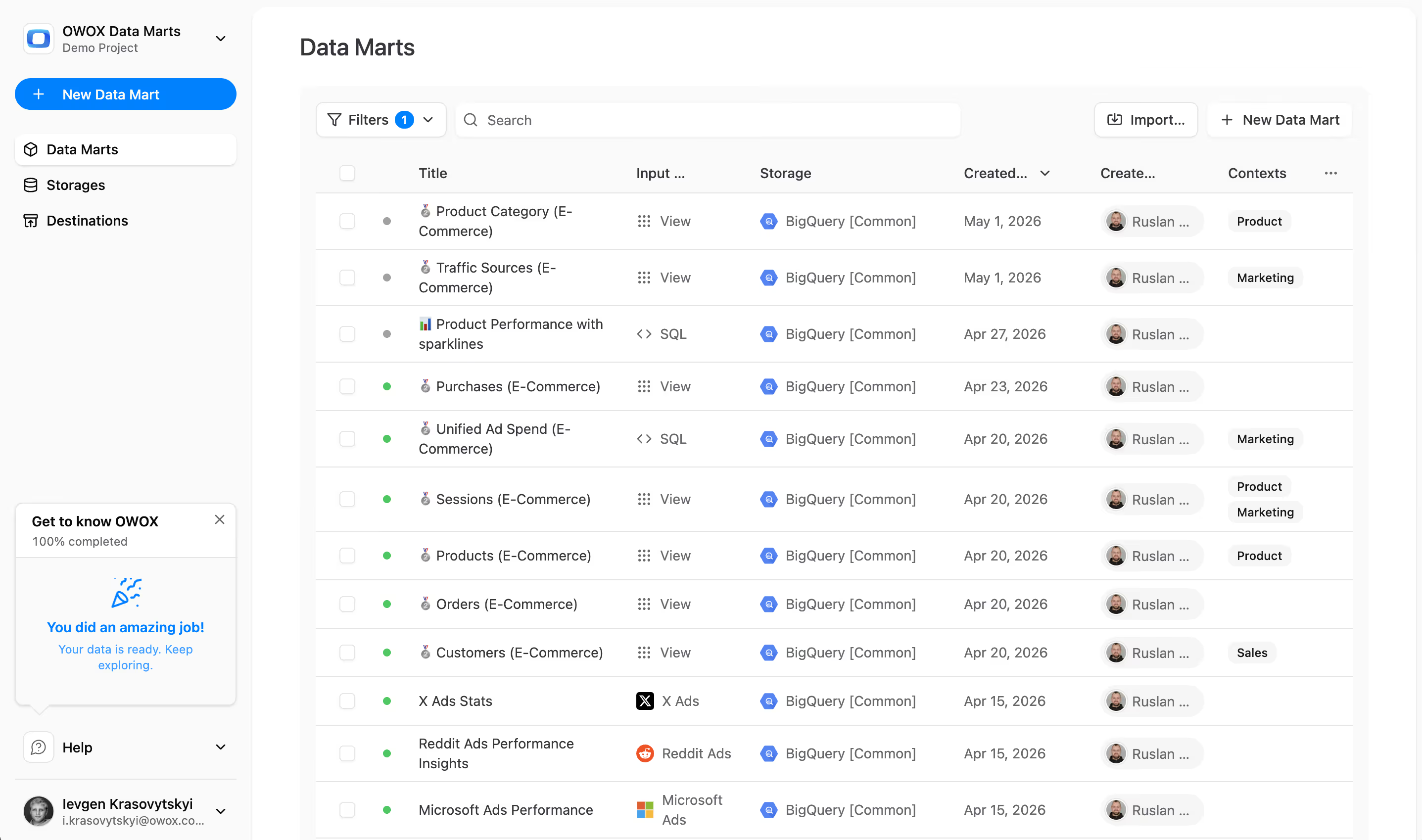
OWOX Data Marts context: keeping reports stable with safer type casting
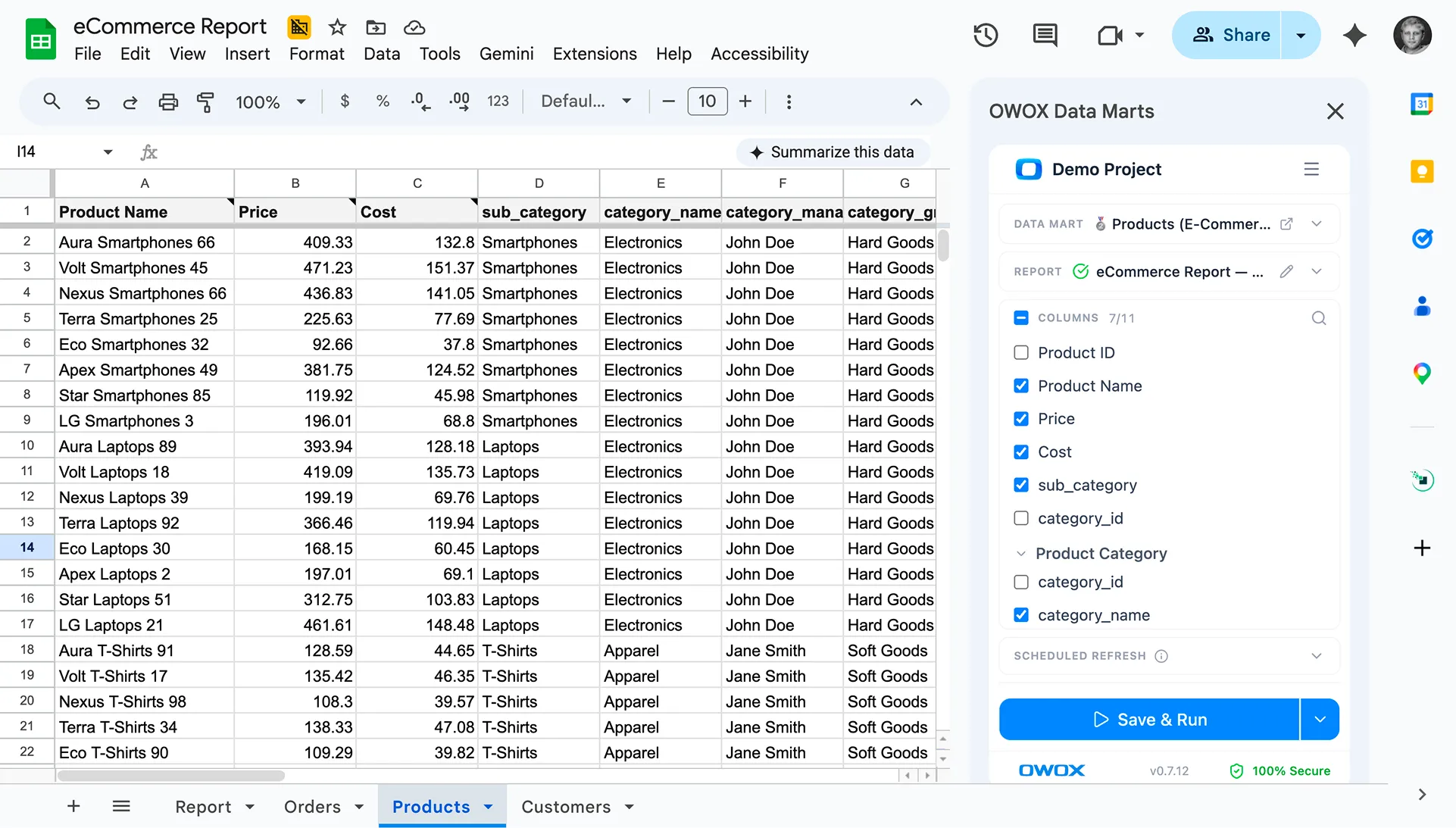
In a data mart workflow, the goal is not just to load data but to make it consistently report-ready. SAFE_CAST supports that goal by turning fragile raw fields into safer typed columns for downstream analysis.
That means analysts can build reporting tables that tolerate occasional source issues while still surfacing invalid records for review. It is a practical pattern for keeping business reporting stable, especially when pipelines bring together marketing, product, and revenue data from different origins.
Want a cleaner way to shape reporting-ready tables? Build safer transformations and data marts with OWOX Data Marts, and turn messy source fields into analysis-friendly models. If you are ready to streamline warehouse reporting, start with data mart workflows built for reliable analytics.
%202.png)



"AI by its nature will hallucinate. You need guardrails so you can trust your data."
"We had six or seven different channels and no single source of truth. It was almost impossible"
"We regained time. And time is the one resource that never comes back."