LTV:CAC ratio: formula, benchmarks and what the number tells you
The LTV:CAC ratio is customer lifetime value divided by customer acquisition cost. How to calculate both sides, what 3:1 means, and where the calculation goes wrong.

The LTV:CAC ratio compares what a customer is worth over the whole relationship with what it cost to win them:
LTV:CAC = customer lifetime value / customer acquisition cost
If a customer brings $900 over their lifetime (LTV) and cost $300 to acquire (CAC), the ratio is 3:1. A ratio of 3:1 is the usual benchmark for a healthy business. Below 1:1, each new customer costs more than they will ever return.
CAC and LTV are two halves of one question: is growth paying for itself? CAC alone can look fine while customers leave after one order, and LTV alone can look fine while acquisition gets more expensive every month. The ratio puts them side by side.
The rest of this article covers how to calculate each half, how to read the result, and where the calculation usually goes wrong.
What the LTV:CAC ratio shows
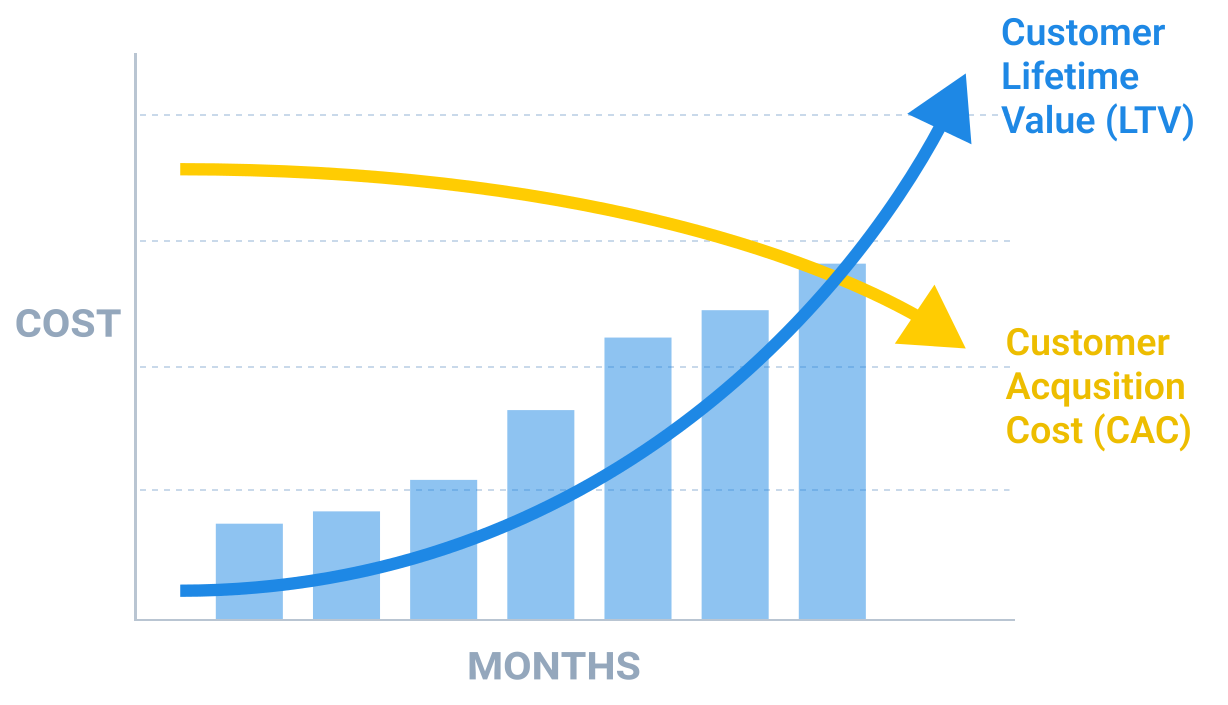
The LTV to CAC ratio compares how much money a customer brings in during their lifetime (LTV) to how much it costs to acquire that customer (CAC). Therefore, it shows if gaining customers is profitable or not.
What is the customer lifetime value?
What is the customer lifetime value?
Customer Lifetime Value (LTV) is the estimated total profit that a business expects to earn from a customer over their entire relationship. It takes into account not only the initial purchase but also any additional purchases, referrals, and cross-selling.
LTV helps businesses understand the long-term value of a customer and guides decisions regarding marketing budgets and retention strategies.
OWOX Data Marts
See your first report built in real time. 15 minutes.
- Connect your data warehouse
- Pick your metrics
- Get a live Google Sheets report
In the time it takes to write a ticket. Then imagine never writing that ticket again.
Book a DemoWe'll use your actual use case
Calculating customer LTV
To understand what is a good LTV, let’s take a look at calculations. The LTV calculation SaaS companies normally use is the following:
Relationship time
This method works well for SaaS businesses or marketplaces where customers consistently spend over a specified period, or if you have a subscription-based business. If your monthly revenue per customer is $100, and they spend throughout the year, the LTV calculation would be:
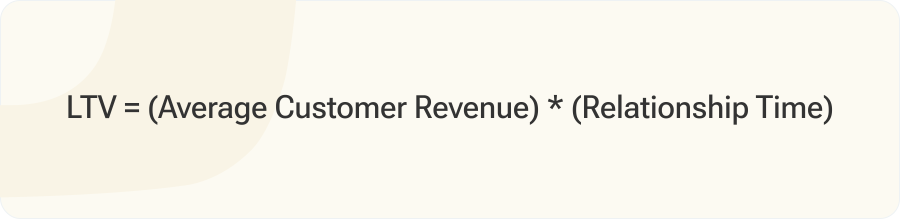
LTV = $100 * 12 = $1,200
If you are an eCommerce or Retail brand, it’s better to use Average Order Value as a basis for calculations:
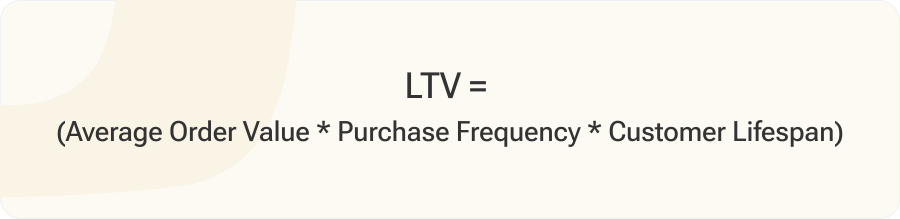
For example, the average order value for an eCommerce business XYZ, is $100, and the average customer shops with them 7 times a year for two years. The lifetime value of this customer is calculated as follows:
LTV = $100 x 7 x 2 = $1,400
Churn rate
If you have a subscription-based model and your average customer revenue is $100 with a churn rate of 15% per month, the LTV calculation would be:

LTV = $100 / 15%
LTV = $666.67
This method focuses on customer retention and is effective for subscription models.
These are just two examples, and there are more methods available to calculate LTV. Having a higher LTV is usually a good thing because it means the customer generates more money for the business over their lifetime. However, what is considered a good LTV can vary from one business to another.
What is the customer acquisition cost?
What is the customer acquisition cost?
Customer Acquisition Cost (CAC) is the total cost to get one new customer to buy for the first time. It includes different expenses associated with marketing, sales, and advertising aimed at attracting and converting potential customers.
Calculating CAC
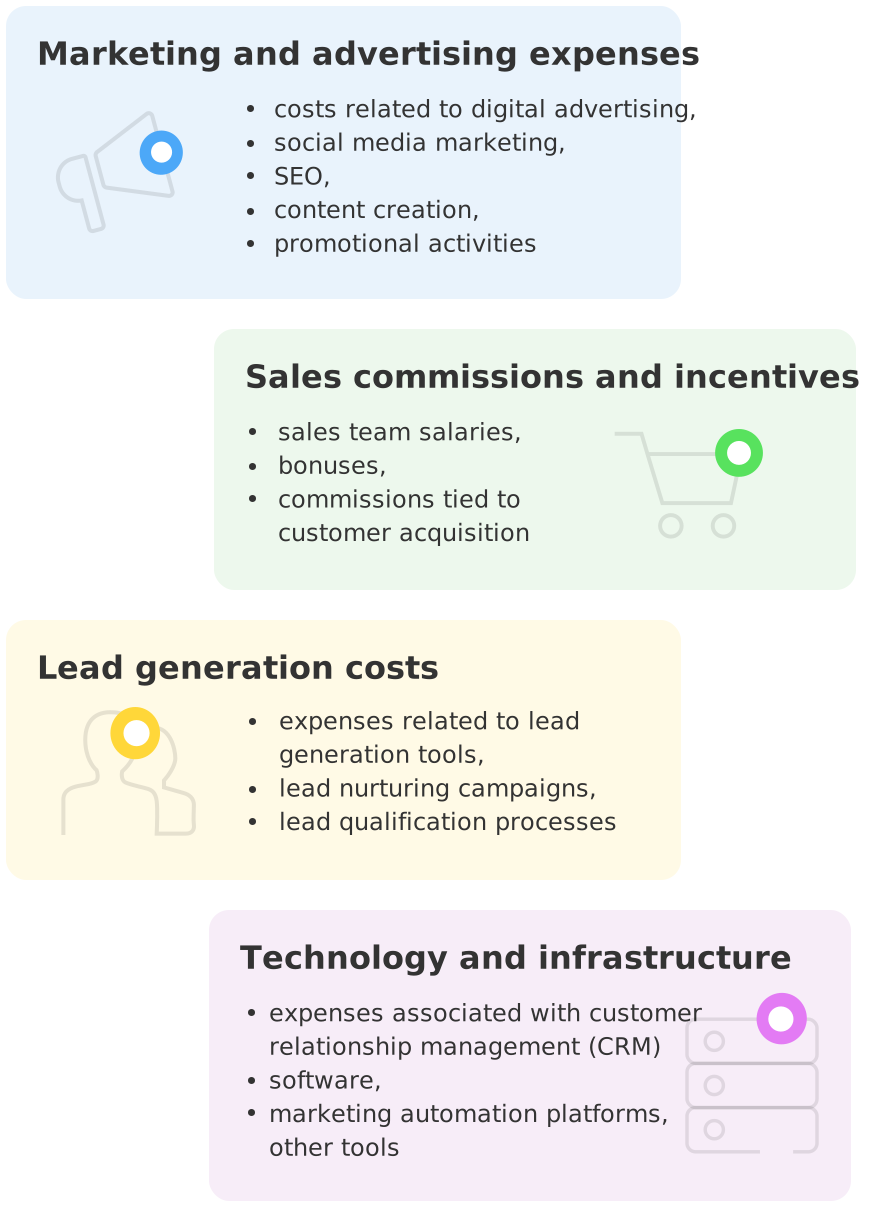
Examples of costs included in CAC calculation are:
Let’s say a business spends $10,000 on marketing campaigns, $5,000 on sales commissions, and $2,000 on lead generation tools in a given period. During that time, they acquired 100 new customers.
To calculate the CAC:
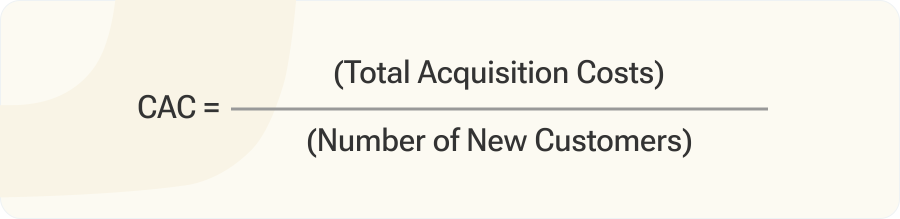
CAC = ($10,000 + $5,000 + $2,000) / 100
CAC = $17,000 / 100
CAC = $170
In this example, the Customer Acquisition Cost is $170 per customer. This means that the business spends an average of $170 to acquire a new customer.
Marketing and finance often reach different CAC figures from the same spend, because each counts different costs and defines a new customer differently. The decisions to agree, and how to reconcile the two figures, are in the marketing analytics data model guide.
How LTV:CAC ratio is calculated
How LTV:CAC ratio is calculated
To calculate the LTV:CAC ratio, divide the customer’s lifetime value (LTV) by the customer acquisition cost (CAC).

Let’s say your business has an LTV of $1,200 and a CAC of $170. To calculate the LTV:CAC ratio, divide the LTV by the CAC:
$1,200/$170 = 7.06
In this example, the LTV:CAC ratio is 7.06:1 (CAC LTV ratio is 1:7.06). It means that for every dollar spent on acquisition, you can expect to generate about seven dollars in customer lifetime revenue.
What makes a good LTV to CAC ratio benchmark
What makes a good LTV to CAC ratio benchmark
After calculating the LTV:CAC ratio, the next step is to learn what is a good LTV to CAC ratio and whether the score means a favorable result.
Note: It might be different for your specific business based on the industry you are in (eg. very competitive niche), your specific cost structure (eg. selling low-margin products), or your business goals (eg. getting more clients no matter what to raise more money)
Less than 3:1
When the ratio is below 3:1, acquisition takes a large share of what a customer is worth, and little is left for the cost of serving them. Below 1:1 the business spends more to acquire a customer than that customer brings in, which cannot be sustained.
3:1
3:1 LTV:CAC ratio shows a healthy balance, where the lifetime value of a customer is three times higher than the acquisition cost. This means that the business is efficiently acquiring customers and generating a satisfactory ROI.
Higher than 3:1
Anything higher than 3:1 means that the value a customer brings over their lifetime is much greater than the cost to acquire them. This means a highly profitable acquisition strategy where the business is earning substantial revenue from each customer.
Read next: Customer lifetime value →
Challenges with the LTV:CAC ratio calculations
Challenges with the LTV:CAC ratio calculations
Achieving a profitable LTV:CAC ratio comes with its fair share of challenges. Let’s explore some common problems businesses face in accurately assessing and optimizing this metric:
Accurate data
Obtaining precise data on customer lifetime value (LTV) and customer acquisition cost (CAC) can be a bit of a headache. It involves collecting information from different sources, making sure the data is reliable and consistent. Sometimes, data might be missing or incomplete, which can throw off the calculations and make it difficult to get accurate insights for decision-making.
Complex calculations
When calculating the ratio, you should take into account factors like customer retention rates, average purchase value, marketing expenses, and more. It is often time-consuming and requires careful analysis, making it a bit of a challenge to crunch the numbers accurately and derive meaningful insights from them
Attribution difficulties
A customer may interact with your website and social media ads, and receive a referral before making a purchase. Accurately attributing revenue and costs to each channel becomes a challenge as multiple touchpoints contribute to the customer’s decision-making process, making it difficult to find the exact impact of each channel on the LTV/CAC ratio.
Customer behavior changes
A business can target a specific group of people, and suddenly, their interests and buying habits shift. This makes it difficult to accurately predict the future value of customers and adjust your acquisition strategies accordingly. What worked before may not work in the future, so businesses need to stay adaptable and keep their finger on the pulse of changing customer trends.
Scalability
If a company expands rapidly, attracting more customers and increasing acquisition costs, the lifetime value (LTV) of these new customers must grow at a similar pace or higher, ensuring that the cost remains sustainable even with the increased scale. However, achieving this balance can be tricky as the business grows, requiring careful management of resources and strategies.
Industry
The LTV/CAC ratio for a software-as-a-service (SaaS) company may differ significantly from that of a retail or ecommerce business. Therefore, finding relevant benchmarks for comparison can be a problem due to these variations, making it important to consider the specific context of your specific business.
Approaches to increase LTV while minimizing CAC
Approaches to increase LTV while minimizing CAC
By implementing these approaches, businesses can increase customer engagement, reduce churn, activate more customers, and nurture long-term relationships, ultimately improving the overall lifetime value of their customer base.
Strategies to improve your customer lifetime value
Strategies to improve your customer lifetime value
To maximize your customer lifetime value (LTV), consider using the following strategies that add value and cultivate long-term relationships with your customers.
Customize onboarding emails
Personalize your onboarding emails to make a strong first impression. Use customer data to make the content personalized and useful, provide helpful information or resources. For example, send personalized welcome emails with recommendations based on your customer’s interactions with your website.
Contact after purchase
Stay engaged with customers even after they made a purchase. Send follow-up emails, gather feedback, offer additional assistance, or provide relevant product recommendations. For instance, send post-purchase emails with related product suggestions to encourage future purchases.
Cart abandonment recovery
If you’ve managed to collect the prospect’s email - send automated emails reminding customers about their abandoned carts and offering incentives like discounts or free shipping to encourage them to complete the purchase. This can help convert hesitant customers into paying customers.
Streamline onboarding
Simplify your onboarding process to ensure a smooth customer experience. Provide clear instructions, tutorials, or videos to help customers understand and use your product or service quickly. You can offer interactive tutorials or a dedicated onboarding portal for new users.
Customer rewards initiative
Offer exclusive discounts, early access to new products, or special perks to reward and retain your customers. For example, you can have a loyalty program where customers earn points for each purchase and receive free samples or discounts after reaching a certain threshold.
Key takeaways
- LTV:CAC = customer lifetime value / customer acquisition cost. 3:1 is the common benchmark; below 1:1 loses money on every customer.
- Both halves depend on definitions. Which costs go into CAC, and whether LTV is revenue or margin, change the ratio more than any campaign will.
- To raise the ratio, work on both sides: retention, repeat purchases and upsells for LTV; conversion rates and channel choice for CAC.
The ratio needs acquisition cost from the ad platforms and customer revenue from the store or CRM in one place. How that join is built, step by step, is in unifying ad spend and CRM data for a CAC report. With OWOX Data Marts, an analyst publishes the calculation once as a Data Mart, so the ratio in the board deck and the one in the weekly report come from the same query.
Turn your data into decisions.
Governed data marts give you the clean foundation ML needs to actually work.
- No AI hallucinations
- Analyst-governed definitions
- Every number traces to SQL
Frequently Asked Questions
What is a good LTV:CAC ratio?
3:1 is the common benchmark: a customer is worth three times what it cost to acquire them. Below 1:1 the business loses money on each customer. A ratio far above 3:1 is profitable, and can also mean there is room to spend more on growth. The right target depends on margin and business model.
How do you calculate CAC vs LTV ratio?
The CAC vs LTV ratio is calculated by dividing the customer lifetime value (LTV) by the customer acquisition cost (CAC).
Why is LTV CAC important?
It helps businesses understand the profitability of their customer acquisition efforts, provides insights into ROI, and guides decision-making for resource allocation and growth strategies.