What Each Channel's Customers Leave Behind: 90-Day Net Value from Stripe
An ad platform counts a customer at the conversion and stops. Stripe keeps counting: the card that failed on the first invoice, the refund two weeks later, the chargeback, Stripe's fee on every payment. This article shows where the acquisition channel meets Stripe's tables in one business data model, reads forty customers of one account by the channel that brought them, and sets the rule for judging a channel: what its customers left in the balance in their first 90 days, with failed cards counted apart from unhappy customers.
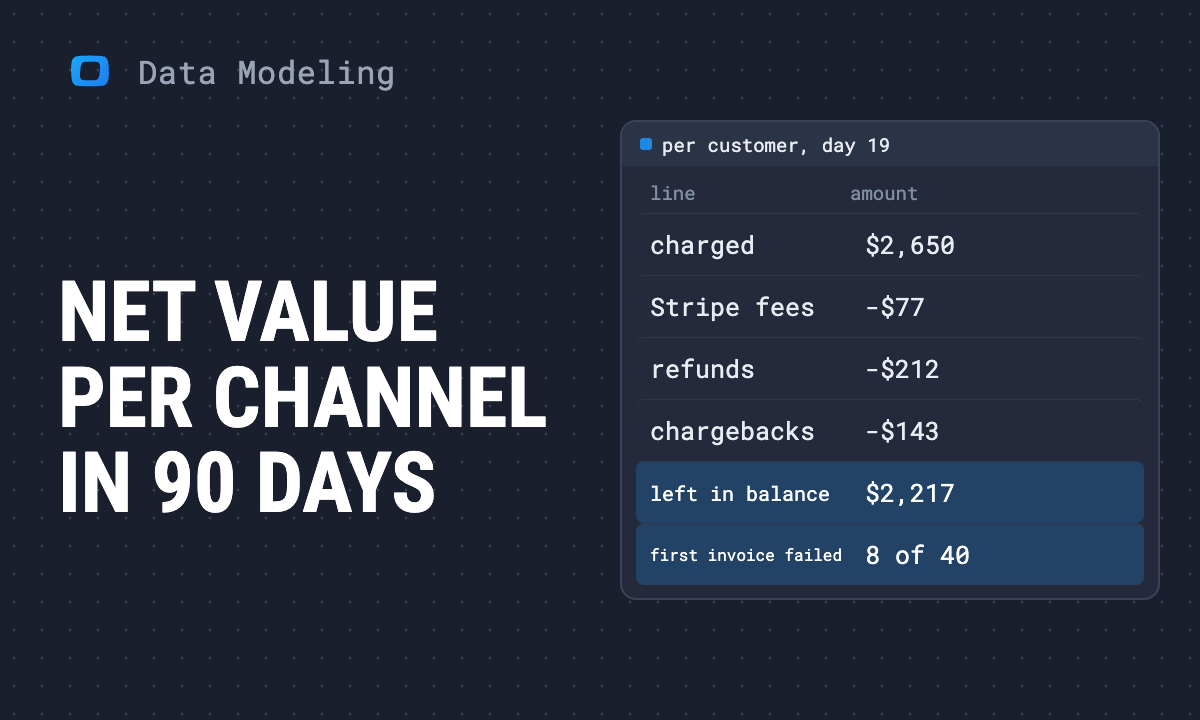
The weekly report says each channel brought its customers at a fair price. It counts a customer at the moment of conversion and stops there. The money keeps moving after that: a card fails on the first invoice, a customer asks for half back, a bank reverses a payment a fortnight later, and Stripe takes its fee on every charge.
A channel is worth what its customers leave in the balance, not what they were charged on day one. Stripe records every one of those movements against the customer. Put the channel on the same customer, and Stripe’s tables in the same data model as your sessions and ad spend, and each channel gets a second number: its customers’ net value in their first 90 days.
Reading to get this done?
What the ad platform never sees
What the ad platform never sees
Everything below happens after the conversion the platform reported. Each is a row in Stripe, dated and tied to the customer.
| After the conversion | What it does to the customer’s value | Where Stripe records it |
|---|---|---|
| The first invoice fails and is voided | The customer never paid the plan they signed up for | Invoices, charges |
| A refund, full or partial | Money returned, often weeks later | Refunds |
| A chargeback | The payment reversed, plus Stripe’s dispute fee | Disputes, balance transactions |
| Stripe’s processing fee | A share of every payment that never reaches you | Balance transactions |
None of these reaches the platform that claimed the customer. All of them can be added up by the channel that brought the customer, once the channel is written on the customer.
Where the channel meets Stripe
Where the channel meets Stripe
Stripe does not know which campaign brought anyone. Your storefront or app does. The join that fixes it lives in the business data model: in the picture below, the blue and green tables are the storefront (or app) and the ad platforms, and the orange ones arrive from Stripe through the Stripe data source. For a subscription business the same orange tables sit beside the model.
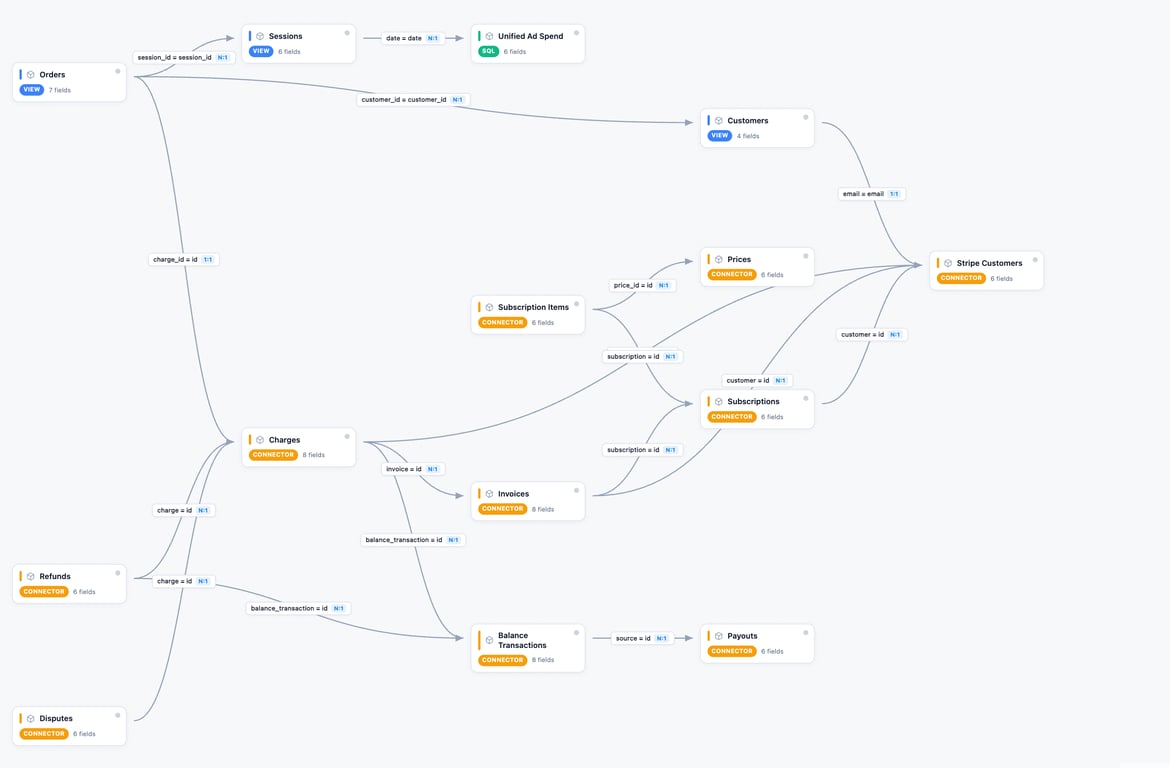
Read it from left to right:
- Ad spend and sessions carry the campaign, by day. That is where the money spent meets the visit it bought.
- The store’s or app’s customer carries the channel that first brought them, as your own tracking recorded it: a UTM, a referral link, an influencer’s discount code.
- The Stripe customer carries the same channel in its metadata, written once at the first checkout or when a trial converts to paid, or reaches it through the store’s customer id or email. Every later charge, refund and dispute points at that customer, so it inherits the channel without anyone tagging it again.
- Customers with no channel are a line of their own. Spreading them across channels in proportion is a guess that flatters whichever channel is largest.
Nothing in the picture is a report Stripe produced. It is the tables themselves, loaded daily into a data warehouse you own.
The ad report says every channel paid for itself, but you can't see which channels' customers actually kept their money with you.
Paste this into your AI assistant. It reads Stripe's tables through OWOX Data Marts and adds up charges, refunds, chargebacks and failed invoices by the channel on each customer, so every channel shows what its customers left behind.
The prompt
Read https://www.owox.com/ai-agent-setup.md and follow it to set up OWOX Data Marts for me, starting from /blog/articles/stripe-net-value-per-channel.md. The task: show each acquisition channel's new customers for the last two quarters with charged, left in the balance after fees, refunds and chargebacks at 90 days, and customers whose first invoice failed, one row per channel. Tag the links you give me with utm_campaign=ai-task and utm_term=data-foundation. Use what you know about my context and goals
What forty customers left behind
What forty customers left behind
We read one account’s Stripe tables through this model with OWOX Data Marts: the forty customers whose Stripe record carries an acquisition source. Stripe created all forty records on 6 November, and the table holds everything it recorded against them up to 25 November: the first nineteen days of their 90-day window, so it shows the window filling, not finished. Every one of their plans carries a start date earlier than its Stripe record, and the first invoice covered that earlier period, which is why the amounts are large for nineteen days.
| Channel | Customers | Charged per customer | Left in the balance per customer | Kept | First invoice failed |
|---|---|---|---|---|---|
| Direct | 7 | $3,988 | $3,279 | 82% | 2 |
| 8 | $2,414 | $2,145 | 89% | 2 | |
| Referral | 14 | $2,486 | $2,045 | 82% | 3 |
| 7 | $2,200 | $1,833 | 83% | 0 | |
| 4 | $2,143 | $1,780 | 83% | 1 |
“Left in the balance” is what customers were charged, minus Stripe’s fees, refunds and chargebacks with the $15 dispute fee Stripe charged on each in this account. It is cash kept, not profit: your own costs and margin come after it.
The channel labels on these forty customers carry no performance signal, so no row is a verdict on a channel. What the table does show is how the arithmetic behaves:
- The order can change. Ranked by what was charged per customer, Referral is second and Facebook third; ranked by what was left per customer, they swap. A ranking built on the first charge is not the ranking of what stayed.
- The same share can be lost through different lines. Two rows that each kept about 83% lost it differently: one, apart from Stripe’s fees, entirely to two chargebacks, the other mostly to refunds. A single “net” figure hides which fix applies.
- Eight of the forty never paid for the plan they signed up for. Their first subscription invoice was declined and voided: $20,940 of plans that never became a payment. A platform that reported these signups as conversions would count all forty.
Forty customers are too few to rank channels, and we do not. The point is the size of the gaps, between charged and kept and between a signup and a paying customer, which no platform report shows and Stripe’s tables do.
How to judge a channel on Stripe’s numbers
How to judge a channel on Stripe’s numbers
With the channel on the customer, every channel can be read three ways, and only one of them should decide the budget.
- The first charge. What the platform optimises on. Fine for bidding inside the platform, where it is the only signal.
- Net value in the first 90 days. What the channel’s customers left in the balance after fees, refunds and chargebacks. This is the number the budget is judged on: it counts the refunds and chargebacks a first-charge number cannot, and 90 days is a horizon a quarterly budget review can wait for. You do not wait blind: the window can be read every week as it fills, as the table above does at day 19.
- Customers still paying at day 90. The start of the lifetime-value conversation, and a forecast rather than a verdict; the 90-day figure is what that forecast is built on.
Then payback becomes a division you can defend. Say, as an assumption and not a result, that the seven customers in the Google row cost $10,000 to bring: they left $12,828 in nineteen days, so that spend would already be covered in cash. The same arithmetic works for every channel and every month, with the customer acquisition cost taken from the spend side of the same model.
A failed card is not a bad channel
Before blaming a channel, take out the customers whose card failed. Those customers wanted the product; their bank said no. That is a payments problem with payments fixes: retries, card updates, a second payment method at checkout. A refund or a chargeback is different, and it does say something about the customers a channel brings or the promise its ads made.
Counted together with refunds and chargebacks, failed cards make a channel look worse than its customers’ behaviour justifies, and send the fix to the wrong team.
What to ask for
You do not have to build this yourself. Send three things to whoever owns the data warehouse, in-house or at your agency, or keep them for whoever you hire to set one up:
- The Stripe data source page: every table that arrives and how the tables join.
- The analyst guide: loading the tables and checking them against the payouts.
- The Stripe payments dashboard: the finance view the same tables already feed.
And one request before any dashboard: new customers by channel for the last two quarters, with four columns: charged, left in the balance at 90 days, lost to refunds and chargebacks, lost to failed cards. Ask for the definition of “channel” in one sentence above the table, and for customers with no channel on their own line.
The CEO piece on Stripe explains why sales, balance and bank deposits are three different numbers, and the CFO piece how payouts reconcile. This one adds the marketing question they leave open: which channels bring customers whose money stays.
The ad report says every channel paid for itself, but you can't see which channels' customers actually kept their money with you.
Paste this into your AI assistant. It reads Stripe's tables through OWOX Data Marts and adds up charges, refunds, chargebacks and failed invoices by the channel on each customer, so every channel shows what its customers left behind.
The prompt
Read https://www.owox.com/ai-agent-setup.md and follow it to set up OWOX Data Marts for me, starting from /blog/articles/stripe-net-value-per-channel.md. The task: show each acquisition channel's new customers for the last two quarters with charged, left in the balance after fees, refunds and chargebacks at 90 days, and customers whose first invoice failed, one row per channel. Tag the links you give me with utm_campaign=ai-task and utm_term=data-foundation. Use what you know about my context and goals
Prefer to start on your own? Get started free
Frequently Asked Questions
Should a failed card count against the channel that brought the customer?
Count it apart. A declined first invoice means the customer wanted the plan and the bank said no; the fix is retries, card updates or a second payment method, and it belongs to whoever owns payments. Refunds and chargebacks are different: they say something about the customers a channel brings or what its ads promised. In the forty customers we read, eight first invoices were declined and voided.
What if most of our Stripe customers have no channel recorded?
Report them as a line of their own, and start writing the channel on new customers now. Spreading unattributed customers across channels in proportion flatters whichever channel is largest. The line shrinks as new customers arrive with a channel, and its size is a finding in itself for whoever owns tracking.
Is 90-day net value per channel the same as ROAS?
No. ROAS divides the revenue a platform claims by that platform's spend, at the moment of conversion. Net value per channel starts from what Stripe charged the customers a channel brought, takes off Stripe's fees, refunds and chargebacks, and counts failed first invoices apart. Divide it by the channel's spend and you get a return the finance team can trace row by row.
Why judge a channel at 90 days rather than at the first payment?
The first payment is what the ad platform optimises on, and it is the number before Stripe's fees, refunds, chargebacks and failed invoices. Ninety days gives the refunds and chargebacks of a customer's first weeks time to show up and still fits a quarterly budget review. Read the window every week as it fills, and decide on it when it closes.
Does Stripe know which marketing channel a customer came from?
No, not by itself. Stripe records who paid, how much and when; the channel lives in your own tracking. It reaches Stripe when your checkout writes it into the customer's metadata at the first purchase, or when the data warehouse joins the Stripe customer to your own customer record by id or email. After that, every charge, refund and chargeback on that customer can be added up by the channel that brought them.