

What Is a Recursive Data Model?
A recursive data model is a structure in which an entity is related to itself, allowing hierarchical or nested relationships within a single table.
This type of model is commonly used to represent parent-child relationships, such as organizational charts, file systems, or category trees. It simplifies data organization and enables efficient querying of multi-level relationships using recursive logic.
Why Recursive Models Matter
Recursive models play a crucial role in simplifying complex relationships across various fields, including economics, data analysis, and database design.
Their structured approach offers several key advantages:
- Ease of Computation: Breaks down interrelated variables into smaller steps, simplifying calculations and making systems easier to analyze.
- Clarity in Dynamics: Helps clarify how variables interact over time, making it easier to trace cause-and-effect relationships.
- Addressing Uncertainty: This allows for the introduction of shocks or changes at each step, making models more adaptable to real-world variability.
- Empirical Applications: Widely used in analyzing time-series or panel data, where past values influence present results.
- Improved Model Structure: Offers a clean, modular approach to modeling complex systems with sequential or hierarchical relationships.
Advantages of Using Recursive Models
Recursive models provide a streamlined approach to representing one-way relationships, making them particularly useful in analytical and theoretical contexts.
- Easier to Estimate: Without feedback loops, recursive models are mathematically simpler and can be computed more efficiently using statistical tools.
- Clear Causal Direction: They define a one-way relationship between variables, making it easier to distinguish causes from effects.
- Better Model Fit: Their simplicity often leads to a better statistical fit with fewer assumptions and easier refinement.
- Useful for Theory Testing: Ideal for testing models with unidirectional causal assumptions, especially in social sciences.
- Supports Sequential Logic: Aligns naturally with step-by-step processes, making them useful in both programming and analysis.
How Recursive Models Work
Recursive models represent hierarchical relationships by allowing records in a table to reference other records within the same table, thereby enabling a more complex structure. This is typically done using a column, such as parent_id, which points to the primary key of another row, creating a structure where each entry can have a parent and multiple children.
To work with these relationships, SQL uses recursive queries, commonly through the WITH RECURSIVE clause. These queries start from the top-level records (those with no parent) and repeatedly join the table to itself to fetch child records, layer by layer. This process continues until the full hierarchy is established, enabling structured data to be queried in a logical and ordered sequence.
Examples of Recursive Models in DBMS
Recursive relationships are common in database design, especially when dealing with hierarchical or nested data structures. Here are a few typical examples:
- Employee–Manager Relationship: In an employee table, each employee may have a ManagerID that refers back to another employee’s EmployeeID, forming a chain of supervision within the same table.
- Folder–Subfolder Relationship: File systems store folders and their nested subfolders in a single table, where each folder can reference a ParentFolderID, allowing for a recursive directory structure.
- Comment Replies: In forums or comment sections (like Reddit), a CommentID may reference a ParentCommentID, allowing threaded discussions and replies within the same comment table.
These examples demonstrate how recursive models facilitate flexible, self-referencing structures without requiring multiple tables.
Build and Manage Recursive Data Models with OWOX Data Marts
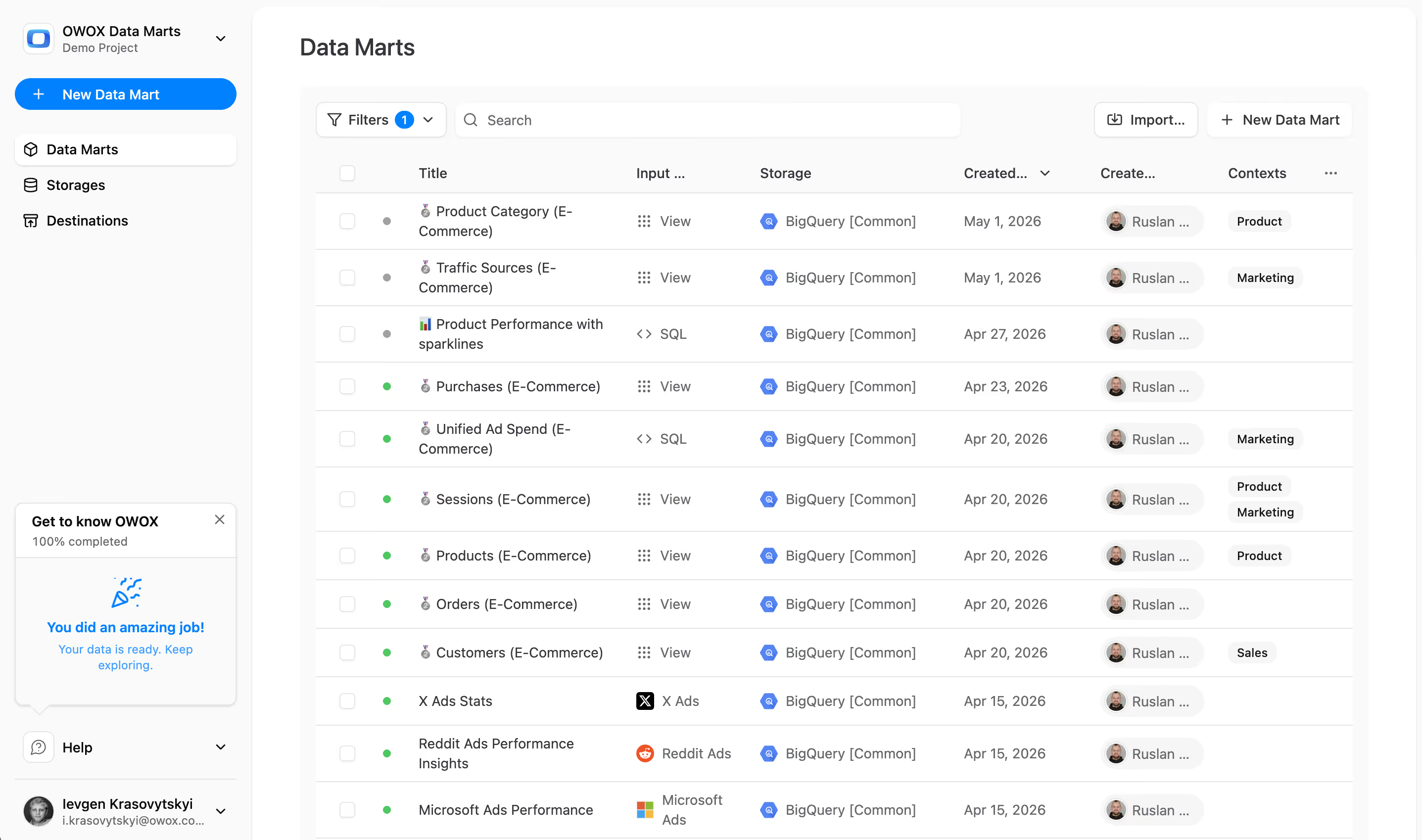
Recursive data models help represent hierarchical or self-referential relationships, but maintaining them efficiently requires structure and control. With OWOX Data Marts, analysts can define recursive hierarchies, manage dependencies, and transform nested data directly in BigQuery. Every relationship stays transparent, documented, and reusable across dashboards or reports.




"AI by its nature will hallucinate. You need guardrails so you can trust your data."
"We had six or seven different channels and no single source of truth. It was almost impossible"
"We regained time. And time is the one resource that never comes back."