Why your AI analytics tool hallucinates (and what deterministic SQL fixes)
“We just found out our AI has been making up analytics data for 3 months and I’m gonna throw up.”
That Reddit post from r/analytics went viral for a reason. Not because it was shocking – but because every data team reading it thought the same thing: “How would we even know if that was happening to us?”
The answer, for most teams, is: you wouldn’t. And this isn’t a bug in any particular tool. It’s an architecture problem baked into how most AI analytics products work. The fix exists, it’s well understood, and by the end of this article you’ll know exactly what to look for – and what to demand – from any AI analytics vendor.
Your AI analytics tool is making up numbers – and you might not know it
Your AI analytics tool is making up numbers – and you might not know it
The scariest thing about AI hallucination in analytics isn’t that it happens. It’s that the fabricated numbers look exactly like real ones.
The Reddit horror story: “AI made up analytics data for 3 months”
In late 2025, a post on r/analytics described a company that discovered its AI analytics tool had been returning fabricated metrics for months. The numbers were plausible. The formatting was clean. Nobody questioned them – until someone manually re-ran a query and got a completely different result.
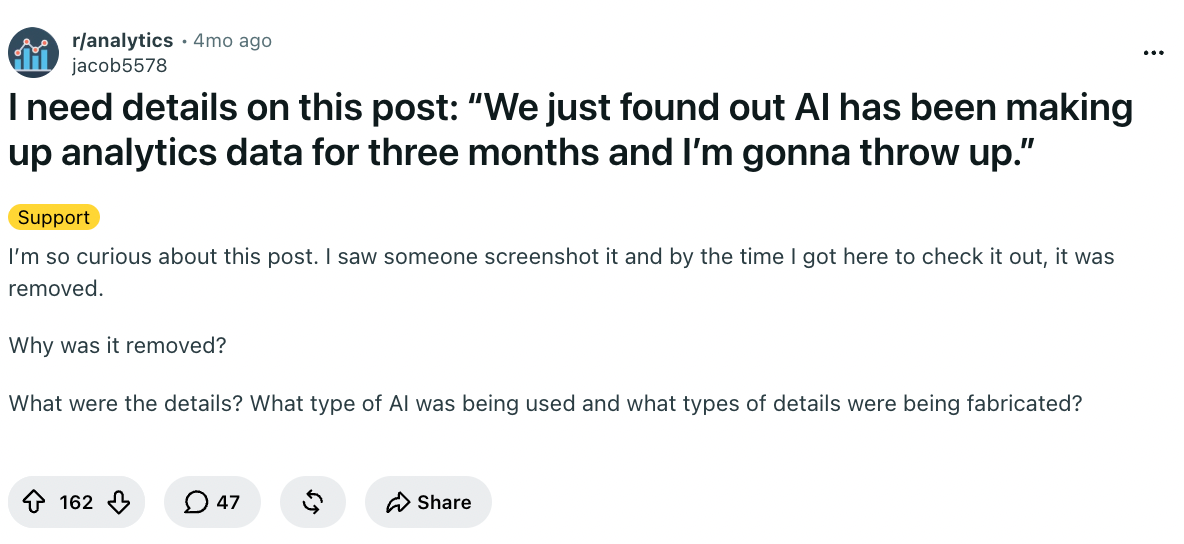
The thread blew up. A related Deloitte report surfaced that was full of hallucinated textual evidence – non-existent citations and fabricated quotes presented as fact.
This isn’t a fringe case. It’s the predictable outcome when AI generates analytics without guardrails.
Why this isn’t a bug – it’s an architecture problem
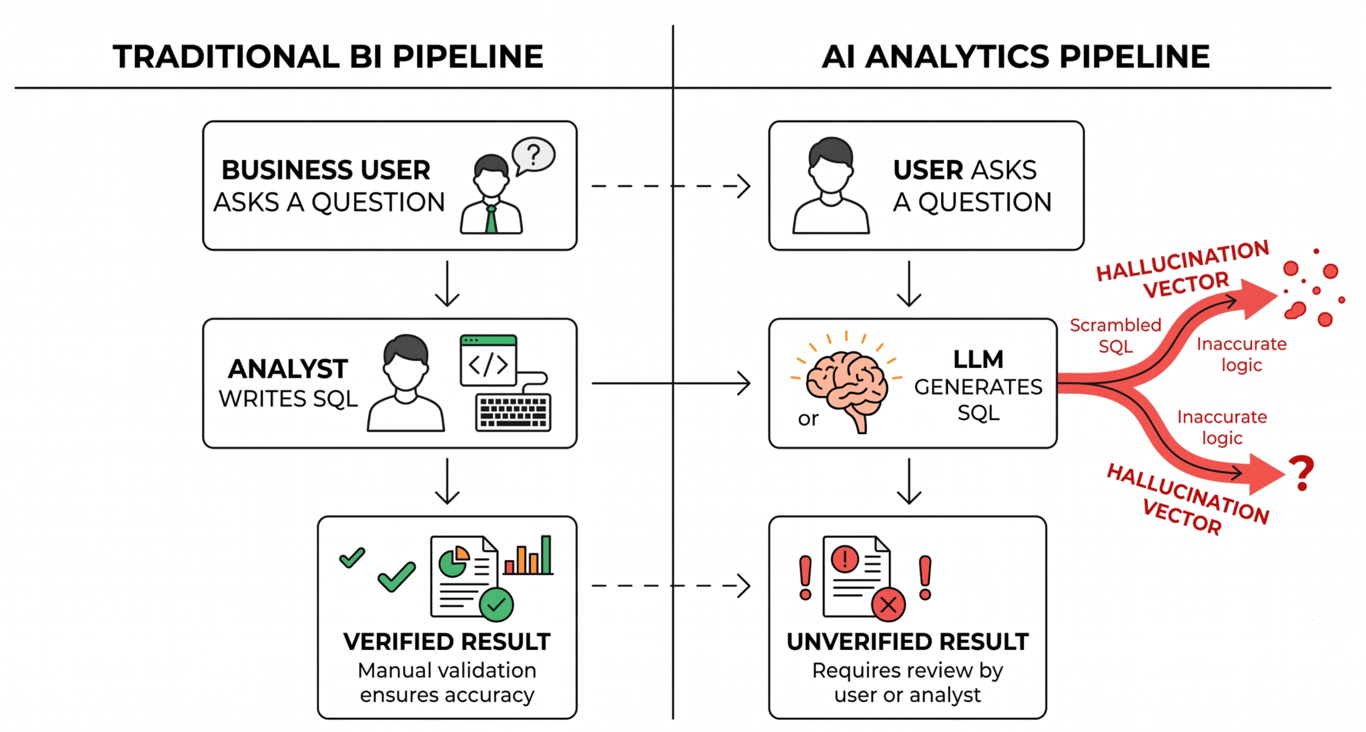
Most AI analytics tools work by converting your natural language question into SQL on the fly. An LLM reads your question, guesses the right query, runs it, and hands back a number.
The problem: that SQL generation step is probabilistic, not deterministic. The AI doesn’t know the answer. It predicts what the right query might look like – and sometimes it predicts wrong while sounding perfectly confident.
This isn’t about “AI making mistakes.” It’s about AI confidently inventing answers that have no basis in your data. And the architecture that allows it is the same one most vendors ship by default.
What AI hallucination actually means in analytics
What AI hallucination actually means in analytics
Before going deeper, it’s worth defining what hallucination means specifically in analytics – because it’s not the same as bad data quality.
Hallucination ≠ wrong data input – it’s fabricated output
Garbage in, garbage out is a quality problem. Your source data is wrong, so your reports are wrong. That’s bad, but it’s a known failure mode with known fixes.
AI hallucination is different. The source data can be perfectly clean, and the AI still returns a number that doesn’t exist anywhere in your database. The AI fabricates the output – it generates a metric, trend, or insight with no basis in the underlying data.
Google Cloud defines AI hallucinations as “incorrect or misleading results that AI models generate.” IBM adds that “AI models often hallucinate because they lack constraints that limit possible outcomes.”
In analytics, that lack of constraints is the text-to-SQL step.
The three types: invented metrics, phantom trends, confident misjoins
Not all analytics hallucinations look the same. I’ve seen them fall into three categories:
Invented metrics. The AI returns a number that doesn’t exist in any table. You ask “what’s our conversion rate?” and get “4.7%” – but you don’t have conversion tracking set up. The AI inferred what a conversion rate might look like from your schema names and training data, then presented a fabrication as fact.
Phantom trends. The AI identifies a pattern or correlation that is statistical noise. “Revenue increased 12% week-over-week in the Southeast region” – except that trend disappears when you run the query again, because the AI generated different aggregation logic the second time.
Confident misjoins. The AI joins tables incorrectly – matching user IDs across incompatible schemas, or joining on a field that shares a column name but has completely different semantics. The result is a number that’s internally consistent but factually meaningless.
Why traditional accuracy measures don’t catch analytics hallucinations
Standard ML accuracy metrics – precision, recall, F1 score – measure how well a model classifies things. They’re designed for tasks like “is this email spam?” not “what was our revenue last quarter?”
Analytics hallucination is about fabrication, not misclassification. There’s no ground truth label to compare against in real time. You can’t A/B test a hallucinated metric because, by definition, you don’t know it’s hallucinated until you manually check. And manual checking defeats the purpose of AI analytics in the first place.
OWOX Data Marts
See your first report built in real time. 15 minutes.
- Connect your data warehouse
- Pick your metrics
- Get a live Google Sheets report
In the time it takes to write a ticket. Then imagine never writing that ticket again.
Book a DemoWe'll use your actual use case
The technical root cause – AI-generated SQL is non-deterministic
The technical root cause – AI-generated SQL is non-deterministic
The hallucination problem in AI analytics has a specific technical root cause: text-to-SQL is probabilistic. Understanding this mechanism is the key to understanding why some architectures are hallucination-prone and others aren’t.
How text-to-SQL actually works (and where it breaks)
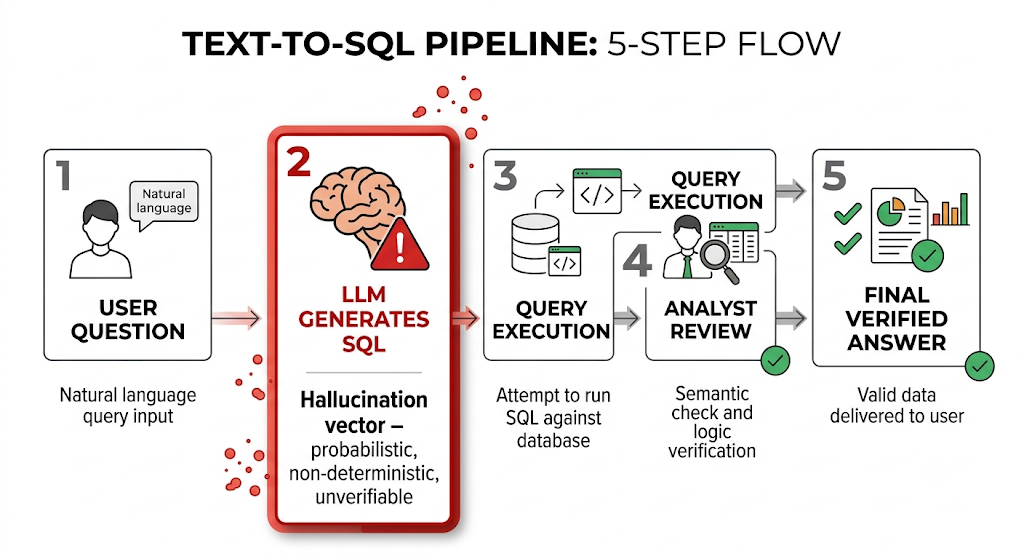
The text-to-SQL pipeline looks simple on the surface:
(1) User types a natural language question
(2) LLM interprets the question and generates a SQL query
(3) SQL runs against your data warehouse
(4) Results come back
(5) AI formats and narrates the answer
The hallucination vector sits at step 2. The LLM doesn’t look up the right SQL query from a verified library. It generates one from scratch every time, using statistical patterns from its training data and whatever schema context it has.
The same question can produce five different SQL queries – each syntactically valid, each returning different numbers. All of them “work.” At most one of them is right.
Same question, different SQL, different answer – every time
Ask an AI analytics tool: “What was our revenue last quarter?”
Sounds simple. But watch what the LLM has to decide behind the scenes:
- Date boundaries: Does “last quarter” mean the calendar quarter, fiscal quarter, or the last 90 days? Does it include the boundary dates?
- Revenue definition: Gross or net? Including refunds? Only completed orders or also pending?
- JOIN logic: Which tables to join? On what keys? Inner join or left join?
- Aggregation: SUM of what column exactly? Are there duplicate rows to deduplicate first?
Each of these decisions is a coin flip for the LLM. Run it five times, get five different combinations, get five different revenue numbers. You can’t audit what you can’t reproduce.
The semantic gap: business meaning vs. database schema
The deepest problem is what I’d call the semantic gap. Business terms like “active user,” “revenue,” and “churn” have precise definitions that differ by company. Your “active user” might mean “logged in within 30 days.” Mine might mean “completed at least one transaction this quarter.”
LLMs don’t know your definitions. They guess from column names, table structures, and training data. A column called `revenue` might actually store gross merchandise value. A table called `users` might include test accounts.
This is why even sophisticated approaches like RAG (retrieval-augmented generation) and few-shot prompting don’t solve the problem. They give the LLM more context, which reduces hallucination frequency – but the SQL generation step remains probabilistic. The semantic gap narrows but never closes.
The numbers that should scare you
The numbers that should scare you
The hallucination problem isn’t theoretical. Research quantifies exactly how unreliable AI-generated outputs are – and the numbers get worse as task complexity increases.
Stanford HAI: 17–82% hallucination rates across models
Stanford’s Human-Centered AI Institute has documented hallucination rates ranging from 17% to 82% depending on the model and task. Even the best-performing models hallucinate at least one in six responses.
In an analytics context, that means if you ask your AI analytics tool six questions in a morning standup, at least one answer is statistically likely to be fabricated. Which one? You won’t know without manually verifying each.
Stack Overflow: 46% of developers distrust AI-generated code
A Stack Overflow survey found that 46% of developers – people who can actually read and evaluate code – don’t trust AI-generated output. If professionals who understand SQL don’t trust AI to write it correctly, why would a marketing director trust AI-generated analytics they can’t verify?
The trust gap is even wider for non-technical stakeholders. A CMO can’t look at a SQL query and spot an incorrect JOIN. They just see a number and make a decision.
Apple study: “complete accuracy collapse” in complex problems
An Apple research paper, reported by The Guardian, found that AI models suffer “complete accuracy collapse” when faced with complex, multi-step problems.
Analytics queries are inherently complex. They involve joins across multiple tables, time-window aggregations, business logic filters, and dimensional breakdowns. Exactly the kind of multi-step reasoning where AI accuracy falls apart.
EU AI Act: up to €35M fines for AI-driven decisions gone wrong
The EU AI Act classifies AI systems by risk level. AI tools used for decision-making – which includes analytics feeding business strategy – may qualify as high-risk, requiring transparency, auditability, and human oversight.
If your AI analytics tool hallucinates a revenue number that drives a board decision, and you can’t prove where that number came from, you have regulatory exposure up to €35M in fines. The question regulators will ask: “Can you show us the exact computation that produced this number?”
If the answer is “an LLM generated SQL on the fly and we didn’t log it” – that’s a problem.
The fix is architectural – deterministic SQL explained
The fix is architectural – deterministic SQL explained
The good news: the hallucination problem has a clean architectural solution. It doesn’t require better prompts, more training data, or waiting for smarter models. It requires a different architecture.
AI-generates-SQL vs. AI-narrates-approved-SQL – the two architectures
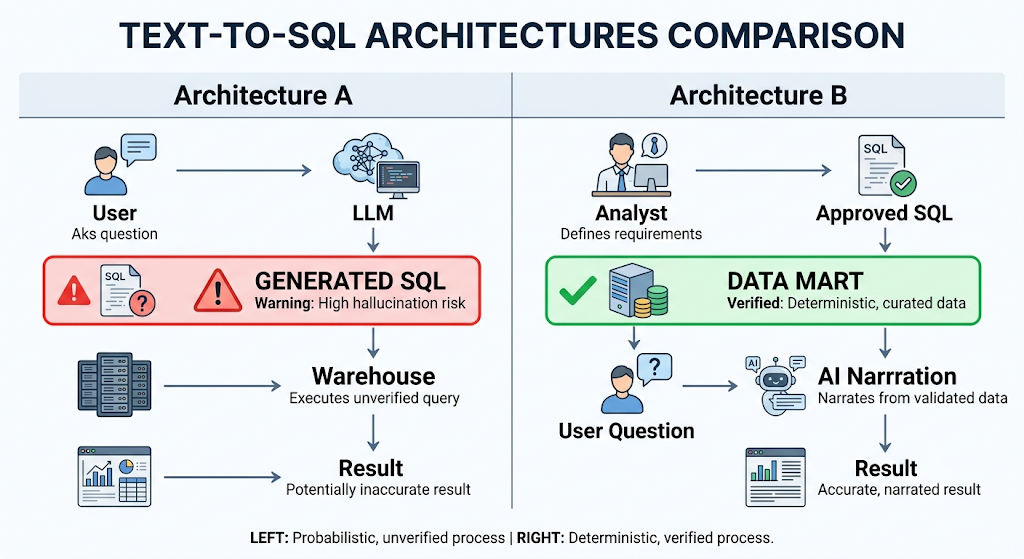
There are fundamentally two ways to build AI analytics:
| Architecture A: AI generates SQL | Architecture B: AI narrates approved SQL | |
|---|---|---|
| How it works | User question → LLM generates SQL → runs on warehouse → returns result | Analyst writes SQL → stored in data mart → user question → AI matches to pre-approved query → runs approved SQL → AI narrates result |
| SQL authorship | AI writes SQL from scratch each time | Analyst writes SQL once; AI never writes SQL |
| Determinism | Non-deterministic – same question can yield different queries | Deterministic – same question always runs the same SQL |
| Audit trail | No – generated SQL is ephemeral | Yes – every query is logged, versioned, traceable |
| Hallucination risk | Inherent – cannot be eliminated | Zero – AI never generates the data |
The key insight: in Architecture B, the AI never writes SQL.
It only selects which pre-approved query to run and how to join by explicitly defined join keys and explains the result in natural language. The hallucination vector – probabilistic SQL generation – is removed entirely.
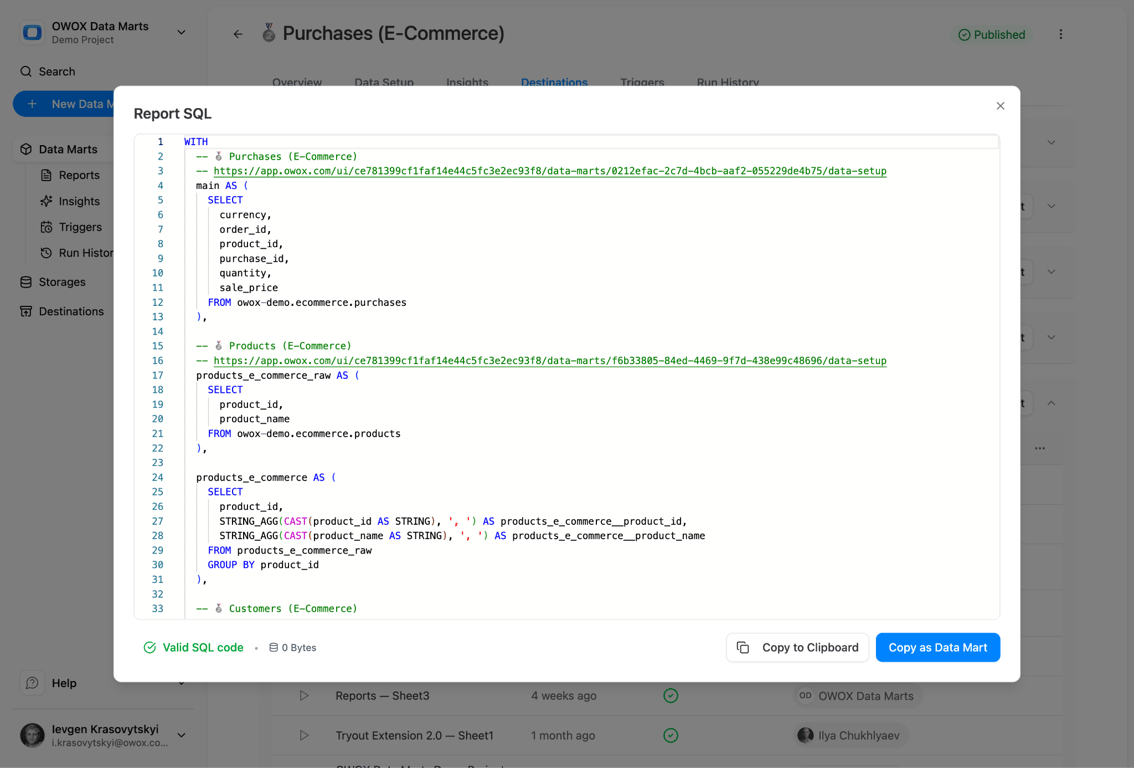
How deterministic SQL works: analyst writes it once, AI explains it forever
The data mart pattern is straightforward:
(1) An analyst defines business metrics as SQL, views, tables
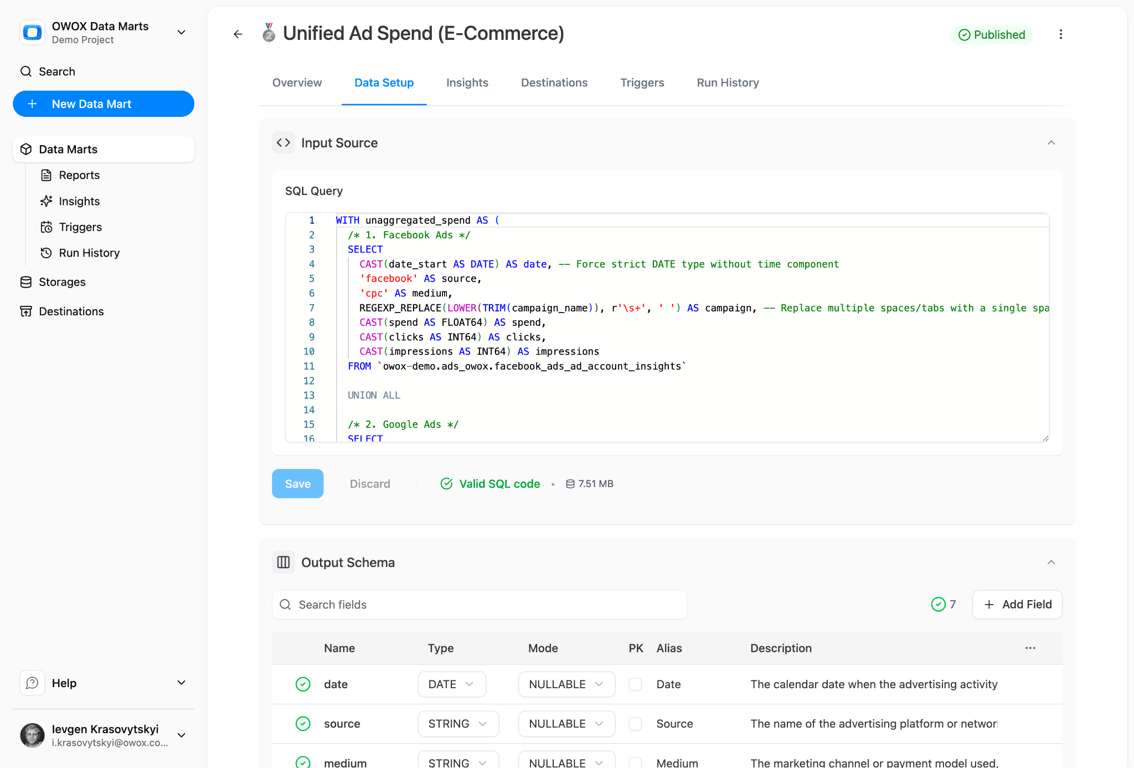
(2) These definitions are stored in governed data marts – versioned, reviewed, approved
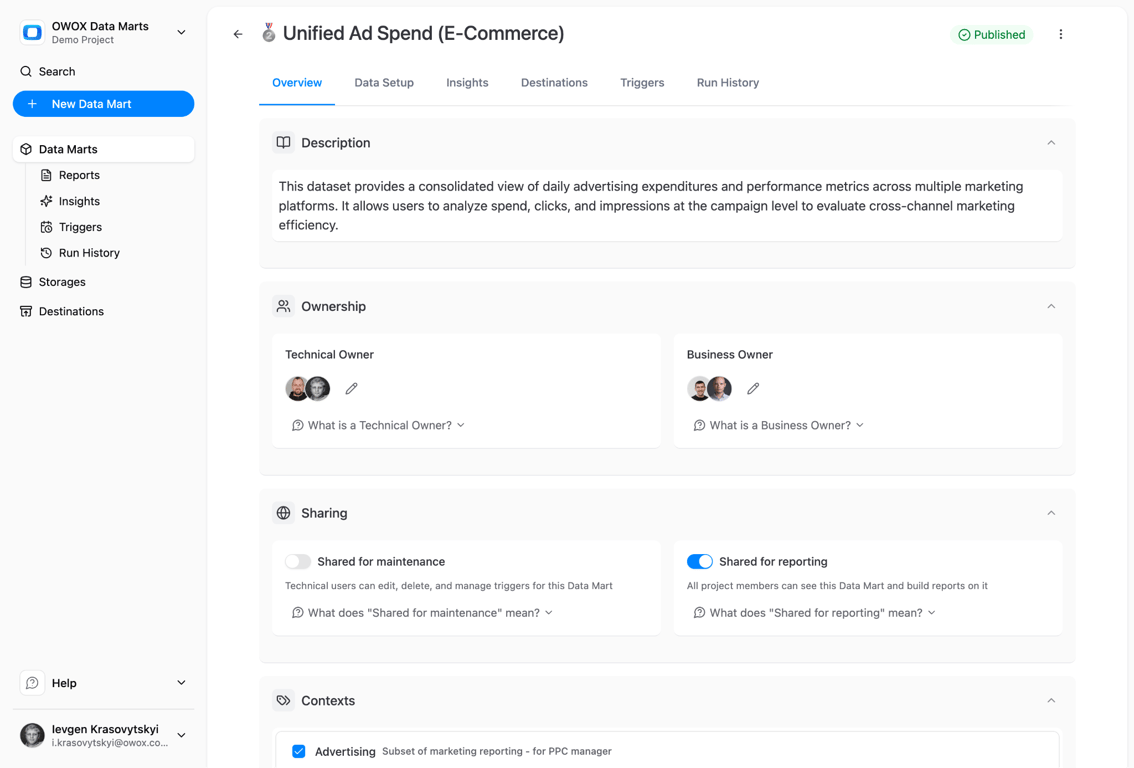
(3) Analyst joins data marts between them (lightweight modeling) with precise JOIN logic, date boundaries, filters, and aggregation rules
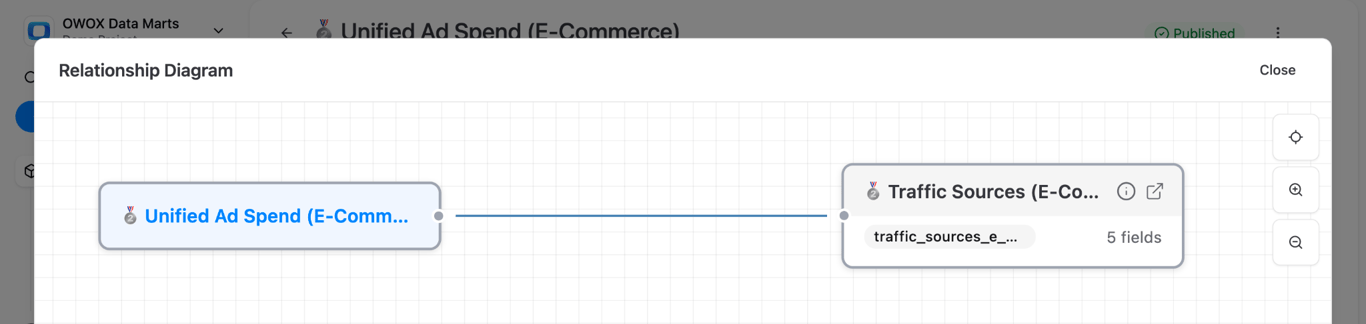
(4) When a user asks a question, the AI maps it to the right data marts but the SQL generates only using the inputs & explicitly defined joined keys - no AI us used to generate SQL.
(5) The AI’s job is narration and explaining: translating the SQL result into a clear, natural language answer
Every query runs the SQL that is deterministic, reproducible, auditable.
Ask “what was our revenue last quarter?” on Monday and Friday, and you get the same number (assuming the same underlying data).
Because the SQL didn’t change.
Version control, audit trails, and reproducible results
With deterministic SQL, every metric has traceable lineage:
(1) Who is the owner of the source: the analyst who defined the data mart
(2) How it was build - which joined keys used
(3) When it was last modified: full version history (coming soon)
This is what auditors and regulators actually need.
Not “an AI said so” – but “here’s the exact computation, here’s who approved it, here’s the data it reads from.”
Why prompt engineering and RAG don’t solve the underlying problem
Some vendors try to reduce hallucination through better prompts or retrieval-augmented generation. These help – but they don’t eliminate the problem.
Prompt engineering can guide the LLM toward better SQL generation. But “better” is not “correct.”
You’re still relying on a probabilistic model to generate the right query. The error rate drops but never reaches zero.
RAG gives the LLM access to your schema documentation, data dictionaries, or example queries. This narrows the semantic gap. But the join keys to be used are still not defined.
But the SQL generation step is still probabilistic – the LLM still writes the query, just with more context. More context reduces mistakes. It doesn’t eliminate the mechanism that produces them.
Only removing the SQL generation step entirely eliminates the hallucination vector. That’s the architectural difference.
How OWOX eliminates hallucination by design
How OWOX eliminates hallucination by design
OWOX implements Architecture B – the deterministic approach described above. It’s not a feature bolted on top of text-to-SQL. It’s the foundational design of the product.
The architecture: data marts with pre-approved SQL → AI narration layer
The OWOX stack works in two layers:
Layer 1: Joinable data marts. Analysts define business metrics as SQL. These are stored as governed, versioned data marts in your cloud data warehouse. Each data mart has a precise schema – what it measures, what tables it joins, what filters it applies.
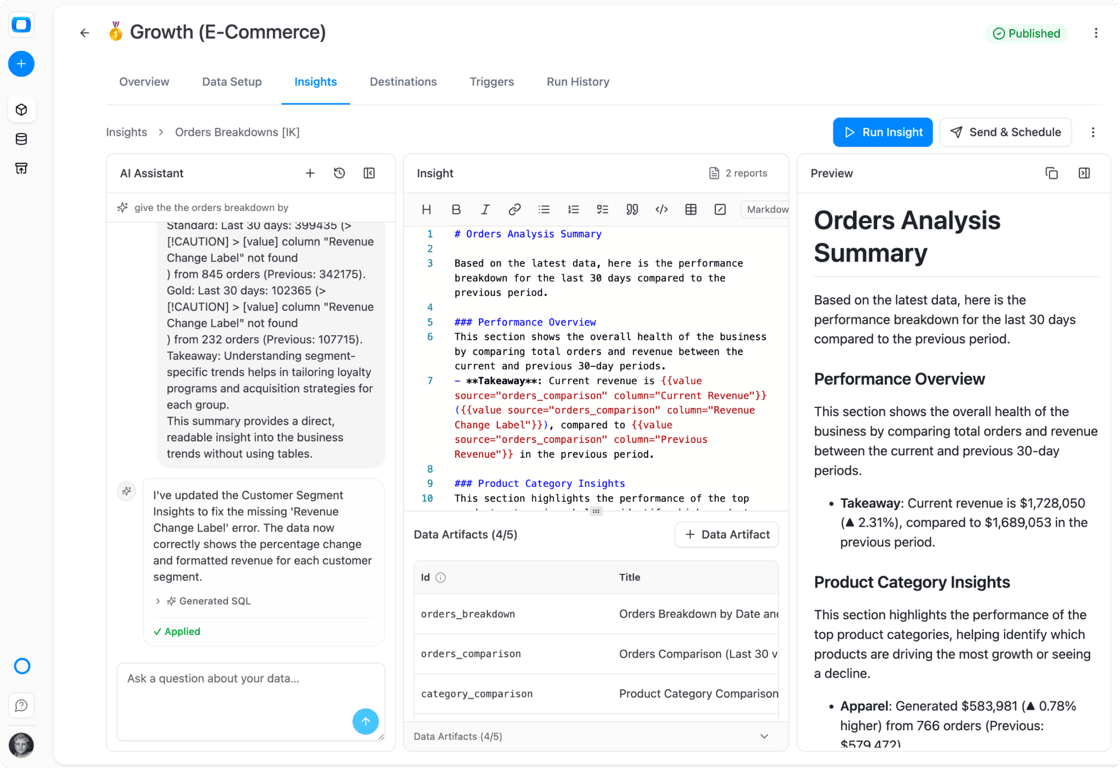
Layer 2: AI Insights. The AI layer takes natural language questions from business users, maps each question to the right data mart, runs the pre-approved SQL, and narrates the result in plain English. The AI never generates SQL. It never touches the warehouse directly. It explains what the pre-approved query returned.
Patented technology: what it means in practice
OWOX’s deterministic analytics approach is patented1.
This is worth flagging because it means the architecture isn’t a marketing positioning – it’s IP-protected technology that competitors can’t trivially replicate.
The patent covers the pipeline from question to answer: how the AI maps natural language to data marts & model, how it selects and executes the right query, and how it generates the narration without altering the underlying computation.
From question to answer – a deterministic pipeline walkthrough
Here’s what happens when a CMO asks OWOX: “What was marketing’s contribution to pipeline last quarter?”
(1) Intent matching: AI identifies this as a marketing attribution question about pipeline value
(2) Data mart selection: maps to the `marketing_pipeline_attribution` data mart and all the joined ones.
(3) SQL execution: runs the exact SQL the analytics team wrote and approved – or merges that with other data marts based on the JOIN logic that was set, same date boundaries, same attribution model, every time
(4) Narration: AI explains the result: “Marketing-sourced pipeline was $2.4M last quarter, up 18% from Q1. The top three channels were paid search ($890K), organic ($720K), and webinar registrations ($410K).”
(5) Source attribution: every number links back to the data mart, the SQL, and the source tables
Every step is logged. The CMO sees a clear answer. The analyst can verify the SQL. The auditor can trace the lineage. Nobody has to wonder if the AI made it up.
How to evaluate any AI analytics vendor for hallucination risk
How to evaluate any AI analytics vendor for hallucination risk
Whether you’re evaluating OWOX or any other AI analytics platform, the hallucination question is the one that matters most. Here’s how to ask it.
The 5-question vendor checklist
Use these questions in your next vendor evaluation. The answers will tell you whether the product is built on Architecture A (hallucination-prone) or Architecture B (deterministic):
(1) Does your AI generate SQL or creates it by deterministic rules? This is the single most important question. If the AI writes SQL, hallucination is inherent.
(2) Can I see the exact SQL behind every metric the AI returns? If the answer is no, you can’t audit the output. Full stop.
(3) Will the same question return the same answer tomorrow? If results are non-reproducible, the architecture is non-deterministic.
(4) Who defines business metric logic – the AI or an analyst? If the AI defines what “revenue” means, it’s guessing. If an analyst defines it, it’s governed.
(5) Can I audit the full lineage from question to data source? Regulatory compliance requires this. If the vendor can’t provide it, walk away.
Red flags that signal hallucination-prone architecture
Watch for these in vendor demos and marketing:
- “AI writes SQL so you don’t have to” – this is literally the hallucination vector packaged as a feature
- No audit trail or query history – if you can’t see what was computed, you can’t trust it
- “Natural language to insights” without specifying the SQL layer – what happens between the question and the answer matters
- Demos that only show simple, single-table queries – text-to-SQL works reasonably well for `SELECT * FROM orders`. It falls apart on multi-table joins with business logic. Ask to see a complex, multi-dimensional query
What “AI-powered analytics” should actually mean
AI should make analytics accessible, not unverifiable. The right role for AI in analytics:
- Narration: explaining SQL-produced results in natural language so non-technical stakeholders can act on them
- Explanation: helping business users understand why a metric changed, with context
- Anomaly detection: flagging unusual patterns in data that’s already been computed correctly
The wrong role for AI: generating the underlying queries that produce the numbers. That’s analyst work. AI should amplify analysts, not replace them.
Turn your data into decisions.
Governed data marts give you the clean foundation ML needs to actually work.
- No AI hallucinations
- Analyst-governed definitions
- Every number traces to SQL
Frequently Asked Questions
What does the EU AI Act mean for AI analytics tools?
The EU AI Act classifies AI systems by risk level. AI analytics tools used for business decision-making may qualify as high-risk, requiring transparency, auditability, and human oversight. Tools that generate ephemeral SQL with no audit trail create regulatory exposure up to €35M in fines. Deterministic SQL architectures with full lineage tracking are better positioned to meet these compliance requirements.
How does a semantic layer prevent AI hallucinations?
A semantic layer translates database schemas into business terms, helping AI understand what 'revenue' or 'active user' means in your organization. It reduces hallucination by providing context, but doesn't eliminate it if the AI still generates SQL on top of it. Full hallucination prevention requires deterministic SQL plus a semantic layer — the AI narrates pre-approved queries rather than generating new ones.
What are the business risks of AI hallucination in analytics?
AI hallucination in analytics can lead to decisions based on fabricated numbers — misallocated budgets, incorrect forecasts, and flawed strategy. The EU AI Act introduces fines up to €35M for AI-driven decisions without adequate transparency and auditability. Research shows hallucination rates of 17–82% across models, meaning at least 1 in 6 AI-generated answers may be fabricated.
How do you verify AI-generated analytics are correct?
With AI-generated SQL, verification is extremely difficult because the queries are ephemeral and non-reproducible. With deterministic SQL, every metric has full lineage — who wrote the SQL, when it was last modified, what tables and columns it reads. You can inspect the exact computation behind any number and reproduce it independently.
Can you stop AI from hallucinating in analytics?
Yes — by removing the hallucination vector entirely. If the AI never generates SQL and instead runs pre-approved, analyst-written queries, there is nothing to hallucinate. This deterministic SQL architecture eliminates the probabilistic step where fabrication occurs. Prompt engineering and RAG reduce hallucination frequency but cannot eliminate it.
What is the difference between deterministic and AI-generated SQL?
AI-generated SQL is written from scratch by an LLM each time a user asks a question. It's non-deterministic — the same question can yield different queries and different results. Deterministic SQL is written once by an analyst, stored in a governed data mart, and executed the same way every time. The AI's role shifts from generating the answer to explaining it in natural language.
Why do AI analytics tools hallucinate metrics?
AI analytics tools hallucinate because they generate SQL queries on the fly using large language models. This text-to-SQL process is probabilistic, not deterministic — the same question can produce different SQL each time, yielding different numbers. The AI doesn't look up the right answer; it predicts what the right query might look like, and sometimes predicts wrong while sounding perfectly confident.