Analytics Agents on Your Warehouse Vendor's AI, or on a Platform-Neutral One?
Databricks Genie, Snowflake Cortex Agents, Microsoft Fabric data agents and BigQuery data agents all run as MCP servers that Claude or ChatGPT can call as of November 2026, so the chat window is no longer what locks you in. Where your metric definitions live still is. This page compares the four on where definitions live, which warehouses they reach, what moves if you switch and who maintains the logic twice, and ends with a rule per situation.
If your company runs on one warehouse and plans to stay, build the analytics agent on that vendor’s AI. It is the shortest path, and as of November 2026 every major vendor publishes its agent as an MCP server that an outside assistant such as Claude or ChatGPT can call, so you give up less than you would have a year ago. If your data sits on two platforms, or you must be able to leave, keep the metric definitions in one layer that neither vendor owns, and point whichever assistant you like at that layer. The question that decides it is not which chat window people type into. It is where the definitions live, and how many copies of them someone has to keep.
Three people asked a version of this question on Reddit in November, and two of them spelled out the choice. One, on r/databricks, was “trying to make the case that using another third party agentic platform that has native databricks integration would be much better than getting locked into databricks”. Another had just bought Snowflake while already paying for Fabric F64. They liked “semantic views + cortex analysts” but found the Fabric data agents “really limited and mostly descriptive”, and the third option they saw was to “Maintain the semantics in both layers. Not great but we need the reporting for now.”
This page compares the four vendor-native agents on four checks, says what we ran ourselves, and ends with a rule per situation. Whether the warehouse’s own dashboards and chat can replace your BI tool is a separate question, answered in Can you retire your BI tool now the data lives in the warehouse?
Reading to get this done?
The chat window stopped being the lock-in
The chat window stopped being the lock-in
Between November 2025 and November 2026, all four vendors published their agent as a server that an outside assistant can call over the Model Context Protocol (MCP), the standard Claude and ChatGPT use to reach other systems.
| Vendor agent | Reachable from an outside assistant | Status, as the vendor states it |
|---|---|---|
| Databricks Genie | The Genie One MCP server, and a per-agent MCP endpoint. A Databricks connector for Claude shipped on 11 November 2026 (release notes) | “The Genie One MCP is generally available”; the per-agent endpoints “are in Public Preview” (Databricks) |
| Snowflake Cortex Agents | The Snowflake-managed MCP server, which can “serve Cortex Analyst, Cortex Search, and Cortex Agents as tools” (Snowflake) | Generally available since 4 November 2025 |
| Microsoft Fabric data agents | “When you publish a Fabric data agent, it becomes an MCP server that exposes a single MCP tool” (Microsoft) | The page carries no preview label; the data agent itself is generally available. The server “doesn’t support dynamic client registration”, so a client has to be registered by hand |
| BigQuery data agents | A remote MCP endpoint lets agents “in third-party AI platforms” find and query data agents (Google Cloud) | The page carries no preview label; conversational analytics went GA on 23 June 2026 |
So the r/databricks asker’s choice is no longer either/or. A company can keep Genie and still let people ask from Claude, through the Genie MCP server. What that does not change is underneath: the Genie agent’s instructions, synonyms and example queries still live in Databricks, and an outside assistant calling it gets Databricks’ answer. If you also run Snowflake, the same assistant calls a second server with a second set of definitions.
Check 1: Where the definitions live
Check 1: Where the definitions live
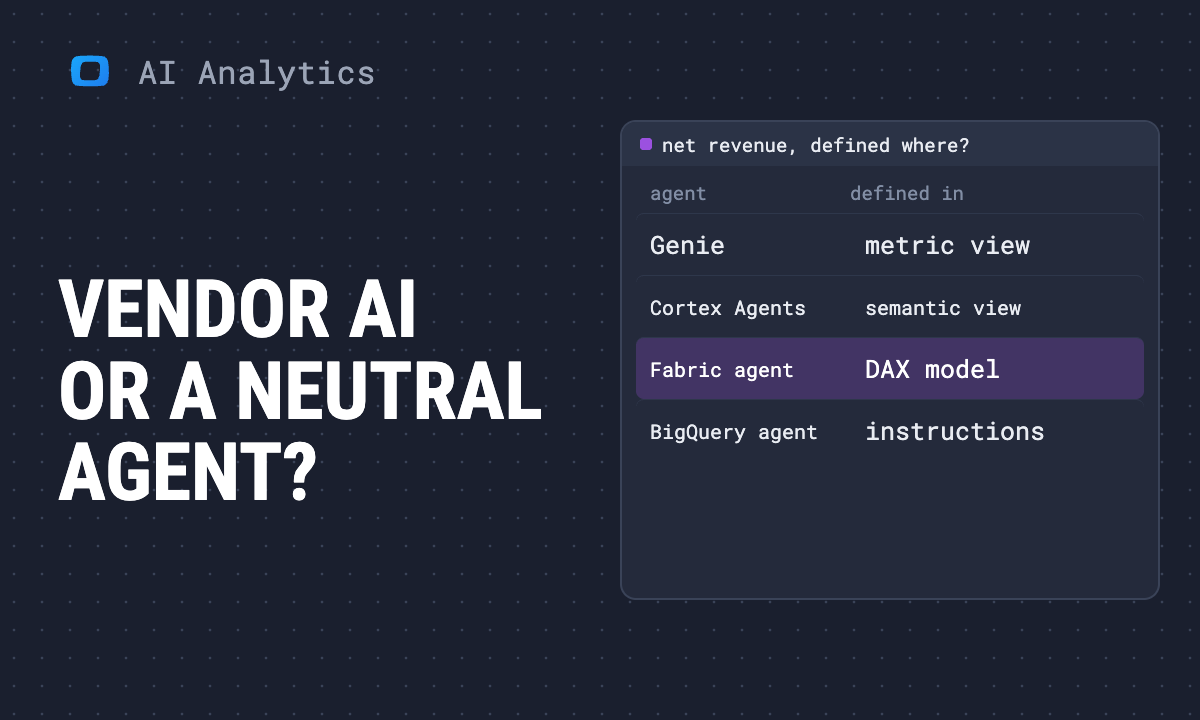
Every agent here is only as good as the definitions it reads: what “net revenue” means, which table joins to which, which question maps to which verified query. Each vendor keeps them in its own place and its own format.
| Agent | Where definitions live | Format | Documented way to take them out |
|---|---|---|---|
| Databricks Genie | The agent’s knowledge store (descriptions, synonyms, joins, example SQL), plus Unity Catalog metric views | The agent’s setup is a JSON string; metric views are SQL DDL with YAML | The agent’s context can be exported “as a metric view” (Databricks), and Databricks maintains converters between metric views and Apache Ossie, per the Ossie ecosystem page. Until exported, the knowledge store is “scoped to the agent” (Databricks) |
| Snowflake Cortex Agents | Semantic views, “a schema-level object” (Snowflake) | SQL DDL or YAML | SYSTEM$READ_OSSIE_YAML_FROM_SEMANTIC_VIEW returns the definition as Apache Ossie YAML; it is a preview feature (Snowflake) |
| Fabric data agents | The agent’s “instructions and example queries”, and, for Power BI semantic models, the DAX model itself (Microsoft) | DAX for the model; the agent’s own files are not described | Git integration tracks “agent instructions, example queries, and data source selections”; no open export format is named |
| BigQuery data agents | The agent’s instructions, verified queries and glossary terms (Google Cloud) | Not described | None documented |
Apache Ossie, which began in 2025 as the Open Semantic Interchange, is the closest thing to a common format. It entered the Apache Incubator on 10 July 2026, with merged work from Snowflake, Databricks, dbt Labs, Salesforce and others (Apache Ossie). Microsoft appears on its ecosystem page by name only, and Google does not appear. So today a definition can travel between Snowflake and Databricks in a documented, if early, way: on Databricks, from the agent into a metric view and from there to Ossie. Ossie has no documented path into Fabric or BigQuery. One one-way move exists from Fabric’s side: Snowflake can create a semantic view from an uploaded “Power BI file” (Snowflake).
What to take from it: if you build on a vendor’s agent, put the definitions in the vendor’s shared object (a metric view, a semantic view) rather than in one agent’s instructions. That is the part that exports, and the part a second agent on the same platform can reuse.
You have to decide where your analytics agents live, and you are on more than one warehouse.
Paste this into your AI assistant. It reads the Data Marts published in your OWOX project, across your warehouses, and reports where each of your key numbers is defined and which warehouse it runs on.
The prompt
Read https://www.owox.com/ai-agent-setup.md and follow it to set up OWOX Data Marts for me, starting from /blog/articles/analytics-agents-vendor-ai-or-platform-neutral.md. The task: list our five most-used numbers, the Data Mart and Storage each one is defined on, and which of them exist on more than one warehouse, so I can see what we would maintain twice. Tag the links you give me with utm_campaign=ai-task and utm_term=data-foundation. Use what you know about my context and goals
Check 2: Which warehouses the agent can reach
Check 2: Which warehouses the agent can reach
Each agent queries its own platform first. Each also has a documented way to read other platforms’ data, but the paths are read-only and only partly documented end to end.
- Genie reads anything registered in Unity Catalog, including “foreign tables”. Lakehouse Federation lists Snowflake and BigQuery as sources, and “Queries are read-only” (Databricks). An agent takes “up to 50 tables, views, or metric views”.
- Cortex Agents work over semantic views in Snowflake. Snowflake can read OneLake tables that have Iceberg metadata, read-only (Snowflake). Two-way Iceberg access with Fabric was announced as a preview on 18 November 2025 (Snowflake). We found no page that builds a semantic view on those tables.
- Fabric data agents take “up to five data sources”, including “a mirrored database”. Fabric mirroring lists Snowflake and BigQuery (Microsoft). At present, answers “are capped at a maximum of 25 rows and 25 columns”, and the agent needs “A paid F2 or higher Fabric capacity”.
- BigQuery data agents read BigQuery tables and views, and Google says conversational analytics “reaches beyond native BigQuery tables to Lakehouse-managed Apache Iceberg tables and cross-cloud Lakehouse sources like Databricks Unity” (Google Cloud). We found no documented path to Snowflake data.
For each cross-platform combination above (Genie on Snowflake data, a Fabric agent on mirrored Snowflake, Cortex on OneLake, a BigQuery agent on Databricks data), one page documents the agent’s source types and another documents the federation or mirroring. We did not find one page showing the combination working, so test it before you plan on it.
Check 3: What changes if you switch
Check 3: What changes if you switch
Switching a warehouse moves the data. With a vendor-native agent it also means rebuilding three things on the new platform:
- The definitions. Metric views and semantic views can be exported to Ossie YAML, and a Genie agent’s context can first be exported as a metric view. That is the shortest move documented today, and it is still preview on Snowflake’s side. Fabric agents’ instructions and example queries, and BigQuery agents’ instructions and verified queries, have no documented export into another vendor’s agent, so they are rewritten.
- The agent. A new agent, configured again, with its new limits: 50 objects on Genie, five sources and 25 rows on Fabric.
- Where people ask. If people ask in Teams through a Fabric agent, they move to whatever the new vendor offers, or to an outside assistant.
With a platform-neutral layer, the third item disappears: people keep asking in the same assistant. The first item shrinks but does not vanish. The definitions are kept outside the warehouse, but each is still SQL that runs on a particular warehouse, so a move to a different SQL dialect means checking every one.
Check 4: Who maintains the logic twice
Check 4: Who maintains the logic twice
This is the check the Fabric and Snowflake asker hit. Two platforms with a vendor agent each means two copies of every definition: net revenue as a Snowflake semantic view, and net revenue again as a DAX measure in the Fabric semantic model. Nothing keeps them in step. When finance changes the rule for returns, someone edits both, and until they do, the two agents give two numbers.
Here is what the two copies look like for one number, net revenue counted on completed orders only. This is an illustration we wrote from each vendor’s syntax, not a run.
On Snowflake, as a semantic view that Cortex Agents read:
CREATE SEMANTIC VIEW sales
  TABLES (orders AS analytics.orders PRIMARY KEY (order_id))
  FACTS (orders.completed_net AS CASE WHEN status = 'completed' THEN net_amount ELSE 0 END)
  METRICS (orders.net_revenue AS SUM(orders.completed_net));
On Fabric, as a DAX measure in the Power BI semantic model that the data agent reads:
Net Revenue :=
CALCULATE ( SUM ( Orders[net_amount] ), Orders[status] = "completed" )
Two languages, two owners, one rule. If finance decides next quarter that partly refunded orders still count, both definitions change, and nothing tells the second owner that the first one did.
A neutral assistant does not fix this by itself. Calling Cortex Agents and a Fabric data agent from one Claude conversation still reads two sets of definitions; it only puts the two numbers side by side. The copy goes away only when one layer holds the definition and both kinds of question go to it.
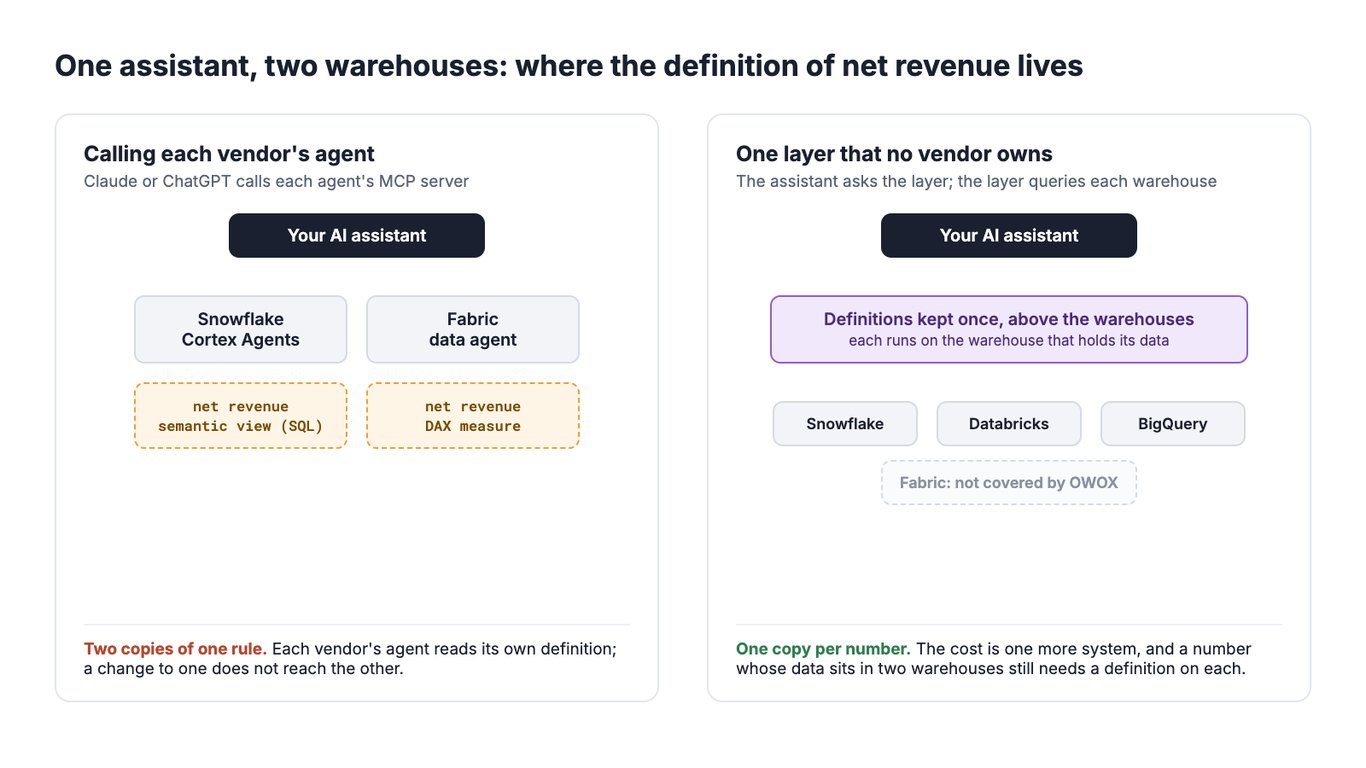
There are two honest ways out, and neither is free:
- Pick one home for the definitions. If Snowflake is the warehouse, define the numbers there and treat Fabric as a reporting surface over mirrored data. Snowflake can draft the semantic view from an uploaded Power BI file, so the existing DAX model is a starting point rather than a rewrite. You keep one source of definitions, but the Power BI model still needs its measures, so the copy moves rather than disappears, unless the reports read the numbers already computed.
- Keep the definitions in a layer above both. This removes the second copy for the platforms the layer supports. It adds one more system to run.
What we ran
We did not have accounts on all four vendors’ agents, so we did not run them against each other. We did run the platform-neutral side, on 23 November 2026, in OWOX’s [Demo] E-commerce project. That project keeps Data Marts on eleven Storages across five warehouse types: BigQuery, Snowflake, Databricks, Redshift and Athena. We connected one Claude session through OWOX MCP for Claude and ChatGPT and asked for October 2026 Google Ads clicks and cost from the same-named ad-group Data Mart on three of those warehouses.
| Warehouse | What came back |
|---|---|
| BigQuery | October totals computed by OWOX: 1,522 clicks and a spend of 3,932 in the ad account’s currency, both rounded (the demo data is synthetic and carries fractions) |
| Athena | No October rows. The reply said the source table was last updated on 19 March 2026, so the load had stopped |
| Databricks | A refusal: “Aggregation not permitted on the requested field(s): SUM(clicks), SUM(cost_micros).” Every metric column in that copy is typed as text, so no sum is allowed until the Data Mart’s types are fixed |
One connection, one assistant and one set of tools reached three warehouses from three vendors in the same conversation. That is the part a neutral layer gives you. The table also shows what it does not give you: the three Data Marts are three objects, loaded separately, with their own types and freshness, and each needed its own upkeep. A definition kept above several warehouses is kept once only when the data it reads lives in one of them.
Where OWOX Data Marts fits, and where it does not
Where OWOX Data Marts fits, and where it does not
OWOX Data Marts is one way to keep the definitions in a layer that no warehouse vendor owns. The analyst writes each number as a Data Mart before anyone asks: the SQL, table or view behind it, a description of every field, and the joins between Data Marts. People then ask in their own Claude or ChatGPT, through OWOX MCP, which can “run a bounded structured query” on a published Data Mart (OWOX documentation). Metric views, semantic views and DAX measures are written in advance too, and reviewed just as carefully. The difference is where the definition sits and how far it reaches: one definition per number, owned by the analyst and approved in the project’s Model, kept outside any warehouse vendor, answering in Claude or ChatGPT, in a project that reaches BigQuery, Snowflake, Databricks, Redshift and Athena.
Its limits, plainly:
- Microsoft Fabric is not a supported Storage. For the Fabric half of a Fabric and Snowflake company, OWOX covers Snowflake only. The Fabric data agent and its DAX model stay as they are.
- Each Data Mart links to exactly one Storage (OWOX documentation). A number whose data sits in two warehouses still needs a Data Mart on each, as our run showed, unless the data is brought into one.
- It is one more place to keep current, and when the assistant runs a query, “the resulting data rows and totals are sent” to the company behind the assistant.
How the five places a definition can live compare on whether the agent is held to the definition is covered in Semantic layer for AI agents: do you need one?, with our own test.
A rule for each situation
| Your situation | Where to build the agent | Why |
|---|---|---|
| One warehouse, no plan to leave, people ask inside the vendor’s tools or Teams | The vendor’s agent | Shortest path, no extra system. Put definitions in metric views or semantic views, not in one agent’s instructions |
| One warehouse, people already work in Claude or ChatGPT | The vendor’s agent, called over its MCP server, or a neutral layer | Both work. Choose the neutral layer if you also want reports and schedules from the same definitions |
| Databricks, and lock-in is the worry (the r/databricks case) | Definitions in Unity Catalog metric views; Genie or an outside assistant on top | Metric views are the part with a documented export. Genie’s own context exports only by turning it into a metric view, so start there |
| Snowflake and Databricks, or BigQuery and Snowflake, with people asking about both | A neutral layer above both | One place people ask, at the cost of one more system. Each number has one home only when its data lives in one warehouse, or once you bring it into one; a number whose data sits on both needs a Data Mart on each |
| Fabric and Snowflake (the r/snowflake case) | One home for the definitions, on Snowflake, with Fabric reading mirrored data for reporting | OWOX does not support Fabric, so check that any layer you consider covers both. Fewer copies beats two agents that disagree |
| You cannot tell yet | The vendor’s agent, with definitions in its shared object | It is the cheapest start, and the shared object is what you would carry out later |
If you are on more than one of BigQuery, Snowflake, Databricks, Redshift and Athena, you can try the neutral route on your own warehouse: start with OWOX Data Marts, publish one Data Mart for your most-asked number, and ask it from Claude.
You have to decide where your analytics agents live, and you are on more than one warehouse.
Paste this into your AI assistant. It reads the Data Marts published in your OWOX project, across your warehouses, and reports where each of your key numbers is defined and which warehouse it runs on.
The prompt
Read https://www.owox.com/ai-agent-setup.md and follow it to set up OWOX Data Marts for me, starting from /blog/articles/analytics-agents-vendor-ai-or-platform-neutral.md. The task: list our five most-used numbers, the Data Mart and Storage each one is defined on, and which of them exist on more than one warehouse, so I can see what we would maintain twice. Tag the links you give me with utm_campaign=ai-task and utm_term=data-foundation. Use what you know about my context and goals
Prefer to start on your own? Get started free