Can you trust AI with your business numbers?
You can trust an AI answer about your business numbers when three things are true: each number has one written meaning that someone owns, the AI may answer only from that, and you can open the calculation behind every answer. This guide explains the two ways an AI answer goes wrong, where your figures go when you ask, and which guide to read for your situation. It ends with a summary to forward.
“Can we actually trust what AI tells us about our numbers?” A founder or a finance lead asks it, usually after two people brought two different revenue figures to the same meeting, both “from AI”. The person who has to answer is whoever looks after the company’s data.
This page is for the person who got asked, with a short part for the person who asked. It gives the answer, the reasons, and where to read more. If you are the one who asked, the last section is written for you.
The short answer
Yes, you can trust an AI answer about your business numbers when three things are true. Each number has one written meaning that someone owns. The AI may answer only from what is written. And you can open the calculation behind every answer. If any of the three is missing, treat the answer as a draft, however confident it sounds.
The common setup today fails all three. Someone pastes a spreadsheet export into an AI chat, or connects the chat straight to the company’s database, and asks for revenue. The AI decides for itself what “revenue” means, and it does not say which meaning it chose. It fails quietly: the number looks right. If your team already pastes exports into a chat, there is no need to ban it; the section on pasted exports says what to do instead.
You should know who is telling you this. We are OWOX, and we make OWOX Data Marts, a product where an analyst defines each number once and people then get that number in their spreadsheets, their dashboards and their AI chat. So we have a view. We have tried to be fair to the other ways of doing this, and we say below when one of them is the better choice.
Two ways an AI answer can be wrong
Two ways an AI answer can be wrong
People usually worry about the first. The second does more damage.
A different answer each time. Two people ask about last quarter’s revenue and get two figures. It is embarrassing, and it is also visible: someone notices, and someone checks.
The same wrong answer each time. The AI settles on one meaning of revenue, for example one that still counts cancelled orders, and repeats it faithfully. Nobody checks, because the number never changes. “It gave me the same figure twice” tells you the AI is consistent. It does not tell you the figure is the one your finance team would sign.
One illustration from our own product, not a measurement: on 9 October 2026 we asked a demo shop’s data for revenue three ways, in three separate chats. Two answers led with net revenue of $849,177. The third led with gross revenue of $998,141 without looking at the data: the AI reused an earlier conversation, and said so. Both figures were correct for what they measured; which came first was the AI’s choice. It shows the failure can happen, not how often. The full run is in our guide to AI analytics on BigQuery.
Why the wording of a question changes the answer is covered in why AI gives different answers to the same data question. And when a supplier says its AI is “90% accurate”, that figure was measured on someone else’s questions and someone else’s data, not on yours.
OWOX Data Marts
See your first report built in real time. 15 minutes.
- Connect your data warehouse
- Pick your metrics
- Get a live Google Sheets report
In the time it takes to write a ticket. Then imagine never writing that ticket again.
Book a DemoWe'll use your actual use case
Why it happens: the AI has to guess what you mean
Why it happens: the AI has to guess what you mean
It is rarely the arithmetic. The AI adds up correctly; it adds up the wrong things.
“Revenue” has several honest meanings inside one company: before or after refunds, with or without cancelled orders, with or without tax, counted on the order date or the payment date. A new colleague would ask which one you want. An AI picks one and carries on.
How much it has to guess depends on what it was given:
| What the AI is given | What it decides for itself |
|---|---|
| A file someone exported | What every column means |
| Direct access to the company’s database | Which tables to combine, and what the number means |
| A definition someone wrote and owns | Only how to present the answer |
Three things follow from that table:
- When the AI writes its own database query, the guesses include table and column names that do not exist. That is covered in AI analytics hallucination: why it happens.
- Loading your documentation into the AI helps it find a definition, not the right one. If three documents describe revenue three ways, it still has to choose.
- When a colleague builds a dashboard by describing it to an AI, the same guessing happens out of sight. Vibe analytics is a hallucination machine lists what goes wrong.
If people already paste exports into a chat
If people already paste exports into a chat
This is the most common setup in smaller teams, and banning it rarely works. Set three rules instead:
- Treat the answers as drafts, not decisions, until the number is written down and its calculation can be opened.
- Keep customer-level and personal data out of pasted files: names, emails, addresses, and any figure that must not leave the company. Everything in a pasted file is sent to the AI company.
- Find out what has already been pasted, by whom, and where those answers ended up.
Three things that have to be true before you rely on an answer
Three things that have to be true before you rely on an answer
They hold whichever tool you use, ours included.
- The number has one written meaning, and a named person owns it. Written means it says what the number counts and what it leaves out. Owning it means three things: you decide when the meaning changes, you agree the change with the people who use the number, and you write the change where the AI reads it. It does not mean vouching for every answer a chat gives. You may already have this without buying anything: a model in your reporting tool, metric definitions your team keeps in code, or a documented table can all count.
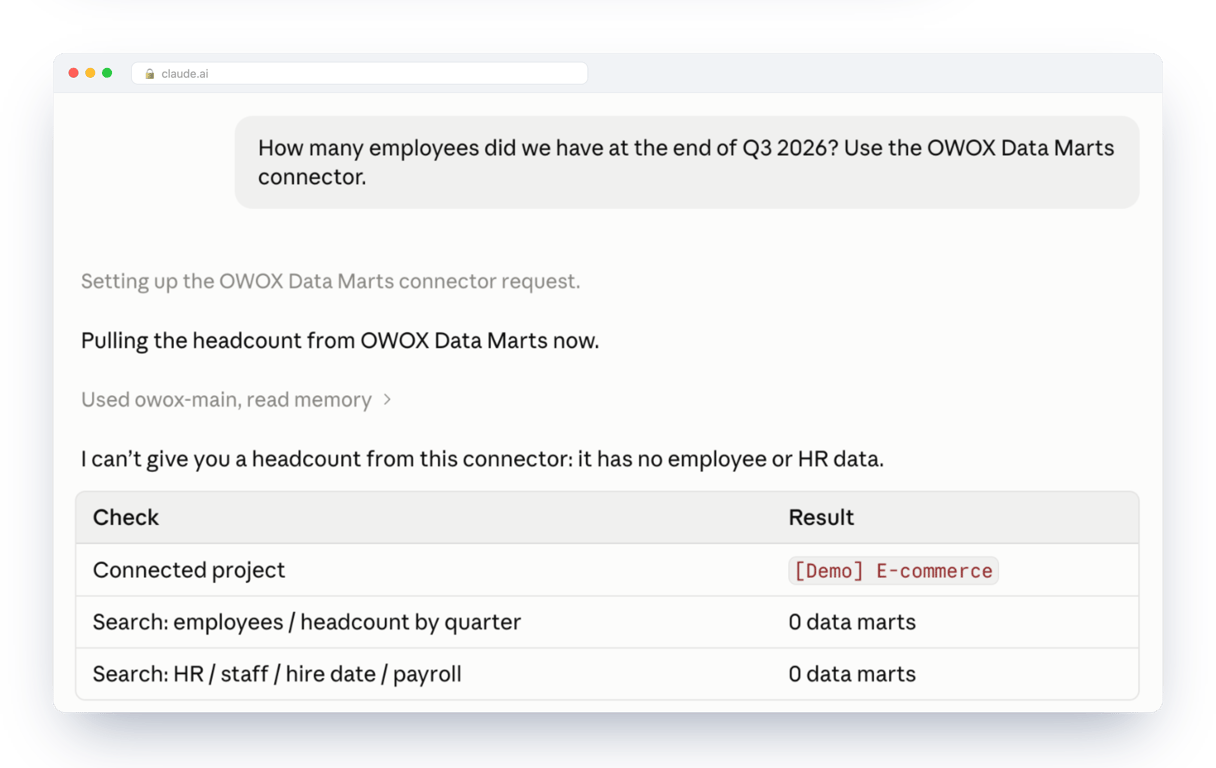
- The AI may answer only from what is written, and says so when it cannot. We tested this on our demo project on 9 October 2026 by asking for headcount, which the project holds no data on. The reply was: “I can’t give you a headcount from this connector: it has no employee or HR data.” A refusal is the correct answer there.
- Every answer has a record you can open. The record shows the question, who asked it and when, which definition the answer used, and the calculation that ran. If an answer has no record behind it, you cannot tell whether it came from your data.
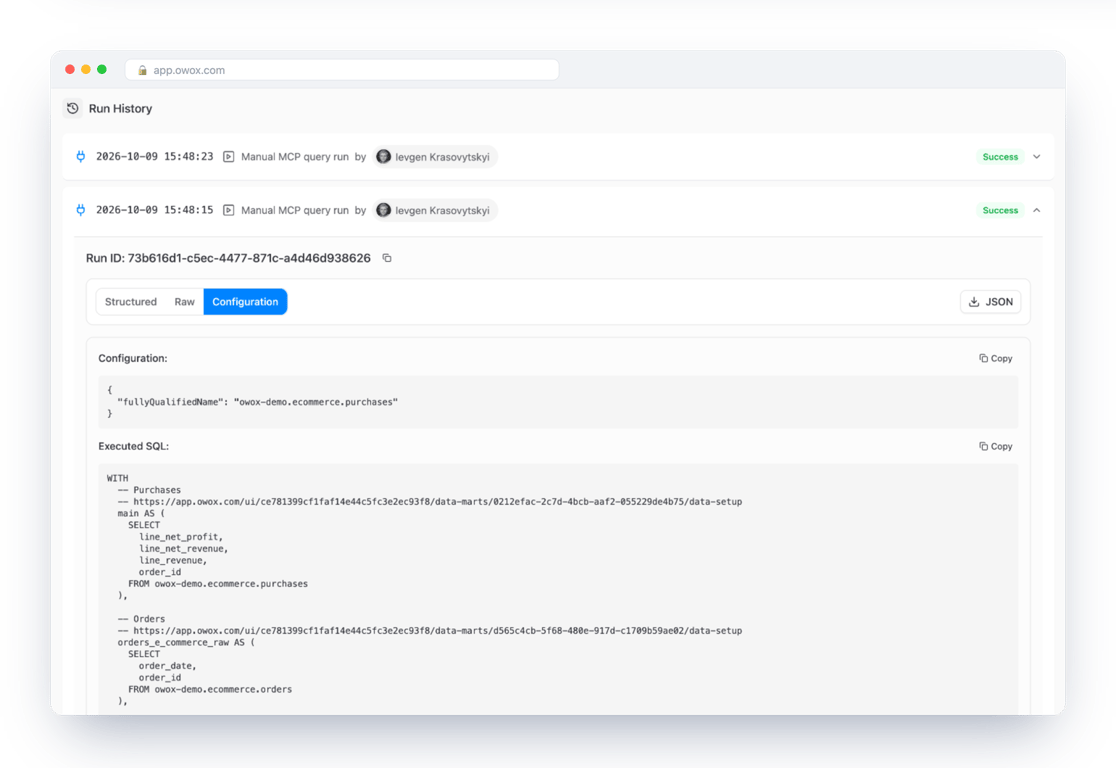
In OWOX Data Marts that record is called Run History. Each entry shows when the question came, who asked, the dataset used (here, Purchases) and the calculation that ran, in full.
If your team already keeps its definitions in a tool that meets these three, that is the tool to use.
Where your figures go when you ask
Where your figures go when you ask
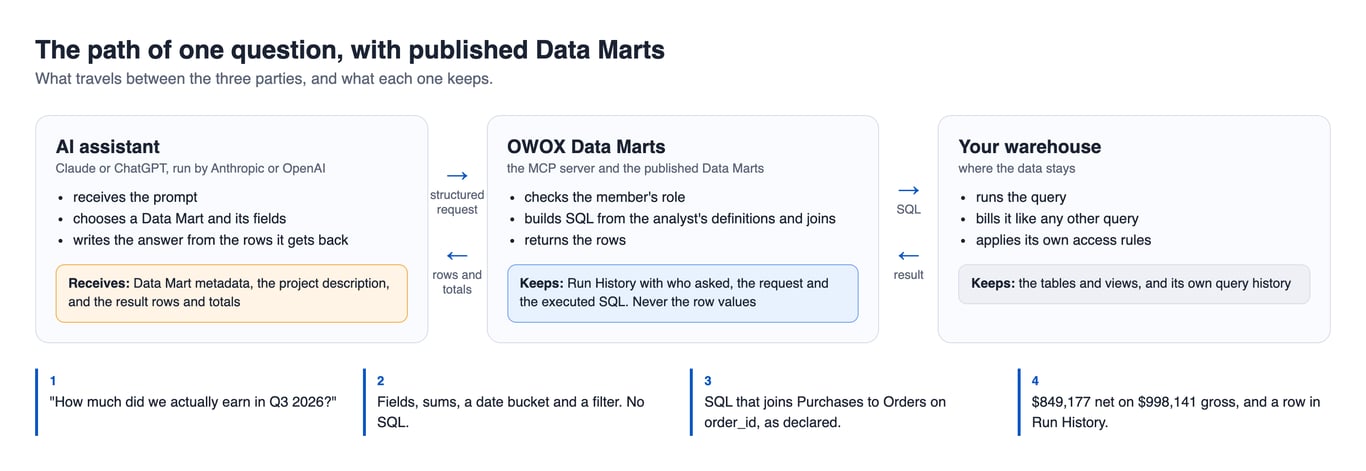
To write a reply, the AI has to read the figures behind it. So those figures are sent to the company that runs the AI: Anthropic if you use Claude, OpenAI if you use ChatGPT. Not only your question. The figures.
You choose what the AI may read. It can only send on what it is allowed to see. Decide that list before anything is connected, and leave out whatever must not leave the company, such as figures that identify a client, or payroll.
Put four questions to any supplier, and ask for the answers in writing:
- Which AI company receives our figures?
- What is kept, and for how long?
- Is anything used to train the AI?
- How is the list of what the AI may read enforced, and who can change it?
Our own answers, in one sentence: the AI gets only the figures an analyst has chosen to share, we keep a note of each question but not the figures, and our documentation does not say how long that note is kept or what the AI company does with the figures, so ask us in writing.
The detail is for your analyst, from our documentation as it reads on 10 October 2026. The connection between OWOX Data Marts and an AI chat, called the MCP server, is part of OWOX Data Marts Cloud.
- Who receives the figures: the company behind your AI chat. Our documentation says that when the AI asks a Data Mart (a dataset an analyst has defined) for figures, “the resulting data rows and totals are sent to that provider”.
- What is kept: on our side, the record of each question keeps “the query definition and executed SQL only”, never the figures themselves, according to the same documentation. How long that record is kept, and what the AI company keeps, our documentation does not state. Ask us, and the AI company, in writing.
- Training: our documentation does not state this. It is the AI company’s policy; ask it, and us, in writing.
- Enforcement: the AI can ask only for Data Marts an analyst has published, and only for “data you are permitted to query”. What each person may see is set by their role and by business areas called Contexts, and only a project admin can create or change a Context.
Inside your own company, the people to ask are whoever handles security, or your auditors. In a small company with neither, agree the list between you, the founder and whoever runs finance, and write it down.
What it takes, and what it does not fix
What it takes, and what it does not fix
The long step is agreement, not connection. Connecting an AI chat to your data is short. Getting the people who use a number to agree what it means is long, and no tool shortens it. We will not give you hours; it depends on how many meanings are in use today.
If nothing is written down, start with one number, the one your leadership argues about most:
- Find every place it is calculated today: reports, spreadsheet formulas, saved queries.
- Write what it counts and what it leaves out.
- Put that definition in one place the AI will read.
- Get the person who uses the number to sign it. In a small company that is usually the founder or whoever runs finance.
That can be done by hand, this week, with no new tool. Step 4 depends on other people and is usually the slow one.
It is not a one-off. The business changes its mind about what counts, and the written meaning has to follow.
Three things stay unfixed, in every tool:
- The AI can pick the wrong number from a correct list.
- It can do its own sums on correct figures and get the sums wrong.
- It cannot combine numbers that are not stored in one place. If yours sit in several tools or several warehouses, start with why cross-tool joins need a warehouse.
And sometimes none of this is needed. If you want help writing a query and will check the result yourself, a general AI chat is the right tool. Writing SQL with ChatGPT covers that.
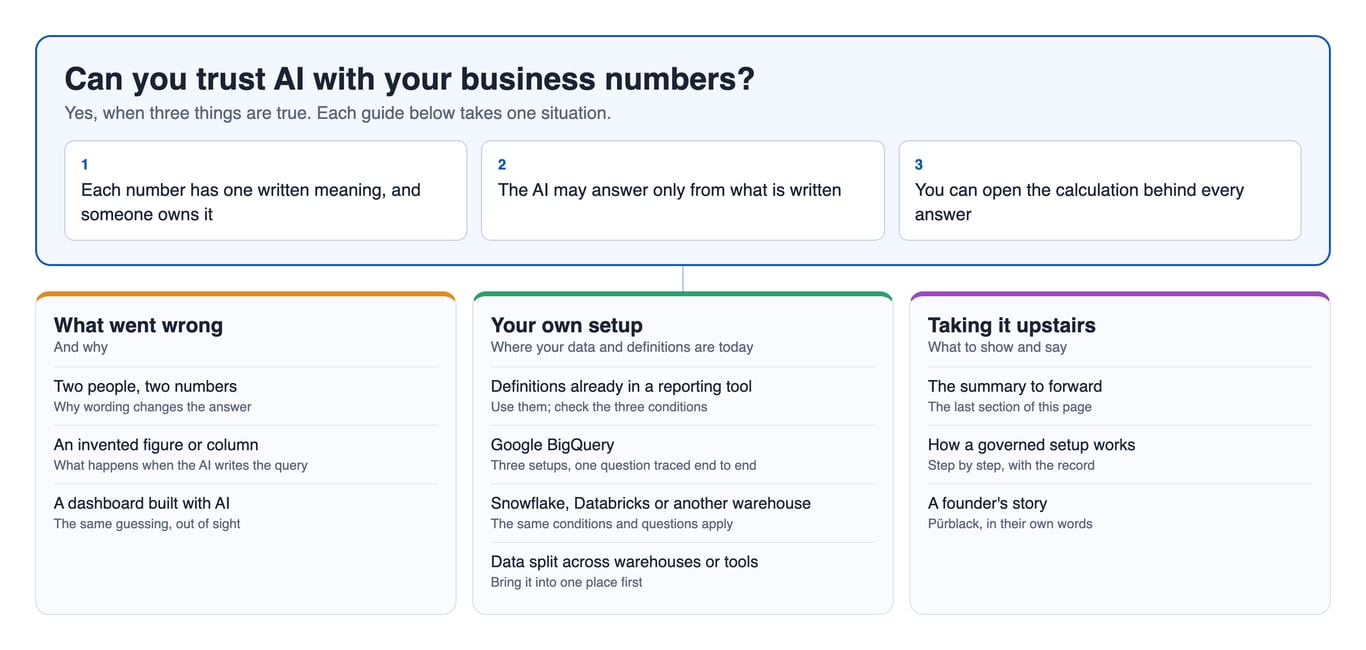
Find your situation
Start from the line that sounds like you.
| If you are asking | Read |
|---|---|
| People already paste exports into a chat | What to do instead of banning it |
| Our reports live in spreadsheets and nothing is written down | Start with one number |
| The AI gave two people two numbers | Why AI gives different answers |
| The AI invented a figure or a column | AI analytics hallucination |
| Our numbers already have definitions in a reporting tool such as Power BI | Use them, and check that tool against the three conditions above |
| Our data is in Google BigQuery | Governed AI analytics on BigQuery |
| We connected Claude to BigQuery ourselves | BigQuery MCP for Claude |
| Our data is in Snowflake, Databricks or another warehouse | The conditions and questions above apply; the comparison below covers each warehouse’s own assistant |
| Our data is split across two warehouses, or several tools | Why cross-tool joins need a warehouse |
| How does a governed setup work? | Governed MCP analytics, step by step |
| What do I tell the person who asked, or the board? | The summary at the end of this page |
| Has a founder been through this? | The Pürblack story |
Pürblack’s chief marketing officer, Mark Simmons, puts it the way we would: “we know the data underneath is solid, so the risk of hallucination is much, much smaller.” Smaller, not gone.
Coming next in this series
- A comparison of AI data analyst tools, including Snowflake’s and Databricks’ own assistants and Copilot in Power BI.
- Whether you need a semantic layer for AI agents, and how to write a definition the AI can use.
- What a text-to-SQL accuracy score says about your own data.
- Why loading documents into the AI does not settle which definition is right.
- How colleagues can build dashboards with AI without each choosing their own revenue.
A check to run this week
You can test whatever AI tool your team already uses, in one sitting, once it is connected to your data.
- Pick the number your leadership argues about most.
- Ask for it three ways, each in a new chat.
- Write down the three numbers, and which one each answer led with.
- Open the calculation behind each answer. If there is none, you cannot tell where the number came from.
- Ask one thing your data cannot answer, and see whether the tool refuses.
If your team only pastes exports into a chat, run the same check on one export: ask the same question three ways, ask the AI to state which definition of revenue it used, and compare each answer with the number you would sign.
The full steps, with the prompts we used and what we found, are in our BigQuery guide.
What to send back to the person who asked
What to send back to the person who asked
Short enough to forward as it is:
- Can we trust AI with our numbers? Yes for the numbers we have written down. Not yet for the rest.
- The risk is not that the AI invents figures out of nothing. It is that it chooses its own meaning of “revenue”. It can do that consistently, so an answer can look stable and still be wrong.
- What I need from you is agreement on what our most-argued number means, and your sign-off on it. That is the slow part, and it is not technical.
- For any figure that matters, I will be able to show you the calculation behind it. If a tool cannot show that, we do not use it for decisions.
- If AI figures have already gone into decisions, including anything in board or investor material, I will re-check the important ones against their calculation.
- People can keep using AI chats on pasted files to explore. Until a number is written down, those answers are drafts, and customer names, emails and other personal details stay out of what is pasted.
- What the AI reads to answer us is sent to the company that makes the AI. We choose what it may read. Let us agree that list, with security or our auditors if we have them, before anything is connected.
- This will not make the AI right every time. It makes a wrong answer something we can catch.
If you want to see the three conditions working on your own data, our product is where we built them, and this page shows how an AI chat connects to it.
Turn your data into decisions.
Governed data marts give you the clean foundation ML needs to actually work.
- No AI hallucinations
- Analyst-governed definitions
- Every number traces to SQL
Frequently Asked Questions
Can AI be trusted 100% with business numbers?
No. An AI can pick the wrong number from a correct list, or do its own sums on correct figures and get them wrong. What you can arrange is that a wrong answer gets caught: each number has one written meaning, the AI may answer only from that, and every answer has a calculation you can open and check.
Is it safe to give AI our financial data?
It depends on what you let it read. To write a reply, the AI has to read the figures behind it, so those figures are sent to the company that runs the AI. For OWOX Data Marts, our documentation says "the resulting data rows and totals are sent to that provider", such as Anthropic for Claude or OpenAI for ChatGPT. Decide the list of what the AI may read before connecting anything, leave out what must not leave the company, and ask every supplier in writing what is kept and whether it is used for training.
Why did the AI give two people different numbers?
Usually because the number has more than one meaning in your company and the AI chose a different one each time: revenue before refunds for one person, after refunds for the other. The wording of the question, and what the chat remembers from earlier, both steer that choice. The causes are covered in why AI gives different answers to the same data question.
If the AI gives the same number every time, is it right?
Not necessarily. A repeated number shows the AI is consistent. It can be consistently using a meaning your finance team would not sign, for example revenue that still counts cancelled orders. Check the calculation behind the answer against the written definition, not the answer against itself.
Do we need a new tool before we can trust AI with our numbers?
Not to start. The first step is one written definition for the number your leadership argues about most, agreed with the people who use it. That is done in a meeting and a document. A tool matters at the next step, when you want the AI held to that definition and a record kept of every answer. If your team already keeps definitions in a tool that does both, use that one.
Does OWOX guarantee the AI is never wrong?
No. With OWOX Data Marts the AI cannot write its own query: the documentation says it "cannot run arbitrary SQL", only structured requests built from fields an analyst published, and each request is recorded in Run History with the SQL that ran. The AI can still choose the wrong Data Mart or misstate a figure in its reply. The record is what lets you catch that.