I watched a CEO fire his weekly report — here's what he does instead
The most expensive meeting in your company
The most expensive meeting in your company
The most expensive meeting in your company is the weekly report review – and it’s always about last week.
I watched a CEO cancel his. Permanently. Not because he stopped caring about the numbers, but because he found a faster way to get them. Here’s what actually happened, and why I think the weekly report as we know it is living on borrowed time.
Flying blind between board meetings
Flying blind between board meetings
Here’s the uncomfortable truth about how most companies are actually run: on a weekly PDF and a quarterly board deck. Between those two artifacts, the CEO is flying blind.
Think about what happens between board meetings. Real questions come up every day. Should I reorder inventory now or wait? Which product line is quietly dragging margin down? Did that pricing change actually work? Each of those questions has an answer sitting in the company’s data. And each of them either waits in someone’s queue – or gets answered by gut feel.
This isn’t a new problem. It’s a decades-old one. The CEO has never been able to query the business directly. Every generation of tooling promised to fix it – data warehouses, BI platforms, self-service analytics – and every generation quietly failed the person at the top. I’ve written before about why self-service analytics keeps failing: it hands executives dashboards, not answers. A dashboard is somebody else’s guess about what you’ll ask next week.
The weekly report is a workaround for that failure. A ritual built on a limitation. And workarounds have a shelf life.
Your weekly report is already wrong by the time you read it
Your weekly report is already wrong by the time you read it
Let me land the first problem plainly: the weekly report is stale on arrival.
It gets built on Friday. You read it Monday morning. It describes last week. But the decision it’s supposed to feed – reorder, reallocate, push, cut – is about this week. You are steering by looking at where the car was, not where it is.
I’m not saying the numbers are wrong. Your data person is careful. I’m saying the numbers are late, structurally, every single time. Data freshness decides the quality of your decisions, and a weekly cadence guarantees your freshest strategic input is days old.
A report that’s always about last week isn’t reporting. It’s history class.
OWOX Data Marts
See your first report built in real time. 15 minutes.
- Connect your data warehouse
- Pick your metrics
- Get a live Google Sheets report
In the time it takes to write a ticket. Then imagine never writing that ticket again.
Book a DemoWe'll use your actual use case
Every question is a queue through one data person
Every question is a queue through one data person
Here’s the second problem, and if you run a 200-person company you already know it: you probably have one data person. Maybe two.
Every question that isn’t already on a dashboard becomes a ticket in their queue. Your question about margin by product line lands behind a broken pipeline, a marketing attribution request, and last month’s board-deck prep. The most expensive queue in your company isn’t in your warehouse or your support desk – it’s in front of your one data guy.
And it’s not their fault. The queue is a systems problem, not a staffing problem – I’ve seen teams double headcount and the analyst bottleneck just doubles its backlog. As long as every answer has to be hand-assembled by a human, the queue is the product.
So most CEOs stop asking. That’s the really expensive part. Not the questions that wait – the questions that never get asked at all.
The CEO who just asks – in his own AI chat
The CEO who just asks – in his own AI chat
Now the alternative, because it exists and I’ve watched it work.
A CEO opens the AI chat he already uses – Claude, in this case – and types: “Show me the revenue last month”.
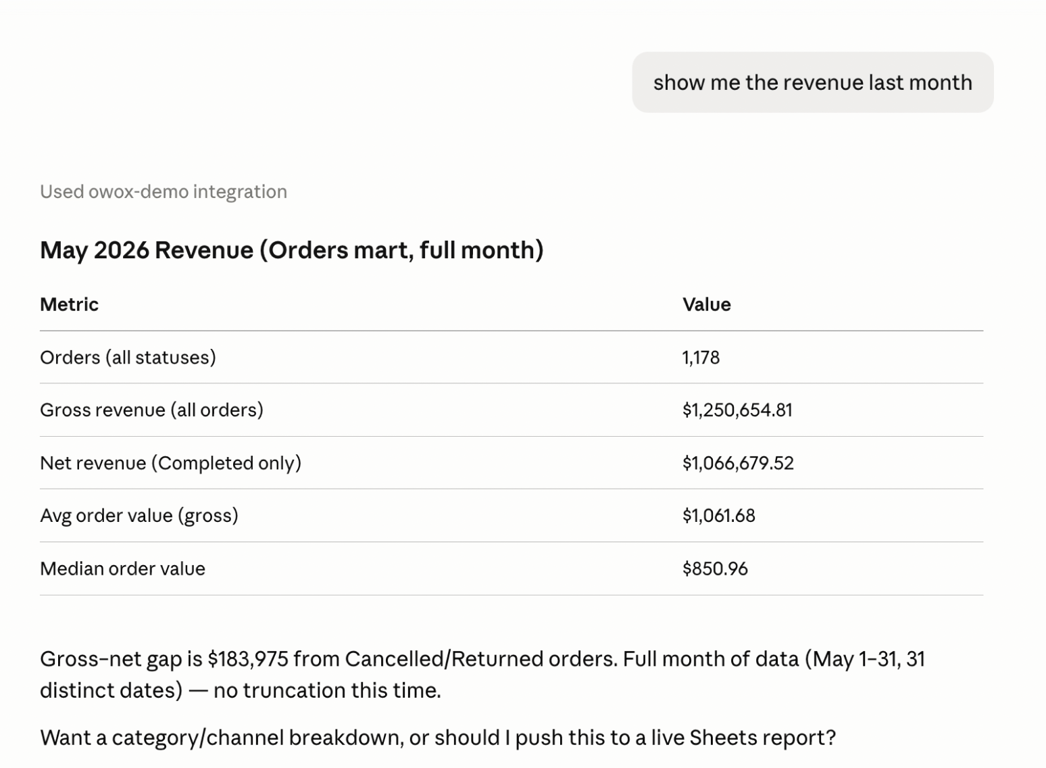
The answer comes back in seconds, with a chart. Second prompt: “now - category and channel breakdown” Done. Two prompts. No ticket, no queue, no waiting for Monday for a planning session of a data team.
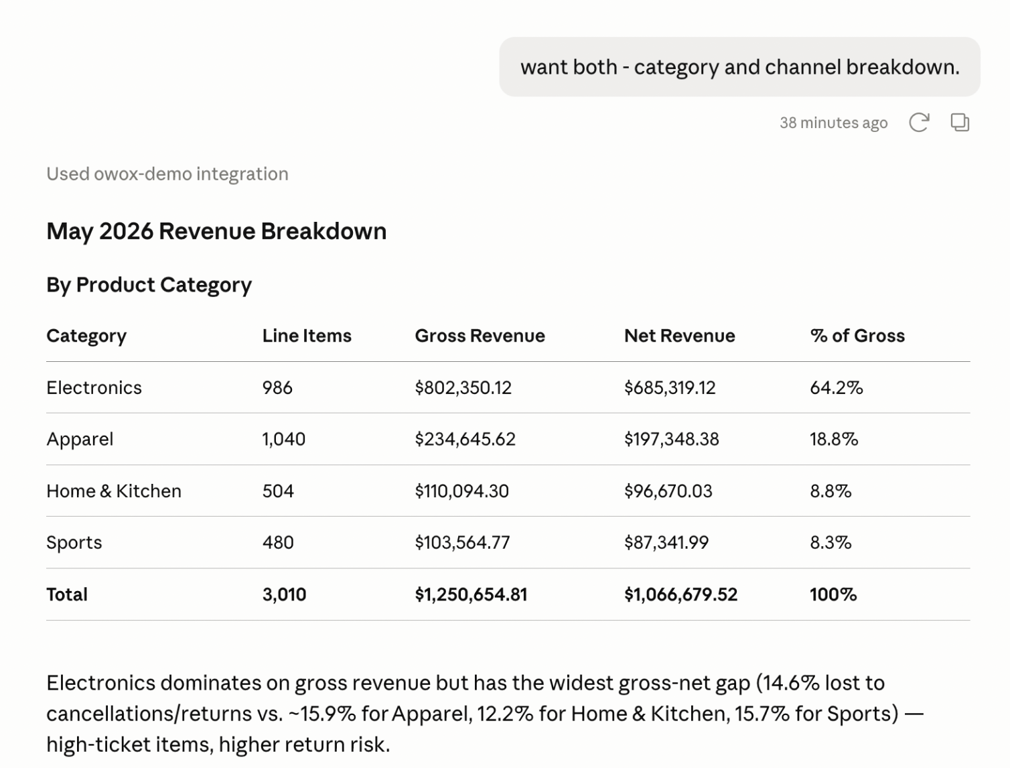
Under the hood this runs on MCP – Model Context Protocol, the open standard that lets an AI chat talk to your business data through a controlled connection.
If you want the technical walkthrough of how mcp works with corporate data, we’ve published how to connect BigQuery data to Claude via MCP. But the point for a CEO isn’t the acronym. The point is the experience: you ask your business a question, and you get an answer you can act on.
This is what CEO self-serve analytics was always supposed to mean. Not “the CEO learns to build dashboards.” Just: ask, and trust the answer.
Why he can trust it: governed data marts, zero hallucinations
Why he can trust it: governed data marts, zero hallucinations
“Trust the answer” is where every AI analytics pitch usually falls apart, so let me be precise about the mechanism – because this is the part that makes the whole thing real. The same question, answered for the analyst who gets asked it, is in can you trust AI with your business numbers?.
The AI never computes anything.
Generic “chat with your data” tools point a language model at your raw database and let it write SQL on the fly. Ask a question, the model guesses at tables, invents a join, and hands you a number with total confidence. Sometimes it’s right. Sometimes it’s confidently wrong – and you can’t tell which, which means you can’t act on any of it. Practitioners see this daily; there’s a whole Reddit thread of analysts watching AI hallucinate on basic data retrieval.
The setup I watched works differently. The data analyst publishes governed data marts – controlled, reusable datasets with the joins and business logic he wrote and approved. The AI can only read from those. When the CEO asks a question, deterministic, analyst-written SQL computes the number; the AI’s only job is to narrate the result and draw the chart. Every figure traces back to SQL a human wrote. The language model never invents a join, because it never writes one.
That’s the precise claim – not “the AI doesn’t make mistakes.” The AI narrates. Governed SQL computes. That’s why the answer is trustworthy: the part of the system that’s creative is never the part that does arithmetic.
What actually changes: decision velocity
What actually changes: decision velocity
So what did the CEO actually gain? Not a prettier report. Something better: the time from question to decision collapsed from days to minutes.
That compounding effect is the real story. When an answer costs three days, you ration your questions. When it costs thirty seconds, you ask the second question, and the third – the follow-ups where the actual insight lives. Decisions stop queuing behind the reporting calendar.
And the weekly meeting? It survived – but it changed species. Nobody reads numbers off a slide anymore, because everyone walked in already knowing them. The meeting became a decision review instead of a data read-out. The report didn’t get better. It became unnecessary.
Five minutes vs ten years
The moment I keep coming back to happened on a call with the CEO of a US ecommerce brand – a founder who had been trying to get real answers out of his data for as long as he’d run the company.
We connected his AI chat to his governed data marts and he started asking questions – his questions, not demo questions. Revenue by channel. Repeat purchase behavior. The year-end picture. Somewhere in that first session he said the sentence I’ve been quoting ever since: “In literally five minutes, it pulled answers I couldn’t get in 10 years.”
Then he did something I didn’t expect. He’d been testing another warehouse MCP connector – Windsor – in parallel. Mid-call, after seeing the answers side by side, he disconnected it. Not because someone told him to. Because one connection gave him numbers he could trace, and the other gave him numbers he had to hope about.
One company, one CEO, one call. I’m not going to pretend it’s a benchmark study – and I’m keeping him anonymous, because it was a working session, not a testimonial shoot. But that’s exactly why I trust it: I watched a skeptical operator change his mind in real time, with his own data.
The career stakes are real
If you’re the person who owns AI rollout at your company – Head of AI, innovation lead, whatever the title – this stops being a productivity story and becomes a career story.
Gartner projects that by 2027, 75% of chief data and analytics officers who fail to show measurable AI value will be reassigned or removed. Read that again. Three out of four. Shipping AI the organization doesn’t trust – AI that hands the CEO a hallucinated number in a board meeting – is precisely how you end up in that 75%. Shipping AI answers that trace to governed SQL is how you don’t.
The safest AI project in your portfolio is the one where every output can be audited back to a human decision.
“The AI will just make it up” – your data person’s objection, answered
“The AI will just make it up” – your data person’s objection, answered
Now the conversation that decides whether any of this happens in your company: the one with your data person. When you propose this, they will push back. They should – skepticism about AI and data is literally their job. Here’s how the honest version of that conversation goes.
| Their objection | The honest answer |
|---|---|
| “The AI will just make it up.” | It can’t. Every answer runs on SQL you wrote and approved. The model narrates results; it never generates a join. If it tries to reach for a field you didn’t expose, it simply can’t. |
| “I’ll lose control – everyone will bypass me.” | The opposite. You define the data marts, the joins, the quality checks. You see every AI query in Run History – including every time the assistant tried something you didn’t allow. You become the gatekeeper, not the bottleneck. |
| “Our data isn’t safe in an AI chat.” | The data stays where it already lives. The AI reads only the governed datasets you publish, through a connection you can revoke. You grant exactly what it can see – nothing more. |
| “This is how I get replaced.” | This takes the grunt work – the export-format-email loop – off your plate. Defining what the numbers mean, catching bad data, doing the variance deep-dives: that stays human, and it’s suddenly the most visible part of your job. |
I’ll be honest: the control argument is the one that lands. A good analyst doesn’t fear AI – they fear ungoverned AI attached to their name. Give them the governance and the gatekeeper role, and they usually go from blocker to architect of the whole thing.
One more move that helps: hand them something useful before you ask for anything. We built a free visual data-modeling tool at model.owox.com – open format, pre-built models, no signup wall. Send it to your data person. It says “we take your craft seriously” better than any pitch deck.
Fire the report, keep the ritual
Fire the report, keep the ritual
Keep the weekly meeting. Kill the read-out. Walk in with the answers already in hand and spend the hour deciding things – that’s the whole trade.
You don’t need a transformation program to test this. Start embarrassingly small: connect the warehouse you already run, have your data person publish one governed data mart, and ask one real question in your own AI chat. If the answer isn’t faster and more trustworthy than your current report, fire me instead.
You can start free with OWOX Data Marts – and send your data person to model.owox.com first. They’re the one who makes this trustworthy. That’s the point.
Turn your data into decisions.
Governed data marts give you the clean foundation ML needs to actually work.
- No AI hallucinations
- Analyst-governed definitions
- Every number traces to SQL