You'll switch tools one day. Will your data still be yours?
Here’s a scene from a real onboarding call.
A founder had our platform open on one screen and a competitor’s tool, famous data connectivity tool, running in parallel on the other, mid-evaluation.
He asked both the same thing: show me the history.
The competitor could pull back 6 months or data. His own warehouse, which we were reading from, went back to 2016.
He disconnected the competitor tool mid-call.
That is the whole argument compressed into one moment, so let me say the quiet part out loud: most reporting tools don’t just report on your data – they hold it.
On their servers, in their formats, capped at their retention.
It looks like a convenience when you sign. It shows up as vendor lock-in when you leave. And you will leave something, eventually – every tool is temporary. The only question that matters is whether your data walks out with you.
The renewal you didn’t price in
The renewal you didn’t price in
Vendor lock-in doesn’t announce itself. It’s the cost you don’t see on the invoice and don’t feel at kickoff – you feel it two years later, at a renewal or an exit, when it’s expensive to undo. By then the data has a center of gravity, and that center is sitting in someone else’s cloud.
The pitch that quietly skips where your data lives
The connector-SaaS pitch is smooth: point us at your ad platforms and your CRM, we’ll stitch it all together in “a secure middle layer,” and you get clean reports. What the pitch doesn’t dwell on is where that middle layer physically sits. It’s their warehouse, in their account.
That single fact – whose infrastructure holds the data – is the one that decides everything later. It’s easy to wave past when the dashboards look good in the demo, and easy to regret when you want three years of trend and the tool only kept two.
Three things you find out later
Once the data lives on the vendor’s side, three consequences follow, and you tend to discover them one at a time, at the worst moments:
- Your history is capped at their retention window, not your business’s actual memory. Two years is a common ceiling – some connector tools even advertise “2-year historical data” as a feature. Your business is older than two years.
- You can’t query it directly. You reach it through their API, in their shape, on their schedule. Your analyst can’t just open a SQL console and ask a question of the raw data.
- The day you leave, you leave it behind. This is the data portability trap: re-pulling from the original ad platforms is usually impossible, because the platforms’ own retention windows are shorter than your company’s history. Export rights on paper don’t help when the source no longer has the rows.
The hidden line items: egress fees and per-row billing
There’s a financial version of the same lock-in, and it hides in the pricing page. Getting data out often carries egress fees. And the tools that do let you load into your own warehouse increasingly meter that by the row – Monthly Active Rows, or MAR – so “own your data” quietly arrives with a per-row bill that scales exactly as your data does.
I’m not going to pretend every tool does this or quote anyone’s price sheet. The point is narrower: when you’re evaluating, read past the monthly seat price and ask what it costs to move and keep the data, because that’s where the ownership question actually gets settled.
It’s a slow-burn cost, not a line item
Add those up and switching tools stops being a matter of learning a new interface. It means the company’s data memory resets toward zero. Nobody quotes you that number during procurement, but it’s the most expensive thing about the whole arrangement.
Data ownership is a decision, not a contract
Data ownership is a decision, not a contract
You don’t negotiate your way out of lock-in with a better clause in the MSA. Data portability language and exit rights are worth having, but they’re a promise about the future; architecture is a fact about the present.
Real data ownership is structural, not contractual. You design your way out of lock-in by choosing a setup where the data was never on the vendor’s side to begin with.
OWOX runs on top of your data, not instead
OWOX sits on top of your own data warehouse – BigQuery, Snowflake, Redshift, Athena, or Databricks – in your own cloud account.
Not as a replacement for it, and not as a copy of it held somewhere else. The data warehouse you already trust stays the home of the data.
If you haven’t settled on one yet, we wrote a practical guide to choosing a data warehouse and an in-depth comparison of the leading options. The point here isn’t which one – it’s that it’s yours.
The data lands in your infrastructure, not ours
Raw data from your ad platforms, CRM, and e-commerce is collected into your data warehouse, through connectors. OWOX does the collection work as well, but the destination is your account. That inversion is the entire product philosophy: we help you fill your warehouse, we don’t fill ours with your data.
When you leave, the data, the full history, and the SQL logic are all still sitting in a warehouse you own. The vendor relationship is the only thing that can end. The asset doesn’t go with it.
What “data-warehouse-first” actually means
There’s a phrase for this design – warehouse-first analytics – and it’s worth being precise about, because plenty of tools now claim it. Warehouse-first means the warehouse is the system of record and everything else is a layer on top: collection writes into it, modeling reads from it, and no tool in the stack becomes the place your data secretly lives.
The test is simple: if you turned the reporting tool off tomorrow, is your data and its history still fully there, queryable, in your account?
If yes, it’s warehouse-first. If you’d lose history or access, it isn’t – whatever the marketing says.
Why this is the floor under a single source of truth
This is also what makes the bigger story credible. “One place to look” only means something if that place is provably yours – a single source of truth you rent is a contradiction. Literal ownership of the warehouse is the foundation the whole single-source-of-truth narrative stands on.
OWOX Data Marts
See your first report built in real time. 15 minutes.
- Connect your data warehouse
- Pick your metrics
- Get a live Google Sheets report
In the time it takes to write a ticket. Then imagine never writing that ticket again.
Book a DemoWe'll use your actual use case
How it actually works
None of this requires you to become a data engineer. The setup is deliberately boring – pick a warehouse, let the connectors fill it, point the model at it. Here’s the shape of it.
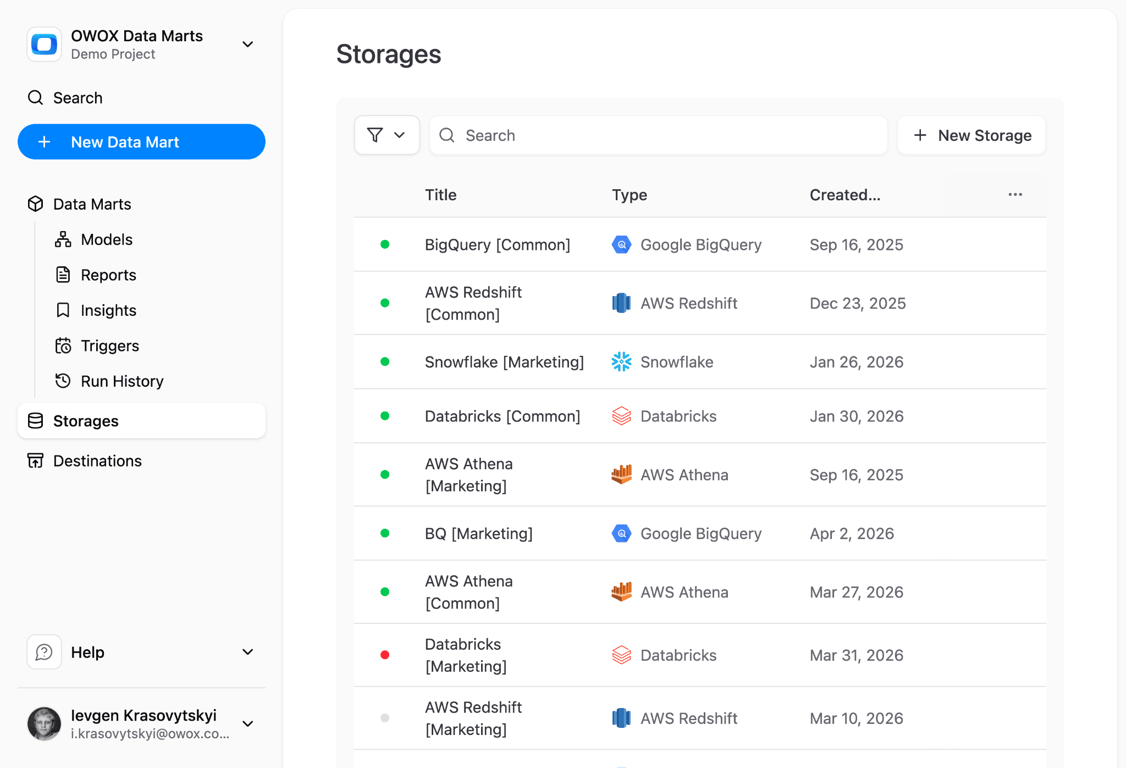
Pick the cloud you already trust
You choose one of five supported storages – BigQuery (by Google), Redshift or Athena by Amazon, Snowflake or Databricks – in your own cloud account. (Azure Synapse by Microsoft is coming for Enterprise)
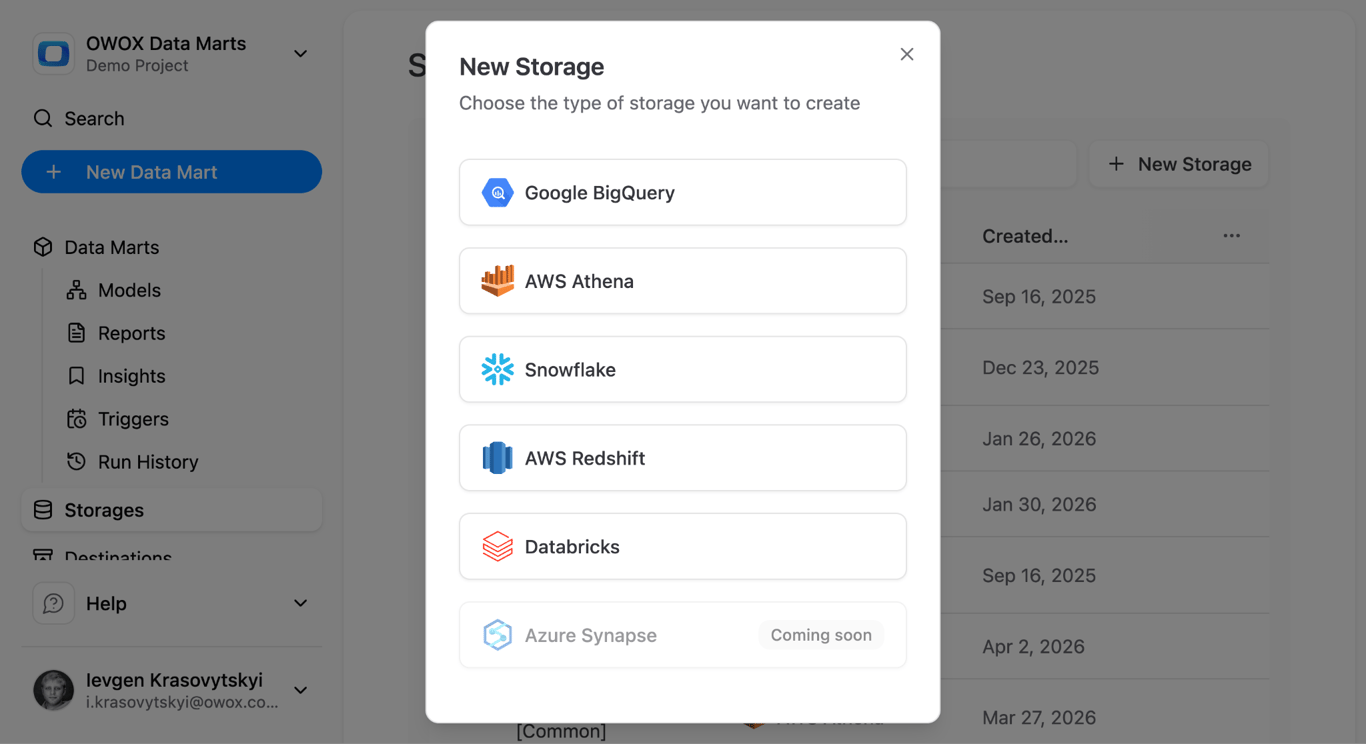
If you already run one, you’re most of the way there; OWOX connects to it rather than asking you to migrate anywhere.
Connectors land the raw data into it
The one-click connectors pull from your sources and write the raw data into your data warehouse. This is the step every connector-SaaS also performs – the difference is only the destination, and the destination is the whole point. No middle layer, no MAR meter on the way in.
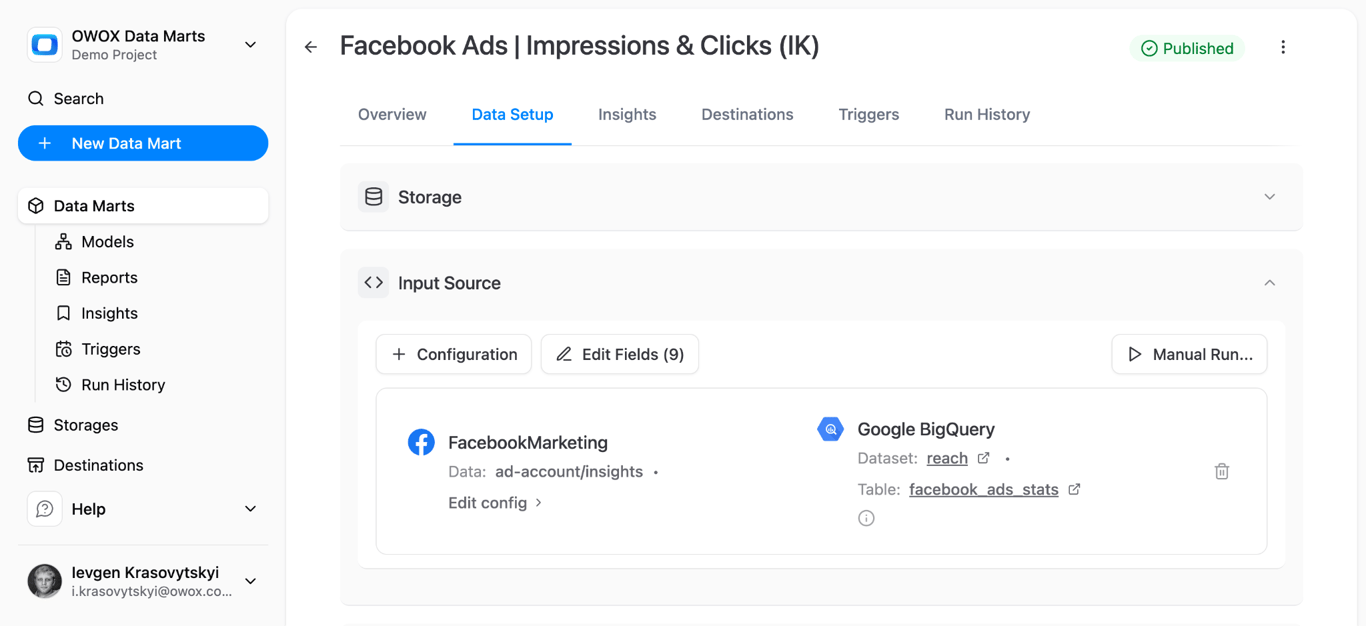
The model and every query run there
Your analyst defines the Data Marts and joins over your own tables, and every query executes in your warehouse. Because it’s your warehouse, your analyst can also just query the raw data directly with SQL – no vendor API, no export ceremony.
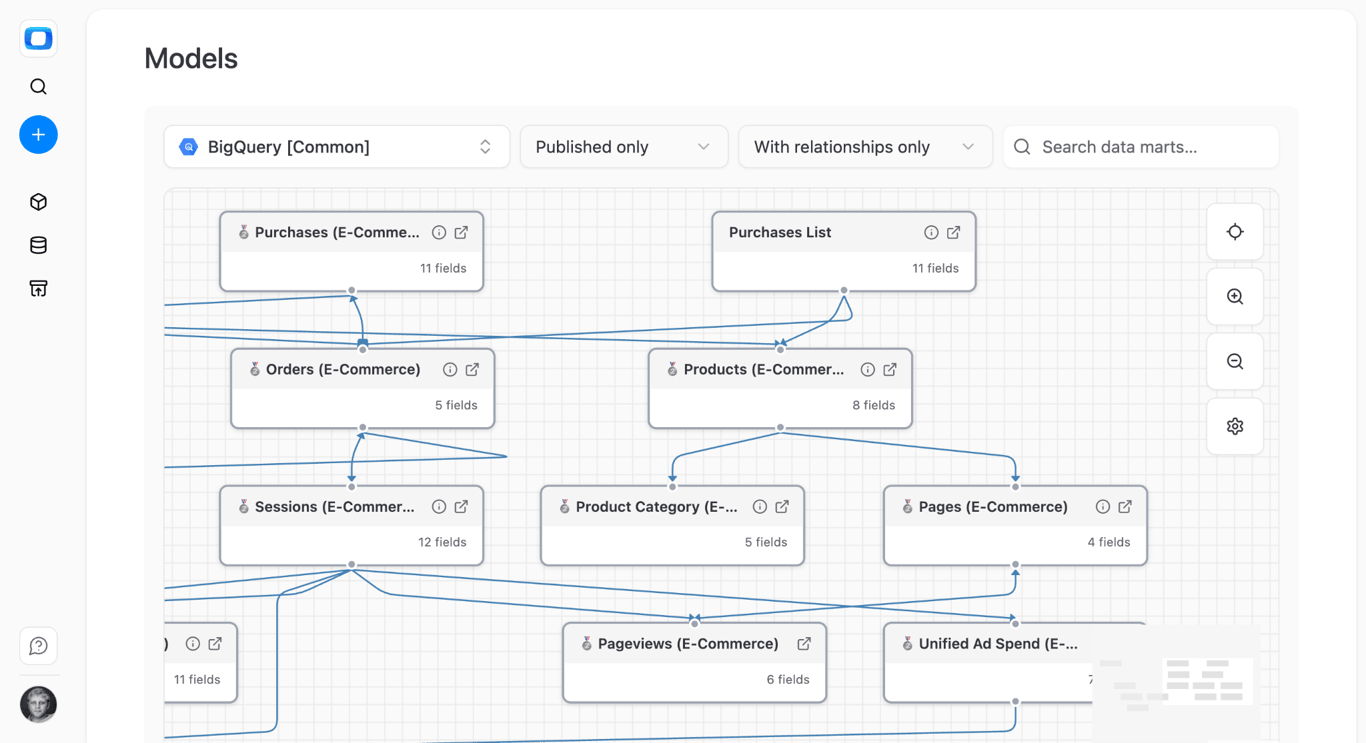
Run History records exactly what ran, so there’s a paper trail for every number.
Exit keeps everything
If OWOX leaves the picture, the data, the history as deep as your storage holds, and the SQL logic remain your assets.
There’s no export ceremony, no egress bill, and no hostage negotiation, because nothing ever left your account.
Why this beats the connector-SaaS alternatives
Why this beats the connector-SaaS alternatives
The ownership angle sounds abstract until you line it up against what you’re probably using or considering. In each case the gap is the same one: where does the data actually live?
Versus connector-SaaS middle layers
The Windsor.ai, Supermetrics, and Funnel-type tools store your data on their side, as “a secure middle layer,” with their retention caps and their formats – and often a per-row (MAR) meter when you do push to a warehouse. The two-years-versus-back-to-2016 contrast from that onboarding call is exactly this gap made concrete. If you’re comparing options as a Supermetrics alternative, here’s the tooling-level comparison your analyst will want.
Versus ad-platform cabinets
The ad platforms’ own APIs and dashboards cap history at their retention window. Your warehouse keeps what the platform forgets – which is precisely the history you’ll wish you had the day you need a three-year trend for a board deck.
Versus rolling your own pipelines
Owning the warehouse without a product on top means owning the pipeline maintenance too, forever. Here the ownership comes with the collection and modeling done for you, so you get the asset without signing up to babysit the plumbing or staff a data-engineering team to keep it alive.
A few honest limits
I would rather be precise than oversell this, because the entire value proposition is that you can trust the claim. Four caveats worth stating plainly.
A data warehouse is required
OWOX runs on a data warehouse – there is no warehouse-less mode today.
If you don’t have one, you’ll stand one up as part of setup; that’s a feature of ownership, not a workaround.
“Back to 2016” is your retention, not our guarantee
The history is as deep as your storage holds. We don’t manufacture history – we stop you from losing it. Phrase it in your own head as “as deep as my warehouse goes,” not as a number OWOX promises.
No cross-storage joins
The model works within one storage. “All your warehouses stitched into one model” is not something we do, and I won’t imply it. One warehouse, one governed model – deep, not sprawling.
The questions worth asking before you sign
The questions worth asking before you sign
Whether you go with OWOX or not, this is the checklist that separates renting your data from owning it. Ask any vendor these four, and watch how quickly the answers get vague.
Who actually owns the data, and where does it physically live?
Not “do I retain ownership” in the contract – where do the rows sit. That’s the real data ownership question. If the answer is the vendor’s cloud, you have export rights, not ownership.
How far back does the history go, and who controls it?
If retention is a plan tier, your company memory is a line item someone can downgrade. In your own warehouse, history is as deep as you keep it.
Can my analyst query the raw data directly with SQL?
If every question has to route through a vendor API in a fixed shape, you don’t have a data asset – you have a reporting subscription.
What does leaving cost – in fees and in lost history?
Add up egress charges, per-row overages, and the history you can’t re-pull from the sources. That number is the real price of the tool, and it’s the one nobody puts on the quote.
Own the place, then trust what’s in it
Own the place, then trust what’s in it
Owning your data has two halves, and it’s worth keeping them straight so you know what this covers.
The storage half and the application half
This is the storage half: the data warehouse is yours. 100%.
The application half – running the whole platform inside your own perimeter – is Self-Managed Deployment, and the two pair rather than merge.
Bringing your own warehouse is true in the standard Cloud edition too; you don’t have to self-host to own your data.
What ownership unlocks
The reason any of this matters isn’t a compliance poster. It’s that once the data and its full history genuinely live in infrastructure you control, everything you build on top inherits that trust – including the ability to just ask your business a question and act on the answer without wondering whether the number came from a vendor’s capped copy.
Rent the tool if you want. Own the data.
See how it works for CEOs and founders
Bringing your data person along?
Start free and point OWOX at the data warehouse you already own.
Turn your data into decisions.
Governed data marts give you the clean foundation ML needs to actually work.
- No AI hallucinations
- Analyst-governed definitions
- Every number traces to SQL
Frequently Asked Questions
Do I have to self-host OWOX to own my data?
No. Bringing your own warehouse is true in the standard Cloud edition too – the warehouse is yours either way. Running the whole platform inside your own perimeter is a separate option (Self-Managed Deployment); the two pair, they don't merge.
Does OWOX store my data, or does it stay in my warehouse?
Your warehouse is the system of record. There is a cache layer for fast answers, but it is rebuilt from your warehouse and never a substitute for it – “we store nothing” would be false, and the accurate claim is that the record lives in your warehouse and the cache can't replace it.
Which data warehouses does OWOX support?
Five bring-your-own warehouses: Google BigQuery, Snowflake, AWS Redshift, AWS Athena, and Databricks, each in your own cloud account. Azure Synapse is coming for Enterprise. OWOX connects to the warehouse you already run rather than asking you to migrate.
What does it cost to leave a connector-SaaS analytics tool?
Add up three things the quote usually hides: data egress charges to get the data out, per-row (Monthly Active Rows, or MAR) overages if you were loading into a warehouse, and the history you can't re-pull because the original ad platforms' retention windows are shorter than your company's. That total is the real price of the tool. With data in your own warehouse, leaving costs nothing – nothing ever left your account.
Can my analyst query the raw marketing data directly with SQL?
Only if the data is in a warehouse you control. When a tool holds the data on its side, you reach it through a vendor API in a fixed shape. Because OWOX runs on top of your own warehouse, your analyst can open a SQL console and query the raw tables directly – no API, no export ceremony.
How far back does my marketing data history go?
If your tool holds the data, your history is capped at its retention window – two years is a common ceiling, and some tools even advertise “2-year historical data” as a feature. When the data lives in your own warehouse, history is as deep as you keep it. In one real evaluation, a competitor could pull back two years while the customer's own warehouse went back to 2016.
Who owns my data when I use a marketing analytics tool?
Read past the contract language and ask where the rows physically sit. Many connector-SaaS tools hold your data in their own cloud – so you have export rights, not ownership. With a warehouse-first setup like OWOX, the data lands in your own BigQuery, Snowflake, Redshift, Athena, or Databricks account, so ownership is structural, not contractual.