Who do you ask about your data?
How a founder gets a straight read on the business — in the AI chat they already use, with every number tracing back to their analyst’s SQL.
It’s the last week of the quarter. You need to know one thing: are we hitting the number?
So – who do you ask?
You ask your CMO, and you get an answer so detailed you can’t find the point in it. You ask Ops, and you get a version that’s internally consistent but somehow misses objective reality. You ask around, and what you slowly realize is that nobody is continuously analyzing all of the data. Everyone is looking at their slice, on their schedule, through their incentives.
And here’s the part that actually grinds: you never get an answer to the question you asked. You get an answer to a question near it — the one that person happened to have ready.
Then there’s the schedule. The picture of your own business gets assembled on somebody else’s calendar. There’s a weekly meeting. There’s a process. There’s someone to nudge. It’s Saturday morning and you want to know if the reorder makes sense, and the honest answer is: wait until Tuesday.
Nobody gets to forbid the CEO to want to know.
TL;DR
When you need to know if you’re hitting the quarter, you ask a person — and get an answer to a slightly different question, on their schedule. Point an AI at your data instead and it guesses the joins and hands you a confidently wrong number. The fix: ask in your own AI chat, where the model narrates but never invents the number — every figure traces to SQL your data analytics team wrote.
The thing you already tried
So you do what any reasonable founder in 2026 does: you point an AI at your data and just ask it.
And it answers. Instantly. Confidently. With a number.
That’s the problem.
Most AI-on-your-data tools work by handing the model your raw schema and letting it write whatever query it wants. It guesses which tables to join and how. Sometimes it guesses right. Sometimes it silently double-counts across a join and hands you a revenue figure that’s 30% too high — with the same cheerful tone it uses when it’s correct. This isn’t hypothetical: it’s exactly what happens when you wire a raw BigQuery MCP into Claude, and it’s why AI analytics tools hallucinate in the first place.
You cannot tell the difference by looking. That’s the whole issue. A number you can’t verify isn’t information; it’s a liability with a chart attached. And you’re the one who takes it into the board meeting — which is how a promising AI rollout quietly costs you the board’s trust.
So the founder’s real choice has been: wait for the analyst’s next deck, trust a tool that might be confidently wrong, or go with your gut and hope. The three conditions that make an AI answer safe to rely on are set out in can you trust AI with your business numbers?.
The inversion
Here’s what changes: a one-shot answer to exactly the question you asked, in the AI chat you already use — where every figure traces back to SQL your own analyst wrote.
Not a dashboard you have to go open. Not a deck that arrives Tuesday. You ask, in plain English, and you get the answer — with a chart — in a couple of prompts. On Saturday morning, if that’s when you want it. That’s OWOX MCP, and there’s a longer walkthrough of how governed MCP actually works under the hood if you want the mechanics.
The mechanic underneath is simple and it’s the entire point: the AI does the talking, but it doesn’t invent the number. Your analyst defines the trusted building blocks once — the governed data marts — that’s governance you never see and never touch. When you ask a question, the answer is computed from those, deterministically. The model narrates. It never freelances the math. Every figure stays traceable back to the SQL behind it.
That’s the difference between “the AI told me” and “I can act on this.”
OWOX Data Marts
See your first report built in real time. 15 minutes.
- Connect your data warehouse
- Pick your metrics
- Get a live Google Sheets report
In the time it takes to write a ticket. Then imagine never writing that ticket again.
Book a DemoWe'll use your actual use case
What that actually looks like
Three questions. This is the real path a founder walks, start to finish — a question in, a decision-ready picture out, no ticket and no queue.
1. “How did the business do last year? Give me the number and what moved it.”
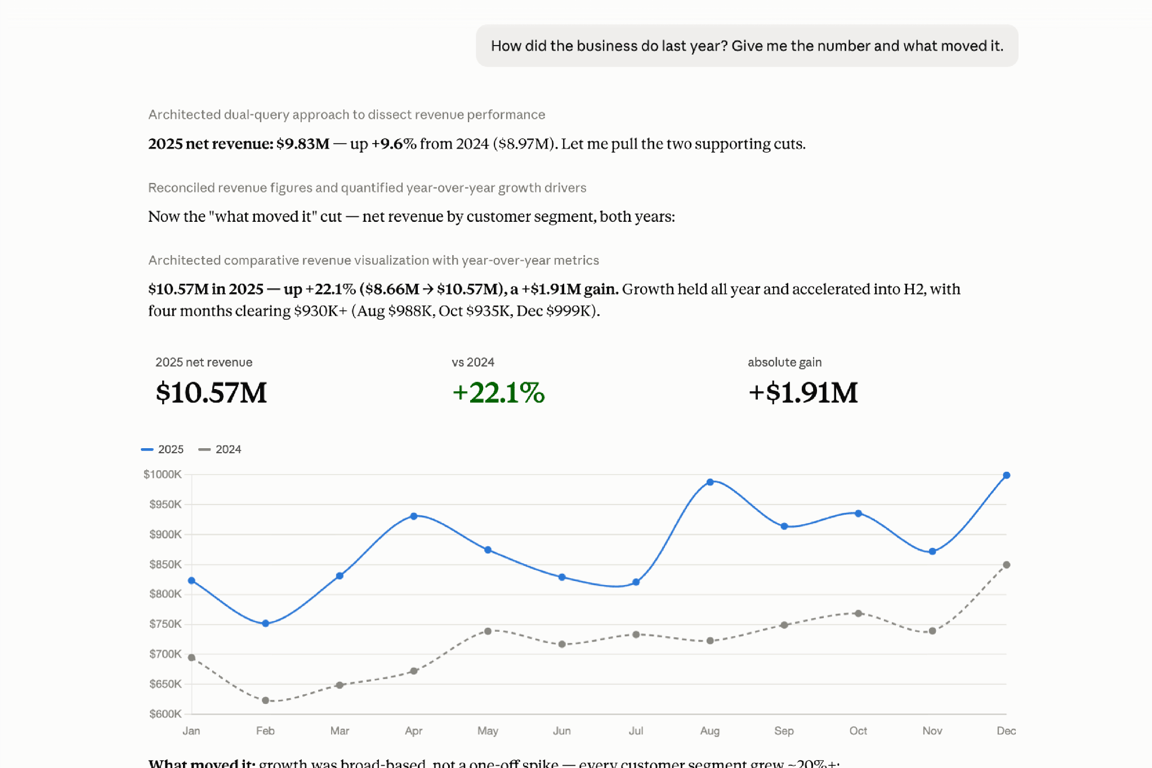
One shot, one answer: net revenue $10.57M in 2025 — up +22.1% year over year ($8.66M → $10.57M), a +$1.91M gain — with the month-by-month curve against last year right underneath. And it doesn’t stop at the headline: it pulls the “what moved it” cut on its own, showing the growth was broad-based rather than a one-off spike — every customer segment grew ~20%+. That’s not a dashboard you had to go build. It’s the answer, and the reason behind it, in the chat you already had open.
2. “Where does that number come from, and can I trust it?”
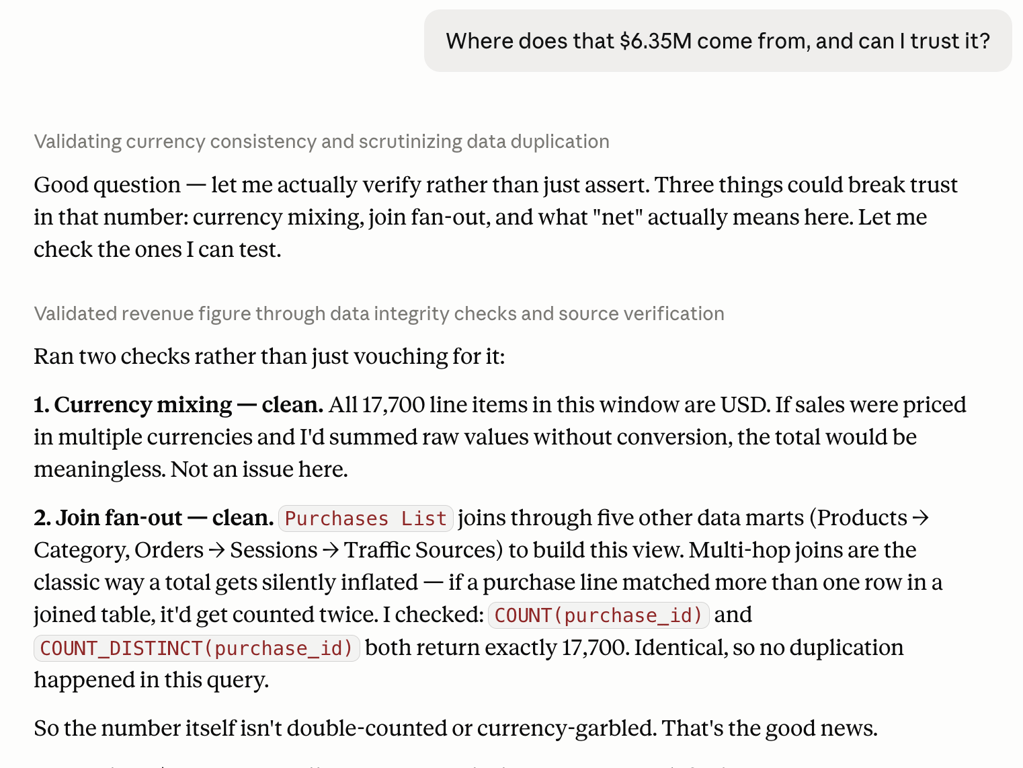
This is the one that matters, and it’s the one no other tool answers well. Instead of asserting the number again, louder, it verifies it: it checks that the currencies are consistent, and that the joins didn’t quietly double-count the total across the underlying data — then it shows you where the figure came from, your analyst’s governed building blocks and their SQL. Not a guess.
That’s the moment a number stops being something the AI said and becomes something you can take into a board meeting.
3. “Now the geography of that growth — which markets are compounding fastest, and where am I most exposed?”
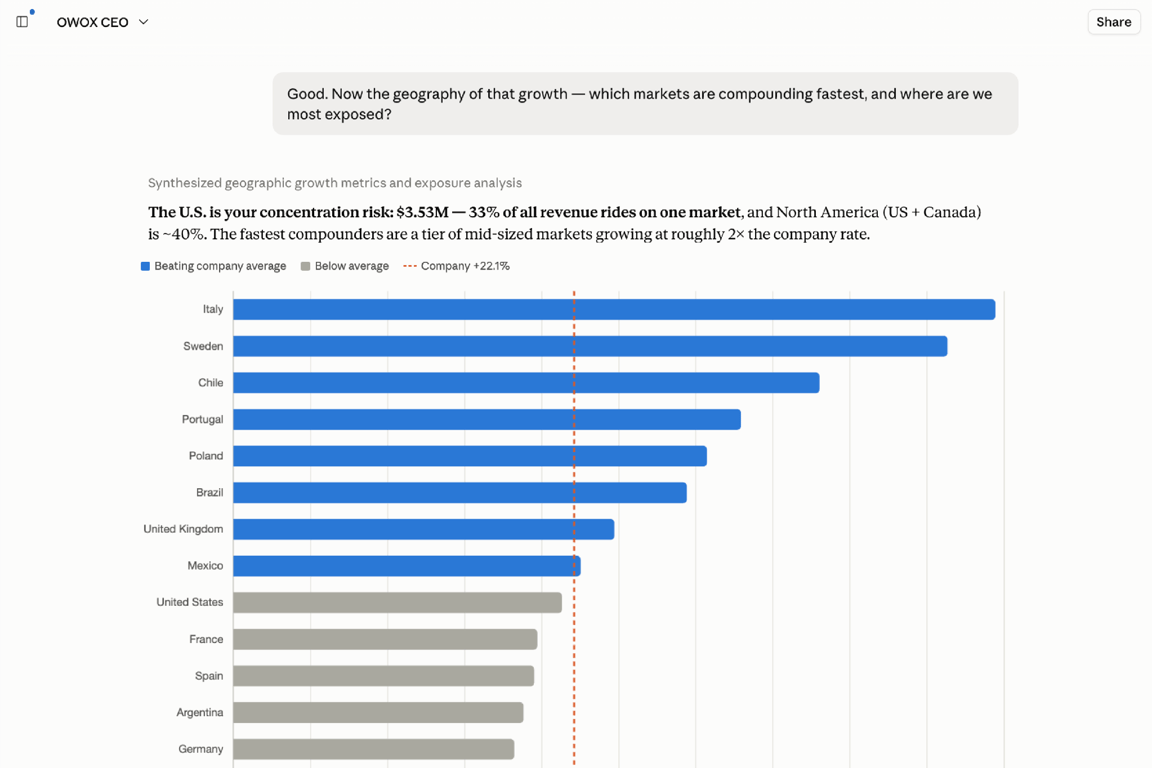
Same chat, next question — and now it’s a strategy conversation. The U.S. is the concentration risk: $3.53M, 33% of all revenue riding on one market (North America ~40%).
Meanwhile a tier of mid-sized markets — Italy, Sweden, Chile, Portugal, Poland — is compounding at roughly 2× the company rate. That’s a reorder-and-reinvest decision you can see in ten seconds, not a deck you commission and read next Tuesday.
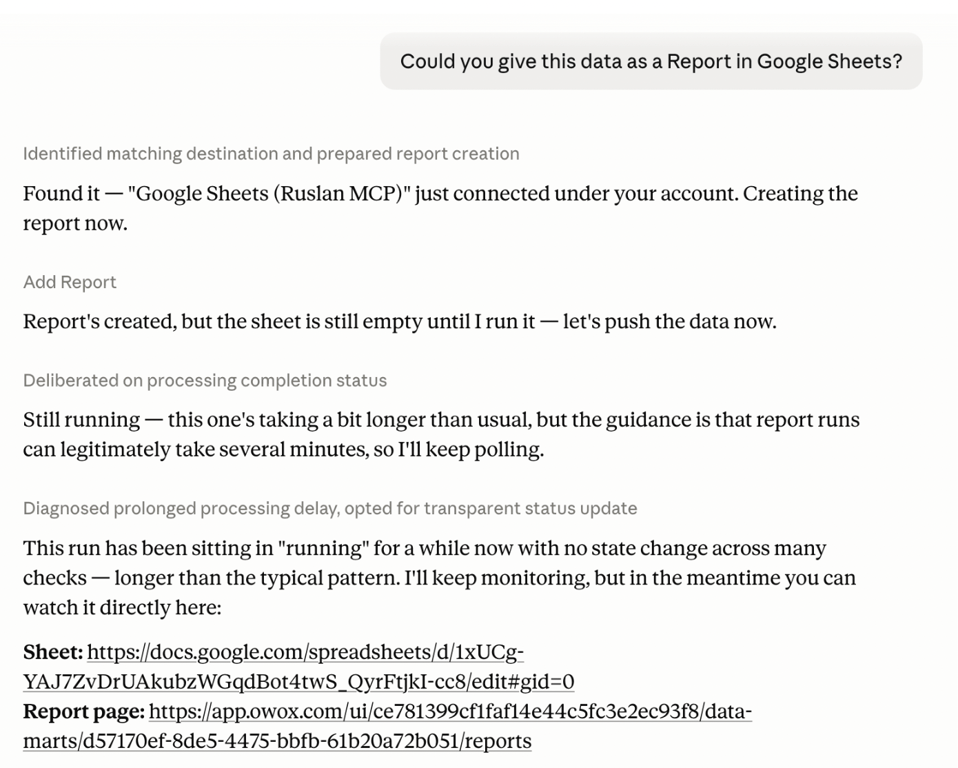
Question in. Decision-ready picture out — and if you want it in front of the team, drop any answer into a Google Sheet they work from live. That’s the whole loop.
Try it yourself – it’s the whole conversation, click-through
Try it yourself – it’s the whole conversation, click-through
The screenshots above are stills from a live chat.
Here’s the real thing: ask the business a question yourself and watch it answer — the number, then “can I trust it?”, then where you’re exposed — every figure a governed query on the same marts.
Why this beats what you’re doing now
Why this beats what you’re doing now
Versus AI tools that read your warehouse directly
The Supermetrics/Coupler/Coefficient/Windsor pattern. They let the model invent joins from raw schema, which is exactly how you get a confidently wrong number. Here, only joins your analyst authored are permitted.
That distinction sounds academic right up until it isn’t: one founder we onboarded had a competitor’s AI tool wired up live on the call, watched it produce a number he couldn’t verify, and disconnected it mid-call.
It gets worse the moment a question spans two tools — cross-tool joins are where MCP-only setups fall apart. If your analyst wants the tooling-level comparison, it’s here.
Versus waiting on the analyst
You get the answer in seconds, yourself, on your schedule instead of the reporting calendar’s. Your analyst gets their week back.
Versus a BI dashboard
You don’t open dashboards. You have a question. Dashboards make you go find the answer inside a grid someone built for a different purpose three months ago. You just want to ask.
In literally five minutes, it pulled questions I couldn't answer in 10 years.
-- a CEO of a US ecommerce brand, on his own data, in his own chat
“So you’re replacing my data person?”
“So you’re replacing my data person?”
No — and if anyone pitches it that way, be suspicious.
Someone has to define what “net revenue” means, decide which numbers are trustworthy, and stand behind them. That’s your analyst, and this makes them more load-bearing, not less. They set up the trusted building blocks once — defining the metrics without needing a full semantic-layer project — and everything you ask afterward is computed from their work.
What goes away isn’t the analyst. It’s the queue — the part where every basic question about your own business has to route through one person’s inbox and come back three days later as a slide. They stop being a report factory. You stop waiting.
Control first, then trust, then freedom. In that order. There’s no version of this where you skip to freedom and the numbers still hold.
A few honest limits
This is not real-time
Answers come from a cache on a refresh schedule. “Ask Saturday morning” means it’s available Saturday morning — not that the data is a second old. Those are two different promises and I won’t mix them.
The claim is precise
It isn’t “the AI is never wrong.” It’s: the numbers trace to SQL your analyst wrote, and the model doesn’t invent joins. That’s a narrower claim, and it’s the one that’s actually true. How other tools handle the same problem, in their vendors’ own words, is in AI data analyst tools you can trust.
It’s cloud-only by design
There’s no self-hosted server version of this OWOX MCP server.
The one question worth asking
Next time the quarter’s closing and you want to know where you stand, notice what you actually do. You pick a person. You brace for an answer to a slightly different question. You wait.
You shouldn’t have to ask a person. You should be able to ask the business.
→ See how it works for CEOs and founders
This is the “ask” surface that sits on top of one governed model — the single source of truth your numbers answer to.
Turn your data into decisions.
Governed data marts give you the clean foundation ML needs to actually work.
- No AI hallucinations
- Analyst-governed definitions
- Every number traces to SQL
Frequently Asked Questions
What kinds of questions can I ask my business?
High-level reads on the business — is revenue ahead of last year, by product line; is margin holding; where does that number come from and can I trust it.
Can I share an answer with my team?
Yes. Any answer can be persisted as a Google Sheets Report and handed off, so the team works from a live Sheet rather than a screenshot that's stale by Thursday.
Can I self-host the OWOX MCP server?
No — it's cloud-only by design.
Do I still need my data analyst?
Yes — more than ever. They define the trusted building blocks once, and that's precisely why the answer is trustworthy. What goes away is the queue, not the analyst.
How is this different from pointing another AI tool at my warehouse?
Most tools hand the model your raw schema and let it write whatever query it wants — so it guesses which tables to join, and can silently double-count and hand you a confidently wrong number. Here, only joins your analyst authored are permitted.
Is the data real-time?
No. Answers come from a cache on a refresh schedule. “Ask on Saturday morning” means the answer is available whenever you want it — not that the data is a second old. Those are two different promises.
Does the AI ever make up the numbers?
The precise claim is narrower than “the AI is never wrong”: your numbers trace back to SQL your analyst wrote, and the model doesn't invent joins. It narrates the answer — it doesn't freelance the math.