Ship AI your board can trust — without betting your seat on a hallucination

Gartner projects that by 2027, 75% of chief data and analytics officers who aren’t seen as essential to their organization’s AI success will lose their C-level position.
Here’s what that number doesn’t say, and should: most of those seats won’t be lost for moving too slowly. They’ll be lost for shipping AI nobody could trust.
Every AI rollout is a bet with your title on the table
Every AI rollout is a bet with your title on the table
If you own AI value at your company – Head of AI, CDAO, VP of transformation – you’re holding a two-sided bet whether you like it or not.
Side one: ship nothing meaningful this year, and you’re the leader who couldn’t turn the most-hyped technology in a generation into value. Side two: ship fast and ungoverned, and you’re one fabricated number away from a different conversation – the one where a figure from your AI showed up in a board deck, drove a decision, and turned out to be invented.
Most AI leaders respond by adjusting their speed: move cautiously, pilot forever, hedge. That’s the wrong variable. The way out isn’t betting slower – it’s changing what you’re betting on: from model behavior, which you can’t control, to architecture, which you can.
The board wants AI ROI now – and only 29% of you can show it
The board wants AI ROI now – and only 29% of you can show it
Boards have stopped asking whether you’re “doing AI.” They’re asking what it returned. And here the numbers get uncomfortable: roughly 79% of executives report productivity gains from AI, but only about 29% can confidently measure the return.
That 50-point gap is the credibility deficit you inherit every time you walk into a board meeting. It exists because most AI programs report activity – adoption rates, prompts per employee, satisfaction scores – and boards discount activity metrics to zero. Watch a CFO’s face when someone presents “3,400 AI queries this quarter” as an outcome: a query is a cost, not a result, until you can show what decision it changed.
What survives a board meeting is a different class of number: financial, baselined against a documented before-state, and traceable to its source. “The team loves it” is a shrug. “This workflow cost X before, costs Y now, and here’s the data lineage” is a budget approval. The bar isn’t higher for AI than for any other investment – it just feels higher because so few AI programs are built to produce evidence at all.
Hold onto that word – traceable. It’s about to do double duty.
OWOX Data Marts
See your first report built in real time. 15 minutes.
- Connect your data warehouse
- Pick your metrics
- Get a live Google Sheets report
In the time it takes to write a ticket. Then imagine never writing that ticket again.
Book a DemoWe'll use your actual use case
A hallucinated number is board-level liability now
A hallucinated number is board-level liability now
The second clock ticking on your rollout is regulatory, and it’s no longer abstract.
The EU AI Act’s operational requirements are built around exactly one theme: you must be able to explain where an AI-assisted decision came from. Articles 12 and 13 require logging sufficient to reconstruct individual AI-assisted decisions after the fact – not just storing outputs, but enabling post-hoc reconstruction. The fine structure is tiered: up to €35M or 7% of worldwide turnover at the top, €15M or 3% for high-risk system breaches.
But set the fines aside – the deeper shift is that “the AI said so” has stopped being an acceptable answer anywhere numbers drive decisions. A fabricated figure in a filed board presentation isn’t an oops anymore; it’s a governance incident with your program’s name on it. An AI system that cannot show its work is no longer a productivity tool with quirks. It’s unbudgeted liability.
The provable win: answers that are auditable by construction
The provable win: answers that are auditable by construction
Now the connection most vendors miss, and the reason this piece exists: the traceability regulators demand and the traceability boards trust are the same property. Build for one, and you get the other free.
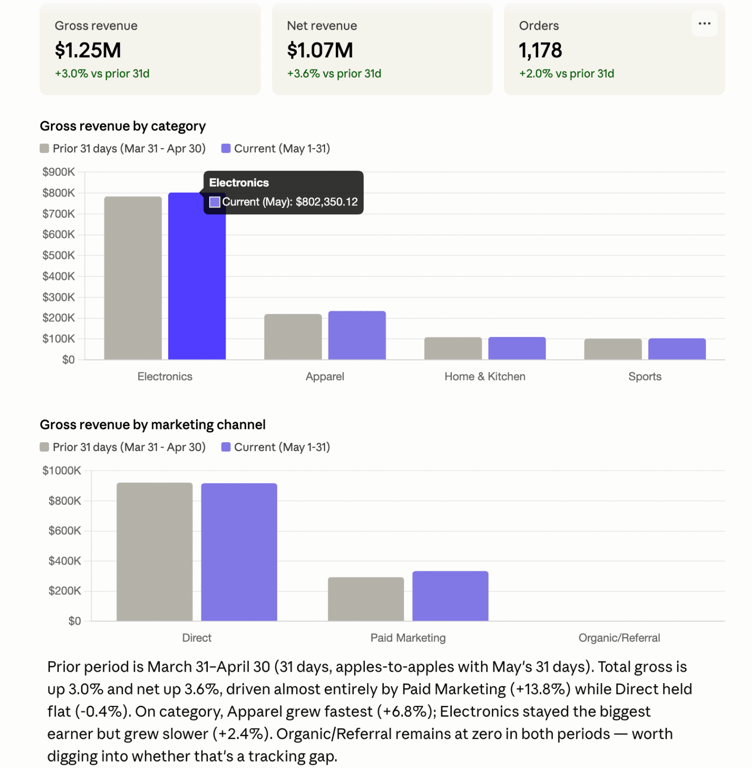
Here’s what that looks like in practice. Your data analyst publishes governed Data Marts – datasets with the metric definitions, joins, and checks they authored. Executives ask questions in the AI chat they already use; the AI narrates and charts, but every number is computed by the analyst’s deterministic SQL. The model never invents a join, never does unsupervised arithmetic – so a hallucinated number is off the table by construction, not by prompt engineering. To be precise: the model can still phrase a sentence clumsily; it cannot fabricate your revenue.
Every answer reconstructs: figure → SQL → Data Mart → source. That’s Article 12 compliance behaving like a feature. It’s also the experience that made a CEO fire his weekly report – the part of that story built for the board is the part nobody screenshots: the audit trail under the chart.
Weeks, not a multi-quarter build
Weeks, not a multi-quarter build
The classic objection to “do it properly” is that properly takes six quarters. It doesn’t anymore – that assumption comes from the semantic-layer era, when governed meant a monolithic modeling project that was obsolete before launch.
The governed Data Mart path inverts the sequence: govern one workflow, prove it, expand. Your analyst takes SQL that already exists, publishes it as a governed Data Mart, and connects it to the AI chat over MCP – that’s days of work, not quarters. Then run the proof pattern boards actually respect: pick one workflow, document the before-state, measure the after. One baselined number, delivered while the budget cycle that funded you is still open.
Concretely, the calendar looks like this. Week one: your analyst picks the workflow with the clearest before-state – say, the weekly revenue review that currently takes a day of manual assembly – and publishes it as a governed Data Mart from SQL that already exists. Week two: the MCP connection goes on, and the executive who owns that workflow starts asking real questions in their own chat, with the analyst watching every query in the log. Week three: you write down what changed – hours eliminated, decision latency, questions asked that previously went unasked – against the documented baseline. That’s the whole pilot. No steering committee, no platform selection phase, no data migration.
Speed here isn’t recklessness. It’s scope discipline: small enough to govern completely, real enough to matter.
A provable win, in days
The fastest proof I’ve personally watched: the CEO of a US ecommerce brand went from first governed connection to acting on the answers within days – pulling comparisons in his own chat that he told me he’d failed to get for years through conventional reporting. No transformation program preceded it. His analyst published the governed Data Marts; he asked questions; the audit trail accumulated quietly underneath. If a board had asked him to justify any figure from those sessions, the reconstruction was one click away.
The detail that belongs in this piece: he was also testing an ungoverned MCP connector in parallel, and it disqualified itself mid-call by producing one plausibly wrong figure next to the governed answer. Nobody wrote a risk memo about it. The side-by-side was the risk memo. That’s what a de-risked rollout looks like operationally – the unsafe option doesn’t need to be argued against; it needs one audit-shaped question it can’t answer.
What boards actually trust
Strip away the AI novelty and boards trust what they’ve always trusted: numbers that are baselined, unit-based, and evidenced – measured against a documented before-state, not asserted. For the plain answer to the question a board member actually asks, see can you trust AI with your business numbers?.
A governed setup produces that evidence automatically. Run History logs every AI query – who asked, which Data Mart, what SQL ran, what was denied. When a director asks “how do we know this number is real?”, the answer is a screen, not a speech: here’s the figure, here’s the SQL a human wrote, here’s the log of every time the AI touched it. Data governance stops being the slide at the end of your deck and becomes the deck’s credibility.

“AI is too risky to put in front of the board”
“AI is too risky to put in front of the board”
I hear this from CFOs and I understand where it comes from – but it inverts the actual risk. AI in front of the board isn’t the danger. Unaccountable AI in front of the board is. Line up what boards actually fear against the two architectures:
| The Board’s Fear | Ungoverned AI | Governed AI |
|---|---|---|
| A Wrong Number Drives a Decision | Possible any day; undetectable by design | Numbers computed only by analyst-written SQL |
| “Explain This Figure” Has No Answer | “The model generated it” | Figure → SQL → Data Mart → source, on a screen |
| Regulatory Exposure | No reconstructable decision trail | Every query logged; Article 12-shaped by default |
| Multi-Quarter Sunk Cost | Fast to start, expensive to unwind | One governed workflow in weeks; expands only on proof |
Governance isn’t the compliance tax on your AI program. It IS the de-risking instrument – the difference between asking the board to trust a model and showing them an audit trail. If your team is comparing AI analytics tools for a board-facing rollout, put “can every figure be reconstructed?” at the top of the scorecard – and bring your CFO into that conversation early; auditable-by-construction is the fastest yes you’ll ever get from finance.
Bet on architecture, not on model behavior
Bet on architecture, not on model behavior
The leaders who keep their seats through 2027 won’t be the ones who moved fastest or most cautiously. They’ll be the ones whose AI programs could always answer one question: where did this number come from?
So change the bet. One governed Data Mart, one real workflow, one baselined before/after number for the next board meeting – auditable end to end, shipped in weeks. Start free, and hand your data analyst model.owox.com on day one. The seat you protect will be your own.
Turn your data into decisions.
Governed data marts give you the clean foundation ML needs to actually work.
- No AI hallucinations
- Analyst-governed definitions
- Every number traces to SQL
Frequently Asked Questions
What is the safest first AI analytics project?
One recurring, high-visibility workflow with a clear baseline — typically a weekly revenue or performance review that's currently assembled by hand. Govern that single surface, connect it to the executive's own AI chat, and measure the before/after. It proves value and safety with the same artifact.
Is AI too risky to use for board-level decisions?
Ungoverned AI is — a model generating its own SQL can produce plausible, wrong numbers with no reconstructable trail. Governed AI inverts the risk: numbers are computed only by analyst-approved SQL, every query is logged, and each figure traces to source. Governance is the de-risking instrument, not a constraint on it.
How fast can governed AI analytics show value?
Weeks. There's no semantic-layer program: an analyst publishes a governed data mart from existing SQL in week one, the MCP connection and real executive questions start in week two, and week three delivers a baselined before/after number. The pilot is small enough to govern completely and real enough to present to a board.
What does "auditable AI" mean in practice?
That any figure the AI presents can be reconstructed: which data mart it came from, which analyst-written SQL computed it, who asked, and when. In OWOX Data Marts this is Run History — a log of every AI query including denied requests. Auditable means the answer to "where did this number come from?" is a screen, not a promise.
What are the EU AI Act fines for non-compliance?
The structure is tiered: up to €35M or 7% of worldwide annual turnover for prohibited practices, up to €15M or 3% for high-risk system breaches, and up to €7.5M or 1% for misleading information. Articles 12–13 additionally require logging sufficient to reconstruct individual AI-assisted decisions after the fact — which is a traceability requirement, not just a storage one.
Why do most AI projects fail to show ROI?
Because they measure activity instead of outcomes: queries run, users onboarded, satisfaction scores. Only about 29% of executives can confidently measure AI returns, mostly because no before-state was ever documented and outputs can't be traced to decisions. A single governed workflow with a documented baseline outperforms a broad rollout with no evidence.
How do you prove AI ROI to a board?
Pick one workflow, document its before-state, and bring finance a baselined, unit-based number — not adoption or productivity metrics, which boards discount. The number must be traceable: in a governed analytics setup every figure reconstructs to analyst-written SQL and its source data, which is exactly the evidence standard boards apply to any other investment.