The data guy will resist. Here's how to bring him along
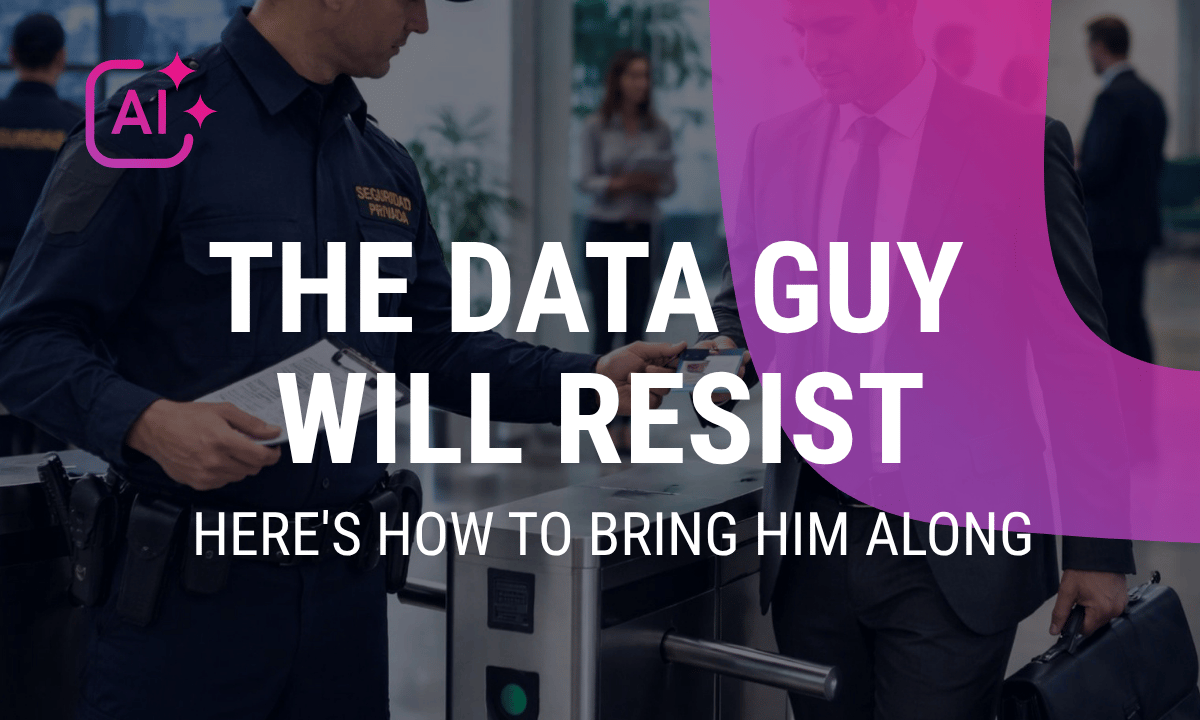
The data guy will resist your AI rollout.
Good news: the resistance means he’s paying attention
That’s the most rational person in your building doing exactly the job you hired him for. The question isn’t how to overcome him – it’s how to bring him along instead of going around him. Because I’ve watched both versions, and only one of them ends with AI your company actually trusts.
He can block it – and going around him is worse
He can block it – and going around him is worse
Let’s be honest about the power map. If you run AI adoption – or you’re the CEO driving it personally – the org chart says you outrank your data person. Reality says otherwise.
In a 200-person company, the one person who owns the data can veto your rollout without ever saying no. Access requests that take three weeks. Security reviews that surface new concerns each round. A pilot that stays “almost ready” through two quarters. And the kill shot: being right, once, about one wrong number the new tool produced. After that, every skeptic in the company has a flag to rally around, and your AI program becomes the thing people mention with a smirk in planning meetings.
None of this makes him a saboteur.
Friction is how a professional without formal veto power exercises professional judgment. If the org gave him no way to say “this isn’t safe yet” that anyone listens to, slow-walking IS the safety process.
So the tempting move is to go around him – buy the tool, connect it quietly, apologize later. That’s worse. Now you have shadow AI answering business questions with no adult supervision over the logic, and when the first hallucinated figure lands in a deck – it will – there’s nobody whose job was to catch it. The program doesn’t just die; it dies discredited, and the data guy gets to say he told you so. Because he did.
The only winning path runs through him. Here’s the map.
Why he resists: control, blame, security
Why he resists: control, blame, security
Before you can answer his objections, respect where they come from – because all three are professionally sound.
Control. He’s spent years making your numbers mean something – chasing definitions, fixing joins, cleaning the quality issues nobody else sees. An AI that redefines metrics at question-time threatens to undo that work at scale, anonymously.
Blame. When the AI is wrong about the data, whose name is attached? His. There’s a whole thread of practitioners watching AI hallucinate on basic data retrieval – his fear isn’t Luddism, it’s evidence. He’s seen the confident nonsense firsthand, probably this week.
Security. “We’re putting company data into a chat tool?” is not paranoia. It’s the exact question your auditor would ask, arriving early.
Notice what these three have in common: they’re the objections of someone who takes the numbers seriously. You don’t want to defeat that instinct. You want to arm it.
OWOX Data Marts
See your first report built in real time. 15 minutes.
- Connect your data warehouse
- Pick your metrics
- Get a live Google Sheets report
In the time it takes to write a ticket. Then imagine never writing that ticket again.
Book a DemoWe'll use your actual use case
The three objections, answered honestly
The three objections, answered honestly
Here’s the kit. Not talking points – mechanisms. Each answer has to survive him actually checking, because he will.
| His Objection | The Honest Answer | What He Can Verify |
|---|---|---|
| “It’ll hallucinate.” | The AI never computes. It narrates results produced by SQL he wrote and approved; the model physically cannot invent a join. | Ask an out-of-surface question – watch it fail loudly instead of fabricating. |
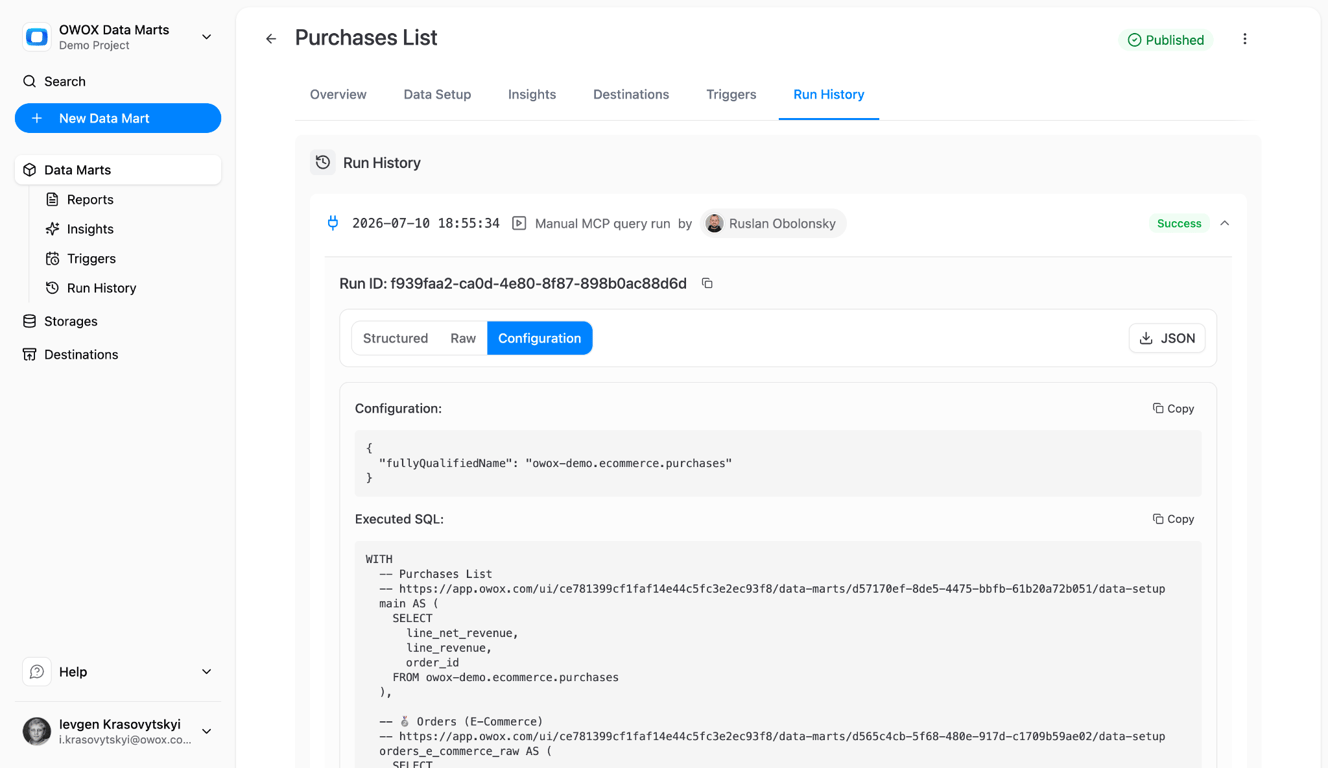
| “I’ll lose control – or get bypassed.” | The opposite: he authors the entire governed surface – Data Marts, joins, definitions, checks – and it’s the only thing the AI can read. | Open Run History: every AI query, every denial, timestamped, reviewable like a pull request. |
| “It’s not safe.” | The data stays where it already lives. The AI reads only what he publishes, through a connection he grants – and can revoke. | He controls the access list himself. Nobody else can widen the surface. |
The pattern across all three rows: every answer gives him more explicit control than he has today, when his control lives in tribal knowledge and hope. That’s the pitch, and it has the advantage of being true – this is governance with his name on the authorship line, enforced at the query level rather than promised in a policy doc.
Gatekeeper, not bottleneck
Now the part that turns him from reluctant approver into architect: what the role becomes.
Today he’s a help desk. Every question in the company queues through his keyboard; his week is other people’s tickets; his craft is spent on fetching. After: he defines the truth once – the governed Data Marts, the joins, the metric logic – and the answering happens without him, at whatever volume the company needs, always running on his logic. He stops being the person who pulls numbers and becomes the person whose judgment is embedded in every number anyone pulls.
There’s a visibility upgrade too, and it matters more than it sounds. Today, leadership sees his output – reports appear, dashboards exist – but not his judgment; the definitions, the catches, the quality saves are all invisible until something breaks. In the governed setup his judgment IS the visible artifact: the published surface, the authored joins, the query log. It’s the difference between being the plumbing and being the architecture.
Concretely, his week changes shape: the “quick questions” evaporate, and what’s left is the work that actually compounds – modeling, quality, turning one-off requests into reusable Data Marts, reviewing the AI’s query log. The industry line for this is blunt: analysts aren’t replaced by AI, they’re replaced by analysts who use AI. Your data person, running a governed surface an entire org self-serves from, is the second kind – with the audit trail to prove it.
The analyst who tried to break it
The analyst who tried to break it
The rollout I keep coming back to – the US ecommerce brand whose CEO famously got ten years of answers in five minutes – didn’t actually stick because of the CEO’s enthusiasm. Enthusiasm doesn’t survive the first wrong number.
It stuck because of what the analyst did next. He went through the governed joins line by line. He asked the AI questions designed to break it – edge cases, ambiguous phrasings, metrics he knew had traps in them. He watched what it did when it didn’t have the data. And then he signed off. His skepticism wasn’t the obstacle to the rollout – it was the certification of it. The CEO trusted the numbers precisely because the person whose job is distrust had gone first and come back satisfied. The checks he ran are the ones listed in can you trust AI with your business numbers?.
That’s what “bringing him along” buys you that going around him never can: a validator whose sign-off means something. When someone later questions a number – someone always does – the answer isn’t “the AI said so.” It’s “our analyst certified the logic, and here’s the audit trail.” One of those survives scrutiny.
The replacement fear, versus the data
The replacement fear, versus the data
Under the three spoken objections sits the unspoken one, so let’s put numbers on it.
McKinsey finds 78% of companies use AI to augment their analytics teams, not replace them, and the U.S. Bureau of Labor Statistics projects 34% growth in data science openings through 2034. What AI is actually absorbing is the mechanical slice of the week – exports, repetitive report assembly, the CSV grind he already resents.
The honest caveat, because he’ll spot a sales pitch instantly: roles that were only report generation are genuinely contracting. Which is precisely the argument for the gatekeeper move now – it relocates his value from the shrinking part of the job to the compounding part while the choice is still his to make.
“This replaces me”
If he says it out loud, take it seriously – and answer with career logic, not comfort.
The governed setup makes him more load-bearing, not less: every answer the company acts on runs on logic he authored; every metric definition is his call; and for the first time, his oversight is visible – leadership can open Run History and see the control he’s exercising, instead of assuming reports appear by magic. The work that stays human is the work that was always the point: validating data integrity, defining what metrics mean, investigating the variances, translating ambiguity into questions data can answer. The exports were never his value. Now the exports are gone and the value is legible.
And here’s the champion’s move that beats any pitch deck: bring a gift before you bring a proposal.
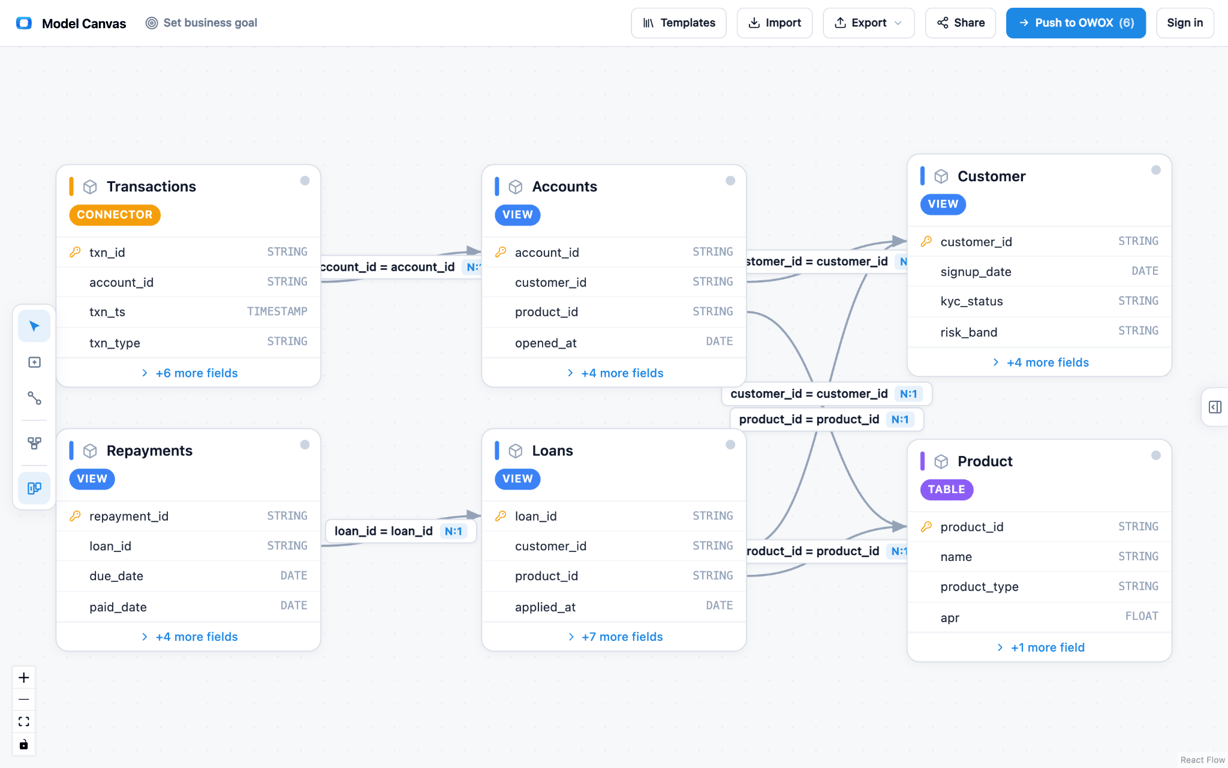
We built model.owox.com – a free visual data-modeling canvas, open format, no signup wall – because the fastest way to show a data person respect is to invest in their craft before asking for their sign-off. Send it with one line: “saw this, thought of you.” Let him form his own opinion about the product behind it afterward, in the role it actually offers him.
The one-conversation playbook
When you sit down with him, the script is four moves, and none of them is a demo.
Name his queue as your problem: “the line in front of you is the most expensive queue in my company, and it’s not your fault.” Hand him the canvas – the gift, not the pitch. Give him explicit veto power over the governed surface: nothing gets published that he didn’t author. And propose the smallest possible start: one Data Mart, one connected chat, his edge-case testing as the acceptance gate.
You’re not asking him to trust AI. You’re asking him to govern it – which is what he’s been trying to do to your data chaos all along. Start free when he’s ready. He’ll know before you do whether it’s real.
Turn your data into decisions.
Governed data marts give you the clean foundation ML needs to actually work.
- No AI hallucinations
- Analyst-governed definitions
- Every number traces to SQL
Frequently Asked Questions
What's a good first project to win over the data team?
One governed data mart for the single most-requested metric, connected to one chat, with the analyst's own edge-case testing as the acceptance gate. It's small enough for them to verify completely, real enough to kill a visible slice of their request queue, and it makes their sign-off — not the demo — the certification event.
What happens if we roll out AI analytics without the data team?
Shadow AI: business questions answered by a model with no one accountable for the logic. The first plausible-but-wrong figure lands in a deck with no adult supervision, the program dies discredited, and the data team's skepticism is vindicated — making the next attempt harder. The path through the data team is slower by weeks and faster by quarters.
What is the gatekeeper role in governed analytics?
The upgrade from help desk to architect: instead of hand-assembling every answer, the analyst defines truth once — data marts, joins, definitions — and the whole org self-serves against that surface. Their judgment becomes embedded in every answer and visible to leadership through the audit trail, while the interruption load drops.
What should the data analyst control in an AI analytics rollout?
Everything about the governed surface: which data marts exist, how metrics are defined, which joins are allowed, what quality checks run, and who has access. Governance is enforced at query level — the AI can only read what the analyst published — and the analyst reviews every executed query in Run History.
Will AI replace data analysts?
The data says augmentation, not replacement: McKinsey finds 78% of companies use AI to augment analytics teams, and the U.S. BLS projects 34% growth in data science openings through 2034. What contracts is pure report generation; what compounds is judgment — defining metrics, validating quality, governing what AI can read. Analysts are replaced by analysts who use AI, not by AI.
How do I convince my data analyst to support an AI analytics rollout?
Answer objections with mechanisms, not reassurance: the AI never computes (analyst-written SQL does), the analyst authors the entire governed surface, and every AI query lands in an auditable log. Then lead with respect — a useful gift like a free modeling tool before any product pitch — and give them explicit veto power over what gets published.
Why do data teams resist AI analytics rollouts?
Three professionally sound reasons: control (AI that generates its own SQL can redefine metrics they spent years standardizing), blame (when the AI is wrong about the data, the analyst's name is attached), and security (company data in a chat tool is a legitimate audit question). The resistance is evidence-based skepticism, not obstruction — and the rollout that respects that wins.