The most expensive queue in your company is in front of your one data guy
You measure your queues obsessively. Support tickets, pipelines, sales follow-ups – SLAs on all of them.
The most expensive queue in your company isn’t on any of those dashboards.
It’s the line of unanswered questions in front of your one data person.
And I’d bet money you’ve never measured it.
The invisible line item
Here’s why this queue costs more than any other: it’s not priced in analyst salary. It’s priced in decision latency – and in something worse.
When an answer takes three days, the decision it feeds takes three days longer. Reorder timing, budget shifts, pricing calls – each one idles while a question waits its turn. That’s the visible cost. The invisible one: people stop asking.
After the third “I’ll get to it next sprint,” your VP of sales doesn’t submit the fourth question – she goes with her gut. Multiply that by every manager who owns a number, every week, and you get a company that collects data like a Fortune 500 and decides like it’s 1995…
Run the math on a single week. Say fifteen real questions hit your data person: five get answered in a day or two, five get answered late enough that the moment passed, five never get asked because their owners pre-surrendered. That’s ten decisions a week made on stale information or none – call it five hundred a year, each one nudged a few degrees off true. No single miss is fatal. The compound interest is.
You can’t see this queue precisely because it doesn’t look like a queue. It looks like confidence. It looks like “we don’t really need the data on this one.” It’s neither – it’s demand that gave up.
Every question is a ticket
The mechanics are brutally simple. In a 200-person company there’s usually one data person – maybe two. Every question that isn’t already on a dashboard becomes their ticket: your margin question queues behind a broken pipeline, which queues behind board-deck prep, which queues behind last week’s “urgent” request that’s still open.
And here’s the part most CEOs get wrong: this is a systems problem, not a staffing problem. Hire a second analyst and watch what happens – the backlog doesn’t halve, it grows, because visible capacity invites the suppressed demand back out of hiding, and every answer breeds two follow-up questions. As long as every answer must be hand-assembled by a human, the queue is the system.
One claim, one proof: you cannot hire your way out of a queue whose arrival rate is set by how many people in your company own a number. That’s everyone.
OWOX Data Marts
See your first report built in real time. 15 minutes.
- Connect your data warehouse
- Pick your metrics
- Get a live Google Sheets report
In the time it takes to write a ticket. Then imagine never writing that ticket again.
Book a DemoWe'll use your actual use case
Dashboards were supposed to fix this
Dashboards were supposed to fix this
We all bought the same fix a decade ago: give everyone , and they’ll serve themselves.
It didn’t work, and the reason is structural. A dashboard is a pre-answered question – somebody guessed last quarter what you’d ask this quarter. The moment your question deviates from the guess (“okay, but split that by region and exclude the promo”) you’re back in the queue, filing a ticket for a filter.
Watch it happen in any leadership meeting. The dashboard is on the screen. Someone asks the obvious follow-up – the interesting question, the one the meeting actually needed – and the room does the ritual: “good question, let’s take that offline.”
Offline means the queue. The dashboard answered the question everyone stopped caring about and generated a ticket for the one they care about now. Meanwhile the industry data backs up what you already suspect from your own login history: 67% of managers and executives say they’re not comfortable accessing data in their analytics tools.
We built self-service analytics that doesn’t self-serve – a library of answers to questions nobody’s asking anymore, and a reporting model that still fails the person with a new question.
The dashboard era didn’t kill the queue. It renamed it.
Governed self-serve, where people already work
Governed self-serve, where people already work
Here’s what actually kills the queue – and I’ve watched it happen: move the hand-off, not the people.
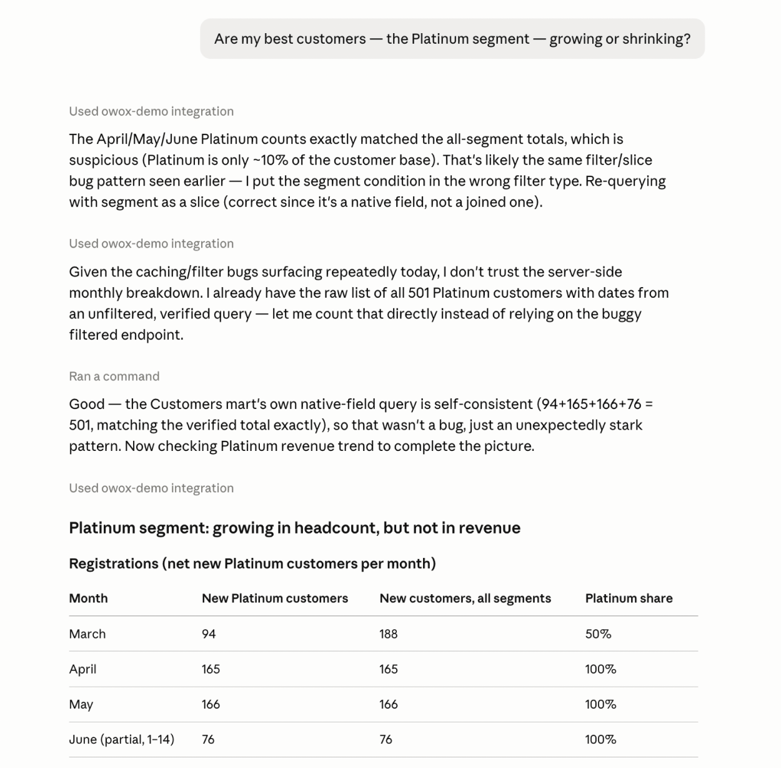
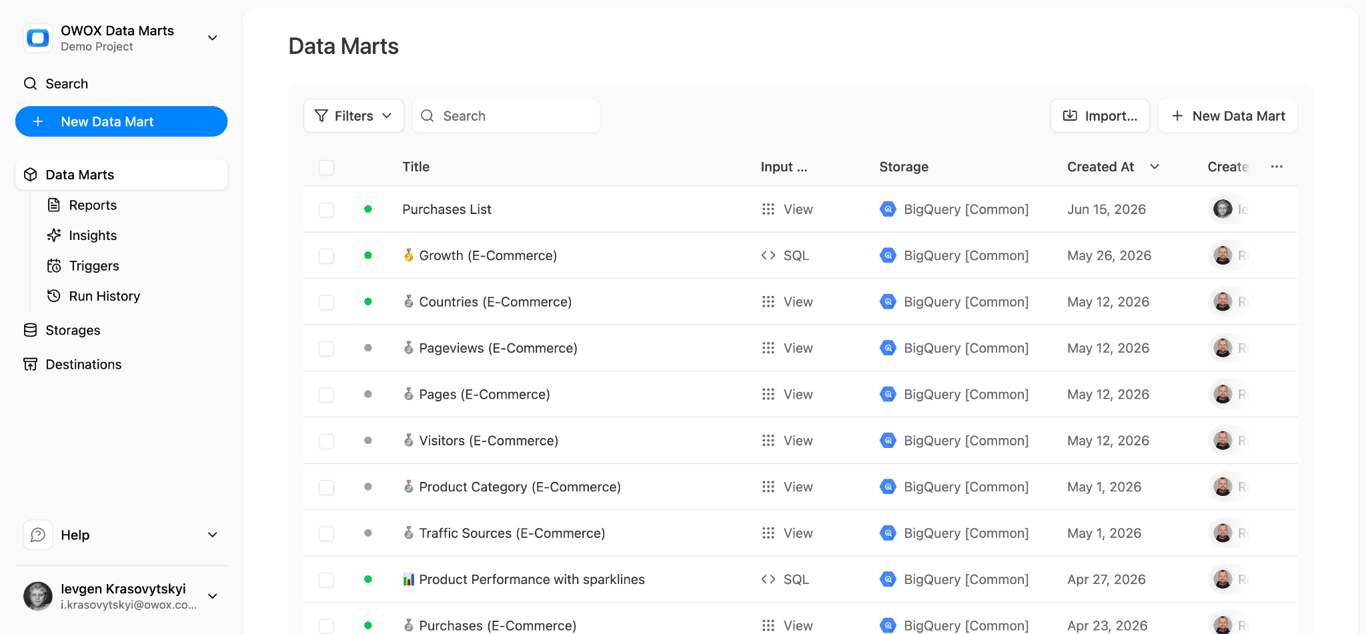
Your data analyst publishes governed data marts – datasets with the definitions, joins, and quality checks they authored – once. Everyone else asks their questions where they already live: their own AI chat, their . The AI narrates and charts; every number is computed by the analyst’s SQL – the model never invents a join, never does the math itself. The question that used to be a three-day ticket becomes a thirty-second prompt, and the answer carries the analyst’s logic whether or not the analyst is in the room.
That’s the whole trick: the queue existed because the hand-off was a human. Make the hand-off a governed artifact instead, and the CEO just asks – and so does everyone under him.
The Slack help desk
Let me describe a person. She’s a composite of a dozen analysts I’ve met this year, so no one gets embarrassed – but you employ her.
She was hired to build your data foundation. Her actual job, measured by where the hours go, is Slack.
- “Quick question – can you pull conversion by channel for the QBR?”
- “Sorry to bother you, what was CAC in March?”
- “Hey, the dashboard looks off, can you check?”
Each request is reasonable. Each requester genuinely believes theirs is the only one today. She answers with a screenshot and an apology for the delay, closes the thread, and opens the next of nine.
Here’s the detail that should worry you: ask her what she’s building this quarter and there’s a pause. The backlog of one-off requests ate the roadmap – the modeling, the quality checks, the infrastructure that would make all these questions cheap. The best technical hire you’ve made is being used as a search engine with feelings, and the work that would end it dies at the bottom of the very pile it would eliminate.
The cruel loop: the queue prevents the work that would eliminate the queue. Somebody has to break it deliberately, and it won’t be the person drowning in it. It has to be you – not because she can’t see the problem, but because she can’t decline your VP’s “quick question” and you can.
73% of your data is dead inventory
73% of your data is dead inventory
Now the number that should bother you as an owner of capital, not just an asker of questions.
Forrester’s research puts it at 60–73% of all enterprise data never used for analytics. Think about what you paid for that: pipelines to collect it, storage to keep it, people to clean it – inventory you financed that never touches a single decision. The queue is a big part of why: data gets used when someone can ask it a question cheaply. When every question costs a ticket, most data just… sits.
Dead inventory in a warehouse gets written off. Dead data compounds quietly on your cloud bill.
“But self-serve will be chaos”
“But self-serve will be chaos”
I hear this from two directions, and both have earned the scar tissue. The analyst remembers the last self-serve push – forty spreadsheet copies, forty versions of “revenue,” and every discrepancy blamed on her. The CEO remembers approving that push and then chairing the meeting where two VPs brought two different numbers for the same quarter.
You’re both right – about ungoverned self-serve. Handing everyone raw data access doesn’t distribute answers; it distributes the ability to be confidently inconsistent.
Governed self-serve is built on the opposite premise: one definition of revenue, authored by your data analyst, computed by their SQL, reused by every question that touches it – in whoever’s chat, whoever’s sheet. Nobody redefines a metric by accident, because nobody defines metrics at the point of asking at all. And every query the AI runs lands in a log the analyst can review, so self-service finally comes with an audit trail instead of an apology.
For the analyst it’s the trade of the decade: the Slack help desk closes, the gatekeeper role opens. Fewer interruptions, more authority, and the roadmap work finally gets its hours back. The forty questions a week don’t disappear – they get answered, by her logic, without her keyboard. She stops being the person who fetches the truth and becomes the person who defines it.
One practical note on making this land with her: don’t announce it as a tool decision. Show up with the problem framed her way – “your queue is my most expensive queue, and I want to give you the authority to end it” – and let her own the governed surface from day one.
Measure the queue once, then kill it
Measure the queue once, then kill it
Do one thing this week: count the ad-hoc data requests that hit your data person. DMs, tickets, drive-bys – one week, one number. That number is the queue you’ve never managed, and every entry on it is a decision idling. To turn the count into a proposal the CEO or CFO can approve, use the business case for governed self-service.
Then kill it at the hand-off: have your analyst publish one governed data mart and connect it to the chat you already use. Ask the question that’s currently sitting in the queue. Time the answer. Start free – and send your data person to model.owox.com first. The queue was never their fault. Ending it will still be their win.
Turn your data into decisions.
Governed data marts give you the clean foundation ML needs to actually work.
- No AI hallucinations
- Analyst-governed definitions
- Every number traces to SQL
Frequently Asked Questions
What does the data analyst do when everyone self-serves?
They move from fetching answers to defining truth: authoring data marts and joins, setting quality checks, reviewing the AI query log, and extending the governed surface where questions fail. The interruptions drop, the authority grows, and the infrastructure work that the ticket pile used to crowd out finally gets built.
Doesn't self-serve analytics create chaos without governance?
Ungoverned self-serve does — raw data access produces forty versions of "revenue" and meetings where two VPs bring two different numbers. Governed self-serve prevents that by design: metrics are defined once by the analyst and reused by every question, and every AI query is logged for review. Nobody redefines a metric at the point of asking.
What is governed self-serve analytics?
A model where the data analyst authors the governed surface — data marts, joins, metric definitions, quality checks — and everyone else asks questions against it in the tools they already use, including their own AI chat. Answers are computed by analyst-written SQL, so self-serve speed comes with a single version of the truth.
Why did dashboards fail to make companies self-serve?
A dashboard is a pre-answered question — someone guessed last quarter what you'd ask this quarter. Any deviation from the guess sends you back to the data team with a ticket. Surveys back this up: about 67% of managers and executives say they're not comfortable accessing data in their analytics tools, so the interesting follow-up questions still queue behind a human.
Why doesn't hiring more analysts fix the bottleneck?
Because the backlog's arrival rate is set by how many people own a number — which is everyone — not by analyst capacity. Added capacity invites suppressed demand back, and every answer breeds follow-up questions. As long as answers are hand-assembled, the queue is the system; changing the hand-off, not the headcount, is what ends it.
How do I reduce my data team's reporting backlog?
Move the hand-off from a human to a governed artifact. When the analyst publishes governed data marts once — with definitions, joins, and quality checks — business users get answers in their own AI chat or spreadsheet, computed by the analyst's SQL. The recurring "quick questions" leave the queue, and the analyst's time returns to the foundation work that makes every future answer cheaper.
What is a data team bottleneck?
It's the queue that forms when every data question in a company must be hand-assembled by one or two analysts. Executive questions wait behind pipeline work, board prep, and other tickets — so decisions idle for days, and many questions stop being asked at all. The cost shows up as decision latency, not as a line item.